Ethics News
News: Homosexuality
>> = Important Articles; ** = Major Articles
>>Christians Urged to Wake Up to Reality of GLBT Agenda (Christian Post, 101019)
>>Has Obama Ushered in a New Era for LGBT Rights? (Christian Post, 091012)
>>Survey: Americans Divided on Homosexuality as Sin (Christian Post, 080606)
>>Christian Ministry Fined $23,000 in Gay Discrimination Case (Christian Post, 080429)
>>Controversial Study: Is Change Possible for Gays? (Christian Post, 070911)
>>How ‘gay rights’ is being sold to America (WorldNetDaily, 051018)
>>Canada Timeline (CBC, 040100)
>>World Timeline (CBC, 040100)
**Outed Pastor Says No to Homosexuality, Follows Jesus (Christian Post, 100804)
**Court Upholds Expulsion of Counseling Student Who Opposes Homosexuality (Foxnews, 100728)
**Google Raises Eyebrows With New Gay-Only Employee Benefit (Foxnews, 100701)
**Conservative Pediatricians Caution Schools on Gay-Affirming Policies (Christian Post, 100412)
**UN GA Votes to Eliminate Controversial Reference to “Sexual Orientation” (C-FAM, 091218)
**Uganda Debates Proposal That Would Sentence Gays to Death (Foxnews, 091208)
**U.S. Supports U.N. Declaration on Homosexuality (Christian Post, 090320)
**Hundreds in Uganda Denounce Homosexuality in Wide Protest (Christian Post, 091104)
**Christians Urged to Speak Out Against Uganda’s Anti-Gay Bill (Christian Post, 091103)
**Toronto to host 2014 World Pride event (Paris, International Herald, 091016)
**Post Sugarcoats Thuggery Against Philadelphia’s Boy Scouts (townhall.com, 071120)
**Report: Fewer LGBT Characters on Network TV (Christian Post, 070925)
**Clergy for Gay Rights (Christian Post, 070627)
**Black Lesbian Activist Turned Evangelist (Christian Post, 070401)
**Survey: One-Third Homosexual Foster-Parents Sexually Abuse Children (Christian Post, 060814)
Parties and protests greet Ellen’s coming out (970416)
Vatican: homosexuals can achieve holiness by abstaining (970423)
American Airlines ‘Pro-Gay’, Say Conservative Christians (970428)
Clinton backs measure outlawing job bias against homosexuals (970424)
Just A Few Reasons To Boycott Disney (970600)
Families shocked by homosexual celebration at Magic Kingdom (970600)
Pro-Gay Actions at Disney (970623)
Conservative Group Pressures Texas to Dump Disney Stock (970703)
Canada is safe haven for sexual refugees (Ottawa Citizen, 970714)
B.C. leads way with gay-rights bill (970716)
Conservatives Step Up Criticism of Disney (970723)
AMA: Homosexuality No Reason for Therapy (970818)
IRS Grants Tax-Exempt Status to Gay Group (970826)
Gay Youths More Likely to Attempt Suicide (970902)
Mayor discriminated against gay activist, inquiry finds (971009)
Pope decries abortion, gay marriage (CNN, 971003)
ABC’s own poll indicts Ellen’s lesbian kiss (971101)
Pope says church must speak out against pedophilia (971107)
Maine becomes first state to repeal gay rights law (Washington Times, 980216)
New Jersey Gives Gays Right to Adopt (971217)
Bishop says the Bible is root of homophobia (980418)
Gay Teens Bear Psychological Burden of Intolerance (980528)
Cardinal condemns Bill for New York gay rights (980528)
Clinton Bars Job Bias Against Gays (980529)
Safe haven for sexual refugees (970714)
What we learned in Sunday school (980418)
Top court defends ‘charter revolution’ (980403)
Teenager wins fight for gay fostering (London Times, 980626)
Lesbians May Have Higher Breast Cancer Risk: Study (980930)
Court won’t review ‘don’t ask, don’t tell’ policy (981019)
Ex-gays suppressed in killing’s aftermath (981101)
State Supreme Court: Boy Scouts’ Ban on Homosexuals Is Illegal (990804)
Boy Scouts argue that gays, atheists should not be allowed (980106)
Pro-homosexual group influences media portrayals (Washington Times, 991121)
Dr. Laura censured for anti-gay talk (National Post, 000511)
Out of the closet, on the tube (CNN, 001016)
Scientific studies fail to corroborate ‘gay gene’ theory (Washington Times, 000801)
Rabbis reach out to change gay Jews (Washington Times, 001117)
Some Gays Can Turn Straight, Study Suggests (Foxnews, 010509)
Pediatricians’ Group OKs Gay Adoption (Foxnews, 020204)
County Closes Bank Account to Protest Handling of Boy Scouts (Foxnews, 020327)
Whoever Causes One of These to Sin: Can gays go straight? (National Review, 010518)
Gays Can Go Straight: And straights can go gay (National Review, 010514)
Critics fear law for gays will muzzle preachers (Washington Times, 021204)
We Told You So: The Homosexual Network Twenty Years Later (Free Congress Foundation, 020208)
Same-sex book ban allowed in B.C. school (CBC Newsworld, 000920)
U. of Maryland Slammed for Freshmen Reading (Foxnews, 020919)
Sexual Rights: Traditionalists v. libertarians at the Supreme Court (NRO, 030221)
Philly Boy Scouts Defy National Stance on Gays (Foxnews, 030529)
Supreme Court Overturns Texas Gay Sex Ban (Foxnews, 030626)
Public Shifts to More Conservative Stance on Gay Rights (Gallup Poll, 030730)
Multiple Gay Images Stir Straight Reaction (Foxnews, 030807)
Adopting Numbers: The Census side of the story (NRO, 030827)
What Heterosexuals Need To Teach Homosexuals (Free Congress Foundation, 030723)
Maintaining Pro-Family Momentum (Free Congress Foundation, 030801)
‘Bible as hate speech’ bill nearing vote (WorldNetDaily, 030917)
Bible verses regarded as hate literature (WorldNetDaily, 030218)
The Bible as ‘hate literature’? (WorldNetDaily, 021021)
The Final Frontier For Civilization As We Know It (Free Congress Foundation, 030916)
Scalia Blasts High Court’s Legalization of Gay Sex (Foxnews, 031023)
Corporate Thought Police (Christianity Today, 031229)
Sailing Off into Irrelevance (Christianity Today, 031200)
Oh, Boy (Scouts): Good kids caught in crosshairs (NRO, 040312)
Canada’s Anti-Gay Violence Law Worries Some (FN, 040518)
‘Hate crimes’ bill: Prescription for tyranny (WorldNetDaily, 040529)
StatsCan figures on sexual orientation in dispute (National Post, 040615)
Dobson: Boycott Procter & Gamble (WorldNetDaily, 040916)
Employees urged to support homosexual agenda (WorldNetDaily, 041006)
Furore as schools dump gay educational magazine (WorldNetDaily, 041011)
Criminalizing Christianity: Sweden’s Hate Speech Law (Christian Post, 040806)
CFI: Christians Should Give Nothing to Target this Christmas (Crosswalk.com, 041126)
Fortune 500 Companies See Money in Gay Families (FN, 040526)
MTV to Launch Gay Cable Network (FN, 040525)
Lesbians Raising Sons—Got a Problem with That? (Christian Post, 041215)
Christians, Arrested for Protesting Homosexual Street Fair, Now Acquitted (Christian Post, 050106)
Origin of Homosexuality? Britons, Canadians Say “Nature” (Gallup, 041102)
Evangelicals Warn Parents of Pro-Gay SpongeBob Video (Christian Post, 050122)
PBS stations to air lesbian-promoting cartoon (WorldNetDaily, 050202)
New Genetics Study Undermines Gay Gene Theory (Christian Post, 050211)
Was Abraham Lincoln Gay? Homosexuality and History (Christian Post, 050222)
Study finds disproportionate abuse by ‘gays’ (WorldNetDaily, 050303)
“Bias Won Out” At the Dallas’ Love Won Out Conference on Homosexuality (Christian Post, 050303)
The radical homosexual agenda and the destruction of standards (Townhall.com, 050309)
Homosexual Groups Unite to Push Agenda (American Family Association, 050308)
Homosexuality Struggles Mount in Mainline Churches (Christian Post, 050329)
Jerusalem Homosexual “World Pride” Parade Postponed Indefinitely (WorldNetDaily, 050506)
Gay, Straight Men’s Brain Responses Differ (Foxnews, 050509)
Experts Weary of “Homosexual Agenda” in Public Schools (Christian Post, 050517)
Acquiesce, Or Else (Tongue Tied, 050613)
Microsoft CEO: Firm Backs Gay Rights (Foxnews, 050506)
Blaming Homosexuals and Running from Public Schools (Christian Post, 050621)
Exodus Launches Initiative for Youth Struggling with Homosexuality (Christian Post, 050818)
Leaders Ministering to Homosexuals React to Media Coverage (Christian Post, 050825)
Bill O’Reilly is Right About Gay Teens (Christian Post, 051014)
Conservatives Warn of ‘Third Way’ Approach to Sexuality Debate (Christian Post, 051122)
Swedish Pastor Accused of Hate Crimes Acquitted (Christian Post, 051129)
A Lighthouse for the Great Ships of Zion (Christian Post, 051129)
Belgium to Allow Homosexual Couples to Adopt Children (Christian Post, 051205)
Focus on the Family Drops Wells Fargo Over ‘Homosexual Agenda’ (Christian Post, 051205)
‘Don’t Ask, Don’t Tell’ Hypocrisy (townhall.com, 051211)
Sexual Confusion and the End of Friendship (051214)
Students ban Christians in row over gays (Times Online, 060125)
Why I Won’t See Brokeback Mountain (Christian Post, 060208)
EU Passes Resolution Banning “Homophobia” 468 -149 (LifeSiteNew.com, 060120)
European Bishops Speak Out Against EU’s ‘Homophobia’ Resolution (LifeSiteNew.com, 060120)
European Union Seeks To Criminalize ‘Homophobia’ (NARTH, 060203)
Russia’s first gay parade vetoed by ‘outraged’ city (The Independent, UK, 060216)
Sexual Orientation: When Conflict Rules the School (Christian Post, 060408)
Calif. Senate Passes Gay Education Law (Christian Post, 060512)
Democratic Chairman Retracts ‘Misstated’ Marriage Definition (Christian Post, 060512)
Judge Strikes Down Georgia Gay ‘Marriage’ Ban (Christian Post, 060517)
Suicide and the textbooks (townhall.com, 060530)
Most Americans Support Gay Rights, Oppose Gay Marriage (Christian Post, 060601)
Commission: Christian OK to Refuse Gay Video Copying (Christian Post, 060614)
Canadian Professor Fined for Stating Opposition to Homosexuality (WorldNetDaily, 060726)
The Gay Study the Media Ignored (Christian Post, 060811)
Ex-Gay Group Releases Guide on Handling Homosexuals in Church (Christian Post, 060909)
Gays Use ‘Sleight of Hand’ to Promote Agenda (townhall.com, 061002)
Can we talk? (townhall.com, 061017)
Ultra-Orthodox Jews protest Jerusalem gay march plan (WorldNetDaily, 061030)
The Ted Haggard Scandal...No Laughing Matter (Christian Post, 061106)
3 Christian Groups Move To Condemn Gay Sex (Washington Post, 061114)
N.C. Baptist Delegates OK Barring of Pro-Gay Churches (Christian Post, 061114)
The Credibility Question (Mohler, 061201)
U.K. Christians Oppose New Regulations on Gay Rights (Christian Post, 070109)
Michigan Court: No Same-Sex Benefits (Christian Post, 070205)
Gay Conversion Not Biblical, Says Former Homosexual (Christian Post, 070215)
Furor Over Baptist’s Gay-Baby Article (Christian Post, 070314)
“A Strictly Christian Policy?” — Linda Hirshman Strikes Again (Mohler, 070404)
Disney to Allow Same-Sex Couples to Have Fairy Tale Weddings (Foxnews, 070405)
Was it Something I Said? Continuing to Think About Homosexuality (Mohler, 070316)
Evangelical Leader Responds to Attacks on Gay Baby Article (Christian Post, 070319)
Why real men confuse and anger Liberals (townhall.com, 070318)
Ex-Gay Backs Mohler: Homosexuality is a Sin (Christian Post, 070320)
Homosexual Practice Trumps Religious Belief: Outlawing Conscience (Christian Post, 070320)
What about the morality of homosexual behavior? (townhall.com, 070320)
Church Challenged to Be ‘Safe Place’ for Homosexuals, Says Anglican Head (Christian Post, 070329)
Evangelical Leader Urges Prayer for Gay Rights Activists (Christian Post, 070329)
On “Outing” Gay Conservatives (townhall.com, 070403)
Gay Rights Bill Passes Oregon House (Foxnews, 070418)
‘Truth’ Counters Pro-Gay ‘Silence’ (Christian Post, 070419)
New Paradigm Helps Gays with Conflicting Religious Values (Christian Post, 070419)
Gay Conversion Not Biblical, Says Former Homosexual (Christian Post, 070414)
Expert Blasts Study on Gays Dying Younger as ‘Severely’ Flawed (Christian Post, 070418)
The I’s Have It: Three cheers for pro-life incrementalism. (National Review Online, 070419)
Partial Victory (National Review Online, 070419)
The Massacre of the Pulpit (townhall.com, 070423)
Normalizing Homosexuality: Coming to a School Near You (Christian Post, 070424)
‘Day of Silence’ Protesters Defended After School Suspensions (Christian Post, 070427)
House Passes Expanded Hate Crimes Bill (Christian Post, 070504)
Bush to Kill Pro-”Gay” Bill? (townhall.com, 070510)
Poll: Gay Tolerance Reaching Record Marks in America (Christian Post, 070529)
Gallup Poll on hate crimes measures feelings versus facts (Townhall.com, 070529)
Largest Ex-Gay Group Expanding Reach, Redemptive Message (Christian Post, 070530)
Change for Homosexuals Still Debated, Increasingly Acknowledged (Christian Post, 070619)
Exodus Freedom Speaker Warns of ‘The Gay Gospel’ (Christian Post, 070625)
Tony Campolo (Wikipedia, 0706)
Homosexual Curriculum Bill Passes Calif. Assembly Committee (Christian Post, 070628)
How a ‘gay rights’ leader became straight (WorldNetToday, 070703)
Pro-Homosexuality Classes to Hit Md. Schools (Christian Post, 070818)
Radical Gay Activist: ‘We Lose’ (Townhall.com, 070819)
Leading Gay Rights Activist Comes Out of Homosexuality, Tells His Story (Christian Post, 070705)
Texas Megachurch Harassed for Refusing to Host Pro-Gay Memorial (Christian Post, 070815)
Ministry Sues to Bar Same-Sex ‘Marriage’ in Church Facilities (Christian Post, 070819)
Hundreds in Uganda Denounce Homosexuality in Wide Protest (Christian Post, 070822)
x-Gay Study: ‘Conversion’ is Possible (Christian Post, 070915)
Pro-Gay Legislation Fuels Concerns Over England’s Anti-Faith Trend (Christian Post, 070909)
Job Bias Bill Privileges Gays Over Faithful, Warn Christians (Christian Post, 070919)
Folsom Street Fair Reminds U.S. of What “Gay Pride” Means (townhall.com, 070930)
Poll: Majority of Americans Back Equality for Gays (Christian Post, 071012)
Schwarzenegger Vetoes Same-Sex ‘Marriage’ Bill; Battle Continues (Christian Post, 071014)
Boy Scouts’ Rent Skyrockets in Philadelphia to $200K Over Gay Ban (Foxnews, 071018)
Ex-Gay Study: ‘Conversion’ is Possible (Christian Post, 070915)
‘Gay Gene?’ No Big Deal, Says Ex-Gay (Christian Post, 071023)
Ex-Gay Group Calls Psychiatrist to Retract False Comments (Christian Post, 071025)
House Passes Ban on Job Discrimination Against Gays (Foxnews, 071108)
Church of Norway Votes in Favor of Homosexual Ordination (Christian Post, 071119)
Philadelphia Sets Deadline for Boy Scouts to Renounce Anti-Gay Policy (Christian Post, 071123)
Baptist Church Grapples Over Including Gay Couples Photos in Directory (Christian Post, 071204)
Megachurches Targeted for Pro-Gay Campaign (Christian Post, 071203)
Half a Million Signatures Sought to Bring Pro-Gay School Bill to Voters (Christian Post, 071223)
‘Gay Jesus’ Play Condemned by Australian Church Leaders (Christian Post, 080122)
Study: Journey to Rid Gay Attractions Not Harmful (Christian Post, 080211)
Wheaton College Invites Pro-Gay Evangelical Speaker (Christian Post, 080220)
>>Unmasking The “Gay” Agenda (townhall.com, 080213)
Christian TV Host ‘Comes Out,’ Gets Support from Churchgoers (Christian Post, 080421)
Conservative Group Fired Up Over Gay Kiss on TV (WorldNetDaily, 080425)
Gay Rights vs. Democracy (Townhall.com, 080519)
What the Gay Brain Looks Like (Time, 080617)
>> Why We’re Losing Our Right to Speak Out (townhall.com, 080501)
Why We Whisper (BreakPoint, 080502)
Employee Fired Over ‘Anti-Gay’ Column (Christian Post, 080514)
McDonald’s Dishonest About Pro-Gay Stance, Group Claims (Christian Post, 080516)
Discussion on Religion, Homosexuality, Therapy Canceled Amid Protest (Christian Post, 080505)
Gay Man Files $70M Suit Against Bible Publishers Over ‘Homosexual’ Verses (Christian Post, 080710)
Exodus Offers ‘A New Day’ for Hundreds Impacted by Homosexuality (Christian Post, 080715)
Exodus Launches Initiative to Help Women Affected by Lesbianism (Christian Post, 080827)
Vatican Clarifies Support for Decriminalizing Homosexuality (Christian Post, 081213)
An unprecedented push in the UN for gay rights (Paris, International Herald, 081219)
U.S. Refuses to Join U.N. Call to End Anti-Homosexuality Laws (Christian Post, 081221)
Church of Scotland Clergy Oppose Gay Minister Appointment (Christian Post, 090506)
Ex-Archbishop Speaks About Catholic Church and Homosexuality (Paris, International Herald, 090514)
Survey Explores Christian Faith of Homosexuals (Christian Post, 090622)
Exodus Boosts Efforts to Help Mainline Churches Address Homosexuality (Christian Post, 090716)
Indian court overturns 148-year-old ban on gay sex (National Post, 090702)
Lithuania Fights Back Against EU Resolution Favoring Homosexual Propaganda (C-Fam, 091112)
Uganda’s Anti-Gay Bill Draws Evangelical Opposition (Christian Post, 091211)
Uganda Pastors Chide Rick Warren; Defend Anti-Gay Bill (Christian Post, 091221)
Group Hopes to Change How Church Responds to Gays (Christian Post, 100306)
New HIV Infections Increasing Among Gays (Foxnews, 100316)
Houston Clergy at Arms Over Lesbian Mayor’s Orders (Christian Post, 100406)
Can Animals Be Gay? (Christian Post, 100409)
Case Against ‘Homosexuality Is Sin’ Preacher Dropped (Christian Post, 100519)
Christians Urged to Oppose U.K. Government’s Pro-Gay Agenda (Christian Post, 100621)
Love Divine, All Loves Excelling: A Perspective on Same-Sex Desire (Christian Post, 100808)
My Hate Speech “Conviction” (townhall.com, 100908)
Texas School Rejects Lesbian Couple’s Daughter (Foxnews, 100821)
Conditioned to Accept a Lie (zth, 100928)
==============================
>>Evangelicals and the Gay Moral Revolution (Christian Post, 110810)
By R. Albert Mohler, Jr.
The Christian church has faced no shortage of challenges in its 2,000-year history. But now it’s facing a challenge that is shaking its foundations: homosexuality.
To many onlookers, this seems strange or even tragic. Why can’t Christians just join the revolution?
And make no mistake, it is a moral revolution. As philosopher Kwame Anthony Appiah of Princeton University demonstrated in his recent book, “The Honor Code,” moral revolutions generally happen over a long period of time. But this is hardly the case with the shift we’ve witnessed on the question of homosexuality.
In less than a single generation, homosexuality has gone from something almost universally understood to be sinful, to something now declared to be the moral equivalent of heterosexuality—and deserving of both legal protection and public encouragement. Theo Hobson, a British theologian, has argued that this is not just the waning of a taboo. Instead, it is a moral inversion that has left those holding the old morality now accused of nothing less than “moral deficiency.”
The liberal churches and denominations have an easy way out of this predicament. They simply accommodate themselves to the new moral reality. By now the pattern is clear: These churches debate the issue, with conservatives arguing to retain the older morality and liberals arguing that the church must adapt to the new one. Eventually, the liberals win and the conservatives lose. Next, the denomination ordains openly gay candidates or decides to bless same-sex unions.
This is a route that evangelical Christians committed to the full authority of the Bible cannot take. Since we believe that the Bible is God’s revealed word, we cannot accommodate ourselves to this new morality. We cannot pretend as if we do not know that the Bible clearly teaches that all homosexual acts are sinful, as is all human sexual behavior outside the covenant of marriage. We believe that God has revealed a pattern for human sexuality that not only points the way to holiness, but to true happiness.
Thus we cannot accept the seductive arguments that the liberal churches so readily adopt. The fact that same-sex marriage is a now a legal reality in several states means that we must further stipulate that we are bound by scripture to define marriage as the union of one man and one woman—and nothing else.
We do so knowing that most Americans once shared the same moral assumptions, but that a new world is coming fast. We do not have to read the polls and surveys; all we need to do is to talk to our neighbors or listen to the cultural chatter.
In this most awkward cultural predicament, evangelicals must be excruciatingly clear that we do not speak about the sinfulness of homosexuality as if we have no sin. As a matter of fact, it is precisely because we have come to know ourselves as sinners and of our need for a savior that we have come to faith in Jesus Christ. Our greatest fear is not that homosexuality will be normalized and accepted, but that homosexuals will not come to know of their own need for Christ and the forgiveness of their sins.
This is not a concern that is easily expressed in sound bites. But it is what we truly believe.
It is now abundantly clear that evangelicals have failed in so many ways to meet this challenge. We have often spoken about homosexuality in ways that are crude and simplistic. We have failed to take account of how tenaciously sexuality comes to define us as human beings. We have failed to see the challenge of homosexuality as a Gospel issue. We are the ones, after all, who are supposed to know that the Gospel of Jesus Christ is the only remedy for sin, starting with our own.
We have demonstrated our own form of homophobia—not in the way that activists have used that word, but in the sense that we have been afraid to face this issue where it is most difficult . . . face to face.
My hope is that evangelicals are ready now to take on this challenge in a new and more faithful way. We really have no choice, for we are talking about our own brothers and sisters, our own friends and neighbors, or maybe the young person in the next pew.
There is no escaping the fact that we are living in the midst of a moral revolution. And yet, it is not the world around us that is being tested, so much as the believing church. We are about to find out just how much we believe the Gospel we so eagerly preach.
==============================
>>Christians Urged to Wake Up to Reality of GLBT Agenda (Christian Post, 101019)
Dr. Michael Brown believes Christians have already lost the battle when it comes to public opinion on homosexuality and gender identity issues.
Pro-gay books are being read in elementary school classrooms, teachers are being mandated to use gender neutral language, gay activists have been welcomed in the White House, and young evangelicals see no problem with same-sex marriage.
Yet the prevailing thought in churches is that “this stuff is happening elsewhere” or that Jesus is coming back soon and “we’re out of here any minute,” Brown, a Jewish believer in Jesus, lamented.
“[We can] put our heads in sand or we can recognize that massive transformation is happening in our society right in front of our eyes, on our watch,” he told Christians over the weekend at the National Conference on Christian Apologetics in Charlotte, N.C.
Author of 20 books, Brown has spoken to revival in America, the need for moral and cultural revolution and Jewish outreach throughout his ministry career. But homosexual issues were never on his radar.
“This is not something that made sense for me to focus on,” he said.
It was just six years ago when he felt a divine mandate to start dealing with the issue.
Since then he has realized that many Christians have largely avoided the issue as well.
“The definitions of male and female are being eroded but don’t sweat it because praise the Lord you had a lovely service last Sunday,” he said sarcastically. “Don’t let me disturb you with these trivialities.”
Brown wants to awaken the conscious of Christians and bring them to a “divine reality” about what’s happening in America.
There is a need to reach out to homosexual men and women with compassion, he said, but at the same time there is “a gay activist agenda that we must resist.”
The speaker and author listed a host of examples, particularly in the public school system, to demonstrate how much GLBT (gay, lesbian, bisexual, transgender) activism has advanced.
Currently, the Los Angeles Unified School District has a policy on “ensuring equity and nondiscrimination” for “transgender and gender nonconforming students.” The policy defines gender identity as “one’s understanding, interests, outlook, and feelings about whether one is female or male, or both, or neither, regardless of one’s biological sex.”
In San Francisco, the school policy for restroom accessibility states, “Students shall have access to the restroom that corresponds to their gender identity exclusively and consistently asserted at school.”
And the policy for locker room accessibility states, “Transgender students shall not be forced to use the locker room corresponding to their gender assigned at birth.
In other words, if Joey’s convinced he’s Jane, then he can use the girls’ locker room and restroom, Brown summarized.
Pro-gay books have also become prevalent in the classrooms. Just ten years ago, it was difficult to get a copy of Heather Has Two Mommies. Now, Brown has been able to collect stacks of similar children’s books.
They include One Dad, Two Dads, Brown Dad, Blue Dads; Two Daddies and Me; Oh The Things Mommies Do!: What Can Be Better Than Having Two?; and the coloring book Girls Will Be Boys Will Be Girls.
Recently, middle school students in Washington, D.C., were given surveys that asked them about their gender (male, female or transgender) and sexual orientation (straight, bisexual, gay or lesbian, nor sure).
Even the largely religious state of North Carolina is not exempt. A preschool teacher in Charlotte was told not to address the class as “boys and girls” but rather as “friends.” In Burke, one Christian girl quit her high school softball team because she was the only non-lesbian, Brown said.
Many schools are also using the Riddle Homophobia Scale, where repulsion, pity, tolerance, and acceptance are measured as homophobic. Meanwhile, “positive levels of attitudes” that are encouraged toward GLBT persons include support, admiration, appreciation, and nurturance.
“Like it or not, this is coming to a community near you,” Brown warned.
All the while, Christians have not concerned themselves with the issue and pastors are afraid to speak out for fear of being perceived as homophobic, he lamented.
“The fact is, when our answer is ‘let’s retreat more quickly,’ we’re already defeated,” Brown said. “When our main concern is ‘I don’t want to be perceived as bigoted, intolerant and hateful, therefore I’ll say nothing instead of speaking truth in love,’ we’re already defeated.”
There is an abysmal lack of teaching and preaching on the issue, he pointed out.
“We’ve been silent because this is unpopular, because people will be offended, because ‘one of my biggest givers in the church has a daughter who’s gay.’”
And while some may be extra sensitive in these times because of the recent bullying of GLBT students and teen suicides spotlighted in the media, Brown pointed out that there are some 4,000 to 5,000 suicides a year among teens and little is said about the other kids.
“I want to find out what these real problems are so we can address them,” he commented.
Brown made clear that he isn’t trying to stir up anything hateful. Rather he is speaking out of love and a broken heart. He also stressed that he is not an alarmist or extremist and that he has done careful research.
“If I’ve given you information, it’s based on facts. It’s not cherry picking things to give a misleading impression,” he said.
He has packed all the collected information into a 475-page book that is slated for release in February.
Though he has published with major publishers before, no secular or Christian publisher was willing to go near his new book, titled A Queer Thing Happened to America: What a Long, Strange Trip It’s Been.
His book was rejected by about 20 publishers, all of whom said the title needs to be changed and that the contents are too controversial.
“You have Queer Eye for the Straight Guy, kindergarten kids being taught terms like gender queer, queer theology and study programs in our schools, and [yet] to have a book [titled A Queer Thing Happened to America] is too controversial to touch,” Brown said.
The book, he stressed, does not have a single hateful syllable in it. He calls for compassion and understanding of gay and lesbian persons while taking issue with gay activism.
“We fail to understand the struggles,” he said. “Can you imagine what someone goes through, raised in the Lord and believing they must be condemned, crying themselves to sleep every night, hoping that they’ll change the next day and their desires don’t change. And then they meet someone and they love this person and they feel like it’s God but it can’t be God and they have to be celibate for the rest of their life and as the best answer you tell them to just suck it up.”
Brown is calling on Christians to repent of their sins against the GLBT community, particularly for making homosexuality out to be the worst of sins. He himself has made public apologies.
He is also challenging the church community to repent of sins within its own household (i.e. high divorce rate).
At the same time, he believes the GLBT issue is the greatest challenge to religious freedoms and family foundations in this generation and is something Christians cannot ignore.
“We must pray for awakening in the church. America’s messed up because the church is messed up, “he said. “This has happened on our watch.
“We must take a stand for righteousness in our society. We’re called to ... expose darkness and to be a moral conscience and moral preservative. If we’re not shining the light, if we’re not making a difference ... how’s the world going to have a moral conscience and know the difference between right and wrong.”
Brown has created his own publishing firm called Equal Time Books to get his book out on shelves. With the release of his book next year, he’ll also be launching a speaking tour called Campaign for Religious Tolerance and Intellectual Diversity.
==============================
>>Has Obama Ushered in a New Era for LGBT Rights? (Christian Post, 091012)
President Obama’s speech this past weekend made it “abundantly clear” that America is looking at “a new era for civil rights for LGBT people,” said one gay rights advocate.
The address on Saturday at an event hosted by the nation’s largest lesbian, gay, bisexual and transgender organization “drew a clear line in the sand for the world to see: this administration believes in and will work with the LGBT community and our allies to achieve full equality under the law for lesbian, gay, bisexual and transgender Americans,” said Mitchell Gold, founder of nonreligious organization Faith in America.
“President Obama’s presence and words represented his recognition that LGBT people are a normal part of our diverse society.”
It was an evening of standing ovations and loud applause as thousands of gay rights supporters heard Obama say he is on their side. He called LGBT people his friends and assured them that despite some of the pressing issues, including the economy, on his desk he remains “unwavering” in his commitment to them.
“We cannot and we will not put aside issues of basic equality,” Obama said at the Human Rights Campaign’s 13th Annual National Dinner. “This fight continues now. And I’m here with a simple message: I’m here with you in that fight.”
Many are hailing Obama as the first U.S. president to express such strong commitment to the LGBT people.
HRC president Joe Solmonese stated, “This was a historic night when we felt the full embrace and commitment of the President of the United States. It’s simply unprecedented.”
During his speech Saturday, Obama said his administration is “moving ahead” on the “don’t ask, don’t tell” policy, which bans gays and lesbians from serving openly in the armed forces. He promised to sign into law an inclusive hate crimes bill, which would expand federal protection to gay, lesbian, bisexual and transgender people; push the Employment Non-Discrimination Act; and repeal the federal Defense of Marriage Act.
The issue of marriage drew out the most emotion and applause from the crowd. Obama noted that when they look back over the years of his administration, they will “see a time in which we as a nation finally recognized relationships between two men or two women as just as real and admirable as relationships between a man and a woman.”
Obama also made it no secret that he wants to go beyond policy changes and change hearts.
“There are still fellow citizens...good and decent people who hold fast to outworn arguments and old attitudes who fail to see your families like their families,” he said. “Are we a nation that can transcend old attitudes and worn divides?”
While it was no surprise that Obama would address HRC members, conservatives were shocked to hear Obama promise what they consider “radical cultural changes.”
Prominent evangelical and Southern Baptist theologian R. Albert Mohler Jr. said Obama’s words “represent a moral revolution that goes far beyond what any other President has ever promised or articulated.”
“It is virtually impossible to imagine a promise more breathtaking in its revolutionary character than this – to normalize same-sex relationships to the extent that they are recognized as being as admirable as heterosexual marriage,” the seminary president commented.
Following Obama’s remarks, Tony Perkins, president of the conservative Family Research Council, similarly said it was clear from the speech that Obama’s goal is not simply equal legal rights but rather “to overturn millennia of moral teaching that has acknowledged the harms of homosexual conduct and the unique benefits of marriage between a man and a woman.”
He further called the president out for neglecting to mention that “all of this will be forced on the American people who in the last election gave the President a mandate to fix the economy – not enact radical social policy changes such as allowing homosexuals to serve in the military.”
“President Obama tried to hide his pro-homosexual agenda during the presidential campaign. With the election behind him and a liberal Congress beside him, he is now positioned to move forward an agenda with the ultimate goal of redefining marriage at the expense of religious liberty,” he said.
In a statement Sunday, Perkins’ organization vowed to work to defeat Obama administration’s legislative strategy and to continue to promote policies that strengthen traditional marriage and religious liberty for generations to come.
Last week, the Pew Research Center revealed in a study that the majority of Americans (53%) oppose gay marriage while 39% favor it. The statistics have remained almost unchanged when compared to 2003. Moreover, 49% consider homosexual behavior morally wrong. At the same time, 64% believe gays and lesbians face more discrimination than any other group.
The study, however, demonstrated that attitudes may be changing as younger generations show more support than older Americans for LGBT people. More than half of 18- to 29-year-olds (58%) support gay marriage, compared to 38% of 30- to 49-year-olds and 35% of Americans aged 50-64. Additionally, the younger generation is less likely to say homosexual behavior is morally wrong compared to older adults.
Results for the survey were based on telephone interviews conducted among a nationwide sample of 4,013 adults, 18 years of age or older.
==============================
>>Survey: Americans Divided on Homosexuality as Sin (Christian Post, 080606)
[KH: observe the increased influence of the gay lobby and the unbelief in the Bible]
Americans are nearly evenly divided on whether they believe homosexual behavior is a sin, a new survey showed.
While 48% of Americans agree it is a sin, 45% said they don’t believe homosexuality is sinful, according to a LifeWay Research study, released Wednesday.
Although those who are religiously affiliated were more likely to call homosexual behavior sinful, the director of the research group cautions that there are still many believers who don’t view the behavior as sin.
The study showed that 61% of Protestants believe homosexuality is sinful compared to 31% who don’t. Among born-again, evangelical or fundamentalist Americans, 79% say it is sinful while 17% do not believe it is.
“17% in that latter category may seem low compared to the others, but considering these people consider themselves born-again, evangelical, or fundamentalist, it reminds us of the need for clear biblical teaching on the issue in our community,” said Ed Stetzer, director of LifeWay Research, in the report.
“We did not develop our views of sexuality because we flipped a coin or took a poll,” he noted. “We believe the teaching of Scripture is clear that monogamous, heterosexual marriage is God’s best for people, culture and society.”
Stetzer also called it surprising to find that the majority of Catholics (55%) do not believe homosexual behavior is a sin. Only 39% of Catholics called it a sin.
Catholics were also most likely to say same-sex attraction is inevitable and determined at birth. 30% of Catholics said that that is what contributes most to homosexuality compared to 20% of Protestants, 12% of born agains, and 24% of Americans overall.
The born-again, evangelical, fundamentalist group (48%) is most likely to believe homosexuality is a choice while 42% of Protestants, 41% of Catholics and 39% of Americans agree, saying “choice” is what contributes most to same-sex attraction.
As debate continues over homosexuality and many churches struggle to address the issue, the LifeWay survey found that what a church teaches about homosexuality can greatly impact a person’s decision on whether to visit or join the church.
According to survey results, 32% of Americans said that if the church they were considering visiting or joining taught that homosexual behavior was sinful, it would negatively impact their decision. Meanwhile, 29% of Americans said that it would positively impact their decision.
“It’s clear we have a challenging but essential task,” Stetzer commented. “We need to strive to show the love of Christ, while upholding the standard of Scripture, to those who struggle with same-sex attraction.”
Many churches have begun to shift from preaching condemnation to showing love to homosexuals while still not compromising their belief that homosexuality is a sin.
In recent years, the Southern Baptist Convention - the largest Protestant denomination in the country - created a task force that would inform, educate and encourage Southern Baptists to be proactive in reaching out to those struggling with same-sex attractions. Bob Stith, who heads the task force, said many, including himself, have harbored a negative and judgmental attitude toward homosexuals and he now wants to encourage fellow Baptists to give a biblical yet compassionate response to homosexuality.
Still, the large Protestant group still has a ways to go when reaching homosexuals.
Tim Wilkins, a Southern Baptist and former homosexual, claims the denomination has not steered much effort toward the Ministry to Homosexuals Task Force.
“If Southern Baptists are going to invest time and money in reaching homosexuals with the Gospel, let’s at least steer Southern Baptists to the appropriate resources,” Wilkins said Thursday, noting that the task force has received little attention.
Among other findings by LifeWay Research, 66% of Americans, Protestants and born agains are personally acquainted with someone who has same-sex attraction. And among those who personally know a homosexual, 44% call homosexual behavior sinful and 49% say it is not a sin.
The survey was conducted on April 10-12, 2008, on a sample size of 1,201 American adults.
==============================
>>Christian Ministry Fined $23,000 in Gay Discrimination Case (Christian Post, 080429)
[KH: persecution is coming]
One of Canada’s largest Christian ministries dedicated to caring for the disabled was fined $23,000 recently by the Human Rights Tribunal of Ontario for allegedly discriminating against a former homosexual employee.
Connie Heintz claimed discrimination against Christian Horizons after she said she was “subjected to a poisoned work environment” and pressured into quitting her job after she entered a homosexual relationship – which was in violation of her work contract back in 2000.
In line with its Christian foundation and principles, the ministry requires that all its employees sign “morality statements” vowing to abstain from immoral behavior, including pornography, pre-marital, extra-marital, and homosexual activity as a condition of employment.
In a recently made public ruling, Michael Gottheil, the single adjudicator representing the Human Rights Tribunal of Ontario, ruled against Christian Horizons, ordering the organization to pay Heintz $23,000 in fines plus two years wages and benefits.
Gottheil also ordered that the organization abandon its Christian principles barring homosexual behavior and issued mandates that it begin requiring all employees to attend a homosexual oriented “human rights training program.”
In a statement, Barbara Hall, the Chief Commissioner of the Ontario Human Rights Commission, wrote approvingly of the decision by the tribunal.
“This decision is important because it sets out that when faith-based and other organizations move beyond serving the interests of their particular community to serving the general public, the rights of others, including employees, must be respected,” she said.
The Family Research Council (FRC), however, criticized the recent ruling as yet another attack in the worldwide effort to stamp out Christianity.
“It sounds unfair, yet this is the same rationale that’s fueling the U.S. Employment Non-Discrimination Act (ENDA) debate. ENDA would mandate employer tolerance of all forms of sexual orientation in hiring, firing, promotion, and many Christian-oriented businesses (such as bookstores and radio stations) may not be protected by the bill’s limited religious exemption,” the FRC said in a statement.
John Jalsevac, of LifeSiteNews.com, also wrote incredulously of the ruling in a column.
“Connie Heintz wasn’t even fired. She resigned. And, what is more, Heintz herself testified that her former boss at CH actually tried to help her find another job by providing her with listings of vacancies with other charities – hardly the actions of someone who is ‘homophobic,’” he wrote.
“In the world of the Commissions, dogmatic Christians are by definition the bigots,” he added.
Founded in 1965 by a group of Christian parents seeking to care for their disabled children, Christian Horizons is one of the largest organizations in Canada dedicated to caring for the disabled, receiving about $75 million annually through the Ontario Ministry of Community and Social Services.
==============================
>>Controversial Study: Is Change Possible for Gays? (Christian Post, 070911)
Results of a controversial study addressing two of the most debated questions on “ex-gays” will be announced this week in Nashville.
First: “Is change of sexual orientation possible?” And second: “Is the attempt to change harmful?”
Researchers Stanton L. Jones of Wheaton College and Mark A. Yarhouse of Regent University, both of whom are evangelical Christians, conducted “A Longitudinal Study of Religiously Mediated Change in Sexual Orientation,” asking the two questions which have been long debated by mental health professionals and Christian counselors.
“We are evangelical Christians committed to the truth-seeking activity of science,” Jones and Yarhouse said in a joint statement, addressing skeptics of Christian researchers on a matter of science. “In conducting and reporting this study, we took seriously the words of one of our heroes, C. S. Lewis, who said that science produced by Christian persons would have to be ‘perfectly honest. Science twisted in the interests of apologetics would be sin and folly.’”
Many professional organizations, including the American Psychiatric Association and the American Medical Association, are critical of what some call “reparative” or conversion therapies. The American Psychological Association is currently revising its 10-year-old policy on counseling homosexuals after years of pressure from pro-gay groups that say such therapy is harmful. Evangelicals meanwhile are calling psychologists to respect religious commitments and allow those who are seeking change out of same-sex desires to be offered the help.
“For many years, mental-health professionals have taken the view that since homosexuality is not a mental disorder, any attempt to change sexual orientation is unwise,” said prominent psychiatrist Dr. Robert Spitzer, according to the Los Angeles Times. “But for healthcare professionals to tell someone they don’t have the right to make an effort to bring their actions into harmony with their values is hubris.”
There are no scientifically rigorous outcome studies to determine either the actual efficacy or harm of “reparative” treatments, according to the American Psychiatric Association. However, there are numerous reports of individuals who have claimed to change, those who claim that attempts to change were harmful to them, and others who claimed to have changed and then later recanted those claims.
While Spitzer has noted cases where people have had bad experiences with “reorientation” approaches, he acknowledged that in other cases, individuals have “felt they were helped by having therapy available that took their religious values seriously.”
The American public remains divided on the issue but is showing growing tolerance for the homosexual lifestyle. A recent CNN poll revealed that for the first time in its polling, the majority of Americans (56%) said they do not believe sexual orientation can be changed.
Results of the milestone research by Stanton and Yarhouse will not be released until Thursday at the American Association of Christian Counselors (AACC) World Conference and will be published this month by InterVarsity Press, the publishing company linked to InterVarsity Christian Fellowship.
Knowing the results of the study will generate controversy, Jones and Yarhouse have thoroughly described the rationale for their procedures, according to a released statement.
George A. Rekers, professor of Neuropsychiatry and Behavioral Science Emeritus at the University of South Carolina School of Medicine, states that the study “meets the high research standards set by the American Psychological Association that individuals be validly assessed, followed and reported over time with a prospective, longitudinal outcome research design.”
Endorsing the upcoming book, Dr. Warren Throckmorton, a noted expert in sexuality counseling, stated, “While the authors fully acknowledge that change in sexual attractions did not occur for some individuals, they offer cogent and compelling reasons to believe that participation in religious ministry resulted in durable changes for others. The Jones and Yarhouse study will set the standard for all future work in this field and demands a serious reading from social scientists.”
Publisher Bob Fryling commented, “In a highly politicized environment, this book is another ‘inconvenient truth’ of scientific research data countering prejudice and ignorance.”
“Ex-Gays?: A Longitudinal Study of Religiously Mediated Change in Sexual Orientation” will be available to the public in October.
==============================
>>How ‘gay rights’ is being sold to America (WorldNetDaily, 051018)
By David Kupelian
Editor’s note: Following is the highly acclaimed – and to many, shocking – first chapter of WND Managing Editor David Kupelian’s blockbuster book, “The Marketing of Evil: How Radicals, Elitists, and Pseudo-Experts Sell Us Corruption Disguised as Freedom.” In it, Kupelian rips the veil off the previously hidden marketing strategies and powerful propaganda techniques used with such stunning success to “sell” Americans on homosexuality and the radical “gay rights” agenda over the last few years – a marketing juggernaut that continues to accelerate daily.
“I did not choose to be homosexual. I would change my sexual orientation if that were within my power.”
So confessed Robert Bauman, the powerful conservative congressman from Maryland. Americans were stunned in 1980 when headlines revealed Bauman had been caught red-handed having a sexual rendezvous with a young male prostitute. In his book “The Gentleman from Maryland: The Conscience of a Gay Conservative,” Bauman revealed the conditions that shaped his own tortured double life as a pro-family Republican congressman and closet homosexual.
At the tender age of five, Bauman had been sexually seduced by a twelve-year-old neighbor. Reflecting on that pivotal experience, as well as subsequent similar episodes, Bauman described the powerful feelings he found welling up within him at a young age:
This was not a matter of chance attraction to a forbidden object. This was a frightening force from deep within my being, an involuntary reaction to the sight, smell, and feel of other boys. I neither understood nor accepted it. And I came to hate myself because of the presence within me of this horrible weakness, this uncleanness of spirit over which I seemed to have no control. …
I was sure my predicament was a unique punishment designed only for me. Unable to understand it myself, I could never even attempt an explanation to someone else. I countered my dilemma with a plan that constituted the essence of simplicity. I made up my mind that I was not “queer.” I heard all those denunciations of homos by my military school peers and firmly resolved I could never be considered one of such a despicable breed.
Bauman was elected in 1973 as representative of the First Congressional District of Maryland, became chairman of the American Conservative Union in 1979, and, many thought, was on his way to becoming Speaker of the House. But he was leading a double life as a married man with four children while at the same time engaging in anonymous homosexual one-night stands. He described the wrenching emotional aftermath he experienced after every episode: “Each time I would feel great guilt and head for Saturday confession at St. Peter’s or St. Joseph’s on Capitol Hill so I could make amends with God and be in the state of grace for Sunday Communion. I would always vow to myself and God I would never do it again.”
Submerging himself “in the excitement of politics where compliments, victories and deference helped reassure me I was a good person,” Bauman looked every bit the quintessential conservative, family-values congressman. “If I could save the world,” he later mused, “I might avoid having to save myself.” Looking back on his secret double life, Bauman engaged in some painful self-examination:
How could any normal and moral human being do what I did? How could anyone, however callous, repeatedly be unfaithful to one’s spouse (lying, evading responsibility, breaking solemn vows)? I have described how it could be done. Why I did it is the serious question. And I have no answer, even to this day. I do not know. In many ways I was driven by a force over which I seemed to have little control.
Of course, my choice was conscious and deliberate. It could have been altered. But some compulsion drove me, blotting out all I had learned, diminishing in importance all that was most dear and important. I seemed willing to risk my marriage, my wife and children, even life itself.
It’s hard not to have compassion on a fellow human being desperately struggling to overcome a powerful compulsion he “neither understood nor accepted.” What happened to Bauman was a tragedy. He needed help – not rejection and condemnation for being a “queer,” nor acceptance and praise for being an “oppressed minority” – but real help in understanding and overcoming his sexual problem.
In today’s polarized climate, however, it seems most of us either condemn homosexuals as evil corrupters of society or we fawn over them as noble victims and cultural heroes. We either accuse them of “choosing” to be “wicked sexual deviants,” or we claim – utterly without evidence – that “gayness” is an inborn, genetic trait.
Reality, however, lies somewhere else. Deep down, people of conscience know homosexuality is neither an innocent, inborn “minority” characteristic like skin color, nor a conscious choice to become evil and to corrupt others. But without understanding what we’re really dealing with, we’re not only powerless to help others but easily confused and corrupted ourselves.
Bauman, under the sway of an overwhelming and self-destructive compulsion, even admits in retrospect that perhaps he wanted to be caught so he could get help:
I can see numerous instances when my conduct, which I thought carefully discreet, was really designed to reveal to someone, anyone, what was happening to me. Perhaps my unconscious conclusion was that someone else must deal with the chaos of my life because I was rapidly reaching the point at which I could not do it myself.
Finally, in 1980, at the age of forty-three, Bauman got his wish and was found out. After the dramatic public exposure of his solicitation of a teenage male hustler, the congressman saw his political career crash. He lost not only his reelection bid but also his family, his historic home, and many of his powerful friends as well.
In truth, Robert Bauman’s sad story is in some ways not too different from that of many others in America before today’s era of “gay pride,” out-of-the-closet politicians and celebrities, “lesbian and gay studies” in most colleges, “Gay Day” at Disneyland, and powerful homosexual lobbying and journalistic and legal groups throughout the land.
Back then, most people like Bauman remained “in the closet” with regard to their homosexuality. And in their secret world they suffered conflict, fear of exposure, and sometimes worse.
Today, thanks to America’s politically correct “gay-friendly” culture, millions of human beings in the grip of this same unnatural sexual compulsion find it much easier to accept – even to wear as a badge of honor.
But they still don’t understand it. In fact, they have less desire than ever to understand it – just as the larger society has also lost interest in understanding homosexuality. But sometimes not knowing what you’re dealing with can be dangerous. So let’s take off the rainbow-colored glasses and objectively explore this phenomenon we call “gay rights.”
It grew out of the “sexual liberation” movement of the 1960s. To be precise, the June 11, 1969, “Stonewall riot” – when a group of homosexuals at New York City’s Stonewall Inn resisted police commands to disperse – is widely regarded as the birth of the “gay liberation” movement.
This emerging political force made considerable strides during the ‘70s, most notably in persuading – many say intimidating – the American Psychiatric Association in 1973 into removing homosexuality from its official list of mental disorders. But “gay rights” was young, inexperienced, underfunded, and understaffed as political movements go, and the issue received little support from politicians or the nation in general.
“Equality for gays” was not yet a phrase that reverberated in the hearts and minds of Americans. Then came AIDS.
The problem of the plague
Surely, many activists thought, this would be their movement’s death knell. For while they were trying to convince the mainstream that homosexuals represented a normal, healthy, alternative lifestyle, along comes a modern plague – horrible, incurable, fatal, and spread primarily by promiscuous homosexual men.
AIDS – originally named GRID (gay-related immunodeficiency disease) until activist homosexuals pressured the medical establishment to switch to the generic acronym AIDS (acquired immune deficiency syndrome) – was the ultimate public relations nightmare. It gave society a brand-new reason to fear and shun homosexuals – namely, concern over becoming infected with a nightmarish new disease.
And AIDS did something else. In order for the medical establishment and news media to communicate to the public how the disease was being transmitted, it became necessary to focus publicly on the one thing homosexuals most wanted to downplay – the sometimes-bizarre sexual acts in which they engage and their often astronomically high numbers of sexual partners. (A widely cited 1978 study by Alan P. Bell and Martin S. Wineburg reported that 43% of homosexuals had more than five hundred sex partners during their lifetime.)
In addition, the “silver bullet” medical cure Americans had virtually come to expect, having grown up in the age of miracle drugs like the polio vaccine and penicillin, never materialized. Rather, AIDS experts and public health authorities issued dire warnings about a disease reminiscent of the bubonic plague of the Middle Ages:
By the early years of the next century, we could have lost between 50 and 100 million people worldwide. There’s no question about that. –Surgeon General C. Everett Koop
Ninety percent of the people infected [with HIV] don’t even know it. – Dr. Robert Gallo, co-discoverer of the HIV virus
In many areas, the number of persons affected with the AIDS virus is at least 100 times greater than reported case of AIDS. – Dr. James Curran, director of AIDS and HIV immunology and prevention activities at the Centers for Disease Control
Meanwhile, throughout the ‘80s and beyond, as AIDS infection and death rates skyrocketed with each passing year, high-profile figures were dying of the disease, including actor Rock Hudson in 1985, ABC News anchor Max Robinson in 1988, and ballet superstar Rudolf Nureyev in 1993.
During this time the public experienced two distinct and widespread reactions to the unfolding AIDS epidemic. One was the natural sympathy evoked by witnessing the terrible suffering and death of AIDS victims.
But the other, if less politically correct, was fear and loathing of homosexuals. After all, there was no way back in those early days of the disease to rule out AIDS transmission via “casual contact” – that is, by means other than sex and intravenous drug use. As prominent Harvard AIDS researcher Dr. William Haseltine warned at the time: “Anyone who tells you categorically that AIDS is not contracted by saliva is not telling you the truth. AIDS may, in fact, be transmissible by tears, saliva, bodily fluids and mosquito bites.”
Fears that AIDS would “break out” into the general population were further fanned by horror stories such as that of Kimberly Bergalis, a Florida girl who contracted AIDS (along with several other patients) from her homosexual dentist, David Acer.
As a matter of fact, many Americans not part of the two main “at-risk groups” (male homosexuals and IV drug abusers) were dying, mostly from HIV-tainted blood transfusions. One of them, Ryan White, an eighteen-year-old Indiana boy with hemophilia who became infected with HIV through a blood transfusion, died of AIDS in 1990 and became the poster boy for rallying Americans to support AIDS research. Two years later tennis great Arthur Ashe, also infected by an HIV-tainted transfusion, succumbed to the disease.
As a public relations matter, AIDS was daunting. This modern plague, if not handled brilliantly in the court of public opinion, could result in homosexuals being widely shunned. On the other hand, perhaps the sympathy factor could be harnessed and multiplied to advance the activists’ cause. The movement definitely needed help.
The defiant, storm-trooper tactics of in-your-face groups like ACT-UP (AIDS Coalition to Unleash Power) may or may not have been successful in pressuring the federal government to increase its commitment to combating AIDS. But such tactics definitely were successful in giving activist homosexuals a very bad name.
One infamous incident was the assault on New York’s famed St. Patrick’s Cathedral on December 10, 1989. While Cardinal John O’Connor presided over the 10:15 Sunday morning Mass, a multitude of “pro-choice” and “gay rights” activists protested angrily outside. Some, wearing gold-colored robes similar to clerical vestments, hoisted a large portrait of a pornographically altered frontal nude portrait of Jesus.
“You bigot, O’Connor, you’re killing us!” screamed one protester, while signs called the archbishop “Murderer!”
Then it got really ugly. Scores of protesters entered the church, resulting in what many in the packed house of parishioners described as a “nightmare.”
“The radical homosexuals turned a celebration of the Holy Eucharist into a screaming babble of sacrilege by standing in the pews, shouting and waving their fists, tossing condoms into the air,” recounted the New York Post. One of the invaders grabbed a consecrated wafer and threw it to the ground.
Outside, demonstrators, many of them members of ACT-UP, carried placards that summed up their sentiments toward the Catholic Church: “Keep your church out of my crotch.” “Keep your rosaries off my ovaries.” “Eternal life to Cardinal John O’Connor NOW!” “Curb your dogma.”
Clearly, the young movement was flirting with oblivion if it persisted in such ugly, indefensible tactics. It needed a new, more civilized direction if it ever hoped to convince Americans that homosexuality was a perfectly normal alternative lifestyle.
This new direction would somehow have to convert the fearsome AIDS epidemic from a negative into a positive. What was needed was a comprehensive, long-term public relations campaign that had to be brilliantly conceived and skillfully executed.
War conference
In February 1988, some 175 leading activists representing homosexual groups from across the nation held a war conference in Warrenton, Virginia, to map out their movement’s future. Shortly thereafter, activists Marshall Kirk and Hunter Madsen put into book form the comprehensive public relations plan they had been advocating with their gay-rights peers for several years.
Kirk and Madsen were not the kind of drooling activists that would burst into churches and throw condoms in the air. They were smart guys – very smart. Kirk, a Harvard-educated researcher in neuropsychiatry, worked with the Johns Hopkins Study of Mathematically Precocious Youth and designed aptitude tests for adults with 200+ IQs. Madsen, with a doctorate in politics from Harvard, was an expert on public persuasion tactics and social marketing. Together they wrote “After the Ball: How America Will Conquer Its Fear and Hatred of Gays in the ‘90s.”
“As cynical as it may seem,” they explained at the outset, “AIDS gives us a chance, however brief, to establish ourselves as a victimized minority legitimately deserving of America’s special protection and care. At the same time,” they warned, “it generates mass hysteria of precisely the sort that has brought about public stonings and leper colonies since the Dark Ages and before. … How can we maximize the sympathy and minimize the fear? How, given the horrid hand that AIDS has dealt us, can we best play it?”
The bottom line of Kirk and Madsen’s master plan? “The campaign we outline in this book, though complex, depends centrally upon a program of unabashed propaganda, firmly grounded in long-established principles of psychology and advertising.”
Arguing that, skillfully handled, the AIDS epidemic could conquer American resistance to homosexuality and form the basis of a comprehensive, long-term marketing campaign to sell “gay rights” to straight America, “After the Ball” became the public-relations “bible” of the movement.
Kirk and Madsen’s “war goal,” explains marketing expert Paul E. Rondeau of Regent University, was to “force acceptance of homosexual culture into the mainstream, to silence opposition, and ultimately to convert American society.” In his comprehensive study, “Selling Homosexuality to America,” Rondeau writes:
The extensive three-stage strategy to Desensitize, Jam and Convert the American public is reminiscent of George Orwell’s premise of goodthink and badthink in “1984.” As Kirk and Madsen put it, “To one extent or another, the separability – and manipulability – of the verbal label is the basis for all the abstract principles underlying our proposed campaign.”
Separability? Manipulability? Allow me to translate this psychological marketing jargon: We can change what people actually think and feel by breaking their current negative associations with our cause and replacing them with positive associations.
Simple case in point: homosexual activists call their movement “gay rights.” This accomplishes two major objectives: (1) Use of the word gay rather than homosexual masks the controversial sexual behavior involved and accentuates instead a vague but positive-sounding cultural identity – gay, which, after all, once meant “happy”; and (2) describing their battle from the get-go as one over “rights” implies homosexuals are being denied the basic freedoms of citizenship that others enjoy.
So merely by using the term gay rights, and persuading politicians and the media to adopt this terminology, activists seeking to transform America have framed the terms of the debate in their favor almost before the contest begins. (And in public relations warfare, he who frames the terms of the debate almost always wins. The abortion rights movement has prevailed in that war precisely because it succeeded, early on, in framing the debate as a question, not of abortion, but of choice. The abortion vanguard correctly anticipated that it would be far easier to defend an abstract, positive-sounding idea like choice than the unrestricted slaughter of unborn babies.)
Okay, you might be wondering, even granting the movement’s cutting-edge marketing savvy, how do you sell middle America on those five hundred sex partners and weird sexual practices? Answer, according to Kirk and Madsen, you don’t. Just don’t talk about it. Rather, look and act as normal as possible for the camera.
“When you’re very different, and people hate you for it,” they explain, “this is what you do: first you get your foot in the door, by being as similar as possible; then, and only then – when your one little difference is finally accepted – can you start dragging in your other peculiarities, one by one. You hammer in the wedge narrow end first. As the saying goes, allow the camel’s nose beneath your tent, and his whole body will soon follow.”
In other words, sadomasochists, leather fetishists, cross-dressers, transgenders, and other “peculiar” members of the homosexual community need to keep away from the tent and out of sight while the sales job is under way. Later, once the camel is safely inside, there will be room for all.
Rondeau explains Kirk and Madsen’s techniques of “desensitization,” “jamming,” and “conversion” this way:
Desensitization is described as inundating the public in a “continuous flood of gay-related advertising, presented in the least offensive fashion possible. If straights can’t shut off the shower, they may at least eventually get used to being wet.” But, the activists did not mean advertising in the usual marketing context but, rather, quite a different approach: “The main thing is to talk about gayness until the issue becomes thoroughly tiresome.” They add, “[S]eek desensitization and nothing more. … If you can get [straights] to think [homosexuality] is just another thing – meriting no more than a shrug of the shoulders – then your battle for legal and social rights is virtually won.”
This planned hegemony is a variant of the type that Michael Warren describes in “Seeing Through the Media” where it “is not raw overt coercion; it is one group’s covert orchestration of compliance by another group through structuring the consciousness of the second group.”
“Structuring the consciousness” of others? If that phraseology is uncomfortably reminiscent of various mind control and brainwashing tales you might have heard over the years, don’t be surprised. Manipulating the emotions and thereby restructuring the thoughts and beliefs of large numbers of people is what modern marketing is all about.
“Jamming,” explains Rondeau, “is psychological terrorism meant to silence expression of or even support for dissenting opinion.” Radio counselor and psychologist Dr. Laura Schlessinger experienced big-time jamming during the run-up to her planned television show. Outraged over a single comment critical of homosexuals she had made on her radio program, activists launched a massive intimidation campaign against the television program’s advertisers. As a result, the new show was stillborn.
But perhaps the highest-profile example of jamming occurred after the 1998 murder of University of Wyoming freshman Matthew Shepard. Lured from a bar, robbed and savagely beaten by two men, Shepard died five days later of head injuries. In the frenzied, saturation media coverage that followed, the press and homosexual activists singled out conservative Christians as having created a “climate of anti-gay hate” in which such a brutal act could happen.
NBC’s Today show took the lead, focusing on a Christian ad campaign running at the time that offered to help homosexuals change their orientation. Reporter David Gregory narrated: “The ads were controversial for portraying gays and lesbians as sinners who had made poor choices, despite the growing belief that homosexuality may be genetic. … Have the ads fostered a climate of anti-gay hate that leads to incidents like the killing of Matthew Shepard? Gay rights activists say the ads convey a message that gay people are defective.”
And in a now-infamous interview, Today’s Katie Couric asked Wyoming Governor Jim Geringer: “Some gay rights activists have said that some conservative political organizations like the Christian Coalition, the Family Research Council and Focus on the Family are contributing to this anti-homosexual atmosphere by having an ad campaign saying if you are a homosexual you can change your orientation. That prompts people to say, ‘If I meet someone who’s homosexual, I’m going to take action to try to convince them or try to harm them.’ Do you believe that such groups are contributing to this climate?”
Consciously or not, the media were following Kirk and Madsen’s playbook to the letter, discrediting anyone who disagreed with the homosexual agenda by associating them with lowlife murderers. In reality, none of the Christian groups smeared by NBC had ever condoned mistreatment of homosexuals – in fact, they had explicitly condemned it.
As if to add even more shame to the whole-hog jamming of Christians after the Shepard murder, in 2004 a comprehensive new investigation by ABC News 20/20 concluded that homosexuality very likely wasn’t a factor in Shepard’s murder, but rather Shepard had been targeted for his money.
So much for desensitization and jamming. But what about “conversion”? Here, Kirk and Madsen announce defiantly:
We mean conversion of the average American’s emotions, mind, and will, through a planned psychological attack, in the form of propaganda fed to the nation via the media. We mean “subverting” the mechanism of prejudice to our own ends – using the very processes that made America hate us to turn their hatred into warm regard – whether they like it or not.
Transforming another person’s hatred into love (“warm regard”) is the object of classic brainwashing. As Kirk and Madsen explain:
In Conversion, we mimic the natural process of stereotype-learning, with the following effect: we take the bigot’s good feelings about all-right guys, and attach them to the label “gay,” either weakening or, eventually, replacing his bad feelings toward the label and the prior stereotype. … Whereas in Jamming the target is shown a bigot being rejected by his crowd for his prejudice against gays, in Conversion the target is shown his crowd actually associating with gays in good fellowship. Once again, it’s very difficult for the average person, who, by nature and training, almost invariably feels what he sees his fellows feeling, not to respond in this knee-jerk fashion to a sufficiently calculated advertisement.
We’re talking about some serious messing around with Americans’ minds here. Do the homosexual activists thus engaged really know they’re deceiving the public, or are they convinced they’re just telling the truth?
“It makes no difference that the ads are lies,” write Kirk and Madsen, “not to us, because we’re using them to ethically good effect, to counter negative stereotypes that are every bit as much lies, and far more wicked ones.”
Homosexualizing history
Another important technique promoted by “After the Ball,” and employed repeatedly to great effect in recent years, is to claim that famous historical figures – “from Socrates to Eleanor Roosevelt, Tchaikovsky to Bessie Smith, Alexander the Great to Alexander Hamilton, and Leonardo da Vinci to Walt Whitman” – were homosexual or bisexual.
Although the authors know these claims are unproven at best and often baseless (they refer to them as “suspected ‘inverts’”), that doesn’t stop them from advocating the tactic.
A recent example of this was the highly publicized, though utterly unsubstantiated, speculation that Abraham Lincoln was a homosexual. Even more outrageous was the suggestion by openly “gay” New Hampshire Episcopal Bishop Gene Robinson – a comment he quickly retracted after a firestorm of protest – that Jesus Christ was a homosexual!
As Kirk and Madsen explain:
Famous historical figures are considered especially useful to us for two reasons: first, they are invariably dead as a doornail, hence in no position to deny the truth and sue for libel. Second, and more serious, the virtues and accomplishments that make these historic gay figures admirable cannot be gainsaid or dismissed by the public, since high school history textbooks have already set them in incontrovertible cement.
The flip side of this “celebrity endorsement” tactic consists of associating all detractors of the radical homosexual agenda with negative images of universally despised tyrants and lowlifes. “After the Ball” lists some of the negative images with which opponents should be associated – including “Klansmen demanding that gays be slaughtered or castrated,” “hysterical backwoods preachers, drooling with hate,” “menacing punks, thugs and convicts who speak coolly about the ‘fags’ they have bashed,” and a “tour of Nazi concentration camps where homosexuals were tortured and gassed.”
Indeed, says Rondeau, “perhaps the most menacing focus of the campaign is the special treatment reserved for the religious dissenters. The strategy is to ‘jam homohatred by linking it to Nazi horror.’”
Kirk and Madsen explain the leverage gained by this nasty technique:
Most contemporary hate groups on the Religious Right will bitterly resent the implied connection between homohatred and Nazi fascism. But since they can’t defend the latter, they’ll end up having to distance themselves by insisting that they would never go to such extremes. Such declarations of civility toward gays, of course, set our worst detractors on the slippery slope toward recognition of fundamental gay rights.
Homosexual activists love to compare their opponents with Adolf Hitler and Nazis, apparently undaunted by the fact that, according to William L. Shirer’s twelve-hundred-page “The Rise and Fall of the Third Reich,” widely regarded as the definitive book on Nazi Germany, “many of the early Nazis” were homosexuals.
But this is not about truth. It’s about manipulation. In a sense, modern psychology-based marketers understand people better than people understand themselves. They use emotional threads to tie their “product” (in this case, homosexuality) to preexisting positive attributes in the consumers’ mind. And in a cultural-political campaign like this, they also successfully tie all who oppose their agenda to preexisting negatives, such as Nazis. The net effect of this conditioning can be so powerful over time that ultimately one’s prior beliefs – based on experience, religious training, conscience, and common sense – are overwhelmed and replaced as a result of successive waves of emotion-driven reprogramming.
Still, one wonders how the press could allow itself to be used in such a blatantly propagandistic way and in pursuit of such a subversive agenda. And make no mistake, the “gay rights” agenda, which includes indoctrinating kindergartners with pro-homosexual propaganda and legalizing same-sex marriage, is extraordinarily subversive to America’s foundational values and institutions.
For the answer to that question you have to realize what’s happened to the news media in recent years.
As you no doubt already know, the establishment press is oriented far to the left of the American mainstream, as study after study for the past three decades has documented beyond rational dispute. But did you know that, in addition, a major homosexual presence has emerged in the “mainstream” media, especially since the dawn of the 1990s?
Indeed, part of the mobilization that occurred in the wake of the 1988 War Conference was the recognition that the news media represented the prime tool for changing the hearts and minds of Americans.
And if getting your message before the media was the name of the game, how much better would it be to actually be the media? Thus 1990 saw the launch of the National Lesbian and Gay Journalists Association (NLGJA), which has since grown into a formidable organization.
To celebrate its tenth anniversary, homosexual journalists from many major news organizations gathered in San Francisco for NLGJA’s gala conference held September 7-10, 2000. The discussion on center stage was surreal. It focused on the question of whether or not, when reporting on stories related to homosexuality, mainstream journalists have a responsibility to include any viewpoints that contradict those of homosexuals. You heard me right.
MSNBC producer Ramon Escobar framed the issue this way: “This whole issue of ‘balance’ that we as journalists are supposed to achieve. … When we cover the black community, I’ve never seen a newsroom where you’re covering one side and then you have to go run out and get the Klan’s point of view: ‘Well, I’ve got to go do my Klan interview.’ How do you be fair?”
NLGJA member Jeffrey Kofman, at the time a CBS correspondent who later migrated to NBC, restated the question: “The argument [is]: Why do we constantly see in coverage of gay and lesbian, bisexual and transgender issues the homophobes and the fag-haters quoted in stories when, of course, we don’t do that with Jews, blacks, etcetera?”
Paula Madison, vice president of diversity at NBC and news director of WNBC in New York, added: “I agree with him. I don’t see why we would seek out … the absurd, inane point of view just to get another point of view.”
“All of us,” Kofman rejoined, “have seen and continue to see a lot of coverage that includes perspectives on gay issues that include people who just simply are intolerant and perhaps not qualified as well.”
Are you getting the picture? Whereas fifty years ago a news story portraying homosexuality as normal and respectable was unheard of, now we’re facing exactly the opposite spectacle. Up on that glitzy convention stage were representatives of top broadcast news networks debating whether or not professional journalists should give voice to the Christian or traditional viewpoint on homosexuality. Or, they suggested, Wouldn’t it be better just to censor such “hateful” and “bigoted” viewpoints as being the moral equivalent of a “pro-racism” or “pro-bigotry” viewpoint, and thus beyond the margins of civilized debate?
By the way, lest you think this was just an unrepresentative group of radical journalists blowing off steam in their off-hours, here’s who sponsored this particular homosexual journalists conference: Hearst Newspapers; Knight-Ridder, Inc.; CBS News; Gannett Foundation; CNN; Bloomberg News; NBC News; the Dallas Morning News; Fox News Channel; the Los Angeles Times; the New York Daily News; the San Francisco Chronicle; Time, Inc.; the Wall Street Journal; the Washington Post; and the San Jose Mercury News.
No wonder the “mainstream press,” overwhelmingly sympathetic toward the “gay rights” agenda, seems to be on the same page as homosexual activists engaged in desensitizing, jamming, and converting Americans to their world view. As a matter of fact, as we saw in the Matthew Shepard case, it’s hard to tell them apart.
Thus a lot of the credit for the “gay-ing of America” can be laid at the door of the news media who, intentionally or not, have worked in tandem with the movement’s public relations machinery for years now.
We forgot one thing
Today, the homosexual activist movement is a juggernaut, racking up success after success. Even the occasional losses, such as voter rejection of same-sex marriage in the 2004 election, are simply the expected “one step back” in the time-honored “two steps forward one step back” mode of most long-term political wars. (After all, by audaciously conducting thousands of illegal same-sex marriage ceremonies, homosexuals all but guaranteed legal and social acceptance of their fall-back position – homosexual civil unions with the full legal force of marriage, something most Americans regarded as radical and unacceptable just a few years ago.)
As just one of a multitude of success indicators, consider that the popular teen magazine Seventeen conducted a reader poll in 1991, shortly after activist homosexuals abandoned the streets in favor of the television studio. At the time, only 17% of the magazine’s adolescent readers accepted homosexuality as appropriate. In 1999, after eight years of intense “gay rights” marketing, a whopping 54%, more than three times as many teens, accepted homosexuality as appropriate. This stunning turnaround is reflected in virtually every area of society.
Whether in culture, politics, law, business, the news media, entertainment, education, or even the church, homosexual strides have been nothing short of astonishing. Once condemned as “immoral deviants,” homosexuals and lesbians today are honored, idealized, defended as victims, and celebrated as role models. Thanks to “hate-crimes” legislation, they are now afforded extra protections as a special class of people – protections not granted to all members of society. (If you were assaulted, the perpetrator would get one sentence, but if you were assaulted because of your homosexuality, the perpetrator would receive a more severe sentence under hate-crimes sentencing guidelines.)
Meanwhile, in what was once a vibrant Judeo-Christian culture, Christians and other proponents of traditional biblical principles are routinely cast as bigots and “homophobes,” thanks to constant jamming.
Direct quotes from the Bible regarding homosexuality are routinely condemned as “hate speech,” and – as we have seen – pro-homosexual journalists piously agonize over whether or not they should dignify the traditional, biblical viewpoint by even acknowledging it.
Multitudes of activists – with almost limitless time and energy to devote to advancing their agenda, largely unencumbered by any need to change diapers, pay for dental braces, or attend their children’s soccer games, as do most heterosexual married people – have succeeded in their goal of transforming society. As public relations campaigns go, it’s been an unqualified success.
However, in the “gay rights” movement’s relentless struggle to legitimize homosexuality, and in the greater society’s veneration of them as heroes of the great civil rights crusade of the new millennium, we’ve forgotten one thing. In the endlessly clever media campaign that’s bamboozled everyone, “restructured their consciousness,” turned their hate into love and their rejection into acceptance, something crucial has been lost.
We’ve forgotten about reality. We’ve been living in a Madison Avenue fantasy world of marketing images and carefully crafted rhetoric in the foreground, with court battles, fascistlike intimidation, and relentless waves of persuasion in the background.
But what about the truth we’ve left behind? What about the reality of homosexuality, of what causes it, and of what it means physically and spiritually for those so oriented? Do we even care any more?
Let’s rewind and go back to former Congressman Robert Bauman, who in poignantly describing his internal struggles against his homosexual compulsions confided that he had been sexually seduced when he was five years old by an older boy.
Did that experience have anything to do with Bauman’s future homosexuality?
There was a time when psychiatry, psychology, religion, and common sense all said “yes.” In fact, sexually abused young males are “up to 7 times more likely to self-identify as gay or bisexual than peers who had not been abused,” concludes the peer-reviewed 1998 study, “Sexual Abuse of Boys,” by William C. Holmes, M.D. and Gail B. Slap, M.D.
On that topic, a reader recently wrote to me: “We are a family of eight siblings and the oldest is gay, and has lived with the same partner for 41 years. At various times, my siblings and I have tried to discover why he is gay and none of the rest of us are. We finally found out through an older cousin that my brother was repeatedly sexually molested when he was six years old by a 19-year-old man.”
Even Kirk and Madsen, who advise activists to claim they were born homosexual, know better. “We argue that, for all practical purposes, gays should be considered to have been born gay,” they write, “even though sexual orientation, for most humans, seems to be the product of a complex interaction between innate predispositions and environmental factors during childhood and early adolescence.”
If “environmental factors” are involved – and everyone knows they are, whether or not they publicly admit it – why then advise homosexuals to claim they were “born gay”?
“To suggest in public that homosexuality might be chosen,” Kirk and Madsen explain, “is to open the can of worms labeled ‘moral choices and sin’ and give the religious intransigents a stick to beat us with. Straights must be taught that it is as natural for some persons to be homosexual as it is for others to be heterosexual: wickedness and seduction have nothing to do with it.”
Unfortunately, with all the brainy marketing behind the campaign to mainstream homosexuality, what’s been swept under the rug is the recognition – once commonplace in America – that flawed early relationships or sexual victimization can put a child on the road to homosexuality.
Children are exquisitely impressionable, so much so that sexual seduction or assault is a major trauma that can, and often does, reprogram the victim’s identity – his view of who and what he is. While the Holmes and Slap study confirms this, the point is self-evident: our prisons are full of child molesters who were molested as children and batterers who were battered as children.
What about the twelve-year-old who molested Bauman? What caused him to sexually seduce a five-year-old boy? No doubt he felt a strong compulsion to do to a new kid what had been done to him. But why?
An innocent young child has a “bright light” quality that feels mysteriously threatening to those in the grip of corruption. In fact, many see this dynamic at the core of a great deal of child abuse.
To the person who’s already been “converted” and is acting out the homosexual “lifestyle,” it’s deeply satisfying – far beyond mere sexual pleasure – to “initiate” an innocent person. Doing so serves to anesthetize his own conscience and assuage his inner conflict by destroying the innocence of another person, since that innocence tends to make him aware of his own corruption.
There was a time when most Americans knew that homosexuals were not “born that way” but rather had their normal gender-identity development disturbed and redirected through early childhood experiences.
There was a time when we recognized on some level that unhealthy relationships with mothers and fathers could cause girls and boys to grow up with gender confusion – just like emotionally devastating traumatic experiences of molestation – if not dealt with properly.
But that was a time before much of America itself was seduced into believing there was no God, or if there was a God, He is inconsequential to the affairs of the world. It was a time when Judeo-Christian morality inspired the culture and laws of the land.
Today we’ve basically abandoned “old-fashioned” notions of right and wrong in favor of “consensuality,” which means two people can do whatever they want, no matter how abominable, as long as they “don’t hurt anybody else.” The problem with that – aside from the fact that it denies the existence of God and His laws – is that in such a deluded state you have no basis for determining if you’re hurting another person or not. A pedophile justifies sex with children precisely because he doesn’t believe he’s hurting the child; rather he believes he’s loving him!
You might wonder: Where and when will this “gay rights” public relations steamroller stop? The end game is not only to bring about the complete acceptance of homosexuality, including same-sex marriage, but also to prohibit and even criminalize public criticism of homosexuality, including the quotation of biblical passages disapproving of homosexuality.
In other words, total jamming of criticism with the force of law. This is already essentially the case in Canada and parts of Scandinavia. “Why?” you might ask. “I thought gays just wanted equal rights and to be free to do what they want in their own bedrooms.” No, they’ve had that for years.
Their campaign will not end until Christians and other traditionalists opposing homosexuality are shut up, discredited, and utterly silenced – and all because of a little factor we’ve forgotten about in our cleverness, namely this: In truth, there is something wrong with homosexuality.
Simply put, it is unnatural and self-destructive – just as Western civilization has long understood it.
Homosexual activists fancy their cause as identical to that of blacks and the ‘60s civil rights movement. But being black is not unnatural and self-destructive. Being of African origin obviously doesn’t involve fleeing one’s own conscience and the author of that conscience – God.
But it is precisely because of this difference that the “gay civil rights” movement is not about changing the laws so homosexuals can have equal opportunity for advancement or access as it was for blacks during the ‘60s. Homosexuals already live in freedom and can reside, work, or play virtually anywhere they want. In fact, as a group, homosexuals enjoy a higher income level than the general American population.
It’s not about rights. It’s about redefining truth and censoring all criticism so that militant homosexuals can be comfortable in their “lifestyle” without having to be disturbed by reality.
Remember, all of us – homosexuals included – have a conscience (that other-dimensional standard that God has tucked away inside each of us) that causes us inner conflict when we’re doing the wrong thing.
But if we tumble into the grip of dark forces we don’t understand and then start to defend our obsessions and compulsions, we inevitably come to regard our conscience as an enemy. And although we may be somewhat successful in drowning out that inner warning bell, what happens when this same rejected conscience factor appears in another person and gets too close to us for comfort? We feel threatened.
Therefore, we feel compelled to silence the “voice of conscience” – not just the one inside of us, but the one in other people, which tends to revive our own conscience with which we’re at war. This means we can’t tolerate dissent. We simply can’t stand it. It makes us want to scream.
To the homosexual living in denial, then, even a loving offer of help from, say, a Christian ex-gay ministry or “reparative therapy” counselor (to help overcome homosexual addiction) feels like the most vile, abusive hatred. In fact, it’s real love – which we misinterpret as hatred and “bigotry” simply because it causes us to confront a truth that is not welcome in us.
Love and redemption
When all is said and done, the “mainstreaming” of homosexuality over the last few decades has been a great tragedy. But of all the societal confusion, chaos, and corruption it has ushered in, the most tragic dimension of all is what it has done to people struggling with homosexual and “transgender” attractions and compulsions.
Remember, our conflicts contain the seeds of redemption – that is, as long as we know we have a problem, there’s hope for a change. But if we deny there’s a problem, we are literally robbed of the chance to find healing. That’s exactly what America has done in buying into the “gay rights movement.” We have betrayed our homosexual brothers and sisters.
Glorifying dysfunctionality and corruption, we have relieved homosexuals of the inner conflict they once felt over their condition – something they desperately need, indeed all of us need, if we’re ever going to overcome our problems and find wholeness.
A generation ago, we understood there is such a thing as sin, and that sin is a serious matter and to be avoided. Now there is no societal consciousness of sin – only limitless “freedom,” “choice,” and “consensual relationships.” Beguiled by our scientific and technological advances into believing we are enlightened, in reality as we move further and further away from our Judeo-Christian spiritual roots, we actually understand less and less about ourselves. Most of all, we’ve forgotten as a society what love is because supporting and justifying homosexuality is not real love any more than glorifying drinking helps the alcoholic or celebrating smoking helps wipe out lung cancer.
We defend our own corruption at great peril. And if defending that corruption becomes a national movement, as it has with our cultural and legal adoption of the “gay rights agenda,” we’re all in serious trouble.
In truth, most homosexuals experience guilt and conflict when they first discover homosexual urges. Thus there is a strong temptation – especially in today’s pro-”gay” culture – for them to “resolve” the conflict by giving in to the compulsion and affirming, “It’s okay to be gay.”
But if they do, there is just no way out for them. For this reason, the most loving stance for others to take is not to serve as enablers of self-destructive and immoral compulsions, but to stand in patient but firm opposition. In other words, we need to side with the afflicted person’s conscience. In America, we’ve done the opposite.
“Hating the sin but not the sinner,” the classic Christian expression for loving your struggling neighbor by nonjudgmentally disagreeing with his errant behavior, actually has great power – more than we realize. By resisting the temptation to hate, yet still standing firm against what’s wrong, God’s love is able to come through that obedient “neutral zone.”
We started this journey into the world of “gay rights” with the poignant words of former congressman Robert Bauman, who said: “I did not choose to be homosexual. I would change my sexual orientation if that were within my power.” Sadly, we’ve failed Bauman and millions suffering with similar sexual problems by glorifying and pandering to their dysfunction and pretending it’s normal.
In the end, we have to ask ourselves which is worse – the previous era in America, when homosexuals were reviled and driven underground? Or today’s America, when the pendulum has swung so far in the other direction that those in the grip of powerful self-destructive compulsions are fawned over and lionized as heroes?
Either way, because the rest of us have failed to find real love, they remain victims.
==============================
>>Time Magazine, School Event Expose Massive Cultural Campaign to Promote Homosexuality to Kids (Christian Coalition, 051010)
“Coming out” age has dropped to 10 for boys, 12 for girls, academic says.
A TIME magazine cover story and a recent pro-homosexual school event should leave no doubt that homosexual activists are recruiting kids into homosexual sex and a “gay” identity, using “tolerance” as a ruse.
The TIME October 10 piece, “The Battle Over Gay Teens,” which includes not a single reference to the extremely dangerous medical consequences of homosexual behavior, especially for boys, includes these details:
• A cocktail party in Manhattan with billionaire liquor magnate Edgar Bronfman, Sr. and Clinton political strategist David Mixner was held in May to raise money for the Point Foundation, a scholarship program to turn “gay” kids into homosexual activists.
• From 100 gay/straight alliance (GSA) clubs in schools in 1997, the number has grown to “at least 3,000…nearly 1 in 10 high schools has one, according to the Gay Lesbian Straight Education Network (GLSEN).”
• The average age of males “coming out” as homosexual has “dropped to 10 for gays and 12 for lesbians,” according to the chair of Cornell University’s human-development program.
• “Gay kids can now watch fictional and real teens who are out on shows like Desperate Housewives, the dating show Next on MTV and Degrassi (a high school drama on the N network whose wild popularity among adolescents is assured by the fact that few adults watch). Publishers like Arthur A. Levine Books (of Harry Potter fame) and the children’s division of Simon & Schuster have released something like a dozen novels about gay adolescents in the past two years….Gay kids can now subscribe to the 10-month-old glossy YGA Magazine (YGA stands for ‘young, gay America’) and meet thousands of other little gays via young gay america. com (sic) or outproud.org.”
• “‘We’re gonna win,’ says [GLSEN founder Kevin] Jennings, speaking expansively of the gay movement, ‘because of what’s happening in high schools right now.’ … Jennings recalls that when he first started raising money more than a decade ago, ‘the attitude was either “Isn’t it cute that you’re working with kids?” or “Why are you working with kids? What are you, f——— crazy?”‘“
Editor’s note: In other settings Jennings has used the “f-word” to dismiss faith-based opponents, and has said he envisions a day when the schools openly embrace homosexuality. At a GLSEN conference, a teacher said she thought it was important to acquaint pupils with homosexuality beginning in kindergarten because “that’s when the saturation process begins.”
• At a youth retreat, the Point Foundation gave out gift bags to students containing, among other things, “a DVD of the film Hedwig and the Angry Inch, in which a teenage boy is masturbated by an adult” and “the Aug. 16 issue of the gay magazine The Advocate, whose cover featured a shirtless man and blared, SUMMER SEX ISSUE.”
• “Because he routinely sees young gays on MTV or even at school, a 14-year-old may now feel comfortable telling friends that he likes other boys, but that doesn’t mean he is ready to enfold himself in a gay identity.”
The article, to its credit, includes passages about the growing ex-”gay” movement, particularly for youths, and quotes Exodus International Youth Director Scott Davis about his group’s ministry, and Parents and Friends of Ex-Gays and Gays (PFOX) Executive Director Regina Griggs about the discrimination faced by groups that help people overcome homosexual desires.
But the overall impact of the article helps validate the idea of “gay kids,” and will undoubtedly induce some to act out their sexual curiosity since so many others appear to be doing so. The constant focus on homosexuality becomes a self-fulfilling prophecy, much as TIME’s frequent articles during the 1960s and 1970s about the “growing phenomenon” of illicit drug use helped spur some kids to try marijuana and LSD.
A Week-Long Effort in the Schools
GLSEN, meanwhile, has been extremely active in the schools. Their most recent effort, “National Ally Week,” was held September 19-24.
According to GLSEN’s Web site, more than 300 gay/straight alliance groups registered to pass out buttons, organize gender education activities, and promote the homosexual lifestyle. Ally Week encourages the recruitment of “straight” students as allies in the fight against bullying of LGBT (lesbian, gay, bisexual and transgendered) students. The “straight” allies are encouraged to speak out in defense of homosexuality.
GLSEN passed out “I am an ALLY” buttons through the GSAs, and the Web site encouraged students to arrange more specific activities to promote acceptance of “gay” students. The listed events included:
• “Organizing LGBT pizza parties, and after-school activities like LGBT Jeopardy or LGBT bingo.
• Informative tabling in school cafeterias.
• Student and/or teacher training workshops.
• Asking allies to attend regular GSA meetings.
• Constructing pro-LGBT bulletin boards.
• Bringing a local LGBT speaker to the school.”
Last April, GLSEN sponsored the annual “Day of Silence,” in which kids are supposed to remain silent all day in support of their “gay” classmates. April 26, 2006, is the next “Day of Silence.”
This past January, GLSEN headed the coalition sponsoring “No-Name Calling Week,” another platform for discouraging resistance to the promotion of homosexuality to school kids, with the next edition slated in January 2006. In effect, schoolchildren across the nation are being subjected to homosexual propaganda in schools via an event every few months.
GLSEN encourages teachers to organize and participate in GSA events. The group provides a web link that supplies educators with pro-LGBT resources. These include “gender liberation” coloring books; “gay” cartoon posters; and several posters challenging traditional views of gender. Teachers can download signs with inverted, rainbow-colored triangles proclaiming “Safe Zone” to put on their classroom door. They can also print off discussion kits on how to organize gender education sessions and start conversations about homosexuality with the children.
One poster, titled, “Things you can do to eradicate gender or multiply it exponentially,” features cross-dressing, and has these suggestions:
• “Think twice before you ask people if their child is a boy or a girl.
• Spend a day in drag.
• Refer to everyone by the incorrect pronoun.
• Challenge binary gender paradigms over Thanksgiving dinner.
• Hang out with children and teach them how to cross dress Barbie and G.I. Joe.
• Refuse to check off your sex when filling out forms.”
Clearly, the homosexual movement’s effort to recruit children has never been stronger than it is now.
Robert Knight is director of the Culture & Family Institute (CFI), an affiliate of Concerned Women for America. Benjamin Frichtl is a CFI intern and a student at Patrick Henry College.
==============================
>>Canada Timeline (CBC, 040100)
Canadian Broadcast Company News Online
1965
Everett Klippert acknowledges to police that he is gay, has had sex with men over a 24-year period, and is unlikely to change. In 1967, Klippert is sent to prison indefinitely as a “dangerous sex offender,” a sentence which was backed up by the Supreme Court of Canada that same year.
December 22, 1967
Justice Minister Pierre Trudeau proposes amendments to the Criminal Code which, among other things, would relax the laws against homosexuality. Discussing the amendments Trudeau says,
“It’s certainly the most extensive revision of the Criminal Code since the 1950s and, in terms of the subject matter it deals with, I feel that it has knocked down a lot of totems and over-ridden a lot of taboos and I feel that in that sense it is new. It’s bringing the laws of the land up to contemporary society I think. Take this thing on homosexuality. I think the view we take here is that there’s no place for the state in the bedrooms of the nation. I think that what’s done in private between adults doesn’t concern the Criminal Code. When it becomes public this is a different matter, or when it relates to minors this is a different matter.”
1969
Trudeau’s amendments pass into the Criminal Code, decriminalizing homosexuality in Canada.
July 20, 1971
Everett Klippert is released.
December 16, 1977
Quebec includes sexual orientation in its Human Rights Code, making it the first province in Canada to pass a gay civil rights law. The law makes it illegal to discriminate against gays in housing, public accommodation and employment. By 2001, all provinces and territories take this step except Alberta, Prince Edward Island, and the Northwest Territories.
Jan. 5, 1978
The Pink Triangle Press (now publisher of Xtra magazine) is charged with “possession of obscene material for the purpose of distribution” and “the use of mails for the purpose of transmitting anything that is obscene, indecent or scurrilous” for publishing an article titled “Men Loving Boys Loving Men” in the Dec. 1977/Jan. 1978 issue of The Body Politic.
After almost six years in the courts, including two trials, the case is finally resolved when on Oct. 15, 1983 the deadline passes for the Crown to appeal the second court acquittal. (In the first trial, The Pink Triangle Press had also won an acquittal but upon appeal the Crown won a retrial.)
The case results in an important precedent. On June 15, 1982, Judge Thomas Mercer, the judge for the second trial, rules that the article “does, in fact, advocate pedophilia,” but says, “It is perfectly legal to advocate what in itself would be unacceptable to most Canadians.”
1978
Canada gets a new Immigration Act. Under the act, homosexuals are removed from the list of inadmissible classes.
1979
The Canadian Human Rights Commission recommends in its Annual Report that “sexual orientation” be added to the Canadian Human Rights Act.
May 2, 1980
Bill C-242, an act to prohibit discrimination on grounds of sexual orientation, gets its first reading in the House of Commons by MP Pat Carney. The bill, which would have inserted “sexual orientation” into the Canadian Human Rights Act, doesn’t pass.
MP Svend Robinson introduces similar bills in 1983, 1985 1986, 1989, and 1991. In 1991, Robinson tries to get the definition of “spouse” in the Income Tax Act and Canada Pension Plan Act to include “or of the same sex.” In 1992 he tries to get the “opposite sex” definition of “spouse” removed from Bill C-55 which would add the definition to survivor benefits provisions of federal pension legislation. All the proposed bills are defeated.
Feb. 5, 1981
More than 300 men are arrested following police raids at four gay bath houses in Toronto, the largest mass arrest since the War Measures Act was invoked during the October Crisis. The next night, about 3,000 people march in downtown Toronto to protest the arrests. This is considered to be Canada’s ‘Stonewall.’ (See world timeline for the 1969 “Stonewall Riots” in the U.S.)
October 1985
The Parliamentary Committee on Equality Rights releases a report titled “Equality for All.” The committee writes that it is shocked by the high level of discriminatory treatment of homosexuals in Canada. The report discusses the harassment, violence, physical abuse, psychological oppression and hate propaganda that homosexuals live with. The committee recommends that the Canadian Human Rights Act be changed to make it illegal to discriminate based on sexual orientation.
In March 1986, the government responds to the report in a paper titled “Toward Equality” in which it writes “the government will take whatever measures are necessary to ensure that sexual orientation is a prohibited ground of discrimination in relation to all areas of federal jurisdiction.”
1988
Svend Robinson, of the New Democratic Party, goes public about being gay, becoming the first Member of Parliament to do so. Robinson was first elected to the House of Commons in 1979. In 2000, the B.C. riding of Burnaby-Douglas (though its borders have changed) elected Robinson for the eighth time.
1991
Delwin Vriend, a lab instructor at King’s University College in Edmonton, Alberta, is fired from his job because he is gay. The Alberta Human Rights Commission refuses to investigate the case because the Alberta Individual Rights Protection Act does not cover discrimination based on sexual orientation.
Delwin Vriend
Vriend takes the government of Alberta to court and, in 1994, the court rules that sexual orientation must be added to the act. The government wins on appeal in 1996 and the decision is overturned. In November 1997, the case goes to the Supreme Court of Canada and on April 2, 1998 the high court unanimously rules that the exclusion of homosexuals from Alberta’s Individual Rights Protection Act is a violation of the Charter of Rights and Freedoms. The Supreme Court says that the act would be interpreted to include homosexuals even if the province doesn’t change it. The Alberta government does not use the notwithstanding clause despite pressure from conservative and religious groups.
August 1992
In Haig and Birch v. Canada, the Ontario Court of Appeal rules that the failure to include sexual orientation in the Canadian Human Rights Act is discriminatory. Federal Justice Minister Kim Campbell responds to the decision by announcing the government would take the necessary steps to include sexual orientation in the Canadian Human Rights Act.
November 1992
The federal court lifts the country’s ban on homosexuals in the military, allowing gays and lesbians to serve in the armed forces.
Dec. 9, 1992
As promised, Justice Minister Kim Campbell introduces Bill C-108 which would add “sexual orientation” to the Canadian Human Rights Act. But the act, which would also restrict the definition of “marital status” to opposite-sex couples, doesn’t pass first reading.
On June 3, 1993, the Senate passes Bill S-15, another attempt at adding “sexual orientation” to the Canadian Human Rights Act, but the bill doesn’t make it to the House of Commons because Parliament is dissolved for the 1993 federal election.
Feb. 23, 1993
In the Mossop case, the Supreme Court of Canada rules that the denial of bereavement leave to a gay partner is not discrimination based on family status defined in the Canadian Human Rights Act. The case isn’t a complete loss to homosexuals though. Two of the judges find the term “family status” was broad enough to include same-sex couples living together in a long-term relationship. The Supreme Court also notes that if Section 15 of the Charter of Rights and Freedoms had been argued, the ruling might have been different.
Jim Egan
May 1995
The Supreme Court rules on the case involving Jim Egan and Jack Nesbit, two gay men who sued Ottawa for the right to claim a spousal pension under the Old Age Security Act. The Court rules against Egan and Nesbit. However, all nine judges agree that sexual orientation is a protected ground and that protection extends to partnerships of lesbians and gay men.
May 1995
An Ontario Court judge finds that the Child and Family Services Act of Ontario infringes Section 15 of the Charter by not allowing same-sex couples to bring a joint application for adoption. He rules that four lesbians have the right to adopt their partners’ children. Ontario becomes the first province to make it legal for same-sex couples to adopt.
British Columbia, Alberta and Nova Scotia follow suit, also allowing adoption by same-sex couples. Other provinces are looking into the issue.
1996
The federal government passes Bill C-33 which adds “sexual orientation” to the Canadian Human Rights Act.
May 1999
The Supreme Court of Canada rules same-sex couples should have the same benefits and obligations as opposite-sex common-law couples and equal access to benefits from social programs to which they contribute.
The ruling centred on the “M v. H” case which involved two Toronto women who had lived together for more than a decade. When the couple broke up in 1992, “M” sued “H” for spousal support under Ontario’s Family Law Act. The problem was that the act defined “spouse” as either a married couple or “a man and woman” who are unmarried and have lived together for no less than three years.
The judge rules that the definition violates the Charter of Rights and Freedoms and declares that the words “a man and woman” should be replaced with “two persons.” “H” appeals the decision. The Court of Appeal upholds the decision but gives Ontario one year to amend its Family Law Act.
Although neither “M” nor “H” chooses to take the case any further, Ontario’s attorney general is granted leave to appeal the decision of the Court of Appeal which brought the case to the Supreme Court of Canada.
The Supreme Court rules that the Ontario Family Law Act’s definition of “spouse” as a person of the opposite sex is unconstitutional as was any provincial law that denies equal benefits to same-sex couples. Ontario is given six months to amend the act.
June 8, 1999
Although many laws will have to be revised to comply with the Supreme Court’s ruling in May, the federal government votes 216 to 55 in favour of preserving the definition of “marriage” as the union of a man and a woman. Justice Minister Anne McLellan says the definition of marriage is already clear in law and the federal government has “no intention of changing the definition of marriage or legislating same-sex marriage.”
Oct. 25, 1999
Attorney General Jim Flaherty introduces Bill 5 in the Ontario Legislature, an act to amend certain statutes because of the Supreme Court of Canada decision in the M. v. H. case. Instead of changing Ontario’s definition of spouse, which the Supreme Court essentially struck down, the government creates a new same-sex category, changing the province’s Family Law Act to read “spouse or same-sex partner” wherever it had read only “spouse” before. Bill 5 also amends more than 60 other provincial laws, making the rights and responsibilities of same-sex couples mirror those of common-law couples.
Feb. 11, 2000
Prime Minister Jean Chrétien’s Liberals introduce Bill C-23, the Modernization of Benefits and Obligations Act, in response to the Supreme Court’s May 1999 ruling. The act would give same-sex couples who have lived together for more than a year the same benefits and obligations as common-law couples.
In March, Justice Minister Anne McLellan announces the bill will include a definition of marriage as “the lawful union of one man and one woman to the exclusion of all others.”
On April 11, 2000, Parliament passes Bill C-23, with a vote of 174 to 72. The legislation gives same-sex couples the same social and tax benefits as heterosexuals in common-law relationships.
In total, the bill affects 68 federal statutes relating to a wide range of issues such as pension benefits, old age security, income tax deductions, bankruptcy protection and the Criminal Code. The definitions of “marriage” and “spouse” are left untouched but the definition of “common-law relationship” is expanded to include same-sex couples.
March 16, 2000
Alberta passes Bill 202 which says that the province will use the notwithstanding clause if a court redefines marriage to include anything other than a man and a woman.
July 21, 2000
British Columbia’s Attorney General Andrew Petter announces he will ask the courts for guidance on whether Canada’s ban on same-sex marriages is constitutional, making his province the first to do so. Toronto was the first Canadian city to ask for clarification on the issue when it did so in May 2000.
Dec. 10, 2000
Rev. Brent Hawkes of the Metropolitan Community Church in Toronto reads the first “banns” – an old Christian tradition of publishing or giving public notice of people’s intent to marry – for two same-sex couples. Hawkes says that if the banns are read on three Sundays before the wedding, he can legally marry the couples.
The reading of banns is meant to be an opportunity for anyone who might oppose a wedding to come forward with objections before the ceremony. No one comes forward on the first Sunday but the next week two people stand up to object, including Rev. Ken Campbell who calls the procedure “lawless and Godless.” Hawkes dismisses the objections and reads the banns for the third time the following Sunday.
Consumer Minister Bob Runciman says Ontario will not recognize same-sex marriages. He says no matter what Hawkes’ church does, the federal law is clear. “It won’t qualify to be registered because of the federal legislation which clearly defines marriage as a union between a man and a woman to the exclusion of all others.”
The two same-sex couples are married on Jan. 14, 2001. The following day, Runciman reiterates the government’s position, saying the marriages will not be legally recognized.
May 10, 2002
Marc Hall
Ontario Superior Court Justice Robert McKinnon rules that a gay student has the right to take his boyfriend to the prom.
Earlier, the Durham Catholic District School Board said student Marc Hall couldn’t bring his 21-year-old boyfriend to the dance at Monsignor John Pereyma Catholic high school in Oshawa. Officials acknowledge that Hall has the right to be gay, but said permitting the date would send a message that the Church supports his “homosexual lifestyle.”
Hall went to the prom.
July 12, 2002
For the first time a Canadian court rules in favour of recognizing same-sex marriages under the law. The Ontario Superior Court rules that prohibiting gay couples from marrying is unconstitutional and violates the Charter of Rights and Freedoms. The court gives Ontario two years to extend marriage rights to same-sex couples.
As a result of the Ontario ruling, the Alberta government passes a bill banning same-sex marriages and defines marriage as exclusively between a man and a woman. The province says it will use the notwithstanding clause to avoid recognizing same-sex marriages if Ottawa amends the Marriage Act.
Also, a ruling against gay marriages is expected to be heard in B.C. by the province’s Court of Appeal in early 2003, and a judge in Montreal is to rule on a similar case.
July 16, 2002
Ontario decides not to appeal the court ruling, saying only the federal government can decide who can marry.
July 29, 2002
On July 29, the federal government announces it will seek leave to appeal the Ontario court ruling “to seek further clarity on these issues.” Federal Justice Minister Martin Cauchon says in a news release, “At present, there is no consensus, either from the courts or among Canadians, on whether or how the laws require change.”
Aug. 1, 2002
Toronto City Council passes a resolution calling the common-law definition restricting marriage to opposite sex couples discriminatory.
Nov. 10, 2002
An Ekos poll commissioned by CBC finds that 45 per cent of Canadians would vote Yes in a referendum to change the definition of marriage from a union of a man and a woman to one that could include a same-sex couple.
Feb. 13, 2003
New Democrat MP Svend Robinson unveils a private member’s bill that would allow same-sex marriages. The federal government has already changed several laws to give same-sex couples the same benefits and obligations as heterosexual common-law couples.
Michael Stark and Michael Leshner
June 10, 2003
The Ontario Court of Appeal upholds a lower court ruling to legally allow same-sex marriages. “The existing common law definition of marriage violates the couple’s equality rights on the basis of sexual orientation under (the charter),” read the decision. The judgment follows the Ontario Divisional Court ruling on July 12, 2002.
Hours after the ruling, Michael Leshner and Michael Stark are married in a ceremony in Toronto. Both men played a key role in the court case.
June 11, 2003
Ontario attorney general Norm Sterling announces that the province will obey the law and register same-sex marriages. Nearly two dozen homosexual couples applied for marriage licences in Ontario on June 10.
June 17, 2003
Prime Minister Jean Chrétien announces legislation to make same-sex marriages legal, while at the same time permitting churches and other religious groups to “sanctify marriage as they see it.” It means Ottawa will not appeal two provincial court rulings allowing same-sex unions. “There is an evolution in society,” Chrétien said.
July 8, 2003
British Columbia becomes the second province to legalize same-sex marriages. The British Columbia Court of Appeal lifts its ban on same-sex marriages, giving couples in the province the right to marry immediately. The decision alters a ruling that would have made same-sex marriages legal, but not until July 2004. The court had already agreed that the definition of marriage should be the union of “two persons” rather than of “one man and one woman.” Ontario was the first province to recognize same-sex marriages as legal.
July 17, 2003
Ottawa reveals the exact wording of historic legislation that would allow gay couples to marry. The Act Respecting Certain Aspects of Legal Capacity for Marriage was sent to the Supreme Court of Canada for review. According to the draft bill, “marriage for civil purposes is the lawful union of two persons to the exclusion of all others. The Supreme Court is being asked: whether or not Parliament has the exclusive legal authority to define marriage; if the proposed act is compatible with the Charter of Rights and Freedoms and whether or not the Constitution protects religious leaders who refuse to sanctify same-sex marriages.
If the country’s top justices decide that the draft legislation is constitutional, it will be put to a free vote in the House of Commons - meaning members of Parliament would not have to vote according to party lines.
Aug. 13, 2003
Prime Minister Jean Chrétien vows not to let religious objections alter his stand on same-sex marriage. He says members of Parliament will be allowed to vote freely on the bill when it’s introduced in the House of Commons after his retirement in 2004. A significant number of Liberal MPs say they do not support same-sex unions and will vote against the legislation.
Aug. 14, 2003
After extensive and emotional debate, the United Church of Canada votes overwhelmingly to endorse same-sex marriages. The majority of delegates at the church’s general council meeting in Wolfville, N.S., vote to ask Ottawa to recognize same-sex marriage in the same way as heterosexual ones.
Aug. 18, 2003
The Archbishop of St. John’s defends his censure of a local parish priest, saying Father Paul Lundrigan’s comments were unacceptable within the Catholic Church. In a sermon one week earlier, Lundrigan challenged the Catholic Church’s campaign against legalizing same-sex marriage. Lundrigan called the church hypocritical, criticizing it for fighting same-sex marriages while it remained silent about sexual abuse by clergy members.
Sept. 9, 2003
A gay and lesbian group goes to trial against the federal government in an attempt to force Ottawa to extend survivor benefits to excluded gays and lesbians. Gay and lesbian partners - pursuing Canadian Pension Plan benefits from their deceased partners - say the federal government is discriminating against them and have filed a $400-million class-action suit.
September 16, 2003 [Kwing Hung: two consecutive days of Canadian shame]
The Canadian Alliance moved a motion to affirm traditional marriage. It was narrowly defeated by the Liberal government.
September 17, 2003
Bill C-250 (against hate crime targetting sexual orientation) drafted by a homosexual NDP MP passed the House of Commons with the help of the Liberal government.
Nov. 27, 2003
Alliance Leader Stephen Harper Thursday fires MP Larry Spencer as family issues critic after Spencer said homosexuality should be outlawed. Spencer told the Vancouver Sun that homosexuality is part of a “well orchestrated” conspiracy that should be outlawed, a Canadian Alliance MP says.
Dec. 19, 2003
An Ontario court rules that Ottawa has discriminated against same-sex couples by denying benefits to those whose partners died before 1998. The court rules that benefits will be retroactive to April 17, 1985, when equality rights in the Charter of Rights and Freedoms came into effect.
==============================
>>World Timeline (CBC, 040100)
August 6, 1885 – The United Kingdom
The British Parliament votes to make homosexual acts a criminal offense.
1930s – Europe
Adolf Hitler takes power and launches a campaign against Jews and other groups. Thousands of homosexuals are sent to concentration camps. Gay men are identified with pink triangles and lesbians are identified with black triangles.
1961 – The United States
Illinois repeals its sodomy laws making it the first state in the U.S. to decriminalize homosexuality between consenting adults in private. The law takes effect in 1962. Connecticut follows in 1969 with the law taking effect in 1971. In the 1970s a rush of other states decriminalize homosexuality including Colorado, Oregon, Ohio, Hawaii, Delaware, New Hampshire, Maine, California, Washington, New Mexico, West Virginia, South Dakota, Indiana, Iowa, Wyoming, North Dakota, Vermont, Arizona, and New Jersey.
July 27, 1967 – The United Kingdom
Britain decriminalizes homosexuality between consenting adults in private, except for those in the military and police.
June 27, 1969 – The United States
At about midnight, New York City police raid the Stonewall Inn, a private gay club on St. Christopher St. in Greenwich Village. Raids on gay and lesbian bars were common but this time people fight back. The events of June 17, 1969 and the violent protests that occurred during the nights that followed are known as The Stonewall Riots, which is seen as the beginning of the gay civil rights movement in the United States.
February 25, 1982 – The United States
Wisconsin becomes the first state in the U.S. to pass a gay civil rights law. Massachusetts, Connecticut, Minnesota and Rhode Island follow, with Massachusetts passing a law forbidding the placement of children for adoption or foster care with gay people.
July 27, 1982 – The United States
The U.S. Centers for Disease Control and Prevention replaces the acronym GRIDS (Gay Related Immune Deficiency Syndrome) with AIDS (Acquired Immune Deficiency Syndrome).
December 1, 1988 – Switzerland
The first World AIDS Day is held by the World Health Organization.
October 1, 1989 – Denmark
Denmark becomes the first country to legally recognize same-sex partnerships, essentially sanctioning gay marriages. The Danish Registered Partnership Act states “Two persons of the same sex may have their partnership registered” and “the registration of a partnership shall have the same legal effects as the contracting of marriage.”
By 2001, Norway, Sweden, Iceland, the Netherlands and France recognize registered partnerships and Italy, Spain and Israel are considering adopting similar legislation.
July 1, 2000 – The United States
Vermont’s civil union law comes into effect making it the first state in the U.S. to provide same-sex couples with rights, benefits and responsibilities similar to those of heterosexual couples, including medical decision-making, tax breaks and inheritance. However, the unions won’t be recognized in other states.
Hawaii allows adults who can’t legally marry to register as domestic partners.
April 1, 2001 – The Netherlands
The Netherlands jumps to the forefront when its lower house of parliament enacts the world’s most comprehensive legal recognition of gay rights. The Dutch law allows same-sex couples to marry and gives them the same rights as heterosexuals when it comes to adopting. The only restrictions to the new law are that same-sex couples can only adopt Dutch children, and foreign same-sex couples can’t come to the Netherlands to marry unless one of them lives there.
The law tops Denmark’s law, which allows gays and lesbians to adopt their partners’ children but not children outside the marriage.
Pope John Paul II criticizes the new law saying no adult relationship other than that of a man and a woman should be recognized as marriage.
June 7, 2003 – The United Kingdom
An openly gay Anglican priest announces he will not accept an appointment as bishop of Reading after bitter arguments within the Church of England. Canon Jeffrey John acknowledges that he’s in a long-term relationship with a man, but says he’s been celibate since the 1990s. Traditionalist groups within the Church insist the Bible forbids homosexuality.
July 31, 2003 – The Vatican
The Vatican issues a 12-page set of guidelines, approved by Pope John Paul, warning Catholic politicians that it is immoral to support same-sex unions. “There are absolutely no grounds for considering homosexual unions to be in any way similar or even remotely analogous to God’s plan for marriage and family,” it says. “Marriage is holy, while homosexual acts go against the natural moral law.”
August 5, 2003 – The United States
Episcopalian Church leaders in the United States vote to accept the election of the American Anglican church’s first openly gay bishop. The vote was 62-to-45 to confirm Rev. Gene Robinson as the new bishop of New Hampshire. Robinson, 56, is a divorced father of two. He has been living with his partner for 13 years. Conservative church members warn that Robinson’s installation could trigger a split in the church.
Nov. 3, 2003 – The United States
Rev. Gene Robinson becomes the first openly gay Anglican bishop. Before the consecration, two Episcopal clerics read letters of protest denouncing Robinson’s appointment as Bishop of New Hampshire.
==============================
**Culture Wars Online: Gay Activists Stamping Out Every Discordant Note (Christian Post, 111003)
By Chuck Colson
Imagine that your laptop finally gives up the ghost. You have several options: You can drive to the store and buy a new one, or you can shop online.
If you choose the latter, you have another option: You can buy it from an online retailer, or you can connect to a retailer via a portal. Why? Because some portals, like CGBG, split its share of the profits with a charity of your choice.
It’s as close as shopping gets to “win-win” in our consumerist culture.
That is, of course, until someone objects to the charities who are receiving a share of the profits. And you won’t be surprised at who is making the objections.
Among the charities CGBG shares its profits with are the Family Research Council and Focus on the Family. In July, a petition asking Microsoft to stop doing business with CGBG hit the Web. The organizer, “Stuart Wilber, a 73-year-old gay man in Seattle,” in the words of the New York Times, says that he was “astonished” that people could buy Microsoft products through CGBG.
Do I have to tell you why he was “astonished?” After all, many gay activists and organizations consider Focus on the Family and FRC to be anti-gay hate groups just because they are opposed to so-called gay “marriage” and consider the biblical teachings that homosexual sex sinful.
It didn’t matter that Focus and FRC were only two of thousands of CGBG’s potential recipients. Nor did it matter what good the other groups did. Focus and FRC spoke a discouraging word about homosexuality, so CGBG was beyond the pale.
Microsoft gave in, as did Macy’s. Others, like Delta, Target, and Wal-Mart, withdrew from any association with CGBG and then thought better of it.
Why? Because for major retailers there is no profit, literally, in alienating millions of potential Christian customers, especially when the “association” alleged by gay activists is so tenuous.
As a Delta spokesman put it, “We thought we were just flying airplanes.”
But to many in the gay-rights movement, retailers and airlines are mere props in a campaign of intimidation. From their perspective, the amount that Focus and FRC may raise through their participation in CGBG (and they don’t raise much) is beside the point.
It’s not enough that gay men and lesbians are free to live, work, and, in six states plus the District of Columbia, marry where and whom they choose.
It doesn’t matter that, within living memory of virtually everyone over the age of eighteen, the opinions being expressed by Focus, FRC and the Manhattan Declaration were literally taken for granted.
It doesn’t matter that, unlike the real “hate groups” to whom FRC is slanderously compared, no one involved with CGBG is threatening, much less doing, violence or even urging discrimination.
It doesn’t matter because, apparently, homosexual activists will not feel “free,” “safe,” “accepted” or “equal” unless every discordant note, every discouraging word about their lifestyle, is banned from the public square.
It’s good that Christians are speaking out. And some businesses have changed their minds. We must never be intimidated into the spiral of silence, which you’ll be hearing me talk about often in the weeks ahead.
==============================
**Obama Signs Proclamation Recognizing June as LGBT Pride Month (Christian Post, 110601)
On Tuesday, President Obama declared June as lesbian, gay, bisexual and transgender (LGBT) month. Obama has issued similar proclamations in prior years by issuing the proclamation each year he has been in office.
Obama wasn’t the first president to issue a proclamation recognizing the LGBT community. Former President Bill Clinton issued the first one in June of 1999.
The proclamation reads in part, “The story of America’s Lesbian, Gay, Bisexual, and Transgender community is the story of our fathers and sons, our mothers and daughters, and our friends and neighbors who continue the task of making our country a more perfect Union. It is a story about the struggle to realize the great American promise that all people can live with dignity and fairness under the law.”
According to a recent study released in April of this year by Dr. Gary Gates and The Williams Institute, an arm of the UCLA School of Law, “An estimated 3.5% of adults in the United States identify themselves as lesbian, gay, or bisexual and an estimated 0.3% of adults as transgender.”
The report went on to conclude that approximately 9 million Americans identify themselves as LGBT, “a figure roughly equivalent to the population of New Jersey,” according to the study. Many religious and family groups have challenged high estimates of the gay population, especially as portrayed in the media, saying such numbers are inflated and inaccurate.
In his proclamation, the president highlighted the 30th anniversary of HIV/AIDS epidemic by challenging the LGBT community to recommit to raising awareness about the disease.
Obama also mentioned his repeal of the “don ask, don’t tell” policy by saying, “With this repeal, gay and lesbian Americans will be able to serve openly in our Armed Forces for he first time in our Nation’s history. Our national security will be strengthened and the heroic contributions these Americans make to our military, and have made throughout our history, will be fully recognized.”
Ashley Horne, federal policy analyst for Focus on the family expressed the group’s frustration with the president’s actions, saying, “To the detriment of the family, President Obama continues to affirm the homosexual lifestyle by issuing this proclamation each year.”
Horne went on to say, “It’s clear the president’s goal of wanting to affirm homosexuality in our culture is a top priority for the administration. While we’re not surprised by his actions, we simply see it as another reminder of his commitment to redefine marriage outside of one man and one woman.”
According to recent Gallup polls, more than half (56%) of Americans say gay or lesbian relations is morally acceptable and 40% believe being gay is “something a person is born with.” Support for homosexuality has also hit a record high this year with 64% of Americans saying gay or lesbian relations between consenting adults should be legal.
==============================
**Obama Calls on UN to Support Gay Rights (Christian Post, 110311)
The Obama administration on Tuesday called on the United Nations Human Rights Council to fight discrimination against gays and lesbians around the world.
The declaration, supported by 84 other countries, marks the first time the United States has pushed for U.N. action on gay rights.
“Human rights are the inalienable right of every person, no matter who they are or who they love. The U.S. government is firmly committed to supporting the right of lesbian, gay, bisexual, and transgender individuals to lead productive and dignified lives, free from fear and violence,” said Eileen Chamberlain Donahoe, U.S. Ambassador to the Human Rights Council in Geneva, in a statement.
The move by Obama on Tuesday was seen as a clear departure from George W. Bush’s administration, which never pressed for gay and lesbian rights. Unlike his predecessor, Obama has aggressively advocated gay rights during his presidency.
The president in February instructed the Justice Department not to defend the constitutionality of DOMA (the Defense of Marriage Act), the federal law defining marriage as between a man and a woman, and has encouraged Congress to repeal the military’s Don’t Ask, Don’t Tell policy.
Last week, Obama announced in a joint statement with the Brazilian president the creation of a special investigator position to monitor respect for lesbians, gays, bisexuals and transgender individuals in the Western Hemisphere.
The representative of Colombia on Tuesday delivered the full text of the declaration entitled, “Ending Acts of Violence and Related Human Rights Violations Based on Sexual Orientation and Gender Identity,” before the Human Rights Council in Geneva.
The document calls on governments to “take steps to end acts of violence, criminal sanctions and related human rights violations committed against individuals because of their sexual orientation or gender identity.”
Signers also affirmed a 2008 joint statement by a group of states representing all five U.N. regions that called for an end to discrimination based on sexual orientation and gender identity. In the statement to the U.N., they also commend attention paid to human rights violations based on sexual orientation and gender identity by international human rights mechanisms and within the context of the Universal Periodic Review.
Acknowledging that “these may be sensitive issues for many,” the document encouraged the search for “common ground” and asked the Council to “be guided by the principles of universality and non-discrimination” in dealing with these sensitive issues.
Meanwhile, the Vatican contended before the Human Rights Council Tuesday that people who speak against same-sex relationships based on religious or moral beliefs are being attacked and vilified.
“People are being attacked for taking positions that do not support sexual behavior between people of the same sex,” Roman Catholic Archbishop Silvano Tomasi told the HRC session, according to Reuters.
“When they express their moral beliefs or beliefs about human nature ... they are stigmatized, and worse - they are vilified, and prosecuted.
“These attacks are violations of fundamental human rights and cannot be justified under any circumstances,” Tomasi said.
==============================
**Second ‘Homosexuality is a Sin’ Preacher Awarded Damages for Wrongful Arrest (Christian Post, 101220)
LONDON – Christian street preacher Dale Mcalpine is to receive more than $10,000 in damages after police in Cumbria, England, admitted wrongful arrest, unlawful imprisonment and a breach of his human rights.
Mcalpine, 42, was arrested in April by Cumbrian police in his home town of Workington after he mentioned that homosexuality was among the sins listed in the Bible. His comments were not made in his main public sermon but in response to a question about homosexuality posed to him by a passerby.
He was arrested by PC Craig Hynes for a “racially aggravated” offense under Section 5 of the Public Order Act and, after being detained at the station for more than seven hours, was charged with using “threatening, abusive or insulting” words “to cause harassment, alarm or distress.” The charges were later dropped.
The arrest sparked fears for freedom of speech among Christians and was even criticized by prominent gay rights campaigner Peter Tatchell.
According to the Christian Institute, which funded Mcalpine’s legal defense, Cumbrian police have accepted that they acted unlawfully.
Mcalpine said he was pleased the case had been settled without going to court.
Responding to the settlement, he said, “I forgive the police for how they treated me and I hope that this doesn’t happen to anyone else. Despite my experience I still respect the police. I will pray for them because they have a difficult and sometimes dangerous job.”
Mike Judge, spokesman for the Christian Institute, said Christians were being treated unfairly.
“Mr. Mcalpine was arrested and held in a cell for expressing his Christian views. This is Cumbria, not North Korea,” he said. “Sadly, it’s not an isolated case. We have defended a number of Christians wrongfully arrested under Section 5 of the Public Order Act.
“There is a problem with the law and it needs to be fixed.”
The settlement comes just weeks after Birmingham County Court awarded street preacher Anthony Rollins more than $6,000 in damages after the judge upheld his claims of wrongful arrest.
Rollins was arrested and charged with breaching Section 5 of the Public Order Act after he described homosexual conduct as morally wrong while preaching in Birmingham city center in June 2008. The charges were later dropped.
The street preacher decided to file a lawsuit against West Midlands Police after his complaint to the Independent Police Complaints Commission was rejected.
His claims of wrongful arrest, unlawful imprisonment, assault and battery, and the infringement of his human rights were upheld by Birmingham County Court on December 8.
The Christian Institute is appealing to the government to amend Section 5 of the Public Order Act, which makes it a criminal offense to use “threatening, abusive or insulting” words or behavior in a way that could alarm or distress another person. It wants the government to repeal the word “insulting.”
==============================
**UK Street Preacher Wins Wrongful Arrest Case (Christian Post, 101213)
LONDON – A street preacher has been awarded more than $6,000 in damages after a judge ruled it was wrong for police to arrest and handcuff him for speaking out against homosexuality.
Anthony Rollins, who suffers from Asperger’s syndrome, was preaching in Birmingham city center in June 2008 when a member of the public, John Edwards, took offense at comments he made describing homosexual conduct as morally wrong.
According to the Christian Institute, which backed Rollins’ case, police arrived on the scene after receiving a call from Edwards and PC Adrian Bill proceeded to handcuff Rollins without any further inquiry.
Birmingham County Court ruled on Wednesday that PC Bill had committed assault and battery against Rollins by handcuffing him unnecessarily.
Judge Lance Ashworth QC said in his ruling on Wednesday that the arrest demonstrated a “lack of thoughtfulness.”
PC Bill, the judge ruled, had made the arrest “as a matter of routine without any thought being given to Rollins’ Convention Rights”, which pertain to free speech and religious liberty.
After his arrest, Rollins was taken by PC Bill to the station where he was held for three hours but never questioned for his account of events.
He was charged with breaching Section 5 of the Public Order Act but the charges were dropped before the case came to trial.
Rollins decided to sue West Midlands Police after a complaint he made to the Independent Police Complaints Commission about his treatment was rejected.
His claims of wrongful arrest, unlawful imprisonment, assault and battery, and the infringement of his human rights were upheld by the court on Wednesday.
Testifying in court, Rollins said he had felt “shocked and very humiliated” when the police marched him away in handcuffs.
He said that when he had tried to speak to PC Bill after his arrest he was told to “shut it.”
Mike Judge, of the Christian Institute, said: “Street preachers may not be everyone’s cup of tea, but it is part of our Christian heritage. Most people just walk on by and ignore it. The police have no business arresting Christians for quoting the Bible.
“Whether you agree with Rollins’ beliefs or not, surely we all value free speech. Christians are tired of being put on trial for their beliefs. There is clearly a problem with the Public Order Act and it needs fixing.”
Section 5 of the Public Order Act makes it an offense to use “threatening, abusive or insulting” words or behavior in a way that could alarm or distress another person.
The law has led to the arrest of several Christians over comments they made expressing their religious beliefs.
Last year, Christian hotel owners Ben and Sharon Vogelenzang were brought before the courts after they “insulted” a Muslim guest during a conversation in which they expressed their concerns about the status of Islamic women. They were eventually found not guilty of a religiously aggravated public order offense.
Earlier in the year, Christian street preacher Dale Mcalpine was arrested after telling a community police officer that he believed homosexuality to be a sin. The charges were later dropped.
The Christian Institute is calling upon the Government to repeal the word “insulting” from Section 5 of the Public Order Act when the Freedom Bill passes through Parliament in the coming months.
Writing on the ConservativeHome website this week, Judge said removing “insulting” from the law would not interfere with the police’s ability to deal with genuine public disorder.
“Free speech is a bedrock principle of any true democracy. That freedom is worthless unless it encompasses the dissenting opinion, the awkward belief, the uncomfortable truth,” he said.
“This freedom doesn’t just protect the speaker. It ensures that you, I and everyone has the freedom to hear, the freedom to listen, the freedom to weigh up competing ideas for ourselves.
“If anyone feels insulted and distressed by that, sorry but that’s the price of living in a free society.”
==============================
**Outed Pastor Says No to Homosexuality, Follows Jesus (Christian Post, 100804)
After being “outed” by a GLBT magazine and being placed on leave, the Rev. Tom Brock returned to Hope Lutheran Church on Sunday.
He didn’t preach to the Minneapolis congregation of some 450 people. But he admitted to his flock for the first time that he struggles with same-sex attraction.
It’s a struggle he’s had since college but the Lutheran pastor has never given in to the temptation. He has been attending a Catholic accountability group called Courage and has always believed and continues to believe that homosexual behavior is a sin.
It’s been a difficult past five weeks for him, he said, since Minnesota’s Lavender magazine exposed Brock’s struggles to the public. In a questionable move, Lavender reporter John Townsend attended the Courage support group meetings undercover and recounted Brock’s confidential stories in the June edition of the magazine.
The GLBT (gay, lesbian, bisexual, transgender) publication implied that Brock had acted out on his attraction to men. But the longtime Lutheran pastor said the magazine got it “totally wrong.”
“I’m a 57-year-old virgin,” he asserted.
Brock may have initially had some anger toward the Minneapolis-based magazine but he told The Christian Post Tuesday that by the grace of God, he was able to forgive them rather quickly.
He added, “I do pray for their salvation because their point of view is that you can behave like this and there’s no problem with it and biblically that’s not true.”
His same-sex attractions weren’t quite a secret. He not only had his support group but he also talked to some close friends about his struggles.
“I’ve had personal support for many years,” he said. “I just never got up in the pulpit and told everybody ‘look, this is my struggle.’”
Nature vs. nurture
Trying to recall how long he’s had same-sex attractions, Brock said, “I knew for sure I had a problem in college. Even looking earlier, I can see signs.”
The 57-year-old pastor remembered attending a conference – possibly a Love Won Out conference which equips Christians with how to respond with truth and grace to people struggling with homosexuality – and hearing a psychiatrist talk about the hundreds of people he had counseled.
“He said he has never met one man in all of his clients who when he was a little boy had a close relationship with his father,” Brock recounted.
“My dad was kind of distant,” he said.
Brock doesn’t believe that people are born a homosexual. If anything, he believes it’s more nurture than nature.
“I don’t see anything biblically that would justify the belief that God makes you a homosexual,” he explained. “Biblically, we all believe in original sin, that we’re all born sinners. I don’t believe there’s a gay gene or that we’re born gay.
“My belief is early in life, there’s a breakdown between the child and the same-sex parent” (like a son not getting a masculine identity from his father).
But even if a “gay gene” were to be proven – which Brock highly doubts will happen – the Minneapolis pastor said it still doesn’t change anything.
“The fact that you’re born with a sinful inclination doesn’t give you the right to practice it,” he stressed.
Interestingly, the conflict between his inclination toward men and what he believes Scripture states clearly never sent him running from God. He never questioned the Bible’s stance that homosexual behavior is a sin and at the same time was never shaken in his faith.
“I knew I was a sinner and that I needed a savior so it actually drove me to Christ, not from Him,” he said. “In a way, it strengthened my faith.”
Still following Jesus
Since the exposure, the Hope congregation has been very supportive of Brock. After weeks of looking into the matter, a task force at the church found the pastor credible. Brock was previously the senior pastor for 21 years but is now just a pastor.
“I can’t tell you how wonderful they’ve been,” Brock said, adding that it’s a conservative Bible-believing church.
Hope Lutheran is a member of the Association of Free Lutheran Congregations. The congregation left the Evangelical Lutheran Church in America nine years ago over its increasing liberal direction on homosexuality and over abortions that are covered in the ELCA healthcare plan for staff.
“Last year is when they (ELCA) decided to allow practicing homosexual pastors and that’s causing a lot of churches to leave but we left nine years ago over that direction that it was going but even more so maybe is the fact that the ELCA pays for abortions with offering dollars and that just so grieved us.”
Last August, the ELCA’s chief legislative body voted to approve a resolution allowing gays and lesbians in “publicly accountable, lifelong, monogamous, same-gender relationships” to serve as clergy. In the AFLC, practicing homosexuals cannot be ordained or serve as a pastor.
“They would never believe like many do in the ELCA that as long as you really love each other you can have a gay sexual relationship. That’s just not them,” Brock said of the conservative denomination.
Though his struggles have been made public and he still currently “[has] temptations,” Brock said he plans to continue to preach the same message that if you don’t repent of sin and come to Christ, you’re not going to heaven.
But he has one new message he can share: “I have this struggle. You can have this struggle, say no to it and still follow Jesus.”
He’s not planning to go back immediately into the Hope Lutheran pulpit. He said he’s going to take some time to heal and also work on plans for the church’s TV ministry expansion.
“The plan is I’ll be back hopefully fairly soon. Just, we got to work all that out,” he said.
And when he returns, his sermons will eventually be beaming to 20 cities across the country, in addition to the Twin Cities.
As for going back to his Catholic support group, Brock isn’t sure whether to return. He may start attending a different group, he said.
In the meantime, he said, “I’ll still be accountable to people.”
==============================
**Court Upholds Expulsion of Counseling Student Who Opposes Homosexuality (Foxnews, 100728)
A federal judge ruled schools can expel students, like Julea Ward, who believe homosexuality is morally wrong. Ward’s lawsuit against Eastern Michigan University was dismissed.
A federal judge has ruled in favor of a public university that removed a Christian student from its graduate program in school counseling over her belief that homosexuality is morally wrong. Monday’s ruling, according to Julea Ward’s attorneys, could result in Christian students across the country being expelled from public university for similar views.
“It’s a very dangerous precedent,” Jeremy Tedesco, legal counsel for the conservative Alliance Defense Fund, told FOX News Radio. “The ruling doesn’t say that explicitly, but that’s what is going to happen.”
U.S. District Judge George Caram Steeh dismissed Ward’s lawsuit against Eastern Michigan University. She was removed from the school’s counseling program last year because she refused to counsel homosexual clients.
The university contended she violated school policy and the American Counseling Association code of ethics.
“Christian students shouldn’t be expelled for holding to and abiding by their beliefs,” said ADF senior counsel David French. “To reach its decision, the court had to do something that’s never been done in federal court: uphold an extremely broad and vague university speech code.”
Eastern Michigan University hailed the decision.
“We are pleased that the court has upheld our position in this matter,” EMU spokesman Walter Kraft said in a written statement. “Julea Ward was not discriminated against because of her religion. To the contrary, Eastern Michigan is deeply committed to the education of our students and welcomes individuals from diverse backgrounds into our community.”
In his 48-page opinion, Judge Steeh said the university had a rational basis for adopting the ACA Code of Ethics.
“Furthermore, the university had a rational basis for requiring students to counsel clients without imposing their personal values,” he wrote in a portion of his ruling posted by The Detroit News. “In the case of Ms. Ward, the university determined that she would never change her behavior and would consistently refuse to counsel clients on matters with which she was personally opposed due to her religious beliefs – including homosexual relationships.”
Ward’s attorneys claim the university told her she would only be allowed to remain in the program if she went through a “remediation” program so that she could “see the error of her ways” and change her belief system about homosexuality.
The case is similar to a lawsuit the ADF filed against Augusta State University in Georgia. Counseling student Jennifer Keeton was allegedly told to stop sharing her Christian beliefs in order to graduate.
Keeton’s lawsuit alleged that she was told to undergo a reeducation program and attend “diversity sensitivity training.”
University officials declined to comment on specifics of the lawsuit but released a statement to FOX News that said Augusta State does not discriminate on the basis of students’ moral, religious, political or personal beliefs.
Tedesco said both cases should be a warning to Christians attending public colleges and universities.
“Public universities are imposing the ideological stances of private groups on their students,” he said. “If you don’t comply, you will be kicked out. It’s scary stuff and it’s not a difficult thing to see what’s coming down the pike.”
The Alliance Defense Fund told FOX News it will appeal the ruling.
==============================
**Google Raises Eyebrows With New Gay-Only Employee Benefit (Foxnews, 100701)
A new Google policy is raising some eyebrows after the company revealed it will be compensating employees for taxes paid on domestic partners’ health benefits – but only if they’re gay.
The company said in its blog Thursday, that it will be “grossing-up imputed taxes on health insurance benefits for all same-sex domestic partners in the United States.”
In other words, the company will be paying homosexual employees who include domestic partners on their health insurance plans more money to make up for the federal taxes they pay on that benefit. (Married couples don’t have to pay taxes on spousal health benefits.)
But under Google’s new policy, the company isn’t offering any extra pay to heterosexual domestic partners, because it says heterosexual employees have the option of avoiding the tax by getting married.
Daryl Herrschaft, director of the Workplace Project at Human Rights Campaign, a gay rights advocacy group, says Google’s policy is a step in the right direction.
“They’re picking up the slack where the federal government hasn’t recognized the reality of diversity in the workforce today,” Herschaft told FoxNews.com. “This is eliminating existing discrimination that ... gays and lesbians face in the workplace as result of federal law that doesn’t acknowledge their families.”
But Focus on the Family, a Christian organization aimed at providing practical help for marriage and parenting, says this far from levels the playing field.
“If Google wants to be truly fair to its employees, it should consider extra compensation to married heterosexuals who are bitten every April 15 by the marriage-penalty tax,” spokesman Gary Schneeberger told FoxNews.com. “How is offering more money to only one group to offset a perceived inequity not a form of discrimination against those groups not fortunate enough to receive such bonuses?”
Fox News legal analyst Lis Wiehl says even if the idea seems good in practice, it could become a legal issue because its deciding which domestic partners get these benefits based solely on sexual orientation.
“There’s a potential for a reverse discrimination suit because of the equal pay for equal work statute which says that if I’m doing the same job as the person next to me that my marital status or sexual orientation shouldn’t be taken into consideration. It’s my work performance that should be taken into consideration,” Wiehl told FoxNews.com.
As for the disparity in the federal tax structure, Wiehl says, legally, it has nothing to do with the employer: You get paid a salary, and it’s up to you to pay your taxes, not your employer.
Google’s not the first company to implement such a policy
The Kimpton hotel and restaurant chain is one example of another company that “grosses up imputed taxes” on domestic partner benefits. But unlike Google, Kimpton’s policies do not single out same-sex couples.
“It didn’t even come as a thought to us to not open it up to everyone. When we designed all of our policies we try to see to it that they’re inclusive to everybody so that we cover all of our employees,” Alan Baer, senior vice president of people and information for the Kimpton Hotel Group told FoxNews.com. “So if heterosexual couples choose to be in domestic partnership, why would we discriminate against them?”
But Google doesn’t seem concerned, calling its policy
“another reason to celebrate.”
In addition to the added compensation, the company says as it will also be providing the equivalent of the Family and Medical Leave Act for all same-sex domestic partners and is working with its insurance carriers to eliminate the one-year waiting period to qualifying for infertility benefits.
“Google supports its LGBT employees in many ways: raising its voice in matters of policy, taking a moment to remember the plight of transgender people around the world and going the extra mile to ensure that its employees are treated fairly,” the company said in the blog.
The company says its new health benefits compensation will be retroactive to January 1, 2010.
Google denied requests to comment any further on the policy.
==============================
**Conservative Pediatricians Caution Schools on Gay-Affirming Policies (Christian Post, 100412)
A group of pediatricians that broke away from the American Academy of Pediatrics (AAP) is cautioning educators about the management of students experiencing same-sex attraction or exhibiting symptoms of gender confusion.
The American College of Pediatricians (ACPEDS) is especially reminding school superintendents that it is not uncommon for adolescents to experience transient confusion about their sexual orientation and that most students will ultimately adopt a heterosexual orientation if not otherwise encouraged.
“Adolescence is a time of upheaval and impermanence,” writes ACPEDS President Dr. Tom Benton in a letter to school superintendents outlining his group’s concerns. “Adolescents experience confusion about many things, including sexual orientation and gender identity, and they are particularly vulnerable to environmental influences.”
For this reason, ACPEDS says schools should NOT seek to develop policy which “affirms” or encourages non-heterosexual attractions among students who may merely be experimenting or experiencing temporary sexual confusion.
Such premature labeling, the group adds, can lead some adolescents to engage in homosexual behaviors that carry serious physical and mental health risks.
“[I]t is clear that when well-intentioned but misinformed school personnel encourage students to ‘come out as gay’ and be ‘affirmed,’ there is a serious risk of erroneously labeling students (who may merely be experiencing transient sexual confusion and/or engaging in sexual experimentation),” Benton says.
“Premature labeling may then lead some adolescents into harmful homosexual behaviors that they otherwise would not pursue,” he adds.
To make his point, Benton notes one study that was published in the official journal of the AAP in 1992 that found as many as 26% of 12-year-olds having reported being uncertain of their sexual orientation. Notably, only 2-3% of adults today identify themselves as homosexual.
“Rigorous studies demonstrate that most adolescents who initially experience same-sex attraction, or are sexually confused, no longer experience such attractions by age 25,” Benton writes.
Over 85% of students with same-sex attractions will ultimately adopt a heterosexual orientation, according to ACPEDS.
Furthermore, Benton notes the absence of scientific evidence that an individual is born “gay” or “transgender.”
“Homosexuality is not a genetically-determined, unchangeable trait,” the ACPEDS asserts.
Instead, Benton says the best available research points to multiple factors – primarily social and familial – that predispose children and adolescents to homosexual attraction and/or gender confusion.
“Dr. Francis Collins, former Director of the Genome Project, has stated that while homosexuality may be genetically influenced, it is ‘… not hardwired by DNA, and that whatever genes are involved represent predispositions, not predeterminations,’” Benton notes, citing one of the world’s leading geneticists. “He (Collins) also states [that] ‘…the prominent role[s] of individual free will choices [has] a profound effect on us.’”
In light of these and other facts, the ACPEDS is reminding schools that its legitimate role is to provide a safe environment for respectful self-expression for all students. It is not the school’s role to diagnose and attempt to treat any student’s medical condition, and certainly not a school’s role to “affirm” a student’s perceived personal sexual orientation, they add.
To assist educators in establishing the optimal school environment, ACPEDS has created a website, www.FactsAboutYouth.com, that provides information about healthy approaches to students experiencing sexual orientation and gender identity confusion.
ACPEDS was officially formed in 2002 in response to what they say was a “disturbing” shift in focus within the AAP from the needs of children to political correctness and the wants of adults.
For ACPEDS, the breaking point came when the AAP rejected a resolution calling for it to “suspend any support for homosexual or same sex (co-parent) adoption until longitudinal, well designed, case controlled studies of statistically adequate sample size exist which can confirm that such arrangements are truly in the best interests of the children involved.”
Presently, the mission of ACPEDS is to enable all children to reach their optimal physical and emotional health and well-being.
==============================
**UN GA Votes to Eliminate Controversial Reference to “Sexual Orientation” (C-FAM, 091218)
In a close vote today, the UN General Assembly (GA) voted to delete a controversial reference to the International Covenant on Economic, Social and Cultural Rights’ (ICESCR) General Comment 20 today.
General Comment 20 on non-discrimination has been at the center of debate this GA session because it claims that two new anti-discrimination categories exist - one based on “sexual orientation” and the other on “gender identity.” Neither of these two items which have ever been included as part of the established list of non-discrimination categories.
A subsidiary body of the General Assembly, the Third Committee, had narrowly voted to keep the controversial reference several weeks ago. Today’s vote reversed the decision and the reference to General Comment 20 was deleted from the resolution entitled “International Covenants on Human Rights.”
==============================
**Uganda Debates Proposal That Would Sentence Gays to Death (Foxnews, 091208)
KAMPALA, Uganda — Proposed legislation would impose the death penalty for some gay Ugandans, and their family and friends could face up to seven years in jail if they fail to report them to authorities. Even landlords could be imprisoned for renting to homosexuals.
Gay rights activists say the bill, which has prompted growing international opposition, promotes hatred and could set back efforts to combat HIV/AIDS. They believe the bill is part of a continentwide backlash because Africa’s gay community is becoming more vocal.
“It’s a question of visibility,” said David Cato, who became an activist after he was beaten up four times, arrested twice, fired from his teaching job and outed in the press because he is gay. “When we come out and ask for our rights, they pass laws against us.”
The legislation has drawn global attention from activists across the spectrum of views on gay issues. The measure was proposed in Uganda following a visit by leaders of U.S. conservative Christian ministries that promote therapy for gays to become heterosexual. However, at least one of those leaders has denounced the bill, as have some other conservative and liberal Christians in the United States.
The Ugandan legislation in its current form would mandate a death sentence for active homosexuals living with HIV or in cases of same-sex rape. “Serial offenders” also could face capital punishment, but the legislation does not define the term. Anyone convicted of a homosexual act faces life imprisonment.
Anyone who “aids, abets, counsels or procures another to engage of acts of homosexuality” faces seven years in prison if convicted. Landlords who rent rooms or homes to homosexuals also could get seven years and anyone with “religious, political, economic or social authority” who fails to report anyone violating the act faces three years.
The bill is still being debated and could undergo changes before a vote, which hasn’t yet been set. But gay-rights activists abroad are focusing on the legislation. A protest against the bill is planned for Thursday in London; protests were held last month in New York and Washington.
David Bahati, the legislator sponsoring the bill, said he was encouraging “constructive criticism” to improve the law but insisted strict measures were necessary to stop homosexuals from “recruiting” schoolchildren.
“The youths in secondary schools copy everything from the Western world and America,” said high school teacher David Kisambira. “A good number of students have been converted into gays. We hear there are groups of people given money by some gay organizations in developed countries to recruit youth into gay activities.”
Uganda’s ethics minister, James Nsaba Buturo, said the death sentence clause would probably be reviewed but maintained the law was necessary to counter foreign influence. He said homosexuality “is not natural in Uganda,” a view echoed by some Ugandans.
“I feel that the bill is good and necessary, but I don’t think gays should be killed. They should be imprisoned for about a year and warned never to do it again. The family is in danger in Uganda because the rate at which vice is spreading is appalling,” said shopkeeper John Muwanguzi.
Uganda is not the only country considering anti-gay laws. Nigeria, where homosexuality is already punishable by imprisonment or death, is considering strengthening penalties for activities deemed to promote it. Burundi just banned same-sex relationships and Rwanda is considering it.
Homophobia is rife even in more tolerant African countries.
In Kenya, homosexuality is illegal but the government has acknowledged its existence by launching sexual orientation survey to improve health care. Nevertheless, the recent marriage of two Kenyan men in London caused outrage. The men’s families in Kenya were harassed by reporters and villagers.
In South Africa, the only African nation to recognize gay marriage, gangs carry out so-called “corrective” rapes on lesbians. A 19-year-old lesbian athlete was gang-raped, tortured and murdered in 2008.
Debate over the Ugandan bill follows a conference in Kampala earlier this year attended by American activists who consider same-gender relationships sinful, and believe gays and lesbians can become heterosexual through prayer and counseling. Author Don Schmierer and “sexual reorientation coach” Caleb Lee Brundidge took part; they did not respond to interview requests.
A third American who took part in the conference in Uganda, Scott Lively, said the bill has gone too far.
“I agree with the general goal but this law is far too harsh,” said Lively, a California-based preacher and author of “The Pink Swastika” and other books that advise parents how to “recruit-proof” their children from gays.
“Society should actively discourage all sex outside of marriage and that includes homosexuality ... The family is under threat,” he said. Gay people “should not be parading around the streets,” he added.
Frank Mugisha, a gay Ugandan human rights activist, said the bill was so poorly worded that someone could be imprisoned for giving a hug.
“This bill is promoting hatred,” he said. “We’re turning Uganda into a police state. It will drive people to suicide.”
Buturo played down the influence of foreign evangelicals, saying the proposed legislation was an expression of popular outrage against “repugnant” practices. But activists like Cato argue anti-gay attitudes are a foreign import.
“In the beginning, when the missionaries brought religion, they said they were bringing love,” he said. “Instead they brought hate, through homophobia.”
Susan Timberlake, a senior adviser on human rights and law from UNAIDS, said such laws could hinder the fight against HIV/AIDS by driving people further underground. And activists also worry that the legislation could be used to blackmail or silence government critics.
Cato said he thinks the Ugandan bill will pass, perhaps in an altered form.
“It’s such a setback. But I hope we can overcome it,” he said. “I cannot believe this is happening in the 21st century.”
==============================
**U.S. Supports U.N. Declaration on Homosexuality (Christian Post, 090320)
The Obama administration announced this week its endorsement of the U.N. declaration decriminalizing homosexuality, a move former President George W. Bush had rejected.
State Department spokesman Robert Wood said Wednesday that the United States supports the U.N.’s statements on human rights, sexual orientation, and gender identity, according to Agence France-Presse.
“The United States is an outspoken defender of human rights and critic of human rights abuses around the world,” Wood told reporters.
“As such, we join with other supporters of this statement, and we will continue to remind countries of the importance of respecting the human rights of all people in all appropriate international fora,” he said.
The United States will join 66 other countries, including all the members of the European Union, in backing the U.N. statement. Other countries who have signed the document include Japan, Australia, Mexico, and dozens of other countries.
Previously, Bush had refused to sign the declaration explaining that he feared it would infringe upon the rights of states. Some states, for instance, allow landlords and certain employers to discriminate based on sexual orientation, according to The Associated Press.
However, Wood assured that the document would not impose any legal changes in the United States.
But World Congress of Families is concerned that the measure will pressure member states to recognize gay marriage and other special rights.
“Violence and harassment in all forms should be condemned, but this special rights measure is not needed by the United Nations,” said Larry Jacobs, managing director of World Congress of Families, in a statement Friday.
“The Universal Declaration of Human Rights (1948) has already been signed by the nations of the world and is supposed to be used by the UN to protect the rights of all persons from conception to natural death. Will this special rights measure be used to push for homosexuals serving openly in the U.S. military?” Jacobs inquired. “Will it be interpreted as a mandate for gay adoption?”
Jacobs noted that the Vatican is also concerned about how the statements would be interpreted.
Under Bush, the United States was the only western country to not sign the declaration in December when it was presented at the U.N. General Assembly.
Among the U.N.’s 192 member countries, 70 of them outlaw homosexuality. Over 50 countries, including members of the Organization of the Islamic Conference, oppose the declaration.
==============================
**Hundreds in Uganda Denounce Homosexuality in Wide Protest (Christian Post, 091104)
Hundreds of people in Uganda joined rallies on Tuesday to denounce homosexuality, a practice they fear is growing in the largely conservative African state.
“Homosexuality breaks the laws of God, the laws of nature and the laws of Uganda,” said Pastor Martin Ssempa, spokesman for the Interfaith Rainbow Coalition Against Homosexuality, which organized the anti-gay rally in Uganda’s capital, according to The Associated Press.
Homosexuality carries a maximum sentence of life imprisonment in Uganda, like in most African states.
Protestors from various religious groups, including Christians, Muslims and Bahai, held signs that read “Homosexuality is crime. That’s the law. Keep it.” and “God loves homos, he hates homosexuality.” They were in Kampala trying to urge the government to uphold the country’s ban against what conservatives have called a “repugnant practice” ahead of November’s Commonwealth Summit.
Ssempa, a Pentecostal pastor, believes homosexuals are using the summit to intimidate Uganda into changing the country’s laws, he told BBC’s Focus on Africa. Homosexuals from the Sexual Minorities Uganda group launched a media campaign last week to demand respect and their rights.
In protest, ethics and integrity minister Nsaba Buturo said the government would not change its law.
“They should not be allowed to pursue an agenda of indoctrinating our children to homosexuality,” said Buturo, according to Uganda’s The New Vision.
Uganda’s government rejected the homosexuals’ call for recognition and equal rights.
Ssempa and his coalition urged the government not to bow to external pressure to relax its laws.
“Government should learn from the Church of Uganda, which has withstood international pressure and had to do without donor funds in order to uphold morality,” said a statement by the Interfaith Rainbow Coalition Against Homosexuality.
The gay community is estimated by activists to number 500,000 in Uganda, according to BBC.
“We want everyone to know that we are disappointed. Homosexuality is a terrible thing. It’s illegal under our laws,” Aaron Mwesigye, the provincial secretary of the Anglican Church of Uganda told Ecumenical News International from Kampala. “They (the government) must make a clear policy over the issue, as they have done with HIV and AIDS.”
Mwesigye spoke at a churches’ rally held on Tuesday to mobilize action against homosexuality.
“God’s design and intention is for humanity to express itself only in male and female relationship and for procreation. We condemn homosexuality,” he said at last week’s press conference.
==============================
**Christians Urged to Speak Out Against Uganda’s Anti-Gay Bill (Christian Post, 091103)
Thousands of Americans are expressing outrage over a new bill in Uganda that would heavily penalize those involved in homosexuality.
The Anti-Homosexuality Bill, which is currently being debated, imposes punishment not only on gays and lesbians who engage in homosexual behavior, but also those who support gay organizations or who know about a homosexual and fail to report it to authorities.
“American Christians have some culpability for this situation by going to Uganda and failing to speak against this error,” said Dr. Warren Throckmorton, associate professor of psychology at Grove City College in Pennsylvania. “American Christians need to step up and speak now.”
Throckmorton recently started a Facebook page to spread awareness about the bill and urge the public to voice their opposition. The page already has more than 2,500 members from around the globe, many of them speechless over the new bill.
“This is just quite simply wrong on all levels,” Deb Parsons wrote on the social networking page.
Homosexuality is already illegal in Uganda and can be punished with life imprisonment. But the anti-homosexuality legislation, proposed by ruling party MP David Bahati, was designed to “fill the gaps” in the provisions of existing laws and “strengthen the nation’s capacity to deal with emerging internal and external threats to the traditional heterosexual family.”
A coalition of human rights and Civil Society groups blasted the measure for attacking human rights protections and placing “everybody” at risk – including parents, teachers, landlords, doctors, media and religious leaders who provide counseling to someone struggling with their sexuality, work with those infected with HIV/AIDS, or do not report an offense within 24 hours of knowledge.
“[I]t cannot be implemented without making every citizen spy on his or her neighbors,” the coalition said in a statement last month. “The last time this was done was in the Amin era, where everyone very quickly became an ‘enemy of the state’. It amounts to a direct invasion of our homes, and will promote blackmail, false accusations and outright intimidation of certain members of the population.”
In addition to penalizing the “promotion of homosexuality” and “failure to disclose the offense,” the bill also states that a Ugandan citizen or permanent resident who engages in homosexual activity outside the country can still be punished. Another provision nullifies international treaties, protocols, and declarations that are “contradictory to the spirit and provisions enshrined in this act.”
Punishments range from a fine and a three-year imprisonment to life imprisonment and the death penalty.
Joann Lockard, the public affairs officer for the U.S. embassy in Kampala, said the bill, if adopted, would “constitute a significant step backwards for the protection of human rights in Uganda,” as reported by Agence France-Presse.
Ugandan Ethics Minister James Nsaba Buturo rejected such arguments, stating, “They have no mandate whatsoever to come and say: ‘Your values are wrong, mine are right,’” according to AFP.
Reports have indicated that religious leaders in Uganda, including the Rev. Aaron Mwesigye of the Church of Uganda, want the death penalty provision removed but support life imprisonment. In the United States, some Christians have expressed opposition to the measure in its entirety in informal discussions but formal statements have yet to be made.
“I am not sure it is on the radar of many groups here,” Throckmorton wrote on the Facebook page. “We are out in front as far as I can tell.”
Throckmorton has urged Christ followers in Uganda to “put down the stones,” as he cited the New Testament account of the woman caught in the act of adultery.
“If any one of you is without sin, let him be the first to throw a stone at her,” Jesus told those who were about to stone the woman. Everyone left without tossing one stone.
“Jesus intervened on behalf of the woman, was He wrong?” Throckmorton noted in an op-ed in Uganda’s The Independent. “Clearly, He did not believe adultery was proper. But He signaled a new way of dealing with sin, one which emphasizes mercy and freedom, rather than coercion and death.
“Brothers and sisters, jailing or killing gays or those suspected of being gay or those who know gays cannot create a righteous people, and in fact may further a self-righteous people. One may disapprove of homosexuality, and still treat homosexuals as you would want to be treated. Who among us could stand if our private sins were judged in such a manner as the Anti-Homosexuality Bill of 2009?”
==============================
**Toronto to host 2014 World Pride event (Paris, International Herald, 091016)
An international celebration of gay rights will be held in Toronto in 2014.
The city has been chosen to host World Pride, a statement on the website of the Pride Toronto organization announced Sunday.
World Pride, which includes a parade, festivals and cultural activities, promotes lesbian, gay, bisexual and transgender issues on the international stage.
The first such event was held in Rome in 2000, said the Toronto statement.
The most recent World Pride was set to take place in Jerusalem in August 2006, but was cancelled due to a violent Israeli-Lebanese conflict, the website said.
The next event is set for just prior to the Olympic and Paralympic Games in London in 2012.
“A festival of this nature will bring Pride contingents from the world over, building international awareness of our culture and identities,” Pride Toronto spokeswoman Crystal Moore said in a statement.
“World Pride 2014 will transform our local pride and community spirit, while generating a positive impact on our economy, our tourism and commercial industry, and our physical and social community.”
==============================
**Post Sugarcoats Thuggery Against Philadelphia’s Boy Scouts (townhall.com, 071120)
By Robert Knight
The Washington Post this week stepped delicately around the thuggish tactics employed by Philadelphia City Solicitor Romulo Diaz, who has engineered a coup against the Cradle of Liberty Council of the Boy Scouts of America.
In the November 19 article, “Philadelphia Gives Boy Scouts Ultimatum,” Post staff writer Dafna Linzer noted that Diaz had given the Boy Scouts until December 3 to agree to pay $200,000 or lose the headquarters the Scouts have had in a city park for nearly 100 years.
The local Scouts, who serve 64,000 mostly minority boys in Philadelphia and in two adjoining counties, had an agreement to lease the building for a dollar a year. Urged on by Diaz, the City Council on May 31 invoked a “sexual orientation” law and reneged on the agreement.
Here’s how the Post summarized the city’s crackdown: “The confrontation between the city and the nation’s third largest Scouts chapter has been building for four years, with each side blaming the other for backing out of previous agreements and for escalating tensions.”
So who’s the bully? Egged on by local homosexual activists, city officials are clearly the aggressors, not the Scouts. But the Post’s description is a classic example of moral equivalence, in which aggressor and victim are co-belligerents.
The Post also noted that the city “has invited the Boy Scouts to remain in the nearly 100-year-old building as paying tenants.”
“Invited?” That’s a little like saying a mugger “has invited” his victim to remain unharmed as long as he forks over his wallet.
Here are a few things the Post story left out:
· The architect of the harassment against the Scouts, City Solicitor Diaz, is openly homosexual, as has been reported in the Philadelphia press.
· The Scouts built the building with their own money, and then gave it to the city in 1928.
· The Scouts had a lease “in perpetuity” with the city, an agreement the City Council broke.
· The Scouts bar openly homosexual Scoutmasters and members for moral reasons and for the sake of protecting young boys from possible harm, not because they are motivated by bigotry or prejudice. The Post article read as if the Scouts have no rational reason for wanting to determine whether prospective leaders or members are attracted sexually to males.
· The national Boy Scouts of America organization gets no ink to defend itself. Cradle of Liberty spokesman Jeff Jubelirer told the Post that the local chapter was trying its best in 2003 to cave in, with a statement saying that “prejudice, intolerance and unlawful discrimination in any form are unacceptable within the ranks of Cradle of Liberty Council.”
Quoth Jubelirer: “We were trying to be amendable to all sides, but National would not allow us to keep that language, so we rescinded it. We can’t have a policy where we put in specific words that National won’t allow or we’ll loose [sic] our charter. We can’t afford not to be part of the national Boy Scouts.”
It might be nice to know what the mean, bigoted old National headquarters thinks of this.
· No one was quoted who has any problem with the city “fathers” threatening to kick out the city’s premiere youth organization.
· Philadelphia suffers from the leading murder and violent crime rate among top 10 cities in the United States. Most of it is being committed by fatherless young men.
The chief bully, Diaz, got the last quote: “If I do not receive an executed lease, signed by the Boy Scouts, to remain as tenants paying a fair market rent, we will begin looking for alternative tenants that can take over the property June 1, 2008.”
How about a Gay Pride Center? No problem there with a lack of money or connections. And it would make a fine kick-off to Gay Pride Month, which the city celebrates annually in June with taxpayer-sponsored activities. Diaz could be the first guest speaker.
As for the ongoing slaughter in the streets, Philadelphia had 406 homicides in 2006, courtesy of fatherless barbarians who could have benefited from character building offered by the Boy Scouts.
“It’s a disturbing statistic, we’re very concerned about it, and we’re going to do everything we can to reduce it,” Police Commissioner Sylvester M. Johnson was quoted in the Philadelphia Inquirer.
Over at City Hall, the City Council and the mayor are doing their part by blessing the city solicitor’s ambitious social agenda. If the Scouts are forced out of town, it might not make Philadelphia a more livable place.
But let’s look at the bright side. Taxable champagne sales will soar in some circles.
Maybe the city can put the money toward building a more efficient morgue.
==============================
**Report: Fewer LGBT Characters on Network TV (Christian Post, 070925)
Gay and lesbian characters on primetime television are on the decline, according to the latest report by the Gay & Lesbian Alliance Against Defamation.
In the 2007-2008 television season, there will be seven regular LGBT (lesbian, gay, bisexual and transgender) characters appearing on broadcast series. That’s 1.1% of all series regular characters in the TV season, down from 1.3% in 2006 and 1.4% in 2005, GLAAD’s study found.
Six of the seven LGBT characters are on ABC while none are appearing on CBS, FOX or The CW this season. NBC’s “The Office” is featuring the seventh.
The ABC shows with regular LGBT representations include “Brothers & Sisters,” “Desperate Housewives,” “Ugly Betty,” and the new midseason series “Cashmere Mafia.”
“While we acknowledge there have been improvements made in how we are seen on the broadcast networks, most notably on ABC, our declining representation clearly indicates a failure to inclusively reflect the audience watching television,” said GLAAD President Neil G. Giuliano in a statement.
There will be an additional 13 semi-regular recurring characters appearing on network TV this season, up from last year’s five.
The increase “suggests that producers and writers are showing a guarded interest in being inclusive without making the characters lead or supporting,” said GLAAD in a release.
Meanwhile, gay and lesbian characters are becoming more prominent on cable shows. This season, a total of 40 series regulars in 21 shows are scheduled to air on mainstream cable networks, which is 15 more characters than last year.
Giuliano said “diversity” on TV is “good for business.” “One need only look at the growing viewership of cable networks to see how inclusive programming can attract a wider audience,” he said in a statement.
Christians have expressed concern over the rise in homosexual content on network TV and mainstream media trying to normalize the LGBT lifestyle. According to an earlier GLAAD report, 15% of ABC’s primetime programming hours were inclusive of LGBT representations in the past year and youth-oriented The CW was not far behind with 12% of its programming hours being LGBT inclusive. In comparison, FOX – the most watched network among young adult viewers – has kept gay and lesbian representation over the past year at a minimum and shows no increase in LGBT content this upcoming TV season.
The latest findings are part of GLAAD’s 12th annual “Where We Are on TV” report which also looked at the representation of minorities, men and women on the broadcast networks. The CW, although without any LGBT characters, ranked first in overall diversity with ethnic minorities making up 32% of its series characters.
==============================
**Clergy for Gay Rights (Christian Post, 070627)
John Lomperis
As Congress considers legislation to enshrine “sexual orientation” in law, homosexual rights leaders are touting their support from an unlikely quarter: religious leaders.
Shortly before bills targeting employment discrimination “on the basis of sexual orientation or gender identity” and “hate crimes” against homosexuals, the Human Rights Campaign (HRC) held a rally of religious leaders outside the U.S. Capitol in support of the legislation.
The HRC, America’s largest homosexual rights group, established its “religion and faith program” two years ago to publicize its support from religiously affiliated allies and to promote homosexual causes within major religious bodies. In his 2005 Annual Report, HRC President Joe Solomonese called this new project “the cornerstone of our efforts to change hearts and minds.” At the recent rally, HRC promoted its new “Out in Scripture” resource, giving guidance from radical theologians on how to preach gay-friendly sermons.
Meanwhile, the National Gay and Lesbian Task Force, which calls itself “the nation’s oldest gay and lesbian civil rights organization,” boasts of having worked for years to “amplify[y] the voice of faith leaders” who are gay-friendly. Last year, it took control of the “Institute for Welcoming Resources,” a coalition of unofficial caucuses within eight major Protestant denominations opposed to their church’s historic teachings on marriage and sex.
So what’s with all the gay rights leaders caring about God?
With so much of the popular culture having already succumbed to the demands of homosexual groups, America’s faith communities are the primary remaining obstacle to the gay agenda.
Gay activists have long targeted America’s mainline churches. Progress has varied, with the 2 million-member Episcopal Church and the 1 million-member United Church of Christ largely having succumbed. The 8 million-member United Methodist is slowly trending in a more traditionalist direction.
Wavering somewhere in between are the 5 million-member Evangelical Lutheran Church in America and the 3 million-member Presbyterian Church (U.S.A.).
Last year, the Gill Foundation, which calls itself “the nation’s largest private foundation focused on lesbian, gay, bisexual, and transgender civil rights,” convened a coalition of major “LGBT” (lesbian, gay, bisexual, and transgender) organizations to plot pro-gay strategy within various North American denominations as part of its new “Movement Advancement Project.”
In the meantime, the Washington rally demonstrated that religious gay rights activism has yet to become a mature political movement. With hundreds of thousands of clergy in this country, HRC was able to gather only a couple hundred to stand behind their “Faith Leaders Support GLBT [gay, lesbian, bisexual, and transgender] Equality” signs. The clergy activists’ need for a more accurate (or perhaps honest) grasp of basic political realities was evident when Reformed Rabbi Denise Eger of West Hollywood, California asserted that the “hate crimes” law was “not a penalty enhancement statute.”
That interpretation would likely come as a surprise to the bill’s lead Senate sponsor, Senator Ted Kennedy (D-Massachusetts).
When introducing the bill, Kennedy made clear its intent for harsher penalties in crimes determined to involve federally classified categories of hate.
The rally speakers also have yet to master the art of persuasively addressing those not already committed to their political perspective. This was painfully obvious when Peggy Campolo, wife of evangelical left activist Tony Campolo, announced that “[t]hat there is a verse in the Old Testament … that speaks directly” to the U.S. Congress’s consideration of the two specific bills in question, and then quoted Micah 6:8 (“God has showed thee, oh man, what is good; and what doth the Lord require of thee, but to do justice, and to love mercy, and to walk humbly with your God?”).
That this Scripture passage’s vague language could just as easily support any other political agenda, liberal or conservative, appeared to be lost on Campolo’s cheering listeners. The response of Miguel De La Torre, an ethics professor at the radical Iliff School of Theology in Denver, to concerns that these bills would be stepping stones for more problematic measures and questions of “where will it all end” was just to unreassuringly declare: “It ends, in the words of the prophet Amos, when justice rolls down like water, and righteousness like a never ending stream.”
For decades, the Left has countered politically engaged religious conservatives with demands that religious values have no place in the public square. But now the Left is faced with the uncomfortable challenge of justifying such shallow Bible-thumping by its political allies to its secularist base. And the Left has to also explain to why religious arguments from conservatives deserve a priori exclusion from national politics but not the at least equally sectarian perspective of religious liberals.
Such foibles aside, gay advocacy within America’s churches will not be going away any time soon, thanks partly to funding from the secular homosexual activist community.
________________________________________________
John Lomperis is a Research Associate at the The Institute on Religion and Democracy in Washington.
==============================
**Black Lesbian Activist Turned Evangelist (Christian Post, 070401)
A prominent black homosexual activist has come out of the closet, except this time as an ex-lesbian.
Charlene E. Cothran, 48, runs a quarterly magazine named after her homosexual friend, Venus, who was shot dead by her ex-lover. For 13 years, the periodical has targeted black gays and lesbians and grew to a circulation of over 38,000 across the nation.
For 29 years, she has encouraged the homosexual community to stand up for themselves and moved to the forefront in gay pride movements and lobbying efforts for “equal treatment” of homosexual persons.
But today, she has a different message for her audience and supporters.
“...I must come out of the closet again,” stated Cothran. “I have recently experienced the power of change that came over me once I completely surrendered to the teachings of Jesus Christ. As a believer of the word of God, I fully accept and have always known that same-sex relationships are not what God intended for us.”
The shocking announcement was made on the cover story of her latest Venus issue in February entitled “Redeemed! 10 Ways to Get Out of the Gay Life If You Want Out.”
“I don’t expect that this message will be widely received, quite the contrary,” she said in her article. “But, I do know that there is someone, possibly reading this very article, who is tired and unhappy living this way.”
Having grown up in a Christian home, Cothran was one of those “tired” persons. She felt disconnected from God living as a lesbian and knowing what Scripture says. So she avoided church altogether.
“When you know the truth, you don’t want to see it,” she told The Christian Post. “I didn’t go to church, I didn’t read the Bible.”
Cothran would only go to service for Easter or other major religious holidays.
At that time, “gay” churches were springing up. She attended a few services but she never stayed. Although a warm and inviting experience, Cothran felt it was like “‘playing’ church.”
“Truth is, I could not bring myself to join a ‘gay’ church,” she said in a blog. “I just could not get it passed any of my senses that God and gay were just fine together. I just never believed it.”
Cothran’s transformation came in June 2006. The Lord gave her what she called “an ultimatum” - to make a choice today who she will serve.
Venus magazine reaches the same audience today - gay and lesbians who are predominantly African American - but Cothran is writing more as an evangelist now. The last two issues ran without the support of all her regular corporate ads that were geared toward gay lifestyle. She has also lost some of her dedicated subscribers, some of whom felt disappointment and sadness while others felt betrayed, considering the role model Cothran was to the gay community.
Still, she hasn’t lost all of them. One reason, she says, is because she still has credibility with them and another, because they are just curious about how such a prominent homosexual activist changed.
“When you’re holding this magazine up, you’re holding up a mirror,” Cothran explained about the new issues of Venus. “A lot of times, you don’t like what you see,” she said, alluding to homosexual persons who were largely raised in a Christian home.
In the African American community, homosexuality is a taboo, says Cothran, and blacks are much more homophobic than any other ethnic group, she believes.
Her piece of advice is to treat everyone with love. Her advice to the black churches - don’t leave out truth.
“We have to mix truth and grace,” she said. “Everyone should be invited to come into the temple of God just as they are ... but you can’t say ‘under grace, it doesn’t matter if you’re gay.’”
“That’s only grace without any truth,” she continued.
“The Lord instructed us to sin no more.”
Churches should say, “We want to help you walk out [of homosexuality] with you” and not “continue to come and be gay,” Cothran noted.
“But not enough people are saying ‘come.’”
Cothran has a flood of new support now in addition to her past supporters, including parents, other ex-homosexuals and churches.
She has no ad clients for her next magazine issue and some of her past friends won’t take her call anymore. But she’s happy.
“I’m celibate,” she now calls herself. “And I’m very satisfied with just me and God.”
On the web: www.venusmagazine.org
==============================
**Survey: One-Third Homosexual Foster-Parents Sexually Abuse Children (Christian Post, 060814)
Evangelicals have repeatedly pointed out that gay marriage “damages” children while fighting to protect marriage. A family think-tank brought attention to new evidence that revealed the risks of permitting homosexual foster-parents.
A tally from Illinois and Minnesota (2003-2005) showed that a third of foster-parent molestations of foster-children were homosexual. Both states permit homosexual foster-parents.
According to the tally of 40 foster-parents, 12 foster mothers sexually abused their charges and 28 foster-fathers sexually abused their charges. Overall, 65% of foster-parent perpetrators engaged in heterosexuality and 35% in homosexuality with their charges.
Family Research Institute pointed out that homosexuals comprise between 2 to 4% of adults, as studies reported, “thus the figures above indicate a disproportionate amount of homosexual molestation.”
“These 40 foster-parent molesters, given the limited official information about molestations of foster children, comprise one of the largest samples in the literature on this issue,” said Dr. Paul Cameron, chairman of the Family Research Institute, in a released statement. “And the evidence keeps on accumulating, indicating that those who engage in homosexuality are much more apt to sexually abuse their foster-children. Children are our most important possession; they must be protected form predators. One way to do that is to bar homosexuals from fostering or adopting children.”
Meanwhile, gay advocates stated in an article on the Well-being of Children of Homosexuals: “There is ample evidence to show that children raised by same-gender parents fare as well as those raised by heterosexual parents. More than 25 years of research have documented that there is no relationship between parents’ sexual orientation and any measure of a child’s emotional, psychosocial, and behavioral adjustment. These data have demonstrated no risk to children as a result of growing up in a family with 1 or more gay parents.”
Mat Staver, president of Liberty Counsel, had emphasized before the New York high court ruled against gay marriage, that thousands of studies say that children do best when raised by a mother and a father. Plus, children are born through the union of a man and a woman.
The study from data was provided by the IL Dept Children & Family Services and MN Dept of Human Services.
==============================
Parties and protests greet Ellen’s coming out (970416)
April 30 is L-Day across North America, and Ottawa is no exception
Depending on your politics, U.S. sitcom star Ellen DeGeneres is a role model, an abomination, the butt of jokes or a great excuse to party.
At Franky’s on Frank, a gay bar in downtown Ottawa, champagne cocktails will be poured, starting at 6 p.m., April 30. At 8 p.m., the music will be turned down and all eyes will be glued to a giant television screen to watch Ms. DeGeneres do her stuff.
Across North America, April 30 is L-Day, the day Ms. DeGeneres, in the role of Ellen Morgan on the ABC comedy Ellen, acknowledges what every TV-watching gay person figured out years ago: Ellen is a lesbian.
There will be parties and protests across the continent.
In an Outaouais home north of Hull, a graphic artist, who is not about to declare her homosexuality on television, is throwing a party for 30 to 40 of her closest lesbian friends on April 30.
“Nan,” as she asks to be identified, is not marking any rite of passage for lesbians, nor celebrating the new acceptance of lesbians on mainstream TV.
Instead, she is protesting the fact that some big companies like Chrysler pulled their commercials from Ellen to avoid being associated with North America’s newest and most famous lesbian.
Nan and her guests plan to send a joint letter of complaint to Chrysler, adding: “Some of us even drive Chryslers.”
Ms. DeGeneres’s coming out has pushed North America into one of the more controversial homosexual sagas since a gang of drag queens fought back against New York City police in 1969 in the Stonewall Riot and launched the gay liberation movement.
Some homosexual rights lobby groups, like the Washington-based Human Rights Campaign, have entered the fray with everything from angry political statements to free “Ellen Coming Out Day” party kits.
Human Rights Campaign has so far received more than 2,000 requests for its special party kits (available by calling 202-628-4160). They include posters, party invitations, party planning tips, an Ellen trivia game and a video with a gay-positive message.
In Toronto, lesbian comic Maggie Cassella is practising her routines for a gay and lesbian comedy festival in that city next week. Ellen, it seems, will come in for both praise and damnation from Cassella and other comedians.
Ms. Cassella wants to treat the Ellen story with compassion in her stand-up routines. But she’s also skeptical.
“Why did it take her 19 years to come out of the closet?” she asks. “Couldn’t she find a therapist?”
Ms. Cassella also plans to poke fun at some of the gay activists playing politics with the Ellen controversy. The J.C. Penney department store chain, like Chrysler, has pulled commercials from Ellen. Some gay groups are asking people to cut up their Penney credit cards and to boycott the chain known for its conservative, middle American fashions.
“Really,” wonders Ms. Cassella, “what gay person would have a J.C. Penney card?”
Many members of the gay and lesbian community are uncertain just how to react to the Ellen phenomenon, wondering if the coming out has more to do with boosting the ratings of a mediocre TV show (in the ratings sweeps week no less), or with the liberation of Ms. DeGeneres or of prime-time TV.
And the huge fuss created by large advertisers boycotting the show demonstrates that society may not have advanced or become as liberated as many homosexuals hope.
Ms. DeGeneres has already made the cover of Time magazine by stepping out of the closet. She will step out again for TV viewers in an interview April 25 on 20/20.
Ms. DeGeneres’s coming out ordinarily would probably have been but a footnote in the annals of the entertainment industry and of gay pride. Look at Canadian singer k.d. lang. People made more of a fuss about her vegetarianism than her sex life. And no one batted an eye when Canadian actor Scott Thompson, of Kids in the Hall fame, came screaming out of the closet with a feather boa in one hand and a martini glass in the other.
This announcement has become a mega-event not because Ellen DeGeneres is exposing her sexual orientation. It’s because Ellen Morgan, the TV character, is also coming out.
Jerry Falwell of the U.S. Moral Majority has branded Ms. DeGeneres “Ellen DeGenerate” for exposing prime-time audiences to lesbianism.
Mr. Falwell and others likely wouldn’t have bothered commenting if only Ellen DeGeneres had talked about herself. That is because Ms. DeGeneres can be dismissed as just another eccentric Hollywood actor with no connection to the real world. But Ellen Morgan is the wholesome girl next door, the seemingly normal woman who enters peoples’ living rooms each week.
Now, Ellen Morgan has become a lesbian. Her life will never be the same. The show will never be the same. And, it seems, Mr. Falwell and his allies fear North America’s living rooms will never be the same.
======================================
Vatican: homosexuals can achieve holiness by abstaining (970423)
VATICAN CITY (Reuter) —Homosexuals can achieve holiness in the Roman Catholic Church but only if they follow the Church’s rules of abstaining from sexual activity, the Vatican newspaper said Wednesday.
In an article concluding a 14-part series of reflections on homosexuality and Christianity, the semi-official newspaper L’Osservatore Romano also said some priests needed to overcome their “fears and repulsion” of homosexuals.
“God loves all of us as we are, with our limits, our peculiarities, which can become paths to holiness,” said the article, written by Jean-Louris Brugues, a member of the International Theological Commission.
The article, however, repeated the Church position that homosexuality or homosexual tendencies were not wrong or sinful but that homosexual acts were. It referred to homosexual acts as “genital practices.”
It also restated themes from a major 1986 Vatican document that deplored violence against homosexuals. It said Catholics, including priests, should not show “contempt” for homosexuals but treat them with the same charity as they would other Christians.
======================================
American Airlines ‘Pro-Gay’, Say Conservative Christians (970428)
NEW YORK —In the first salvo of a campaign that may eventually target numerous U.S. corporations, a coalition of conservative Christian groups has accused American Airlines of promoting homosexuality and warned that the airline faces economic sanctions from conservative Christians.
In an open letter to American, the coalition —which comprises some of the most influential bodies in the conservative Christian movement —accuses the airline of offering gays and lesbians “special privileges,” both in the workplace and in the marketplace. The airline denies the allegation.
At issue are company policies forbidding discrimination based on sexual orientation, targeting the homosexual market, allowing the formation of gay and lesbian employee groups, and sponsoring gay organizations and events.
The airline argues that what the coalition calls “special privileges” is really a policy of equal protection in the workplace and evenhandedness in the marketplace.
“We take real umbrage at this ‘special privileges’ claim,” American Airlines spokeswoman Andrea Rader said. “No one here is getting special rights.”
The coalition’s letter contends that homosexuality “is immoral, unhealthy and destructive to individuals, families and societies.” Although it falls short of explicitly calling for a boycott of the airline, the letter warns that “millions of American’s customers who are pro-family ... vote with their pocketbooks.”
Rader responds that American is engaged in a balancing act: While the company allows a homosexual employee group, it also allows, among others, a Christian employee group; while the company forbids discrimination on the basis of sexual orientation, it also forbids discrimination on the basis of race and religion; while the company provides special discounts to the homosexual community, it makes similar offers to other identifiable communities, among them Christians; and while the company sponsors homosexual groups and events, it makes comparable provisions for other organizations and their programs.
“It’s a policy of neutrality, not an endorsement of homosexuality,” Rader said.
John Aman, a spokesman for the Fort Lauderdale-based Coral Ridge Ministries whose president, D. James Kennedy, is one of the letter’s signatories, disagreed.
“What they call ‘neutrality’ is a moral indifference to a behavior that until 30 years ago was illegal in every state in the union,” he said. “Would they adopt this approach to, for example, a group of white racists? They’re allowing their company logo to appear on material promoting homosexual events —if that’s not an endorsement, I don’t know how else to characterize it.”
The coalition is reported to have tentative plans to pursue similar strategies against other corporations with policies comparable to American, among them American Express and IBM. Earlier this year, Coral Ridge Ministries contacted the Disney Corporation to demand that it stop providing benefits to the domestic partners of homosexual employees. It also called on the company to produce more “family-friendly entertainment.”
Signatories to the original letter include Gary Bauer of the Family Research Council in Washington, D.C., Beverly La Haye of the Concerned Women for America in Washington, D.C., and Donald Wildmon of American Family Association in Tupelo, Miss. Subsequent editions were signed by, among others, James Dobson of Focus on the Family in Colorado Springs, CO.
With the exception of Aman, none of the groups responded to calls from FOX News.
In a related press release, the coalition claims American has sponsored “homosexual ‘circuit’ parties at which illicit drug-use and promiscuous sex occur,” accusations based on a Family Research Council representative’s alleged eyewitness account of an April 13, 1996 event in the nation’s capital.
Rader responded angrily that the event in question was a benefit for the Whitman Walker Clinic, which provides food to people with AIDS: “I can tell you without equivocation that none of our people at the fund raiser —gay or straight —saw any of the activities alleged.”
Undaunted, the coalition is threatening to ratchet up its attack on American with a full-page ad in USA Today, the content of which, Aman said, would not differ significantly from the letter. The ad has not yet run, he said, because the coalition and the newspaper have been unable to “reach agreement” —on what, Aman would not say.
USA Today’s director of media relations, Steve Anderson, was similarly reticent: “I’m not going to get into a pissing match with them through you,” he said. “We don’t talk about any ads that may or may not appear in the paper. It may be that we asked them to change some things or reword some things because we’re a family newspaper, but I don’t know, I can’t speak directly to it.”
The letter repeats the much-disputed notion that unlike, say, race or gender, homosexuality is a reversible behavioral choice. It accuses the airline of reinforcing rather than “healing” this choice, and that while people are entitled to protection from discrimination based on innate characteristics, they are not entitled to similar protection for their choices.
“You need to support positive policies that promote healthy families,” the letter states, “not policies that promote even more sexual ambiguity and less commitment to traditional family life.”
======================================
Clinton backs measure outlawing job bias against homosexuals (970424)
WASHINGTON (AP) —President Clinton renewed his support Thursday for a bill that would outlaw employment discrimination against homosexuals, saying such bias must be eliminated “in our country and in our hearts.”
During a closed half-hour White House meeting with the bill’s sponsors, gay and civil rights advocates, Clinton said he intends to lobby hard for passage of the bill, which would bar firing or discriminating against an employee on the basis of sexual orientation.
“Individuals should not be denied a job on the basis of something that has no relationship to their ability to perform their work,” Clinton said in a statement. “This is wrong.”
Conservative groups say they will fight the legislation, arguing that it unfairly forces employers to have inappropriate, on-the-job discussions about sexuality and gives homosexuals an advantage in hiring.
“What this would do is to force sexual politics into every workplace in America,” said Kristi Hamrick, spokeswoman for the Family Research Council, a private family issues think tank. “It’s just a very dangerous step to take, and a very unnecessary one.”
The legislation bars employers from using a worker’s sexual orientation as a factor in decisions on hiring or firing, promotion or compensation. The Senate rejected the bill in September on a 50-49 vote. The House never voted on it, and its sponsors plan to reintroduce it soon.
The bill exempts small businesses, the military, religious organizations and schools or educational institutions run by religious groups. Clinton said the exemptions improve the bill’s chances of passage, because it “respects the deeply held religious beliefs of many Americans.”
“I support it and I urge all Americans to do so,” Clinton said. “It is about our ongoing fight against bigotry and intolerance, in our country and in our hearts.”
Currently, gay workers in 41 states could be fired or denied jobs or a promotion because of their sexuality, and most cannot seek relief in state or federal courts. Nine states have laws or other rules that extend to homosexuals job protections similar to those offered on the basis of age, race, religion or gender.
Three of the bill’s sponsors, Sens. Edward Kennedy, D-Mass., and Joseph Lieberman, D-Conn., and Rep. Barney Frank, D-Mass., said they are optimistic that Clinton, whose lobbying brought the bill close to Senate passage in the last Congress, would be able to help push it through this year.
“I am confident this bill will become law,” said Frank, who is gay. However, he added, “I wouldn’t want to bet the farm that it happens this year.”
A June 1996 poll by The Associated Press indicated that 85% of Americans favor equal rights for homosexuals in job opportunities, while 10% are oppose. The poll involved 1,019 adults and had a margin of error of plus or minus 3%age points.
A poll released Thursday by the Human Rights Campaign, the nation’s largest gay political organization, suggested that 68% of voters support the jobs legislation. The survey of 1,000 adults, conducted April 8-10, had a margin of error of 3.1%age points.
======================================
Just A Few Reasons To Boycott Disney (970600)
After much hype Disney owned ABC Television has Ellen Morgan, lead character of the TV show Ellen, “come out” as a homosexual. This marks the first time that the lead character of a television show is openly gay or lesbian. Shortly after the annoucement, Ellen DeGeneres the actress who plays Ellen Morgan, reveals to Time magazine and on ABC’s Primetime Live that she too is a lesbian.
Disney subsidiary Hollywood Records is distributing records by the group Danzig whose music is “laced with Satanic themes.” Los Angeles Times, 10/18/96
Company executives, including Chairman Michael Eisner, work with Hollywood Supports, a homosexual advocacy group whose focus is to promote the gay agenda in the workplace. Hollywood Supports online
Disney has extended company health benefits to live-in partners of homosexual employees. (The policy does not cover unmarried heterosexual couples who live together.) The Orlando Sentinel, 10/7/95; USA Today, 10/19/95; Daily Variety, 10/9/95
Eisner and The Walt Disney Company are both donors to People For the American Way (PAW), a group whose stated goal is to “monitor and counter the divisive agenda of the Religious Right.” PAW Annual Report
In June, 1996, the company hosted the 6th annual “Gay and Lesbian Day at Walt Disney World.” In a cartoon, homosexual organizers portrayed Mickey Mouse and Donald Duck as homosexual lovers; and Minnie Mouse and Daisy Duck as lesbians. Disney has not publicly objected. An Orlando Weekly writer says, “Take away the gay workers and Disney World becomes the planet’s largest self-service theme park.”
Disney helped underwrite the 1993 Hollywood benefit for the National Gay and Lesbian Task Force. The Press Enterprise, 12/28/93
Disney advertised in Out, a homosexual magazine. Out, 2/94
Tom Shumacher, Disney VP of feature animation, is an open homosexual who takes his “husband” to executive retreats. In an interview with the homosexual publication The Advocate, Shumacher said: “There are a lot of gay people (at Disney) at every level. It is a very supportive environment.” Human Events, 8/12/94; The Advocate 6/25/94
Disney hired avowed lesbian Lauren Lloyd to develop female and lesbian movies. Out, 11/94
The May, 1995, issue of Buzz magazine reported that a homosexual rights activist said that she was once told by Disney Chairman Michael Eisner that “as many as 40% of the company’s 63,000 employees might be gay.” The cover story, entitled “Disney Comes Out of the Closet,” also reported that Disney has the “largest lesbian and gay employees organization in the entertainment industry” and that the perception of Disney as having many homosexual employees is “well founded.” In addition to Schumacher, Buzz names prominent openly homosexual Disney executives: production vice president Lauren Lloyd of Disney’s Hollywood Pictures; studio producer Laurence Mark; supervising animator Andreas Deja, the man responsible for the character of Gaston in Beauty and the Beast; senior vice president at Disney’s interactive division Steven Fields; Rick Leed, who heads the production company that produces the television sitcom Home Improvement. Disney training coordinator Jimi Ziehr said that at Disney’s Epcot Center in Orlando, Florida, “gays outnumber the straights at Futureland operations, and there’s nothing in the closet at Guest Relations.” Buzz, 5/95
Hyperion Press, a Disney-owned subsidiary, published Lettin’ It All Hang Out, the autobiography of RuPaul, a well-known “drag queen” (transvestite) entertainer.
Hyperion Press published Growing Up Gay. Written by three homosexual comedians, the book is aimed at “gay youngsters who were bred by heterosexuals.”
Hyperion is planning to publish Daniel Harris’ book about “gay culture.” Harper’s magazine, 12/95
Actors Ernie Sabella and Nathan Lane said that the characters they played (Timon, the meerkat, and Pumbaa, the wart hog) in The Lion King are “the first homosexual Disney characters ever to come to the screen.” NY Times, 6/12/94
Disney signed Martin Scorsese, the director of The Last Temptation of Christ, Casino, Taxi Driver and many other hard-edged films to a 4-year-contract. Daily Variety, 1/30/96
Disney hired Victor Salva, a convicted child molester, to direct its movie Powder. When Salva’s victim, Nathan Winters (now 20), publicized the hiring, some of the police officers who investigated the 1987 molestation were incredulous that Salva was working again as a movie director. “It just blows me away,” said Officer Gary Primavera. “He has serious signs of being a pedophile.” Responding to Winter’s demand that Disney fire Salva, Disney’s John Dreyer said, “What’s the point other than you want to make headlines?” Washington Times, 10/25/95
Disney hired Kevin Smith to produce two movies: Dogma, which asserted that Christian beliefs are little more than mythology, and Chasing Amy about a man’s pursuit of a lesbian. Daily Variety, 11/3/95
Mark Gill, the president of Disney-owned Miramax admitted that his company thrives on racy, often violent promotion for its movies. Daily Variety 9/13/95
In the 1994 Disney movie The Santa Clause, the number of an actual phone sex line appears in a scene. The movie is aimed at children and families. Associated Press, 5/1/96
Priest (Miramax) is a pro-homosexual movie which depicts five Catholic priests as dysfunctionals and blames their problems on Church teachings. One priest is a homosexual; a second an adulterer; a third an alcoholic; a fourth demented; and the fifth just plain mean and vicious. The film is blatantly anti-Christian. The Advocate, 4/4/95, 4/18/95; Family Issues Alert, 3/30/95
Pulp Fiction (Miramax) is a seedy, hyper-violent movie that was first rated NC-17 (formerly “X”). Further editing gave it an R rating. Entertainment Weekly, 6/10/94; Daily Variety, 6/15/94
Color of Night (Hollywood Pictures) featured full frontal nudity. Entertainment Weekly, 6/10/94; Daily Variety, 6/15/94
The Advocate (Miramax) is filled with nudity. The movie was rated NC-17 (formerly “X”), but on appeal (and after cutting out a 12-second sex scene) it was given an R. Daily Variety, 8/17/94
Clerks (Miramax), a black and white film about New Jersey convenience store clerks, was originally rated NC-17 because graphic and sexually explicit language is woven throughout the film. On appeal, it was given an R rating. Daily Variety, 10/12/94
Kids (Miramax) was described by Daily Variety magazine as “one of the most controversial American movies ever made.” According to Newsweek, “the film follows a number of barely pubescent looking boys and girls around New York City as they smoke pot, bait gays, beat a black man and engage in graphic sex.” Under pressure Miramax formed an independent company to market and distribute the pornographic movie. Daily Variety, 1/27/95; Newsweek, 2/20/95; Wall Street Journal, 3/30/95; AP, 6/29/95
Chicks in White Satin (Hollywood Pictures) is a film about a lesbian couple who decide on a semitraditional “commitment celebration.” Glamour, 8/9/94
======================================
Disney execs in collusion with homosexual rights activists (American Family Association Journal, 970600)
Homosexuality. Violence. Anti-Christian themes. Incest. Graphic sex. Hard drug use. Profanity and obscenity. All these now share a strange legacy with Pinnochio, Snow White, Peter Pan and the Little Mermaid as hallmarks of the Walt Disney Company. This radical departure from traditional Disney values is nowhere more evident than in the company’s headlong rush to promote homosexuality as normal and to profit enormously from that promotion.
Disney and the homosexual agenda
When Disney extended company benefits to the same-sex partners of its homosexual employees, it was following a blueprint developed by Hollywood Supports, a powerful workplace advocacy group that wants to influence cultural attitudes concerning homosexuality. Hollywood Supports was founded in 1991 by two Hollywood moguls: Barry Diller, chairman of the Home Shopping Network, and Sid Sheinberg of MCA/Universal. The group managed to influence every major U.S. film studio to offer domestic partner benefits to its employees. The group’s written benefit policy has served as a model adopted by other businesses, municipalities and universities. By offering same-sex benefits, companies take the position that homosexual unions are morally equivalent to traditional marriage. The Hollywood Supports/Disney link is clear. Michael Eisner, current Disney chairman, and Joe Roth, chairman of Walt Disney Motion Pictures, serve on the Hollywood Supports Board of Trustees. Former Disney President Michael Ovitz is also a board member. Hollywood Supports works behind the scenes to shape homosexual-friendly workplace policies. That covert strategy was used to strike a deal with Eisner on the benefits issue. Diller said: “I remember discussing domestic partnership with Disney at a meeting where Michael Eisner said, ‘We can’t be out in front of an issue like this, but when it’s over 50% [referring to the percentage of companies that offer such policies], that would be the right frame for the Walt Disney Co. because of the connotation that Disney is in the majority.’ I said that was fair and reasonable. And when we passed that mark, there was his company saying yes.” Entertainment billionaire David Geffen confirms the Disney chairman’s sympathy for the gay rights movement, describing Eisner as “very homo-friendly….”
Mickey’s sympathetic ears
Perhaps another reason gay activists have found the Magic Kingdom eager to embrace their cause is the significant number of homosexuals in Disney management. One ex-Disney executive admitted in 1995 that five top creative executives, not to mention a host of underlings, are open homosexuals. These include Donald Deline, president of production, Tom Schumacher, vice president of feature animation, and then vice-president of production Lauren Lloyd. It also appears that a large number of Disney employees throughout the company are homosexual. Elizabeth Birch, homosexual activist and executive director of the Human Rights Campaign, told the Aspen Human Rights Summit II in Colorado that she “said to Michael Eisner, ‘30% of your employees are gay,’ and he said, ‘You’re wrong, Elizabeth. It’s 40%.’” John Dreyer of Disney’s Corporate Communications office has officially denied the veracity of Birch’s quote, but Robert L. Williams, president of Disney’s homosexual employee group, agreed with the estimate.
Disney uses ABC to promote agenda
In the last year the homosexual revolution at Disney has become more public. ABC – purchased by Disney in 1996 – leads the television networks in the number of prime-time gay characters. The Gay and Lesbian Alliance Against Defamation (GLAAD), a homosexual media watchdog group, stated in March, 1997, that of the 28 homosexual, bisexual and transgender regular characters on prime-time television – 13 were on ABC. NBC came in a distant second place with six. Likely the growing number of homosexuals on ABC programming is no coincidence. ABC insiders told the Wall Street Journal that since the buy-out, Disney’s handling of ABC is nothing less than “micromanagement” of the network. Eisner has assured company shareholders that Disney would “make substantial contributions to the success” of ABC. And according to Daily Variety, Eisner’s contributions would include his personal development of a successful prime-time line-up for ABC. Eisner’s plan for the network apparently includes a growing homosexual presence, a point made clear when he attempted to pressure the producer of a top prime-time show to add a gay couple as regulars. The producer and series star refused.
However, Eisner found a cohort in Ellen DeGeneres, star of the popular sitcom Ellen. Early in the 1996 fall TV season DeGeneres began to tease the audience that her character on the show might declare herself a lesbian, thus becoming the first TV series to have a homosexual lead character. The storyline, including the final script in which Ellen openly declares her homosexuality, was approved by Eisner.
Ellen producers admitted they wanted the show to encourage young people who were confused about their sexual orientation to have the courage to come out just as Ellen did. Executive Producer Dava Savel said, “If this episode helps some child in the Midwest with their sexual identification, we’ve done our job.”
Another part of Savel’s “job” was reaching middle America with the message that homosexuality is OK. For that task she chose Oprah Winfrey to play Ellen’s therapist. “I suggested Oprah.…” Savel said. “She’s so well liked by the American people, it was perfect to have someone like her who connects with middle America, where if Oprah said it was OK, then it was OK.”
The choice of using comedy to introduce prime-time’s first homosexual lead also suggests a calculated move on Disney’s part. Actor Michael Boatman, who plays homosexual activist Carter Heywood on Spin City, another Disney/ABC sitcom that stars Michael J. Fox, said comedies are perfect vehicles for controversial subjects like homosexuality. Boatman told TV Guide, “The best way to slide these controversial issues under America’s doorstep, into their living rooms, is to have them start laughing first. Suddenly they find themselves, if not accepting new ideas, certainly more willing to discuss them.”
Dollars and depravity
In normalizing the homosexual lifestyle, Disney has discovered a successful mix of mission and money. Homosexuals form a wealthy and identity-conscious consumer group – and Disney knows it. Offering movies, books and TV shows with gay themes guarantees the company a loyal homosexual following. For example, one study showed that gays and lesbians are avid film fans –more than three times as likely as the general population to see two movies a month.
Disney also exploits their gay connection by welcoming “Gay and Lesbian Day at the Magical Kingdom (that Walt Built).” Organizers of the annual celebration at Disney World in Orlando, Florida, estimate that the economic impact to the city is $20 million, much of that going into Disney’s bank account.
Hyperion Press is another Disney subsidiary which pushes homosexuality. It has published the autobiography of well-known transvestite entertainer RuPaul, as well as the book Growing Up Gay, aimed at the so-called homosexual children of heterosexual parents.
The company is also in the process of producing a series targeting the homosexual “jet-set.” According to the homosexual magazine New York Native, gays generally travel more and take more vacations than any other demographic group, to the tune of $17 billion a year. And Hyperion aims to make gay travel even easier, creating a series entitled Out & About Gay Travel Guides.
The authors of the guides, David Alport and Billy Kolber-Stuart, already produce an Out & About newsletter, which alerts readers to the “sexual temperature” of certain gay destinations. According to USA Today, for example, the description of one Palm Springs gay resort reads: “Casual, clean and small, with as frisky a daytime atmosphere as one could find in a legitimate establishment…nudity is encouraged and practiced by the management. Sexual temperature: very high.” With the winds of change blowing across America’s moral landscape, Disney’s marketing strategy has little downside, because middle America– even many Christians – appear to be sleeping while the homosexual revolution overthrows Judeo-Christian culture.
So, Disney enjoys the best of both marketing worlds. On one hand, the company reaps a bonanza from homosexuals. At the same time, Disney keeps American families feeding at their trough with traditional entertainment products, such as animated films and theme parks.
If middle America continues to support Disney’s good products, the company will continue to use that money to subsidize the normalization of homosexuality. While a day at Disney World may not seem like a visit to Sodom and Gomorrah, it might just take us there.
======================================
Families shocked by homosexual celebration at Magic Kingdom (970600)
Includes eyewitness accounts from Disney World event
The first weekend in June is the unofficial beginning of summer vacation when kids bolt out of their school rooms, pile into the family minivan and head off for the annual respite from the day-to-day grind.
This year many pointed their compasses toward Disney World in Orlando, Florida, unaware of an impending cultural collision with a two-faced “family entertainment” company that welcomed hordes of homosexuals to celebrate their sexual perversions at “The Sixth Annual Gay and Lesbian Day at the Magical Kingdom that Walt Built.”
The 1996 “Gay Day at Disney” celebration provided few surprises for those who have watched the infamous gathering over the years. But for the unsuspecting families who happened into the lair of depravity, shock would be an understatement, according to Rusty Pugh, an AFA reporter who witnessed this year’s event. Pugh said he saw several families crestfallen as they entered the Magic Kingdom and found themselves surrounded by male and female homosexuals displaying their affections and stereotypical “gay” attitudes. “Families [were] forced to be subjected to this. They [didn’t] have any choice,” said Pugh in regard to the lack of prior warning families received.
Although Disney does not officially sponsor the celebration, the company seems to accommodate and even welcome it. An internal correspondence from Clyde Min at Disney says: “Each Resort has been asked to supply one Management Team Member to assist with the Gay Pride Day in the Magic Kingdom on June 1, 1996. I am looking for any volunteers who may be interested in helping with this event.” Two years ago Disney employees who claimed to be volunteers served as greeters wearing “Gay Day at Disney” T-shirts and handing out a pamphlet promoting the event and asking homosexual patrons to write a letter to Disney to encourage them to allow the event to continue. A report in a New York homosexual newspaper concerning the 1994 celebration said, “Even Disney has been exceptionally helpful this year.”
Since its beginning six years ago, the homosexual celebration has been organized by Doug Swallow, a homosexual activist in Orlando. In earlier years a group of homosexuals who call themselves “Digital Queers” was involved.
Another revealing first hand account of this year’s celebration came from “Disney Diary,” a column in the Orlando Weekly newspaper. In it writer Jeff Truesdell recounts the day and the invasion of red shirts —the traditional color of choice for the homosexuals during their day at Disney. The column implies that many Disney World workers are homosexual. Truesdell writes: “Take away the gay workers...and Disney World becomes the planet’s largest self-service theme park.” The newspaper also describes an occasion when a parking attendant, upon seeing the crimson-attired passengers in one vehicle, waved them through without collecting the $5 parking fee. Even the afternoon Disney parade down the theme park’s Main Street —a favorite family event —portrayed strong homosexual overtones, according to Truesdell. The performers in the parade, paid by the company that claims to have no connection to the homosexual celebration, were decked out in —you guessed it —red costumes.
Disney’s claim not to sanction the event could more easily be believed if the company were consistent in applying policies concerning groups that come en masse to their theme parks. Disney claims it can’t deny admission to someone only because he belongs to a group which might upset other patrons.
However, dozens of gang members visiting Disneyland in California were evicted recently after they entered the park wearing gang colors. Kenneth Green, Director of Corporate Communications, said the company was concerned the group might intimidate or invoke fear in the hearts of mainstream patrons.
Even families who knew about the homosexual event before making the trip to Orlando were met with problems. David Caton of AFA of Florida reports instances where families who tried to change their reservations were told they would not be given a refund on their deposits.
BOYCOTT CARDS AVAILABLE
AFA is making it easier for churches and individuals to participate in the Disney boycott by supplying a special two-part boycott card. The cards are available in lots of 100 for only $1.50.
One part of the tear-off card is to be mailed to Disney Chairman Michael Eisner. It contains a simple message expressing concern over the direction Disney is heading. The other part of the card provides a quick reference list of key businesses and holdings of the Walt Disney Company.
To place your order, send $1.50 per 100 cards to Disney Boycott Cards, American Family Association, P.O. Drawer 2440, Tupelo, MS 38803.
Insiders say Hunchback is “testing the limits”
A priority in Disney’s current philosophy of movie-making seems to be “pushing the envelope.” Roughly translated, that means including as much sexual content as possible and defending it with high sounding arguments about artistic integrity, but still having the public buy it in huge numbers.
Case in point —the new animated film The Hunchback of Notre Dame. Composer Alan Menken is part of the team that scored the movie and he describes one song in the movie, Hellfire, like this, “With Hellfire, we weren’t just expanding the envelope, we were taking it into another room. It really tests the limits of what we can get away with. In one song, we have Frollo sing the church liturgy, but also sing of twisted sexual fantasies: Hellfire, Hellfire, there’s a fire in my skin / This burning desire is turning me to sin.
The drifting of Disney from its family friendly heritage does not come without the knowledge of the people in charge. In fact, it seems to be encouraged from the pinnacle of Disney’s corporate ladder, Chairman Michael Eisner. Actor Tony Jay, who supplies the voice for the character Frollo talks about the way his character was scripted. “It’s quite graphic. I told Michael Eisner, I’m surprised how far they’re going with Frollo.’ He said to me, We can’t keep making Dumbo forever.’” Composer Menken also remembers a conversation with Eisner: “He said even if it goes to PG, he would not compromise the material.”
Esmeralda, the female lead in Hunchback, is described by USA Today as a voluptuous, raven-tressed Gypsy dancer who draws a reaction of “...pure unadulterated lust” from Frollo. Not surprising, considering Demi Moore (Striptease) is providing the voice for Esmeralda.
Perhaps one of the most telling indictments of the film comes from another of the actors involved in the project. Jason Alexander, who provides the sounds for a gargoyle character, has this to say about the film: “Disney would have us to believe this movie’s like the Ringling Brothers, for children of all ages. But I won’t be taking my four-year-old.”
It’s wholesome family entertainment, as Disney sees it. USA Today, 6/14/96, Entertainment Weeks, 6/21/96
Disney takes high profile on ABC
Disney’s control of the ABC Television network is an ominous prospect that bears watching. Will Disney use ABC to push its agenda like it uses Miramax and Hyperion Press (published two pro-homosexual books)? One thing is for certain, Disney will have a say in the content that airs on ABC.
Many shows on the network have managed to work references to vacationing at Disney world into the script. ABC even went as far as building an entire evening’s programming around the Disney vacation theme.
In June, ABC created a show called Disney’s Most Unlikely Heroes, which analyzed several of Disney’s characters and served as a promotional tool for the Hunchback of Notre Dame movie. It’s obvious Disney intends to cross promote between its various properties, and with control of ABC, ESPN, and a hand in Lifetime and A&E, Disney has unequaled access to deliver whatever message it wants to.
First quarter loss of $25 million may mean changes at Disney
Is Disney in trouble? Not yet, but the red ink is starting to trickle at the company. Struck by a $25 million loss in the first quarter of 1996, Disney is starting to downsize in its live action film division following financial reports that saw movie profits drop 35% in 1995.
Joe Roth, chairman of Disney Studios, says the company will cut its output of live action films in half over the next year and may drop releases further in subsequent years. Disney is also expected to shut the door on its Hollywood Pictures division and make some changes at the controversial Miramax Film unit.
======================================
Pro-Gay Actions at Disney (970623)
Southern Baptists say they won’t be visiting Disney theme parks this summer if the company doesn’t change some of its policies that they say promote homosexuality.
In an overwhelming show of hands at the church’s national convention in New Orleans, the Baptists also agreed to swear off Walt Disney Co. movies and products.
Here are some of the reasons:
In June, 1996, the company hosted the 6th annual “Gay and Lesbian Day at Walt Disney World.” In a cartoon, homosexual organizers portrayed Mickey Mouse and Donald Duck as homosexual lovers; and Minnie Mouse and Daisy Duck as lesbians. Disney has not publicly objected. An Orlando Weekly writer says, “Take away the gay workers and Disney World becomes the planet’s largest self-service theme park.”
Disney has extended company health benefits to live-in partners of homosexual employees. (The policy does not cover unmarried heterosexual couples who live together.)
After much hype Disney owned ABC Television has Ellen Morgan, lead character of the TV show Ellen, “come out” as a homosexual. This marks the first time that the lead character of a television show is openly gay or lesbian. Shortly after the annoucement, Ellen DeGeneres the actress who plays Ellen Morgan, reveals to Time magazine and on ABC’s Primetime Live that she too is a lesbian. And Eisner was heavily involved in the decision of Disney/ABC to allow sitcom star Ellen DeGeneres to promote lesbianism on her show.
The May, 1995, issue of Buzz magazine reported that a homosexual rights activist said that she was once told by Disney Chairman Michael Eisner that “as many as 40% of the company’s 63,000 employees might be gay.” The cover story, entitled “Disney Comes Out of the Closet,” also reported that Disney has the “largest lesbian and gay employees organization in the entertainment industry” and that the perception of Disney as having many homosexual employees is “well founded.”
Disney Company executives, including Chairman Michael Eisner who sits on their board of trustees, work for Hollywood Supports, a homosexual advocacy group whose focus is to promote the gay agenda in the workplace.
======================================
Conservative Group Pressures Texas to Dump Disney Stock (970703)
AUSTIN, Texas — A conservative group is pressing Texas officials to dump $27 million in Walt Disney Co. stock held by a school trust fund because of “violent, obscene music” produced by a Disney subsidiary.
Citing a controversial new Texas law banning investments by state agencies in companies producing obscene or violent materials, the American Family Association of Texas Wednesday called on the state Board of Education to dump its Disney holdings.
“They must conform with state law and dump Disney,” said Wyatt Roberts, executive director of the group, which two years ago called for a boycott of Disney.
Disney last week pulled rap group Insane Clown Posse’s album “Great Malenko” from distribution because of “inappropriate” lyrics, and in a statement said it is “committed to maintaining standards compatible with Texas law in lyrics for records released by our labels ...
“In fact, we think it is odd that the AFA is taking this direction in light of our recent action,” Disney said.
Disney’s Los Angeles-based Hollywood Records produces gangsta rap and heavy metal records by artists including Humble Gods and Ny Loose. Hollywood Records also produces Danzig, a heavy metal rocker whose songs, according to Roberts, are laced with satanism and violence.
“Absent the legislation, we would still call the state on it, but we have the law on our side,” Roberts said. “Disney is the corporate equivalent of Dr. Jekyll and Mr. Hyde. Yes, they do some good things, but they also do some bad.”
The law, passed in April, prohibits state agencies from investing in companies producing music advocating violence, obscenity or gang activity. Initially voted down, the proposal snuck through the legislature as a rider on a state budget bill and is expected to be challenged in court.
The call for divestiture of the Disney stock comes a month after the Southern Baptist convention meeting in Dallas voted to boycott the entertainment giant, accusing it of “promoting immoral ideologies such as homosexuality, infidelity and adultery.”
======================================
Canada is safe haven for sexual refugees (Ottawa Citizen, 970714)
Canada is a world leader in offering asylum to persecuted gays
When his family found out he was gay, they tied him to a hitching post and crushed a lit cigarette into his hand. His father also burned his son’s scalp in an attempt to cauterize the evil.
A few years later, the man’s boss found out about his sexual preference, and fired him. Then police raided the man’s home, found a few gay magazines, and threw him in jail. He was beaten and tortured.
Released from jail after two weeks, the man staggered on to a Moroccan beach, shaking and chain smoking, and “cried his eyes out.”
Moroccan beaches are known as a mecca for gay tourists. But for residents of the Muslim country, homosexuality is a family shame and potentially life-threatening.
The man finally fled to Canada after his family tried to force him into an arranged marriage. Four months ago, the 31-year-old Moroccan joined a small but growing number of gays and lesbians who have been granted asylum. Canada is a world leader in offering haven to sexual minorities who are in danger in their home countries.
The first reported case in Canada was in 1992, when a gay man from Argentina who had been beaten and raped by police was given refugee status. Since then, Canada probably has accepted more gay refugees than any other country.
It’s difficult to compare, because Canada, the U.S and many European countries don’t track the numbers. But at least 160 people have been granted refugee status in Canada based on their sexual orientation, interviews with immigration lawyers across the country indicate.
At least 60 homosexuals have won asylum in the U.S., according to the San Francisco-based International Gay and Lesbian Human Rights Commission. Human-rights and refugee groups are aware of only a handful of gays winning asylum in other countries, primarily western Europe, Australia and New Zealand.
“We’re pretty well in the forefront,” said Mike Bell, an immigration lawyer who splits his time between Ottawa and St. John’s, Nfld. He’s represented 40 gay men, all of whom won refugee status.
The stories they bring before Canada’s Refugee Board are a catalogue of abuse suffered by sexual minorities around the world. They’ve been jailed, beaten, tortured, raped, fired from their jobs, and thrown into mental institutions to be “cured.”
The Moroccan man, whose case is documented in a Canadian legal data base, now he lives in Vancouver. His emotional health is fragile, and he suffers from depression. He declined a request for an interview.
It’s been easier to argue gay claims in Canada since the Supreme Court in 1993 clarified that sexual orientation could be grounds for refugee status. But it’s only recently that many homosexuals realized they could seek asylum. “The word is getting out that there is a safe haven here,” said Mr. Bell.
Juan and his partner, for instance, had visited Canada from their home in Mexico several times, but it wasn’t until 1994 that a friend told them about the possibility of gaining refugee status.
Juan, 26, asked that his real name not be used because it might cause problems for his family back home.
It’s impossible to live as an openly gay man in Mexico, Juan said in a telephone interview from his home in Vancouver. There is widespread violence and discrimination against homosexuals in Mexico, much of it by the police, according to human rights groups.
“You have to watch what you say, how you talk, all the time,” said Juan. But hiding his sexuality became more difficult after he met his partner, “on the 19th of May, 1990, that’s our anniversary,” he said. When the two men moved in together, neighbours suspected. “Everyone was watching. Did we bring girls or not bring girls to the house? It was a lot of pressure. We were scared all the time.”
Anti-gay slurs were painted on their door, and once the pair had to bribe police to avoid trouble when officers found a gay magazine in the trunk of their car.
And before that, his partner was almost killed by a man who attacked him with an ice pick after a sexual encounter. “The most dangerous people in Mexico are gay people who don’t accept themselves,” said Juan. Police refused to investigate the attempted murder because the victim was gay, he said.
Juan and his partner won refugee status last year. Juan now works in an office on Davie Street, in the heart of Vancouver’s gay district. He says living in Canada is a “dream come true.
“There is a lot of freedom, you can use your mind on other things, you don’t have to worry so much.”
Like other refugee claimants, gays must prove they face “persecution” in their home country. It’s a vague term that is open to interpretation by the Refugee Board members who judge the claims. Usually, claimants must prove they face more than just harassment —for example, being beaten, imprisoned, raped, or having their lives threatened.
Claimants must also prove their state won’t protect them. After all, gay bashing happens in Canada as well, but police investigate and courts prosecute those responsible.
That’s not the case elsewhere. In about 50 countries, homosexual sex acts are against the law. In other countries, discrimination and violence against homosexuals is tolerated, or condoned by authorities.
Mario Gonsalves says he couldn’t turn to the police for help in his native Antigua.
Mr. Gonsalves said he told no one, not even his family, that he was gay, but it was difficult to hide because of his mannerisms and the way he carried himself. “I would walk down the street, keep looking over my shoulder, and pretend to be someone else.”
Once, a crowd of men followed him home, threw stones at his house and spray-painted “kill batty-man” (a derogatory term for gays) on his door.
A local police officer often called him “faggot” and threatened him. One night, that police officer trailed him down the street. The officer pushed Mr. Gonsalves into an alley, beat him with a baton, and raped him. “He told me if I told anybody he would kill me.”
Mr. Gonsalves came to Canada in the spring of 1995 to visit and ended up on the street, where a counsellor for the homeless suggested he apply for refugee status.
His claim was accepted, but his life in Toronto has been difficult. Shortly after he arrived in Canada, friends back home told him the police officer who raped him had died of AIDS. Mr. Gonsalves got tested. He was HIV-positive, and now has AIDS.
Mr. Gonsalves, 23, spends his days doing volunteer work and trying not to think about the future. “I miss home, actually,” he said. “But I can be myself here, I don’t have to hide any more. People accept me for who I am.”
Many of the refugees accepted by Canada are from Muslim countries and South American states like Venezuela, Chile, and Brazil, where societies are intolerant of homosexuals. But gays have won refugee status in Canada from at least 30 countries around the world, from eastern Europe to the Caribbean.
Canada’s Refugee Board doesn’t keep track of the acceptance rate, but lawyers who represent the claimants say most are successful.
However, a lot depends on the board members hearing the case, says Toronto lawyer El-Farouk Khaki. He’s represented about 60 gay and lesbian clients, and estimates 70 per cent were accepted.
“Some members of the board are open to understanding what gay-lesbian persecution is all about, and there are others who just don’t get it,” said Mr. Khaki.
Indeed, a review of 30 Refugee Board decisions shows wide variations, depending on which members decide the case. For example, one gay man from Mexico had difficulty holding a job and had been harassed by police. The refugee panel turned him down, saying the treatment he received didn’t amount to persecution, and that police harassment was a problem for everyone in Mexico, not just homosexuals.
But another panel granted refugee status to a gay man from Mexico who had been detained by police once but not physically harmed.
Board members also disagree on whether homosexuals should be expected to try to avoid persecution at home by hiding their sexuality. For example, one refugee panel rejected a man from Morocco who said he was unable to live openly as a homosexual. The panel said the man faced a “general social constraint” on his sexual life, not persecution.
Mr. Khaki says some panel members have asked his clients why they can’t simply be discreet about their sexuality. He argues that’s a different standard than applied to people fleeing persecution because of their politics or religion. Would a refugee panel ask a Jew facing persecution to be discreet by changing his name and denying his religion, he wonders?
Another complication is the difficulty in obtaining documentary evidence about the status of homosexuals in other countries. Established human rights groups have only recently begun collecting information on persecution suffered by gays. And because of the stigma and secrecy surrounding homosexuality, especially in conservative cultures, it’s often hard to collect evidence of abuse. People are reluctant to talk about it.
That’s not surprising given conditions in some countries. In Iran, for instance, the penalty for gay sexual activity is death. In Colombia, death squads target sexual minorities as part of their “social cleansing.”
In Russia and Ukraine, laws criminalizing homosexual sex have been lifted, and gays are no longer sent to the gulags. But entrenched hatred of homosexuals endures, and police do little to protect them from violence or extortion by criminals.
“These people are coming from cultures where you’d be as likely to fly to the moon as come out of the closet,” said Toronto lawyer Mary Tatham. Sometimes refugee claimants are even reluctant to tell their Canadian lawyers the real reason they are in danger back home.
Ms. Tatham said she was puzzled by a client from the Middle East who explained he had been threatened by paramilitary groups who believed he had access to sensitive information from a high-ranking politician. The story didn’t make sense. The man had a low-level job, and would be unlikely to have contact with such a high-level official.
Finally the man admitted that the high-ranking official was, in fact, his lover. “I knew he was gay,” said Ms. Tatham. “But he was so ashamed. He didn’t want to talk about it.” The man won refugee status in Canada.
======================================
B.C. leads way with gay-rights bill (970716)
With the expected passage of legislation this week, British Columbia will become the first province to ensure that homosexual couples have the same privileges and responsibilities for child support, access and custody as heterosexual couples. The Anglican church in the province supports the bill. Roman Catholic, Jewish, Sikh and other groups have issued statements denouncing it.
======================================
Conservatives Step Up Criticism of Disney (970723)
WASHINGTON — Conservative Christian groups and advocates of traditional family values stepped up their criticism of the Walt Disney Co. Wednesday after saying a Disney executive skipped a meeting with them.
But most from the more than half-dozen groups stopped short of saying they would join a boycott of the entertainment giant launched last month by Southern Baptists, who argue that Disney’s corporate policies are too tolerant of homosexuals.
“By declining to meet with leaders of several large Christian and pro-family groups, Walt Disney Co. Vice President John Cook has shown that the company still doesn’t understand the concerns of American families,” said Robert Knight of the Washington-based Family Research Council.
“Despite an enormous outpouring of support for the effort to persuade the Disney Co. to stop promoting homosexuality, anti-Christian movies and television shows, and patently offensive rap and rock music, they still don’t get it.”
The groups said they were asked by Disney to meet with company executives in Washington, but that Cook pulled out of the meeting and instead sent a subordinate.
Disney spokesman John Dreyer said Cook had to cancel because “something had come up” in Los Angeles. “It was something unavoidable and he offered to meet with them on Friday,” said Dreyer, adding that the groups declined.
The groups had hoped Disney would offer a proposal to meet their concerns. Dreyer said Disney wanted to have a dialogue.
“We want Walt Disney’s Disney back,” said Richard Land of the Southern Baptist Convention, referring to the founder of the company and creator of Mickey Mouse.
“We want a Disney that we can trust,” he added at a news conference.
Last month, 12,000 delegates at the Southern Baptist Convention’s annual meeting voted for a non-binding boycott against Disney and its subsidiaries by their 15.7 million members. The boycott so far has had little impact on Disney.
The Baptists singled out Disney’s policy of extending health benefits to partners of homosexuals and allowing “gay days” organized by gay rights groups at its theme parks.
Concerned Women for America, a traditional family rights group with more than half a million members nationwide, told the news conference it would join the boycott.
======================================
AMA: Homosexuality No Reason for Therapy (970818)
CHICAGO (AP) — Homosexuality is not a mental disorder and doesn’t need treatment, and there’s no good evidence that so-called reparative therapy works anyway, the nation’s biggest group of psychologists says.
The American Psychological Association also urged mental health professionals to “take the lead in removing the stigma of mental illness from homosexuality.”
The association’s policy-setting body made the statements in a resolution passed Thursday. The resolution affirms APA’s position that homosexuality isn’t a mental disorder and doesn’t need treatment, the association said.
The resolution says some believe the controversial practice of reparative or conversion therapy —— aimed at changing a person’s homosexuality —— is ineffective and harmful, while others say it’s effective and helpful. “Well-designed scientific studies to test either belief have not been done,” the resolution said, “therefore, claims of effectiveness need to be very carefully considered.”
Kim Mills, a representative of the Human Rights Campaign, a lesbian and gay political group, said in a statement that the resolution “reaffirms the fact that since there is nothing wrong with homosexuality, there is no reason that gay, lesbian or bisexual people should try to change their orientations.”
Robert H. Knight, director of cultural studies for the conservative Family Research Council, said there is evidence that therapy can change homosexuality.
People “have been successfully treated for decades,” he said in a statement, and “a growing population of ex-gays is becoming more visible in America today.”
Knight said the psychological association “is trying to snuff out genuine hope for those struggling with gender identity problems.”
======================================
IRS Grants Tax-Exempt Status to Gay Group (970826)
WASHINGTON — A gay rights group says the Internal Revenue Service has reversed its position and granted tax-exempt status to a support group for young gays.
The IRS last month admitted it was wrong to demand that the Gay and Lesbian Adolescent Support System (GLASS), of Greensboro, N.C., show it discouraged “homosexual attitudes and propensities” after the Lambda Legal Defense and Education Fund in New York stepped in and wrote the IRS.
On Aug. 20, the IRS followed up and notified the group that it would receive tax-exempt status as an education and social welfare group, Lambda lawyer David Buckel said Monday.
“The bottom line is they granted the group tax-exempt status,” Buckel told Reuters.
“Evidently they happened to have a renegade agent” who was responsible for the controversial letter the IRS sent GLASS last autumn.
In its letter, the IRS asked the group to “detail the procedures and safeguards in place to assure that counselors and participants do not encourage or facilitate homosexual practices or encourage the development of homosexual attitudes and propensities by minor individuals attending your program.”
Lambda argued that the IRS had no business inquiring about homosexual attitudes since it never inquired about “heterosexual attitudes.”
Tax-exempt status would make a big difference to GLASS since it would allow donors to the group to claim tax deductions for their donations, a fact that would likely encourage greater donations, Buckel said.
He said the expected rise in funding would allow creation of more GLASS chapters around the country.
Lambda provides civil rights representation for gay and lesbian causes.
======================================
Gay Youths More Likely to Attempt Suicide (970902)
WASHINGTON — Young gay men are seven times more likely to attempt suicide than their heterosexual peers, researchers reported Thursday.
They said society’s attitude toward gay men was almost certainly to blame, because the effects were not seen in gay women.
Gary Remafedi and colleagues at the University of Minnesota used a study of 36,000 junior and senior high school students aged 13 to 18.
They homed in on 131 young men and 144 young women who identified themselves in a confidential survey as homosexual or bisexual, and compared them to “straight” peers.
Reporting in the American Journal of Public Health, they said 28% of the males said they had tried to kill themselves — seven times the rate among heterosexual males.
They did not see the effects in the young women.
“We saw the association for boys but not for girls,” Remafedi said in a telephone interview. “It appears the suicide attempts are not related to homosexuality but to other factors.”
Special risk factors were “coming out” — publicly defining oneself as homosexual — at an early age, having conflicts with families and peers over sexual orientation and having different manners of appearance, Remafedi said.
“There has been a controversy among experts over this,” he added. “This study, I think, goes along way towards providing evidence of a connection.”
Remafedi said the findings probably had importance across the world. “I think that it does translate to other countries, probably because homophobia is universal,” he said.
======================================
Mayor discriminated against gay activist, inquiry finds (971009)
LONDON, Ont. (CP) -A board of inquiry ruled Wednesday that London Mayor Dianne Haskett discriminated against a gay activist.
*Haskett has been ordered to pay $10,000 in damages for violating the Ontario Human Rights Code.
*Richard Hudler, former president of London’s Homophile Association of London Ontario, complained to the Ontario Human Rights Commission after being denied a municipal proclamation for a gay pride weekend in London in 1995.
*Haskett was also ordered to declare a gay pride day or week in London this year if such as request is made.
*Haskett said she never intended to hurt the gay community.
*She’s also upset about the timing of this decision because she intends to launch her re-election campaign Thursday.
======================================
Pope decries abortion, gay marriage (CNN, 971003)
Day 2 of John Paul II’s trip to Brazil
RIO DE JANEIRO, Brazil (CNN) - Pope John Paul II told a Brazilian audience Friday said the institution of the family is threatened by abortion and marital infidelity. The Roman Catholic leader also made a veiled attack on gay and lesbian marriages.
“Marital fidelity and respect for life in all phases of its existence are subverted by a culture that doesn’t admit the transcendent nature of man, created in the image and likeness of God,” he told delegates to a conference on family issues.
“Among the truths obscured in the hearts of men by growing secularism and rampant hedonism, those regarding the family have come under particular attack,” he said.
In his address the pope also said that sexual “diversity” should not be recognized when it comes to marriage, an apparent reference to gay and lesbian marriages, which the Catholic Church opposes.
Brazil in middle of abortion debate
The church also opposes abortion, and Brazil — the world’s largest Catholic country — is in the throes of a debate over whether abortion should be made more readily available.
Church officials have campaigned against a proposal that would make it easier for women to obtain an abortion in cases of rape or if their health is in danger. But Brazil’s first lady, Ruth Cardoso, was quoted by newspapers on Thursday as saying the pope should not seek to influence the debate.
The pope said women needed to enjoy equal dignity in a stable marriage that remained open to procreation.
“When the destructive forces of evil manage to separate marriage from its mission on behalf of life, they attack humanity itself, depriving it of the essential guarantees for its future,” the pope said.
‘He is still alive!’
Vatican spokesman Joaquin Navarro-Valls said the pontiff, who has had a series of health problems in recent years, was holding up well on his journey, the 80th trip abroad during his papacy.
The pope himself humorously alluded to his recent frailty upon finishing his statement Friday. Acknowledging cheers of “Long live the pope,” from the audience, John Paul paused for a moment, looked up and quipped, “He is still alive!”
The pope then joined in with some boisterous cheering from delegates to the conference, repeating the unofficial slogan of his visit, “If God is Brazilian, then the pope is a Carioca (from Rio).”
On Friday, a German newspaper reported that a top German surgeon was holding talks with the Vatican about carrying out an operation to give the pope an artificial hip. He has limped since slipping in his bath in 1994 and breaking his leg.
Wolfram Thomas told the Flesburger Tageblatt that without the operation, the pope’s pain would increase and he might have to eventually use a wheelchair.
Pope meets with Brazil’s president
On Friday, the pope held talks in Rio with Brazilian President Fernando Henrique Cardoso.
Cardoso later said he and the pope had discussed Brazilian and world problems. He said the pope made an appeal for a more just society, adding that “the Brazilian government joins this appeal.”
Upon his arrival Thursday, the pope had spoken out about the gap between rich and poor in Latin America’s largest nation and the plight of the landless farmers and street children.
On his way to the meeting with the president at the Palacio Laranjeriras, a baroque palace in the city center, the pope ordered his motorcade to stop so he could meet residents of a nearby slum, or favela.
John Paul lowered the window of his gray Alfa Romeo and greeted a number of the people waiting.
The pope is due to preside at a rally of Catholic families from around the world in the Maracana soccer stadium on Saturday and hold an open-air mass for an expected 1.5 million people on Sunday, the last day of his visit.
Brazilian bishops hope his trip will help bolster the Catholic Church in Brazil, where evangelical churches have made strong inroads in recent years.
==============================
ABC’s own poll indicts Ellen’s lesbian kiss (971101)
TUPELO, MS -ABC News has quietly buried the results of its own Internet poll which showed that Americans don’t want their children watching same-sex kissing on television, according to American Family Association (AFA). The poll was in response to a lesbian kiss between actress Ellen DeGeneres and another woman on the Disney/ABC sitcom ELLEN.
Homosexual activists cheered the initial poll results, which were in their favor. However, after the final results were tallied, Gay & Lesbian Alliance Against Defamation (GLAAD) spokesperson Liz Tracey called the poll results “skewed” and “not necessarily valid.”
“Disney decided to allow Ellen’s out-of-the-closet experimentation with her homosexuality to play in primetime, and I think ABC News hoped this poll would vindicate that decision,” said Tim Wildmon, vice president of AFA. “Now that the poll proved America’s distaste for same-sex French-kissing, ABC wants to bury the results.”
The poll asked the question, “Would you allow your child to watch a lesbian kiss on television?” Initially GLAAD e-mailed its subscribers, encouraging them to vote, and early poll results reflected that push: almost 64% of respondents voted in favor of allowing children to watch a lesbian kiss; 36% against.
Thinking that the poll had ended, GLAAD declared a victory over AFA in a press release, calling the organization an “anti-gay hate group” and “a marginal radical religious group.” GLAAD Entertainment Media Director Chastity Bono claimed the results of the poll demonstrated “America’s willingness to see lesbian and gay characters represented with fairness and with the same standards as heterosexuals receive.”
AFA and other pro-family groups responded by alerting its own Internet subscribers to vote, and by the time the poll closed on October 20, the results had changed dramatically: only 46% favored the lesbian kiss; 54% were opposed.
The kiss had earned the October 8 ELLEN episode a parental advisory warning of “adult content.” DeGeneres said the advisory was discrimination against same-sex affection and threatened to quit. “This advisory is telling kids something’s wrong with being gay,” DeGeneres complained to The New York Times. The point to the show is to let kids know there’s nothing wrong with being gay, she said. “And now they’re saying children shouldn’t watch it,” she told TV Guide. ABC backed away from the confrontation and removed the parental advisory the following week.
======================================
Pope says church must speak out against pedophilia (971107)
VATICAN CITY (AP) — In a forceful call to his clergy, Pope John Paul II said today that the church must lead the way in protecting youngsters from adult sex predators.
“The Church must repeatedly recall the need to protect all people, especially the young, being weak and defenseless,” the pope told bishops from Belgium.
He said children were often the “targets of perverted adults.”
Belgium has been battered by a series of pedophile scandals, the worst being the bungled investigation into a child sex ring blamed for the deaths of at least four girls.
John Paul asked the bishops to give the families of child sex victims assurances that “the pope remembers them in his prayers.”
Belgian Cardinal Godfried Danneels had raised the issue with the pope, decrying that “our country has had a tormented year: the violence practiced on children has created a true trauma.”
======================================
Maine becomes first state to repeal gay rights law (Washington Times, 980216)
The people of Maine voted Feb. 10 to make their state the first in the nation to repeal a homosexual rights law. Organizers of the movement to repeal the law, enacted only last June, said they had detected declining support for granting what they call special privileges for homosexuals.
“Until now, it has been looking as if homosexual rights were sweeping the nation,” said Mike Heath, executive director of the Christian Civic League of Maine, which helped gather the required signatures to get the referendum on the ballot.
“My sense is we are at a turning point, based on what happened in Washington state and here in Maine,” Mr. Heath said. He noted that Washington voters defeated that state’s proposed homosexual rights law 60% to 40%.
In the final tally, 52% of the voters chose to repeal the law and 48% voted to keep it. Voter turnout for the special election was 31%, well over the 20% that had been the most optimistic prediction.
Mr. Heath said the voters’ decision to repeal the law was all the more noteworthy because there was “a very intimidating atmosphere up here, with Gov. [Angus] King running hundreds of TV advertisements saying that if you cast a yes vote, you are a bigot.”
“A number of businessmen volunteered to me that they would like to help out more,” he said, “but fear reprisals from powerful interests in this state.”
Paul Volle, executive director of the Maine chapter of Pat Robertson’s Christian Coalition, said his group’s poll of likely voters found 67% favored repeal. But a recent independent survey found almost 65% of registered voters opposed the referendum.
Homosexual rights advocates say the law is necessary to help them fight what they call a pattern of discrimination.
“You can be fired in 40 states simply for being gay,” said David Smith, spokesman for the Human Rights Campaign, a national homosexual rights organization. “Our opponents say we want special rights, but all we’re seeking is equal rights.”
Mr. Smith said there “is anecdotal evidence that gays are being fired all over the country, but it is hard to quantify because there is no protection on the books.”
Outside organizations plowed money and effort into the campaign on both sides of the issue. Repeal supporters said they spent about $150,000 and the pro-homosexual-rights groups said they spent nearly $500,000.
The national Christian Coalition and Gary Bauer’s pro-family group American Renewal invested time and money in the repeal campaign.
Mr. Bauer’s lobbying organization invested $30,000 in advertising for the repeal campaign and sent five formerly homosexual men, all now married and with children of their own, to tell voters that homosexuality is not a genetic or immutable condition that requires civil rights protections.
Mr. Heath said a vote for repeal is not a vote for discrimination. “We don’t feel we are denying anybody access to credit or jobs,” he said. “Folks who are discreet about their sexual practices are not and never have been denied credit, public accommodations or employment in Maine, although there are isolated cases to the contrary.”
Homosexual-protection laws are on the books in Washington, D.C. and in 11 states: California, Connecticut, Hawaii, Massachusetts, Minnesota, New Jersey, Rhode Island, Vermont, Wisconsin, New Hampshire and Maine. Maine’s law has not been enforced because of the challenge mounted by the referendum supporters.
Eight other states are under executive order not to discriminate on the basis of sexual orientation in state employment: Colorado, Louisiana, Maryland, New Mexico, New York, Ohio, Pennsylvania and Washington.
Homosexuals also enjoy legal protection in Baltimore; Phoenix; Chicago; Boston; Cleveland; Portland, Ore.; Portland, Maine; Detro it; Atlanta; Bloomington, Ind.; and Miami Beach.
Jurisdictions that have overturned homosexual-protection laws include Tampa, Fla.; Cincinnati; Salt Lake City; Lewiston, Maine; Springfield, Mo.; and Ferndale, Mich.
In 1992, Oregon voters rejected a proposed constitutional amendment to label homosexuality as “abnormal, wrong, unnatural and perverse.” But in the same year, Colorado voters approved a law forbidding the courts, the state Legislature and local governments to approve homosexual rights measures. In 1996, the U.S. Supreme Court invalidated the Colorado law as unconstitutional.
======================================
New Jersey Gives Gays Right to Adopt (971217)
NEWARK, N.J. — Adam is like most 2-year-olds — quick, curious, scurrying here and there. Unlike most, his adoptive parents are both men — whose successful fight to keep their boy won the gay movement a step toward equality with heterosexuals, activists said after a landmark court settlement.
The struggle began soon after Jon Holden and Michael Galluccio began caring for Adam, then 3 months old. On Wednesday, they won a settlement that gives gay and unmarried couples in New Jersey the right to jointly adopt children, like married couples. It only affects children in state custody.
Adam Holden Galluccio, blond-haired with rosy cheeks, scurried before the news cameras.
“This is a victory about goodness and equality,” Holden said.
Conservatives, already fighting efforts to legalize same-sex marriages, were diametrically opposed.
The settlement is “a victory for homosexual activism and a defeat for children already bruised in life and in need of an intact, committed husband-and-wife family,” said Robert Knight, director of cultural studies for the Family Research Council in Washington.
“I think it’s a sad commentary,” said state Assemblywoman Marion Crecco, Republican sponsor of a bill banning same-sex marriage that has not yet made it to the Assembly floor.
“I think every child deserves to grow up with a mother and father. It’s a very natural thing,” she said.
The agreement by New Jersey authorities came in a class-action lawsuit brought in June by gay and lesbian families with the assistance of the American Civil Liberties Union. Holden and Galluccio won the right to adopt Adam on Oct. 22.
In about half the states, including New Jersey, each individual in a gay or unmarried relationship could adopt a child, but the “second-parent” adoption required an additional petition, taking more time and money.
Florida and New Hampshire bar adoptions by gay and lesbians. The rest allow individual adoption by gays and have not been tested for second-parent adoptions by a gay partner, said Michael Adams, a staff attorney with the ACLU’s Lesbian and Gay Rights Project.
Under the settlement, New Jersey must scrap its policy barring joint adoption of its wards by gay or unmarried couples.
“The settlement guarantees that all couples seeking adoptions will be judged only by their ability to love and support a child,” said Lenora M. Lapidus, legal director of the state ACLU.
The state may deny consent only by applying the same standards it applies to married couples, including “considerations such as the stability of the prospective adoptive couple’s relationship,” the settlement said.
In addition, it allows any gay or unmarried couple who believe they are denied joint adoption based on marital status or sexual orientation to ask a state judge to enforce the decree and award them legal fees.
Activists said the settlement will put more foster children in permanent homes.
Wendi Patella, a spokeswoman for the state Division of Youth and Family Services, said the agency now has custody of about 100 children who are eligible for adoption. In 1996, 687 children in the agency’s care were adopted, she said.
The agency said there are currently 15 unmarried couples seeking to adopt children in state custody.
Kate Kendell, executive director of the National Center for Lesbian Rights in San Francisco, estimated there are 8 million to 13 million children being raised by gay or lesbian parents in the United States.
================================
Bishop says the Bible is root of homophobia (980418)
THE leader of the Anglican Church in Scotland today accuses the churches of homophobia and links this to “ignorant” Bible texts.
The Right Rev Richard Holloway, Bishop of Edinburgh, will tell the conference of the Lesbian and Gay Christian Movement in London: “Violent homophobia is still alive and kicking, and much of it is motivated by religious zeal.” He says: “The Bible, though it is one of our greatest treasures, is also our greatest danger.”
His comments will cause further anguish in a Church struggling to control the conflict over homosexuality. On Easter Day Peter Tatchell, the gay rights campaigner, pictured, was charged with “riotous or violent behaviour in a church” after disrupting the Archbishop of Canterbury’s sermon.
In his address, released yesterday to The Times, Bishop Holloway says that traditional religions are being abandoned as “primitive superstitions” because they cannot change. “This is why many feminists have abandoned Christianity,” he says. “They see it as incurably patriarchal and oppressive.”
He says the Bible can no longer be read as a fixed and unchanging law, and must be seen as “flawed and fallible”. Declaring that eventually the churches will accept homosexuality, he says: “We have recently abandoned the text’s tyranny over women, as we abandoned its justification of slavery, and soon we’ll abandon its ignorant misunderstanding of homosexuality.
“It must be acknowledged that there is a dynamic connection between the theological rejection of gay and lesbian people, based on the texts in question, and the persecution and abuse they have endured over the centuries, just as there is an obvious connection between anti‑Jewish rhetoric in the New Testament and the Holocaust.”
Bishop Holloway, 64, recently announced plans to leave the Church and stand for the Scottish parliament.
In a new book, Dr John Stott, Rector Emeritus of All Souls, Langham Place, Central London, says homosexual relationships are “incompatible with true love because they are incompatible with God’s law”.
======================================
Gay Teens Bear Psychological Burden of Intolerance (980528)
NEW YORK — Intolerance of homosexuality can have serious psychiatric effects for adolescents, both heterosexual and homosexual, according to psychiatrists.
Gay and lesbian teenagers have increased rates of assault, suicide, substance abuse, and homelessness. These can reflect homophobic attitudes expressed by others as well as internalized feelings of self-hatred, write Drs. James Lock and Brian N. Kleis.
Lock, of Stanford University School of Medicine, and Kleis, of Children’s Health Council, Palo Alto, California, discuss teens and homophobia in an article in the June issue of the Journal of the American Academy of Child and Adolescent Psychiatry.
Gay and lesbian youth experience frequent verbal and sometimes physical assault because of their sexual orientation: In one study, 80% reported verbal insults, 44% were threatened with violence, 31% were chased or followed, and 17% said they were physically assaulted.
The term “homophobia,” when used by psychiatrists, refers to irrationally negative attitudes toward homosexual people. Homophobia can be internalized in a gay person as part of an identity struggle caused by the emotional stress of self-acceptance and the social process of “coming out,” Lock and Kleis explain.
Young adolescents, especially boys, are concerned about the physical changes of puberty and may develop homophobia in association with anxiety about their masculinity. At this age, teenagers may need nothing more than information about sexual development, anatomy, and behavior.
If adolescents express homophobia with physical or verbal assaults, “it will be necessary to work with families, schools, and police to contain the behavior while its origins are explored in therapy,” Lock and Kleis write.
Adolescents who have already determined that they are gay or lesbian can become depressed or act out; they may be truant or run away from home, or they may project hostile feelings onto family members.
Older adolescents are more independent of their families and more interested in peer support groups. Those who are uncomfortable with openly gay peers may do better with individual therapy, as well as literature and films that “provide structure, privacy, and some psychological distance,” Lock and Kleis comment.
Gay teens with homophobic attitudes “need assistance managing the effects of persistent attacks by social institutions on their self-esteem and hopes for a successful career,” they write.
======================================
Cardinal condemns Bill for New York gay rights (980528)
AMERICA’S leading Roman Catholic cleric has criticised Rudolph Giuliani, New York’s Mayor, over an impending city law that would extend full legal rights to homosexual couples, putting them on a par with married couples.
Speaking from the pulpit at St Patrick’s Cathedral here, Cardinal John O’Connor, the Archbishop of New York, described the new law as “contrary to natural law and Western tradition”.
The archbishop’s ire was directed at the mayor’s Domestic Partnership Bill, now before the City Council, which would force municipal agencies to treat all unmarried couples -whether gay or heterosexual -as they would married couples, giving them the same rights in such areas as housing and death benefits.
Unmarried couples, regardless of sexual orientation, would also be eligible for “family” health insurance. The Bill is expected to sail through, since it is backed not only by Mr Giuliani, but also by Peter Vallone, the Speaker, who is a powerful voice in the Catholic community.
But Cardinal O’Connor, who has a history of intervention in the city’s political debates, has said that the legislation could provoke “moral and cultural changes in our society neither anticipated nor traditionally desired from our earliest days as a people”.
In a homily packed with references to such authorities -both spiritual and temporal -as Pope John Paul II, Cicero and the United States Supreme Court, the archbishop said: “Marriage matters supremely to every person and every institution in our society. It is imperative, in my judgment, that no law be passed contrary to natural moral law and Western tradition by virtually legislating that marriage does not matter.”
The mayor is determined to stand by his Bill. Although a conservative, his politics are more pragmatic than doctrinaire: a tenacious fighter of crime and labour unrest, he is nonetheless sympathetic to various gay causes, in part in response to New York’s powerful gay rights lobby.
Last night Mr Giuliani said: “The cardinal is a religious leader. He has every right to preach and to argue for his moral point of view. My analysis of it is that this is a human rights issue. What it really is doing is preventing discrimination against people who have different sexual orientations.”
======================================
Clinton Bars Job Bias Against Gays (980529)
WASHINGTON (AP) —President Clinton signed an executive order Thursday to protect homosexual federal workers from job discrimination.
“Individuals should not be denied a job on the basis of something that has no relationship to their ability to perform their work,” Clinton said in a statement accompanying the order.
Gay and lesbian political activists heralded the move, which adds sexual orientation to the list of categories for which discrimination is illegal. The others are race, color, religion, sex, national origin, handicaps and age.
Previously, the Clinton administration had instituted the policy agency-by-agency. Thursday’s action ensures a uniform policy for civilian workers throughout the federal government.
“Since early in President Clinton’s first term, most Cabinet-level departments and agencies have added sexual orientation to their equal employment policies, but these policies were not uniformly administered,” said Kim I. Mills, education director for the Human Rights Campaign. “This executive order will remedy that situation.”
Clinton, in his statement, added a pitch to Congress to pass a long-pending bill to extend protection from job discrimination to all American workers in both the public and private sectors.
======================================
Safe haven for sexual refugees (970714)
Canada is a world leader in offering asylum to persecuted gays, writes Jacquie Miller.
When his family found out he was gay, they tied him to a hitching post and crushed a lit cigarette into his hand. His father also burned his son’s scalp in an attempt to cauterize the evil.
A few years later, the man’s boss found out about his sexual preference, and fired him. Then police raided the man’s home, found a few gay magazines, and threw him in jail. He was beaten and tortured.
Released from jail after two weeks, the man staggered on to a Moroccan beach, shaking and chain smoking, and “cried his eyes out.”
Moroccan beaches are known as a mecca for gay tourists. But for residents of the Muslim country, homosexuality is a family shame and potentially life-threatening.
The man finally fled to Canada after his family tried to force him into an arranged marriage. Four months ago, the 31-year-old Moroccan joined a small but growing number of gays and lesbians who have been granted asylum. Canada is a world leader in offering haven to sexual minorities who are in danger in their home countries.
The first reported case in Canada was in 1992, when a gay man from Argentina who had been beaten and raped by police was given refugee status. Since then, Canada probably has accepted more gay refugees than any other country.
It’s difficult to compare, because Canada, the U.S and many European countries don’t track the numbers. But at least 160 people have been granted refugee status in Canada based on their sexual orientation, interviews with immigration lawyers across the country indicate.
At least 60 homosexuals have won asylum in the U.S., according to the San Francisco-based International Gay and Lesbian Human Rights Commission. Human-rights and refugee groups are aware of only a handful of gays winning asylum in other countries, primarily western Europe, Australia and New Zealand.
“We’re pretty well in the forefront,” said Mike Bell, an immigration lawyer who splits his time between Ottawa and St. John’s, Nfld. He’s represented 40 gay men, all of whom won refugee status.
The stories they bring before Canada’s Refugee Board are a catalogue of abuse suffered by sexual minorities around the world. They’ve been jailed, beaten, tortured, raped, fired from their jobs, and thrown into mental institutions to be “cured.”
The Moroccan man, whose case is documented in a Canadian legal data base, now he lives in Vancouver. His emotional health is fragile, and he suffers from depression. He declined a request for an interview.
It’s been easier to argue gay claims in Canada since the Supreme Court in 1993 clarified that sexual orientation could be grounds for refugee status. But it’s only recently that many homosexuals realized they could seek asylum. “The word is getting out that there is a safe haven here,” said Mr. Bell.
Juan and his partner, for instance, had visited Canada from their home in Mexico several times, but it wasn’t until 1994 that a friend told them about the possibility of gaining refugee status.
Juan, 26, asked that his real name not be used because it might cause problems for his family back home.
It’s impossible to live as an openly gay man in Mexico, Juan said in a telephone interview from his home in Vancouver. There is widespread violence and discrimination against homosexuals in Mexico, much of it by the police, according to human rights groups.
“You have to watch what you say, how you talk, all the time,” said Juan. But hiding his sexuality became more difficult after he met his partner, “on the 19th of May, 1990, that’s our anniversary,” he said. When the two men moved in together, neighbours suspected. “Everyone was watching. Did we bring girls or not bring girls to the house? It was a lot of pressure. We were scared all the time.”
Anti-gay slurs were painted on their door, and once the pair had to bribe police to avoid trouble when officers found a gay magazine in the trunk of their car.
And before that, his partner was almost killed by a man who attacked him with an ice pick after a sexual encounter. “The most dangerous people in Mexico are gay people who don’t accept themselves,” said Juan. Police refused to investigate the attempted murder because the victim was gay, he said.
Juan and his partner won refugee status last year. Juan now works in an office on Davie Street, in the heart of Vancouver’s gay district. He says living in Canada is a “dream come true.
“There is a lot of freedom, you can use your mind on other things, you don’t have to worry so much.”
Like other refugee claimants, gays must prove they face “persecution” in their home country. It’s a vague term that is open to interpretation by the Refugee Board members who judge the claims. Usually, claimants must prove they face more than just harassment —for example, being beaten, imprisoned, raped, or having their lives threatened.
Claimants must also prove their state won’t protect them. After all, gay bashing happens in Canada as well, but police investigate and courts prosecute those responsible.
That’s not the case elsewhere. In about 50 countries, homosexual sex acts are against the law. In other countries, discrimination and violence against homosexuals is tolerated, or condoned by authorities.
Mario Gonsalves says he couldn’t turn to the police for help in his native Antigua.
Mr. Gonsalves said he told no one, not even his family, that he was gay, but it was difficult to hide because of his mannerisms and the way he carried himself. “I would walk down the street, keep looking over my shoulder, and pretend to be someone else.”
Once, a crowd of men followed him home, threw stones at his house and spray-painted “kill batty-man” (a derogatory term for gays) on his door.
A local police officer often called him “faggot” and threatened him. One night, that police officer trailed him down the street. The officer pushed Mr. Gonsalves into an alley, beat him with a baton, and raped him. “He told me if I told anybody he would kill me.”
Mr. Gonsalves came to Canada in the spring of 1995 to visit and ended up on the street, where a counsellor for the homeless suggested he apply for refugee status.
His claim was accepted, but his life in Toronto has been difficult. Shortly after he arrived in Canada, friends back home told him the police officer who raped him had died of AIDS. Mr. Gonsalves got tested. He was HIV-positive, and now has AIDS.
Mr. Gonsalves, 23, spends his days doing volunteer work and trying not to think about the future. “I miss home, actually,” he said. “But I can be myself here, I don’t have to hide any more. People accept me for who I am.”
Many of the refugees accepted by Canada are from Muslim countries and South American states like Venezuela, Chile, and Brazil, where societies are intolerant of homosexuals. But gays have won refugee status in Canada from at least 30 countries around the world, from eastern Europe to the Caribbean.
Canada’s Refugee Board doesn’t keep track of the acceptance rate, but lawyers who represent the claimants say most are successful.
However, a lot depends on the board members hearing the case, says Toronto lawyer El-Farouk Khaki. He’s represented about 60 gay and lesbian clients, and estimates 70 per cent were accepted.
“Some members of the board are open to understanding what gay-lesbian persecution is all about, and there are others who just don’t get it,” said Mr. Khaki.
Indeed, a review of 30 Refugee Board decisions shows wide variations, depending on which members decide the case. For example, one gay man from Mexico had difficulty holding a job and had been harassed by police. The refugee panel turned him down, saying the treatment he received didn’t amount to persecution, and that police harassment was a problem for everyone in Mexico, not just homosexuals.
But another panel granted refugee status to a gay man from Mexico who had been detained by police once but not physically harmed.
Board members also disagree on whether homosexuals should be expected to try to avoid persecution at home by hiding their sexuality. For example, one refugee panel rejected a man from Morocco who said he was unable to live openly as a homosexual. The panel said the man faced a “general social constraint” on his sexual life, not persecution.
Mr. Khaki says some panel members have asked his clients why they can’t simply be discreet about their sexuality. He argues that’s a different standard than applied to people fleeing persecution because of their politics or religion. Would a refugee panel ask a Jew facing persecution to be discreet by changing his name and denying his religion, he wonders?
Another complication is the difficulty in obtaining documentary evidence about the status of homosexuals in other countries. Established human rights groups have only recently begun collecting information on persecution suffered by gays. And because of the stigma and secrecy surrounding homosexuality, especially in conservative cultures, it’s often hard to collect evidence of abuse. People are reluctant to talk about it.
That’s not surprising given conditions in some countries. In Iran, for instance, the penalty for gay sexual activity is death. In Colombia, death squads target sexual minorities as part of their “social cleansing.”
In Russia and Ukraine, laws criminalizing homosexual sex have been lifted, and gays are no longer sent to the gulags. But entrenched hatred of homosexuals endures, and police do little to protect them from violence or extortion by criminals.
“These people are coming from cultures where you’d be as likely to fly to the moon as come out of the closet,” said Toronto lawyer Mary Tatham. Sometimes refugee claimants are even reluctant to tell their Canadian lawyers the real reason they are in danger back home.
Ms. Tatham said she was puzzled by a client from the Middle East who explained he had been threatened by paramilitary groups who believed he had access to sensitive information from a high-ranking politician. The story didn’t make sense. The man had a low-level job, and would be unlikely to have contact with such a high-level official.
Finally the man admitted that the high-ranking official was, in fact, his lover. “I knew he was gay,” said Ms. Tatham. “But he was so ashamed. He didn’t want to talk about it.” The man won refugee status in Canada.
======================================
What we learned in Sunday school (980418)
St. Andrew’s Presbyterian Church in Lachine, Quebec, is a small, A-frame, glass and brick building, which looked very modern (and big) in the late 1950s and early 1960s, when, on sunny Sunday mornings (the only type of Sunday morning in my memory of that era) my siblings and I attended its Sunday school, learned the Ten Commandments and the Apostle’s Creed, and heard the many dozens of Bible stories and sermons that somehow, deeply subliminally no doubt, still shape our behaviour. Its architectural daring, for the time, was in no way typical of the ordinary, but in all ways pleasant, postwar subdivision it served.
Having (quite pompously, I’m sure) become apostate in my early teens, I haven’t been inside the church in two or three decades. From the outside, as the bricks have worn and the ivy ascended, it has attained the look of something that once was avant-garde and modern but is now commonplace.
I found myself wondering this week whether, in 30 more years, its policy on homosexual ministry will have acquired the same patina: once bold, now commonplace. For, to the great surprise of anyone who attended it, St. Andrew’s finds itself in the national spotlight, its congregation having decided to support an openly gay minister, against the church’s teaching and in defiance of its national authorities.
One of the rebel elders, I have been shocked to learn, was in my Sunday school class. (“Shocked,” not because of his views, but because he is now an “elder.” Where has the time gone?) My most vivid childhood memory of him was as the perennial victim in a charming schoolyard game we played. Called “call-tackle,” it involved (naturally) calling a person’s name and then having everyone tackle, jump on, and generally pummel him. The victim then got to call a name, which meant that this poor fellow was usually called every other turn. (Children aren’t more vicious today, just better armed.) My former classmate, despite these heavy odds against him, appears to have turned out quite reasonably. The national presbytery should be warned: They are up against stern stuff.
You might think that after the Supreme Court’s recent Vriend decision, in which an instructor fired from a Christian college successfully sued Alberta for not including sexual orientation in its human rights code, the national Presbyterian church will have to cave in —and quickly. It may well do that, but it’s not clear the law will force it to.
In fact, the great irony of the Vriend case is that one of the few Albertans whose job may not be protected by the court’s “reading-in” of sexual orientation into the Alberta code is Delwin Vriend, who brought the suit.
The Alberta code contains an escape clause that says discrimination is permitted if it is based on a “bona fide occupational requirement.” If a church taught that homosexuality was immoral, a reasonable person might conclude that not being a homosexual was a “bona fide occupational requirement” of being a minister in that church. Similarly, a reasonable person might conclude, in Mr. Vriend’s case, that a Christian college that did not approve of homosexuality might be justified in asking that its employees not be openly homosexual.
In its decision in Vriend, the court explicitly recognized that the rights of homosexuals, which it felt were implied by the Charter, had to be balanced against the right to religious freedom, which is explicitly mandated in the Charter, but it argued that this balancing could be undertaken by the Human Rights Commission “on a case-by-case basis in specific factual contexts.” Balancing didn’t justify leaving sexual orientation out of the human rights act altogether, as the province had argued.
If the courts do allow such discrimination, that would give rise to the anomalous situation in which churches that believe homosexuality is a sin will be able to discriminate, but members of these churches, in their private lives away from their church, will not be able to give effect to their moral beliefs by, for instance, not hiring or renting to homosexuals.
In fact, given the great emphasis in Vriend on how human dignity is available only in a world without discrimination, it’s hard to believe the courts will allow the religious exemption much longer. In the end, gay rights seem bound to trump religious rights.
Oh, yes. Why did we pick on my former Sunday-school mate? We thought he was, in the pre-modern meaning of the word, queer: that is, different, an outsider, not quite one of us. In retrospect, we probably all feel ashamed at how we treated him. Though not because the Charter says we should.
======================================
Top court defends ‘charter revolution’ (980403)
Judges order Alberta to protect homosexuals
The Supreme Court of Canada confronted its critics head-on yesterday, declaring that unelected judges have a constitutional duty to overrule elected legislators if they fail to protect minorities.
The court ordered Alberta to include protection for homosexuals in its human-rights legislation, commenting that the province’s failure to do so “sends a strong and sinister message, ... tantamount to condoning or even encouraging discrimination against lesbians and gay men.”
Speaking with rare unanimity, the country’s top court said yesterday such judicial activism under the charter of rights, far from being undemocratic, actually “enhances the democratic process.”
And it again reminded politicians that they may have the final say by invoking the controversial notwithstanding clause —the “ultimately parliamentary safeguard” —to override the court’s rulings.
Although individual judges have expressed similar sentiments before in speeches and interviews about judicial power, rarely has the entire court found it necessary to devote so much time in a judgment to a justification of its own role.
The ruling is also significant because it is one of the first times the top court has explicitly told a government what it must do in passing a law as opposed to what it may not do.
The Alberta government and several religious groups argued it is up to elected legislators, not appointed judges, to decide such contentious issues as gay rights.
The ruling ends a seven-year dispute that started when an Edmonton religious school fired teacher Delwin Vriend upon discovering he was gay. Mr. Vriend went to court after learning he couldn’t complain to the Alberta Human Rights Commission because the law didn’t cover his grievance.
In 1994, the Court of Queen’s Bench ruled in Mr. Vriend’s favour; however, the decision was overturned by Mr. Justice John McClung of the Alberta Court of Appeal.
Judge McCLung ruled in 1996 the human rights law was not unconstitutional, and slammed “crusading, ... ideologically determined, ... constitutionally hyperactive judges.”
Much of yesterday’s ruling was devoted to a detailed rebuttal of that scathing critique, which one conservative commentator heralded as the first shot in the “charter counter-revolution.”
Writing for the Supreme Court, Mr. Justice Frank Iacobucci said “hardly a day goes by” without some criticism that, through charter of rights rulings, courts are meddling or wrongfully usurping the role of legislatures.
But such critics, Judge Iacobucci wrote, misunderstand what transpired when the charter was passed by Parliament and the provinces in 1982, “commanding” judges to invalidate unconstitutional laws.
He called the charter a “new social contract that was democratically chosen.
“Our charter’s introduction and the consequential remedial role of the courts were choices of the Canadian people through their elected representatives as part of a redefinition of our democracy,” he wrote.
“Our constitutional design was refashioned to state that henceforth the legislatures and executive must perform their roles in conformity with the newly conferred constitutional rights and freedoms.
“That the courts were the trustees of these rights insofar as disputes arose concerning their interpretation was a necessary part of this new design.”
He said courts are not meant to second-guess legislatures and the executive or to make value judgments on what they regard as policy decisions. “Rather the courts are to uphold the Constitution and have been expressly invited to perform that role by the Constitution.”
He explained the charter has given rise to a “dialogue” between the different branches of government —the courts speak to the legislature and executive by reviewing laws to ensure they are constitutional and the legislature responds to the courts by introducing new legislation.
“This dialogue between, and accountability of, each of the branches have the effect of enhancing the democratic process, not denying it.”
The court’s reminder that the notwithstanding clause gives politicians “the final word in our constitutional structure” is significant, given that Alberta Premier Ralph Klein has set up a special committee to decide whether to use the section to override yesterday’s ruling.
Last month, a massive public outcry forced Mr. Klein to abandon efforts to use the section to limit compensation for the victims of forced sterilization.
Judge Iacobucci said democracy means more than majority rule: It also requires legislators to take into account the interests of majorities and minorities alike.
“Where the interests of a minority have been denied consideration, especially where that group has historically been the target of prejudice and discrimination, I believe that judicial intervention is warranted to correct a democratic process that has acted improperly.”
But the court’s self-defence did little to convince University of Calgary political scientist Ted Morton, who has emerged as one of the leading critics of judicial activism.
He called the Supreme Court’s latest comments “facile legalism.”
“Maybe they realize this is an unsurpassed example of judicial law-making and they finally are having pangs of conscience,” he said.
Mr. Morton said the only minorities the court is prepared to protect are those “favoured by the social left.”
“Why not unborn children, why not smokers, why not gun owners? There are more restrictions on smokers and gun owners in Alberta than there are on homosexuals.
“There’s a political bias. This minorities game can be played left, right and centre and the court plays it right down the left lane.”
======================================
Teenager wins fight for gay fostering (London Times, 980626)
A homosexual teenager yesterday won the right to be placed with gay foster carers after a two-year battle.
A High Court judge was told that a London council’s social services department had at last agreed to his request. Fifteen-year-old “H”, who cannot be named for legal reasons, had started a legal challenge against Wandsworth council accusing it of “unreasonably and irrationally” refusing to give due consideration to his wish to live with homosexual foster carers.
His application for judicial review was withdrawn after the council indicated it would now comply with his request. H, whose ambition is to become an “all-singing, all-dancing” performing artist, hugged his legal team outside court and said: “I am really happy -2 1/2 years of torment are finally over.”
His solicitor, Paul Aitchison, said: “If this child had been a black child, a request for a black-based placement would have been acceded to almost immediately. Wandsworth adopted a political stance, rather than a child-centred stance.”
======================================
Lesbians May Have Higher Breast Cancer Risk: Study (980930)
SAN FRANCISCO — Lesbians appear to be at a higher risk for developing breast cancer than heterosexual women, according to a new scientific study.
“The answer appears to be a qualified yes,” the San Francisco-based Gay and Lesbian Medical Association said in a news release received on Tuesday.
“More research still needs to be done, but the results of this study indicate that there are significant differences between the two groups of women.” The research, led by Dr. Stephanie Roberts, medical director of Lyon-Martin Women’s Health Services in San Francisco and Suzanne Dibble, associate adjunct professor at the University of California, San Francisco, compared the charts of 1,019 women who attended Lyon-Martin between 1995-97.
About 57% of the women identified themselves as heterosexual, while 42% said they were lesbian. All of the women were low income and lacked health insurance.
The study, which appears in the current issue of the Journal of the Gay and Lesbian Medical Association, found that the lesbians scored significantly higher on three previously identified risk factors for breast cancer — high body mass index, fewer pregnancies and more breast biopsies.
The researchers found no significant difference between the two groups on risk factors such as family history of breast cancer, current or past alcohol use, or having had a mammogram.
While the study found no statistically significant difference in the prevalence of breast cancer among the two study groups — five cases identified in the lesbians, three in the heterosexual women — they said the fact that the women in the study were in their early 40’s could mean the difference would become more apparent as they age.
“Our study underscores the need for more research that compares lesbian and heterosexual women of different ages and economic groups,” Roberts said. “Our study shows the importance of encouraging lesbians to seek medical care on a regular basis.”
======================================
Court won’t review ‘don’t ask, don’t tell’ policy (981019)
WASHINGTON (AP) —A gay aviator kicked out of the Navy after appearing on national television in 1992 to say he’s homosexual lost a Supreme Court appeal Monday.
The justices, for the fourth time in recent years, rejected a challenge to the military’s “don’t ask, don’t tell” policy on military service by homosexuals.
The nation’s highest court never has ruled on the policy’s constitutionality, but consistently has refused to hear the appeals of former service members ousted for discussing their homosexuality.
Tracy Thorne, a former bombadier-navigator, contended in a strongly worded appeal turned away without comment that the policy is based on “bigotry” and “invidious and irrational prejudice.”
Thorne appeared on the ABC news program “Nightline” in May of 1992 to urge an end to the ban then in place on military service by homosexuals. During the program, he disclosed his sexual orientation.
Within days of his television appearance, the Navy notified Thorne of discharge proceedings.
He was not discharged, however, until March 6, 1995. In the interim, Thorne was awarded the Navy Achievement Medal for “superb leadership, exceptional professionalism and total devotion to duty.”
Thorne was a reservist by the time of his honorable discharge for “homosexual admission.”
He sued, contending that the military’s policy violated his free-speech and equal-protection rights. A federal judge and the 4th U.S. Circuit Court of Appeals ruled against him.
The policy requires a board of inquiry proceeding for any service member who states that he or she is homosexual to determine whether that person is someone who “engages in, attempts to engage in, has a propensity to engage in, or intends to engage in homosexual acts.”
The policy states that the service member can attempt to rebut the presumption that he or she has engaged in, or has a propensity to engage in, such acts.
Thorne’s Supreme Court appeal said the number of people ousted from the military under the policy has increased each year since 1994. “Almost 1,000 servicemembers were discharged ... in 1997 alone, a number that surpasses the number discharged annually under the former ban ... between 1990 and 1992,” the appeal said.
“Gay and lesbian servicemembers who want to serve their country while living an open and honest life are the victims,” the appeal said. “This victimization will continue absent guidance from this court.”
Clinton administration lawyers urged the court to reject Thorne’s appeal, noting that three other federal appeals courts have upheld the “don’t ask, don’t tell” policy.
Thorne was 25 and based at the Oceana Naval Air Station in Virginia when his TV appearance occurred. He grew up in West Palm Beach, Fla., and graduated from Vanderbilt University.
The case is Thorne vs. Department of Defense, 98-91.
======================================
Ex-gays suppressed in killing’s aftermath (981101)
Criticism of homosexuality is being suppressed as “hate speech” in the wake of Matthew Shepard’s death, causing incidents on college campuses and leading a Los Angeles hotel on Oct. 23 to evict a conference on whether homosexuality is curable.
Mr. Shepard, a 21-year-old University of Wyoming student, was robbed and severely beaten on Oct. 8. His death on Oct. 12 sparked nationwide protests and vigils.
The backlash from his death started two weeks ago when Amy Tracy, a former lesbian and spokeswoman for Focus on the Family, got booted off the Boston College campus. Critics say she was promoting the “hate” they blamed for Mr. Shepard’s death.
Campus fliers billed Miss Tracy’s topic as “Feminism, Sex and the Search for Truth.” She was slated to speak to Chi Alpha, a campus outreach group of the Assemblies of God.
Brad Cooper, adviser for Chi Alpha, said he was summoned to the office of the dean of students to explain the invitation. Mr. Cooper said the dean, Robert Sherwood, wrongly associated Focus on the Family with the Rev. Fred Phelps of Topeka, Kan., who led anti-homosexual protesters at Mr. Shepard’s funeral.
“I don’t want homophobes and gay bashers on this campus,” Mr. Cooper said Mr. Sherwood told him.
Mr. Cooper said that he offered to move Miss Tracy’s speech to another slot, but that Mr. Sherwood and the college chaplain, the Rev. Richard Cleary, refused.
“This has been boiling my blood since it happened,” Mr. Cooper said. “It’s a shame this goes on, especially at a university.”
The college’s version of the story is that officials objected to the three private bodyguards Miss Tracy wanted to bring on campus, as college policy does not allow firearms.
“We’ve had many controversial speakers on campus,” college spokesman Reid Oslin said. “Dean Sherwood said we made it very clear to Brad that we were not forcing him to cancel the speaker but we felt from a security point of view he was not providing us with sufficient information.”
Boston College was founded by Jesuits, as was Georgetown University, where 2,500 copies of the conservative student newspaper the Academy were stolen the night of Oct. 8 after the newspaper criticized the campus’s new “safe zone” policy encouraging tolerance for homosexuals.
The Academy also called on Georgetown’s president, the Rev. Leo J. O’Donovan, to resign for inviting President Clinton, an alumnus, to be guest of honor at the university’s kickoff of its fall capital campaign.
“At first we thought people thought it was a really great issue and that they were snatching them up,” Academy Editor Sean Rushton said. “Then we realized whole stacks were missing.”
The Hoya, another campus newspaper, applauded the destruction of the papers in an Oct. 16 editorial. Father O’Donovan declined to condemn the theft for two weeks, finally doing so just before the Arlington, Va.-based Student Press Law Center sent a letter to him on Oct. 23 suggesting “a failure to respond sends the wrong message” about First Amendment rights on campus.
He also issued a one-paragraph statement on free-speech rights —which did not mention the Academy —and directed Georgetown’s dean of students, James Donahue, to look into the theft. Father O’Donovan also sent a private letter to the editors of the Academy that referred to “alleged” removal of the copies.
“It will not surprise you that I have often found the Georgetown Academy to be objectionable in content and tone,” the president wrote. “That said, I adamantly believe that students have the right to publish the Georgetown Academy and to distribute it.”
This was little consolation to the newspaper’s publisher, Brooken Smith, who, with a friend, attended a student vigil commemorating Mr. Shepard’s life at Georgetown on Oct. 21.
“We were kind of startled when an assistant Roman Catholic chaplain got up, and at the end of his speech, he pleaded that the people who were writing the hate articles would refrain from doing it,” he said. “His wording was ‘hate articles.’ We took it to refer to the Georgetown Academy, one of only two publications that have criticized the safe zone program.”
The Academy reprinted its missing run two weeks ago and began redistributing the issue on campus on Oct. 26.
In Los Angeles two weeks ago, a conference of 50 therapists, doctors, politicians, social scientists and conservative activists examining the “ex-gay” movement were booted from their meeting place less than 24 hours before their annual conference.
The Encino, Calif.-based National Association for Research and Therapy of Homosexuality said it was informed by the Beverly Hilton in Beverly Hills it was canceling the conference. Hotel spokeswoman Marcia Neuberger said NARTH and its co-sponsor, the Claremont Institute, had not signed a formal contract or paid for the conference.
But NARTH director Joseph Nicolosi said the group had already paid the Hilton a $5,000 deposit check, which the hotel had already cashed. He says the real reason behind the cancellation was a deluge of phone calls to the Hilton’s switchboard.
“Their phone lines were swamped with gay activists,” he said. “They said they would picket and disrupt the conference. The hotel had a choice between free speech and dollars, and they chose dollars.”
Organizers scrambled on Oct. 22 to find an alternate site, finally landing at the Regal Biltmore in downtown Los Angeles. At its own expense, the hotel beefed up security for the conference for the approximately 50 demonstrators who blocked the doors on Oct. 24. A few protesters worked their way past the guards and disrupted conference sessions, Mr. Nicolosi said.
“People within the gay community found out and put pressure on the hotel, and they caved into that pressure,” said John Paulk, a gender and homosexuality analyst for Focus on the Family who was at the conference. “So much for First Amendment rights. We live in a police state where we can’t express our opinion.”
Unable to get NARTH to cancel its conference, lesbian activist and Los Angeles City Council member Jackie Goldberg got all 15 council members to sign a statement on Oct. 23 condemning the conference as promoting “fear and intolerance.”
“Being condemned by the city of Los Angeles is a powerful thing,” Mr. Nicolosi said. “It’s outrageous that the city would draw a parallel between a professional organization discussing treatment options and a brutal murder. It’s slanderous.”
The Rev. Lou Sheldon, president of the Traditional Values Coalition, said the “hate crime” designation is increasingly going to be applied against those who believe homosexuality is wrong.
“What Hitler began to build against the Jews is now being built against people of faith who believe the Scriptures are valid for today and their injunctions against certain sexual behaviors is correct,” he said.
======================================
State Supreme Court: Boy Scouts’ Ban on Homosexuals Is Illegal (990804)
TRENTON — The Boy Scouts of America’s ban on homosexuals is illegal under New Jersey’s anti-discrimination law, the state Supreme Court ruled Wednesday.
The court’s ruling is a big defeat for the Boy Scouts, which is fighting numerous court challenges to its exclusion policies.
The court, in a unanimous decision, sided with James Dale, a Matawan assistant scoutmaster who was kicked out of the Boy Scouts nine years ago when leaders found out he is gay.
The court said the Boy Scouts organization constitutes a “place of public accommodation” because it has a broad-based membership and forms partnerships with public entities and public service organizations. Thus, the court said the Boy Scouts fall under New Jersey’s anti-discrimination law and cannot deny any person “accommodations, advantages, facilities and privileges” because of sexual orientation.
The court also rejected the Boy Scouts’ contention that striking down their ban on homosexuals violates the group’s First Amendment rights.
“To recognize the Boy Scouts’ First Amendment claim would be tantamount to tolerating the expulsion of an individual solely because of his status as a homosexual — an act of discrimination unprotected by the First Amendment freedom of speech,” the decision reads.
Dale earned 30 merit badges and various other awards and was an Eagle Scout during his 12 years in the organization. He was expelled in 1990.
A lower court judge ruled in the Scouts’ favor in 1995, calling homosexuality “a serious moral wrong” and agreeing with the Boy Scouts that the group is a private organization and has a constitutional right to decide who can belong.
In overturning that decision last year, an appeals court said Dale’s “exemplary journey through the Boy Scouts of America ranks as testament enough that these stereotypical notions about homosexuals must be rejected.”
==============================
Boy Scouts argue that gays, atheists should not be allowed (980106)
California Supreme Court hears discrimination cases
LOS ANGELES (CNN) —A lawyer for the Boy Scouts of America argued Monday that atheists and homosexuals do not belong in an organization that promotes a duty to God and teaches conservative sexual morality.
The Boy Scouts are before the California Supreme Court fighting two discrimination suits filed by twin brothers who were thrown out because they do not believe in God and a former assistant scoutmaster who was expelled because he is gay.
The cases hinge on whether the Boy Scouts should be considered a business or a private organization. If the justices determine the Scouts are a business, the organization would be subject to California’s civil rights act, which prohibits businesses from discriminating because of religion, sexual orientation and other factors.
Scout lawyer George Davidson told the seven justices that the Boy Scouts was merely upholding its tenets by barring atheists and gays. He added that the group is a private organization that can choose with whom its members associate.
“It is for the Boy Scouts to determine what those policies are rather than having the government dictate what those policies are,” Davidson said.
Holding up a Boy Scout book, he added, “There’s God on the front cover. There’s God on the back cover.”
Allowing gays and atheists in, Davidson said, would be like asking the NAACP to provide services to the Ku Klux Klan.
Plaintiff: Group is ‘not The Heterosexual Boy Scouts’
Lawyers for the plaintiffs sought to portray the Boy Scouts as a business rather than a private club.
James Randall, an attorney representing his two sons, twins William and Michael, told the court that the organization sells camping supplies, engages in public relations, pays a full-time staff and charges fees to its 5 million members across the country.
“It acts like a business, operates like a business and it runs a business,” he argued.
Michael and William Randall, now 16, were expelled from the Scouts because they refused to acknowledge a duty to God as contained in the Boy Scout oath. The twins say they are “still deciding” about religion and say the best way to describe them is agnostic.
Asked why they just don’t quit, Michael said, “I’m not going to quit an organization I think is the best for young men.”
Jon Davidson, representing Timothy Curran, a former Eagle Scout who was barred from the post of assistant scoutmaster 16 years ago because he is gay, also argued that the Boy Scouts is a business and should be held accountable under the state’s civil rights act.
He said his client was fired from his Scout troop in Berkeley when the organization found out Curran “in addition to being a perfect role model and leader, he was also gay.”
Scanning the courtroom, Davidson said, “It is not The Heterosexual Boy Scouts of America,”
A decision is expected within 90 days.
The ruling could also affect a third California case, recently accepted for review by the court but not scheduled for argument, on whether the Boy Scouts must admit girls.
==============================
Pro-homosexual group influences media portrayals (Washington Times, 991121)
Soon after word got out on the national wires 13 months ago about the fatal attack on Matthew Shepard in Wyoming, Cathy Renna swung into action.
The community-relations director for the Gay and Lesbian Alliance Against Defamation (GLAAD) flew out West within 48 hours and arranged to help handle media interviews for everyone from local residents to the University of Wyoming.
The 34-year-old spokeswoman was able to give her organization’s spin on the matter, which was that a “climate of hate” caused by conservative groups caused Mr. Shepard’s death. Within days, national media such as NBC’s “Today” show hostess Katie Couric had parroted that viewpoint.
“They put pro-family groups in the same league as Aryan Nation,” says Peter LaBarbara, founder of Americans for Truth about Homosexuality. “The reason they have so much influence is because the rest of the media wants to believe the best of homosexuality and the worst of pro-family people.”
Miss Renna may be the most visible spokesperson for a relatively small national organization with a staff of 27. Operating on a $3.7 million budget, it has had amazing success in influencing the media and gaining access to movie and TV scripts.
“We like to think we’re influential,” says Scott Seomin, entertainment and media director for GLAAD in Los Angeles. Formerly with “Entertainment Tonight,” he estimates he meets several times a day with writers, producers and actors to discuss how homosexuals should be portrayed on screen.
“They are more powerful than we are,” says Tom Snyder, managing editor of MovieGuide, a conservative publication affiliated with the Christian Film and TV Commission. “Hollywood is very pro-gay. They accept the homosexual agenda of GLAAD.”
It doesn’t help, he adds, that groups from yesteryear, such as the Catholic League of Decency or the Protestant Film Office no longer operate in Hollywood, leaving a void of conservative influences. Mr. Snyder’s office is 30 miles north of Hollywood in Ventura County.
GLAAD also hosts yearly media-awards banquets in Los Angeles, New York, Washington and San Francisco.
“Ninety percent of our work is relationships,” Mr. Seomin says. “It’s having lunches and coffees. I’ve met the Los Angeles Times to introduce myself, to ask them to use us as a resource and to say ‘We’re also going to call you on coverage we’re not happy with.’ “
Media that do not comply with GLAAD’s standards are listed on GLAAD’s on-line “GLAADalert,” sent to 150,000 people every two weeks. On May 20, it castigated the Washington, D.C. area’s CBS affiliate, WUSA-Channel 9, for interviewing Anthony Falzarano, then-national director of Parents and Friends of Ex-Gays (P-Fox).
“Please voice your concerns that this segment was unbalanced and that it privileged P-Fox by presenting only their contact information at the close of the telecast,” the alert read, with a copy of WUSA News Director Paul Irwin’s phone number and e-mail address. GLAAD, it added, had met with WUSA, which agreed to prepare a piece on ex-ex-homosexuals. The piece has yet to run, says Miss Renna, who is on WUSA’s community-advisory board.
“We’ve evolved as an organization that has access to the media,” she says. “We’ve spent a lot of time developing relationships with people. They’re built on mutual relationship and basic trust. We know this is a process of education.”
In early May, a coalition of conservative groups had attempted to air ads touting the ex-homosexual movement on Washington TV stations. GLAAD and allied groups persuaded several stations not to run the ads. Only the UPN affiliate, WDCA Channel 20, defied them.
GLAAD’s biggest success story this year concerns its negotiations with Time magazine. When Time released its 75th anniversary issue and year-end issue in 1998, GLAAD was distressed to see little ink devoted to the growth of the homosexual-rights movement and the impact of AIDS over the past 15 years. GLAAD Executive Director Joan M. Garry and other staff met with the magazine’s senior editorial staff, including Time’s managing editor, Walter Isaacson.
Things changed quickly, starting with a series of issues commemorating the 20th century’s 100 most-influential people. On March 29, mathematician and computer scientist Alan Turing was featured in a piece that mentioned the influential thinker’s homosexuality and his suicide at the age of 41. A separate piece on the AIDS virus ran in the same issue.
In its June 14 issue, Time featured as one of its 20th-century heroes the late San Francisco City Supervisor, Harvey Milk, the first openly homosexual man to be elected to public office in 1977. This was followed by a full-page timeline of highlights of homosexual history starting in 1869.
Also on June 14, columnist Liz Smith featured author Gertrude Stein and her companion, Alice B. Toklas, in a piece on the five romances that, “for better or worse, captured our imagination this century.” In its June 17 alert, GLAAD asked its readers to thank Mr. Isaacson for “a truly remarkable turnaround.”
GLAAD may have met its match with Laura Schlessinger, the popular talk-show hostess with up to 18 million listeners. On Aug. 3, a GLAADalert suggested the talker’s rhetoric against homosexual activism “fans the fires of prejudice and discrimination,” and asked readers to protest to local stations.
“I don’t have a beef with GLAAD,” says Keven Vellows, a Schlessinger spokeswoman. “She can effectively derail their goals for the time. That’s why she’s a target.”
Ms. Schlessinger responded in an Aug. 24 column. “Please pay attention to who is doing the name-calling and trying to silence opposing speech,” she wrote. “Beware of the folks who wave the banner of free speech. They generally mean it only for themselves.”
GLAAD began in 1985 as a few people demonstrating in front of the New York Post building to protest its coverage of homosexuals. In 1997, Chastity Bono’s brief tenure as GLAAD’s entertainment and media director brought more publicity, as did the hiring of Joan Garry, former vice president of business affairs at Showtime.
“She really turned this organization around,” Mr. Seomin says of Miss Garry. “She brought in more funding, cleared out projects and made GLAAD’s voice one of reason, rather than protest.”
GLAAD’s positioning of itself as the voice of reason has gone over well, reports Justin Torres, a senior writer with Conservative News Service at CNSnews.com who has covered GLAAD.
“Conservatives have never been as good in manipulating the press, but conservatives aren’t as brazen as are some of these gay-activist groups like GLAAD,” he says.
“They already have a lot of good will toward them in the establishment press already. People from the religious right are seen as yahoos from Alabama, whereas these other folks . . . say there can’t be two sides of the story. There’s just us moderates and those extremists.”
Birds do it, bees do it, animals do it —and just for fun
Steamy new book on wild-kingdom sex challenges decades’ worth of conventional wisdom
==============================
A provocative new book about gay animals is challenging the belief that homosexuality is an aberration of nature (Ottawa Citizen, 991129)
Biological Exuberance, a ground-breaking review of homosexuality in the wild kingdom, documents hundreds of cases of mammals and birds enthusiastically engaging in sex and long-term relationships with members of the same sex.
The list of homosexual creatures, according to author and biologist Bruce Bagemihl, would fill Noah’s Ark: apes and monkeys, dolphins and whales, giraffes, zebras, warthogs and woodpeckers. Lesbian gulls mated for life and raising chicks together. Male manatees splashing around in group orgies.
In all, the book notes 471 species, including fish and insects, that exhibit varying types of homosexual behaviour.
The 751-page work, which took nearly 10 years to research and write, not only challenges the notion that homosexuality is unnatural and simply doesn’t occur among animals —it confronts the basic evolutionary theory that animals are biologically programmed only for reproductive sex.
Instead, it contends many animals engage in homosexual sex for the same reason people do —they enjoy it.
The book is clearly a scholarly endeavour. Among other things, it explores the debate about the origins of homosexuality —genetics versus environment, biology versus culture, and nature versus nurture.
Yet it’s been called the steamiest publication on biology in a decade. Take the opening chapter:
“In the dimly lit undergrowth of a Central American rain forest, jewel-like male hummingbirds flit through the vegetation, pausing briefly to mate now with a male, now with a female.
“A whale glides through the dark icy waters of the Arctic, then surges toward the surface in a playful frenzy of churning water and splashing, her fins and tail caressing another female. Drifting off to sleep, two male monkeys lie gently in each other’s arms, cradled by one of the ancient jungles of Asia.
“Tiny midges swarm above a bleak tundra of northern Europe, a whirlwind of mating activity as males couple with each other in midair. Circling and prancing around her partner, a female antelope courts another female in an ageless, elegant ritual staged on the African savanna.”
Mr. Bagemihl stresses his research is not intended as an argument in favor of the “naturalness” of human homosexuality. But he admits the comparisons are inevitable.
“That really is an overly simplistic interpretation,” he said during an interview from his home in Seattle, Washington. (He spent about 10 years studying on doctoral research grants and teaching at the University of British Columbia.)
==============================
Dr. Laura censured for anti-gay talk (National Post, 000511)
Canadian radio watchdog: ‘Discriminatory’ comments could incite violence
Dr. Laura Schlessinger, the wildly popular American radio host and indefatigable champion of orthodox Jewish ethics, has been censured by the Canadian Broadcast Standards Council (CBSC) for on-air remarks that the regulatory authority claimed could trigger violence against homosexuals.
The CBSC, the national self-regulatory body that administers professional broadcast codes on behalf of Canada’s private broadcasters, ruled yesterday that Dr. Schlessinger’s consistent characterization of the sexual behaviour of homosexuals as “abnormal,” “aberrant,” “deviant,” “disordered,” “dysfunctional” and a “biological error” were in violation of the human rights provision of the voluntary Code of Ethics of the Canadian Association of Broadcasters.
Dr. Schlessinger’s comments on her California-based syndicated talk show — which reaches 900,000 Canadians and 20 million listeners across the continent — were “of a critical and discriminatory (although not abusively discriminatory)” nature, the council decided.
“In Canada, we respect freedom of speech but do not worship it,” the ruling stated.
The cumulative effect of her views on gay and lesbian issues “from her powerfully influential platform behind a very popular microphone ... may well fertilize the ground for other less well-balanced elements, by her cumulative position, to take such aggressive steps,” it added.
Ian Grant, the managing director for TALK 640 in Toronto, said he would soon issue on-air apologies for Dr. Schlessinger’s comments in light of the council’s ruling. “We’re very disappointed with the findings, but we’re going to adhere to them,” he said.
Bob Laine, the general manager of Chum Radio Network, which is the Canadian distributor of the show, said 30 stations across all major markets now carry the program in Canada. He would not comment on the ruling.
Under the council’s rules, if a broadcaster has breached any of the codes, it must make a public announcement during prime-time TV hours or peak radio listening hours.
“It’s sad, because it’s our most popular show — by far,” said Mr. Grant. “But that doesn’t mean we’re going to cancel it. No, no, no. We’d never do that,” he added.
In the view of the council, the host’s terminology was “clearly pejorative.” Dr. Laura, it said, was “unhesitatingly critical, negative and unambiguous and her words are as critical and unrelenting as she can make them. In the end, she is utterly rigid about a fundamental issue which goes to the nature, the essence of gays and lesbians.” The CBSC noted that professional psychiatric associations felt Dr. Schlessinger’s views were more than two decades out of date.
The council also roundly dismissed Dr. Schlessinger’s argument that she “can ‘surgically’ separate the individual persons from their inherent characteristics so as to entitle her to make comments about the sexuality which have no effect on the person is fatuous and unsustainable.”
The council concluded that, “with the power emanating from that microphone goes the responsibility for the consequences of the utterances. It is for such reasons, among others, that the respect of Canadian broadcast standards assumes such great societal importance.”
According to Hudson Janisch, an expert in administrative law at the University of Toronto, the council’s decision poses a dilemma for those broadcasters who wish to run Dr. Laura’s daily radio show, since there are no avenues of appeal beyond the council itself.
Another problem, Prof. Janisch said, is that the council is effectively a “surrogate” for the CRTC, which assigns and renews individual broadcast licences.
“Although it is said that this is just voluntary self-regulation, it’s the sort of kind of voluntary self-regulation that says if you don’t do it, we’re going to come in and do it,’” said Prof. Janisch.
The council, by virtue of its remit under the Broadcasting Act, has imposed sanctions on stations that refuse to heed its rulings. The most recent example occurred when it ordered a Winnipeg radio station, CJKR, to issue a public apology for sponsoring a contest offering $10,000 to any woman willing to who ride her bicycle naked down a busy city street.
Dr. Schlessinger has become the second most popular radio host in America, after Howard Stern, mostly for her hard-nosed approach to ethics and morality. She provides frank and often brusquely-delivered advice on moral questions and has written many bestsellers — including How Could You Do That?!: The Abdication of Character, Courage, and Conscience and The Ten Commandments: The Significance of God’s Laws in Everyday Life. There is even a Dr. Laura board game.
On some isolated complaints regarding on-air comments on homosexuality, the council sided with Dr. Schlessinger. For example, the council said that her critical comments about the behaviour and lifestyle of Matthew Shepard, a homosexual university student from Wyoming whose murder in 1998 was assailed as a “hate crime” by several gay-rights groups, were justified in the name of spirited verbal jousting.
“She is absolutely unequivocal that murder is the worst of all crimes and that there are no circumstances in which she or any conservative Christians would support it as a solution,” the council’s decision stated.
However, the council denounced as discriminatory Dr. Schlessinger’s frequent suggestions that “paedophilia is more common among members of the gay community than the heterosexual community” and that paedophilia was causally associated with homosexuality.
John Fisher, the executive director of EGALE, a national gay rights lobby group, praised the council’s decision, saying “she’s been using the microphone simply as a platform for her personal prejudices.”
==============================
Out of the closet, on the tube (CNN, 001016)
Gay issues, characters, join prime time
LOS ANGELES, California (CNN) —The powerhouse hit “Will & Grace” is back for season No. 3, bringing with it an enviable pedigree. The show, about a gay man and his straight best friend, won three Emmys in September —best comedy, and best supporting actor and actress.
The NBC sitcom, airing at 9 p.m. EDT Thursdays, also is helping bring a message to the masses: Gay is here to stay.
Hollywood trade paper Daily Variety has a special issue this week devoted to gay entertainment including movies, music and TV. Not to be outdone, the current edition of Entertainment Weekly sports a front-page headline that says it all: “Gay Hollywood 2000.” Inside, the magazine highlights 101 gay movers and shakers in the entertainment industry.
More entertainers are open about their sexuality than ever before, and entertainment reflects that openness, said Mark Harris, assistant managing editor of Entertainment Weekly. The magazine is owned by Time Warner, the parent company of CNN.
“We did a gay entertainment issue five years ago and had a lot of trouble finding even a dozen people who were open in the industry and willing to be profiled,” he said. “This time we found hundreds, with dozens to spare.”
Leading gay characters
According to the Gay and Lesbian Alliance Against Defamation, there are more than a dozen new and returning television shows this fall whose lead or supporting characters are gay.
In addition to “Will & Grace,” two other prime-time shows feature leading gay roles.
John Goodman stars in the new show “Normal, Ohio” (Fox, Wednesdays at 8:30 p.m.) as a single gay dad returning to his hometown, and Alyson Hannigan continues her role as Buffy’s faithful friend Willow, a lesbian, on “Buffy, the Vampire Slayer” (WB Network, Tuesdays at 8 p.m.).
The shows’ goal is to offer good stories, not a specific sexual agenda, said Greg Berlanti, executive producer of “Dawson’s Creek” (WB, Wednesdays at 8 p.m.). The teen drama features a supporting gay character.
“There’s no doubt that television is at the forefront, and it’s sort of continuing to widen that audience and make things palatable to everyone as a whole,” he said.
Todd Holland, a two-time Emmy winning director for “The Larry Sanders Show” and “Malcolm in the Middle,” agrees with Berlanti. “At the end of the day, what people really want is to be entertained,” said Holland, who came out several years ago.
Other traits, too
Just how out of the closet Holland is became evident this year when he kissed his partner at the Emmy ceremony before bounding to the stage to accept an award for “Malcolm.” How diverse is TV’s offering of gay characters these days?
“Dark Angel” (Fox, Tuesdays at 9 p.m.); “Grosse Point” (WB, Fridays at 8:30 p.m.); “Beggars and Choosers” (Showtime, Tuesdays at 10 p.m.); “Felicity” (WB, Wednesdays at 9 p.m.); “Bette” (CBS, Wednedays at 8 p.m.); “Sex and the City” (HBO, Sundays at 9 p.m.); “Spin City” (ABC, Wednesdays at 9:30 p.m.); and “Queer as Folk” (a Showtime series airing in December) all have continuing gay characters or storylines.
Being gay is not always a character’s overriding trait, said Michael Boatman, who plays the mayor’s gay director of minority affairs on “Spin City.”
“The writers ... wanted this character’s sexuality to be not the only thing that’s important about him,” said Boatman. “All of our sexuality’s important for us, but it’s not the most important thing. It’s just a part of who we are.”
Ellen DeGeneres can take some credit for that. The actress came out in life and on screen three years ago in her comedy series. That coming-out episode attracted 36 million viewers, and placed the issue of sexual preference in the middle of TV screens everywhere.
Changing perceptions
The coming out was a watershed in how the public perceives how homosexuality is portrayed on TV, said Boze Hadleigh, author of the just-published “In or Out: Gay and Straight Celebrities Talk About Themselves and Each Other” (Barricade Books).
“Ellen was gay, playing a gay character, and what the American public and showbiz establishment are far more comfortable with is somebody heterosexual or supposedly heterosexual playing a gay or lesbian character,” Hadleigh said. “They don’t want the reality underneath to seep through.”
Since then, gay TV characters have become more complex, defined by more than sexuality, said Holland. “…I think ‘Will & Grace’ pulls that off —elegantly,” he said.
The show does hit the right balance, agreed Sean Hayes, who plays the gay Will opposite the straight Grace.
“Really,” Hayes said last month, moments after winning an Emmy for best supporting actor, “our first priority is to make people laugh.”
==============================
Scientific studies fail to corroborate ‘gay gene’ theory (Washington Times, 000801)
The human genome finally has been sequenced, and with that, one theory seems to have fallen from favor — that of the “gay gene.”
Ideas about the origins of sexual preferences are reverting to the argument that homosexuality is a decision rather than an inherited trait.
Edward Stein, a law professor at the Benjamin N. Cardozo School of Lawin New York, is leading a movement calling for homosexuals and the groups that support their causes to abandon the “gay gene” theory. He argues it hurts rather than helps their fight for equality.
“How or why people are gay doesn’t matter, says Mr. Stein, himself a homosexual. Linking “human rights to some scientific theory as yet completely unproven is risky. All that you’ll get with the gene theory is the right with things you don’t choose, but homosexuals want things they do choose: to be openly gay and hold a job and have same-sex ‘marriages.’ “
Mr. Stein’s recently published book, “The Mismeasure of Desire: The Science, Theory and Ethics of Sexual Orientation,” argues that genetic research could lead to misguided attempts to abort potentially homosexual fetuses or to medically alter people.
“My concern is that as soon as we start to encourage and embrace as part of a political agenda scientific research in this area, we lead to remedicalization of sexual orientation,” he says. “Jumping on the genetic bandwagon is hurting [our] cause. The point is, nothing’s wrong with homosexuality, so why try to take it on with science?”
But homosexual-rights groups are reluctant to abandon the “gay gene” theory because of the sympathy it creates from those who otherwise would disapprove of the lifestyle, Mr. Stein says. Groups that tout the “gay gene” theory often demonize the few media personalities critical of the lifestyle, such as conservative radio personality “Dr. Laura” Schlessinger.
The Gay and Lesbian Alliance Against Defamation since May 1997 has criticized Mrs. Schlessinger for calling homosexuality a biological error. Such comments are “defamation,” they say.
Last month, Time magazine quoted GLAAD director Joan Garry as saying: “When [Mrs. Schlessinger] states that some people just don’t want to hear the truth, she can’t be referring to lesbians and gays. Scientific truth is on our side.”
What scientific truth?
GLAAD communications director Stephen Spurgeon says the proof lies with the official statements from organizations such as the American Psychological Association (APA).
Local GLAAD spokeswoman Cathy Renna says that when Mrs. Schlessinger talks about homosexuality as if it is something that can be cured, she defames homosexuals because, “the preponderance of scientific evidence that we can point to, states it’s genetic.”
When asked to cite the evidence, Miss Renna points to the APA’s Web site (www.apa.org). But that site does not state homosexuality is genetic.
“We have not said it’s genetic,” says Rhea Farberman, director of communications for the APA. “We don’t have an official position as an organization. The current state of science is that it’s probably a combination of factors, partly biological and partly environmental.
“What causes it is an interesting question, but it doesn’t really matter, except maybe in political arguments. Discrimination is wrong, no matter what the cause of sexual orientation.”
Still, the cause of homosexuality is a hot topic among many. Chandler Burr, author of “A Separate Creation: The Search for the Biological Origins of Sexual Orientation,” states on his Web site (http://members.aol.com/gaygene) that homosexuality is indeed genetic.
He adds that people easily accept the notion that left-handedness is genetic because it “doesn’t threaten anyone’s theology, political power base, or morality.”
But “with homosexuality, people don’t want to accept the evidence that they so easily accept with handedness,” he says, “because they don’t want to believe what’s clearly empirically true, [so] they demand higher proof: a gene.”
Many homosexual-rights groups embraced such ideas in the early 1990s as scientific research on genetics and homosexuality exploded, says Paula Ettelbrick, New York family policy director for the National Gay and Lesbian Task Force.
Miss Ettelbrick says she agrees with Mr. Stein’s viewpoint that genetic claims are irrelevant and perhaps harmful to homosexual rights. She says groups that still cling to the notion are “confused.”
The homosexual community is not divided on the issue, she says, but there is a need for education on the topic.
So the debate rages on. The human-genome sequencing success in June will help answer the question of whether homosexuality is genetic.
Although no study has ever been able to prove that homosexuality is inherited, 35% of Americans think it is, according to a recent Harris Interactive poll.
In fact, the closest researchers have come to proving that human behavior and biology are linked is through animals, not humans, says National Institutes of Health neuroscientist Dr. Vittorio Gallo.
“I think the human-genome mapping is a very important step to learning about disorders and diseases. However, there is a very long way to go to link complex human behaviors, such as homosexuality, to human genes,” says Dr. Gallo, who emphasizes that his viewpoint does not represent the NIH’s official stance on the matter.
The neuroscientist had three main complaints with the most prominent and widely accepted studies in support of the “gay gene” theory and the like:
• Many are based on deceased subjects, and therefore cannot take into account the chemical changes a brain undergoes throughout life, as well as the drugs used to prevent death, and the effect the cause of death had on the brain’s chemicals.
• The famous “gay gene” study has yet to be reproduced despite attempts to do so.
• The definitions of heterosexuality and homosexuality are ambiguous; therefore, a scientific sample population is nearly impossible to create.
While scientists try to uncover the mystery, others — such as former homosexual Anthony Falzarano, director of the National Parents and Friends Christian Ministries — quietly change their homosexual behaviors through therapy and religion.
Despite opposition from homosexual groups, Mr. Falzarano insists people become homosexual through sexual molestation or rape, an absentee father, or an overbearing female influence during childhood.
He bases these claims on his own research with more than 600 former homosexuals, as well as studies by the National Association for Research and Therapy of Homosexuality.
“If you’re happy being gay, and you’re not concerned about answering to God, then I would suggest a monogamous relationship,” Mr. Falzarano says. “We minister to people of faith, who know that [homosexuality] is not an alternative for them.”
==============================
Rabbis reach out to change gay Jews (Washington Times, 001117)
New Jersey Rabbi Sam Rosenberg and talk-show host Laura Schlessinger have two things in common: Both are Orthodox Jews and both believe homosexuals can change.
Rabbi Rosenberg is one of only a few Jews in a largely conservative Christian movement to reorient homosexuals to heterosexuality.
“Jews would prefer to avoid the issue,” said Rabbi Rosenberg of Jersey City. “We can’t afford not to get involved. We can’t bury our heads in the sand.”
He also will describe his organization, Jews Offering New Alternatives to Homosexuality (JONAH), this weekend at the annual conference of the National Association for Research & Therapy of Homosexuality (NARTH). Therapists, college professors and members of NARTH will gather at the Renaissance Mayflower hotel in the District of Columbia for a conference that begins tomorrow.
JONAH, formed in early 1999, is the only Jewish organization in the nation, and possibly the world, offering psychotherapy to homosexuals dealing with unwanted homosexual thoughts and feelings.
The 53-year-old rabbi and therapist says Judaism does not condone homosexuality and homosexuals have a choice to change. He quotes Leviticus 18:22 in the Old Testament: “Thou shalt not lie with mankind as with womankind: it is abomination.”
His efforts go against the grain of the largest and most liberal of the three branches of Judaism in the United States.
In March, a group of Reform Jewish leaders granted rabbis the option to preside over homosexual commitment ceremonies. The Central Conference of American Rabbis (CCAR), a Reform group, now supports same-sex “marriages” and practicing homosexual rabbis.
This move appalled members of the Orthodox Jewish community.
Rabbi Kenneth Hain, president of the Rabbinical Council of America, told the Associated Press his Orthodox organization believes Reform Judaism made “another tragic assault on . . . the sanctity of our people” and undermined the unity of Jews.
Mr. Rosenberg said that because observant Judaism and a practicing homosexuality are two conflicting precepts, homosexual Jews are being forced “underground” into their own communities.
“We should not put down anyone who fails to uphold the laws of Judaism,” Mr. Rosenberg said. While he argues against ostracizing homosexuals from the Jewish community, the rabbi said the caveat is that they should not publicly violate Jewish law by flaunting their sexuality.
“Coming to synagogue eating a ham sandwich would not be in good taste,” he said. “Similarly, flaunting homosexuality is not in good taste.”
However, “I felt we would be greatly amiss to turn a deaf ear to those who cry for help,” he added. Above all, Mr. Rosenberg stresses that while homosexuality is not condoned in Judaism, homosexuals should not be treated as pariahs.
“My voice is hopefully going to be heard that there is hope,” he said. “There is a redirection for those struggling with homosexuality and those not comfortable with the lifestyle.”
==============================
Some Gays Can Turn Straight, Study Suggests (Foxnews, 010509)
A psychiatric study to be released Wednesday says some gay people can become “straight” if they really want to.
Major mental health organizations, who say that sexual orientation is fixed, and that so-called “reparative therapy” may actually be harmful, are expected to disagree.
Homosexual-rights activists attacked the study, and one of its critics noted that many of the 200 “ex-gays” who participated were referred by anti-gay religious groups.
Dr. Robert L. Spitzer, the professor of psychiatry at Columbia University who led the study, said he can’t estimate what percentage of highly motivated gay people can change their sexual orientation.
But he did say that his research “shows some people can change from gay to straight, and we ought to acknowledge that.”
Spitzer is scheduled to present his findings Wednesday in New Orleans at a meeting of the American Psychiatric Association, and said he plans to submit his work to a psychiatric journal for publication.
Presentations for the meeting were chosen by a committee of the association. Selection does not imply endorsement by the association, said John Blamphin, director of public affairs for the association.
Spitzer himself spearheaded the APA’s 1973 decision to remove homosexuality from its list of mental disorders. At the time, he said homosexuality does not meet the criteria for a mental disorder, and he called for more research to determine whether some people can change their sexuality.
The issue has been hotly debated both in the scientific community and among religious groups, some of which contend gays can become heterosexuals through prayer and counseling.
Major mental health groups agree in saying that nobody knows what causes a person’s sexual orientation. Old theories tracing homosexuality to troubled family dynamics or faulty psychological development have been discredited, the psychiatric association says. The American Psychological Association says most scientists think sexual orientation probably comes from a complex interaction including biological and environmental factors.
Spitzer, who said he does not offer reparative therapy and began his study as a skeptic, said the research was paid for out of his department’s funds.
He conducted 45-minute telephone interviews with 200 people, 143 of them men, who claimed they had changed their orientation from gay to heterosexual. The average age of those interviewed was 43.
They answered about 60 questions about their sexual feelings and behavior before and after their efforts to change. Those efforts had begun about 14 years before the interviews for the men and 12 years for the women.
Most said they had used more than one strategy to change their orientation. About half said the most helpful step was work with a mental health professional, most commonly a psychologist. About a third cited a support group, and fewer mentioned such aids as books and mentoring by a heterosexual.
Spitzer concluded that 66% of the men and 44% of the women had reached what he called “good heterosexual functioning.”
That term was defined as being in a sustained, loving heterosexual relationship within the past year, getting enough satisfaction from the emotional relationship with their partner to rate at least seven on a 10-point scale, having satisfying heterosexual sex at least monthly and never or rarely thinking of somebody of the same sex during heterosexual sex.
In addition, 89% of men and 95% of women said they were bothered only slightly, or not at all, by unwanted homosexual feelings. But only 11% of the men and 37% of the women reported a complete absence of homosexual indicators, including same-sex attraction.
Psychologist Douglas Haldeman, who is on the clinical faculty of the University of Washington and has published evaluations of reparative therapy, said the study offers no convincing evidence of change.
He said there is no credible scientific evidence that suggests sexual orientation can be changed, “and this study doesn’t prove that either.”
He also said the participants appeared unusually skewed toward religious conservatives and people treated by therapists “with a strong anti-gay bias.” Such participants might think that being a homosexual is bad and feel pressured to claim they were no longer gay, Haldeman said.
Some 43% of the sample had been referred to Spitzer by “ex-gay ministries” that offer programs to gay people who seek to change, organizations Haldeman said are chiefly sponsored by religious conservatives. An additional 23% were referred by the National Association for Research and Therapy of Homosexuality, which says most of its members consider homosexuality a developmental disorder.
David Elliot, a spokesman for the National Gay and Lesbian Task Force in Washington, also criticized the study because of the main sources of its participants.
“The sample is terrible, totally tainted, totally unrepresentative of the gay and lesbian community,” he said.
Spitzer said he has no proof that participants were honest. But he said several findings suggest their statements cannot be dismissed out of hand.
For example, he said, participants had no trouble offering detailed descriptions of their behavior. Spitzer also said the gradual nature of the change they reported indicates “it is not a simple made-up story.”
==============================
Pediatricians’ Group OKs Gay Adoption (Foxnews, 020204)
CHICAGO — The American Academy of Pediatrics has endorsed homosexual adoption, saying gay couples can provide the loving, stable and emotionally healthy family life that children need.
The new policy focuses specifically on gaining legally protected parental rights for gay “co-parents” whose partners have children, but it also could apply to gay couples who want to adopt a child together, said Dr. Joseph Hagan Jr., chairman of the committee that wrote the policy.
Citing estimates suggesting that as many as 9 million U.S. children have at least one gay parent, the academy urged its 55,000 members to take an active role in supporting measures that allow homosexual adoption.
An academy report, based on related research, says “there’s no existing data to support the widely held belief that there are negative outcomes” for children raised by gay parents, Hagan said.
“Denying legal parent status through adoption ... prevents these children from enjoying the psychologic and legal security that comes from having two willing, capable and loving parents,” the policy says.
Critics say the nation’s largest pediatricians’ group relied on flawed data and is meddling in a political issue.
“It’s a group of pro-homosexual people ... who want to further tear down the one-man, one-woman relationship in America,” said the Rev. Louis Sheldon, chairman of the Traditional Values Coalition, a Christian lobbying group. He called the policy irresponsible and “a disservice to medicine.”
But the academy says it’s crucial for pediatricians to get involved because gay households are becoming more prevalent and doctors are increasingly confronted with related issues.
Gay partners often are the primary caretakers, but without parental rights they have no legal say in matters as simple as granting doctors’ permission to give a child a shot, said Dr. Barbara J. Howard, an assistant pediatrics professor at Johns Hopkins University Medical Center who helped draft the policy.
Also, children in gay households may lack health insurance if the family’s only breadwinner is a gay parent without parental rights, Hagan said.
In addition, gay partners lacking parental rights may lose visitation or custody battles when a couple separates or one partner dies, depriving children they’ve helped raise of future contact, Howard said.
“It’s not a political issue,” Howard said. “This is an issue regarding the well-being of the child.”
The policy is published in the February issue of the academy’s medical journal, Pediatrics.
The American Academy of Child and Adolescent Psychiatry and the American Psychological Association also support homosexual adoption.
Nationwide, about half the states have allowed second-parent gay adoptions, where one partner already is a legal parent, said Patricia Logue, an attorney with the gay rights advocacy group Lambda Legal Defense and Education Fund.
A handful of states have prohibitive statutes. Florida bans any homosexual from adopting, while bans in Utah and Mississippi affect gay couples but not gay individuals, said Lisa Bennett of the Human Rights Campaign, a gay rights group.
Research cited in the academy’s report includes a study published last year suggesting that children with gay parents are more open to considering homosexual activity than those raised in heterosexual homes, although not more likely to be homosexual as adults.
Gay rights opponents say that study supports their contention that being raised in a gay family is harmful.
Hot-button issues aren’t new for the academy, which also has supported gun control and banning television for children under 2, and opposed mandatory disclosure to parents when patients are considering abortion.
==============================
County Closes Bank Account to Protest Handling of Boy Scouts (Foxnews, 020327)
AUBURN, N.Y. — The Cayuga County legislature decided to close its $3.8 million account with HSBC Bank USA after the company shut its doors to local Boy Scout meetings because of the group’s ban on gay leaders.
The county council voted 14-1 Tuesday night without dispute to withdraw its money from the bank.
“I hope it sends a message to the bank that if they want to fight with the national Boy Scout organization, go right ahead and do it. But they should not just single out the local group and discriminate against them,” said county lawmaker Herbert Marshall.
“Our local Boy Scout group is an asset to the community,” he said.
Earlier this month, bank officials told the local Boy Scouts chapter that it could no longer use the building as a meeting place after June 30 because the national organization’s policy of excluding gay leaders conflicts with the company’s commitment to diversity.
HSBC spokesman Kathleen Rizzo Young said Wednesday that the bank did not intend to change its position. She declined any further comment about the county’s action, citing the bank’s policy on customer confidentiality.
Young also stressed that HSBC has “a strong presence of community involvement and support” in the communities where it operates. “This has gotten a lot of attention ... but there is a bigger picture,” she said.
The local council, with approximately 2,000 Scouts, has rented a 1,200-square-foot space in the bank on a month-to-month basis since 1993. It uses the space for administrative offices, a retail supply store and training room in the bank, Marshall said.
Cayuga lawmakers acknowledged that their protest action was purely symbolic and would have no financial impact on the corporation.
HSBC Bank USA, based in Buffalo, is the country’s 11th largest holding company with $87.6 billion in assets. It has 420 branches in New York as well as 13 other branches in Florida, Pennsylvania and California and is a wholly-owned subsidiary of the London-based HSBC Holdings, with 6,500 offices in 78 countries.
Young said she was not aware of any other similar situations involving the bank.
“We are rarely in the landlord business. Most of our buildings do not have rentable space,” she said.
Since the bank’s decision, at least two Auburn churches and the Town of Throop also have pulled their money — totaling about $752,000 — from HSBC.
On Thursday, Auburn city lawmakers will consider a similar move, but Mayor Melina Carnicelli said she would vote against such action. The city has between $5 million and $10 million in HSBC.
She called it “blatantly inappropriate” for “two business reasons.” First, she sees the situation as a landlord-tenant dispute. More importantly, she said the city should not arbitrarily decide to withdraw millions of dollars without studying the financial ramifications for the city and its taxpayers.
The groundswell of local support has been overwhelming, said Don Grillo, the local council’s executive director.
“We’re not going to put them out of business, but I think people have felt very strongly to show their concern for the well-being of Scouting,” Grillo said.
Gregg Shields, a spokesman for the National Council of the Boys Scouts of America, said similar situations involving the Scouts’ policy have come up “here and there, now and then but by and large it has not been much of an issue.”
Last year, Syracuse University told the Hiawatha Council that it could no longer hold its annual fund-raising dinner in the Carrier Dome. The dinner, which had been held in the Dome since 1984, features national prominent speakers and is attended by more than 2,000 Scouts.
Shields said only a few of the Scouts’ 315 local councils do not own their own building. He said he thought it would be easy for the Cayuga council to find new accommodations, adding that Scouts do not plan to alter their stance.
“We will hold to our mission, which is to help young people build character and make ethical choices throughout their lives,” Shields said.
==============================
Whoever Causes One of These to Sin: Can gays go straight? (National Review, 010518)
John Derbyshire
I am going to take issue with my colleague Deroy Murdock. Reluctantly and respectfully, since I love Deroy’s stuff, and I also love the fact that a tiny alteration to his first name gets you started on my last name. And in fact I’m not even sure I’m taking much issue, rather filling in something important I think he left out of his piece on homosexuals being re-oriented by therapy (Gays Can Go Straight).
To begin with, let me quote, with permission, an e-mail I recently received from Lawrence Henry, who is a columnist for Enter Stage Right and a person of much worldliness and wisdom. This email was one of several in some exchanges we were having about homosexuality. Here is what Larry wrote (except that I have changed a name and a city).
My best friend in college was a wonderful-looking young man named Gerry, who studied modern dance with Merce Cunningham and Martha Graham. He was really very good. I visited Gerry’s home with him once on a school break. He lived in Richmond. His father was the rector of one of the oldest downtown Episcopal churches.
During that visit, his father told me (perhaps suspecting an attachment that did not exist between Gerry and me) that Gerry had come home from a high school vacation spent at a dance camp or conclave of some kind, and had told him he had been propositioned by a homosexual, and had asked him what to do about it.
“I told him,” the old rector rumbled in self-righteous satisfaction, “‘Gerald, it’s up to you.’”
I thought then, and still think, this was one of the most extraordinarily cowardly acts I ever heard of.
Adolescence, of course, is a time of such powerful sexual desires that adolescents can be persuaded to attach themselves to almost any set of images, objects, or ideas — especially when appeals are made to the equally powerful adolescent insecurities and desires to belong to some seemingly attractive group. Lee Trevino, describing himself as a young man, said, “I’d f— a rock if I thought there was a snake under it.” W. H. Auden, asked in old age what it felt like when his sexual desires diminished said, “It’s like being allowed to get off a wild horse.”
To exploit that adolescent complex of desires is about the most despicable thing I can think of. “Whoever causes one of these to sin, it would be better if a millstone were hung about his neck and he were cast into the sea,” just about summarizes it.
Before I proceed to my main point, let me say that I think the whole issue of homosexuality is a very difficult one for social conservatives. For some of us, anyway. If you’re a Christian or Jewish fundamentalist, it’s a no-brainer: The proscription is right there in Leviticus 18:22, and there is nothing more to be said. Most of us, however, are not fundamentalists. I myself am a not-very-observant Episcopalian. (Which, from a strictly pastoral point of view, leaves me wide open on this topic. A colleague of mine who once served time in a Jesuit seminary told me the following joke, which apparently has them slapping their thighs round the refectory table. Q: How many heterosexual Episcopalian ministers does it take to install a bishop? A: All three of them.) For people like me, who think that homosexuality as a social phenomenon — whatever we may think of individual homosexuals, or wish them to think of us — is deplorable, or at least regrettable, there is some explaining to do, especially to the homosexual friends and colleagues all of us have. I have no space to do that explaining here, though I think what I’m going to say covers some of the territory. What I mainly want to do is just unpick one single thread from Deroy’s Monday piece, and pull on it to see how much unravels.
In that piece, Deroy discussed the controversy over a recent study asserting that “highly motivated” homosexual men can be “turned” by appropriate counseling and therapy. Deroy quotes some of the angry reactions to this study from homosexual-rights activists, and points out that their protests are based on the widely-held beliefs that sexual orientation is firmly fixed at birth, and that a person is either 100 per cent gay, or 100 per cent straight. He then explodes those beliefs by raising some counter-examples, for example of heterosexuals like James Hormel, the former U.S. Ambassador to Luxembourg, who went in the other direction after fathering five children. Deroy concludes:
Perhaps it’s best for gays and straights to agree that it’s OK for every American to follow whichever sexual frequency suits his fancy, whether he tuned in at conception or switched channels as an adult.
Perhaps it is; but what, exactly, does the phrase “every American” encompass? Every American above the age of…what? Obviously it does not include my son, aged, as he will be pleased to tell you, five and three-quarters. What about “Gerry” in Lawrence Henry’s little story — is he included, as his father seemed to believe? Young people — and I would include college-age under “young” — need some guidance and authority to turn their raging romantic and sexual urges into healthful and socially desirable channels. They know they do — what is Gerry doing but asking for guidance? So what guidance should we give? Is homosexuality healthful? Is it socially desirable?
Well, in the first place, there cannot be much dispute about the fact that male homosexuality is seriously un-healthful. There was not much to dispute about this even before the rise of AIDs, though this has been pretty much forgotten now. Leaving that aside, is homosexuality — male or female — socially desirable? Is any kind of entirely private behavior any of society’s business?
That, of course, is where the interesting arguments begin. Social conservatives like myself rest their case on the common experience of humanity across the ages. You can’t have much of a society — let alone a civilization — without some reasonably stable system for nurturing and socializing children, some system sanctioned by custom, fortified by law, and granted preferences and privileges to assist it. The only system with much of a track record is the man-woman family arrangement. There might be individual records of success with other schemas; but statistically speaking, homosexual partnerships are way too unstable to serve the nurturing and socializing purposes, and the single-parent family gets you what we see in our inner-city ghettoes. (And while polygamy and polyandry might, for all I know, both work, they are both grossly and obviously unfair.) It follows that while homosexuality can be, and in my opinion ought to be, tolerated as a fringe activity for people who are determined to follow that inclination, attempts to proselytize and normalize homosexuality ought to be resisted, even if it could be shown that normalization is possible, which I don’t think it could.
The common attitudes of humanity reflect these (as it seems to me) obvious truths. Very large numbers of people agree with me that homosexuality is not socially desirable. Polled by Gallup in February 1999, in fact, 43% of respondents to the question “Do you think homosexual relations between consenting adults should or should not be legal?” answered with “Not legal.” This is much sterner than my own position — I can’t see any point in laws against homosexuality, nor can I see how such laws might be enforced — but it’s obviously how an awful lot of people feel.
Now, you might say that widespread beliefs prove nothing. You might say — well, you probably wouldn’t say, but you might very well think — that the only thing proved by Mr. Gallup is that 43 per cent of the American public are unenlightened bigots in need of some serious re-education. They are homophobes! (A stupid word, which, if it meant anything, would mean “having similar fears,” as in: “She and I are homophobic; we’re both scared of spiders.”) You might add that a majority of citizens in 16th-century Spain probably supported the burning of heretics, and that until quite recently, a majority of people everywhere believed that the earth was flat. Sure, sure: but look at the sheer stubbornness of these attitudes. By 1999, the American public had been marinated in pro-homosexual propaganda for thirty years. Movies, TV sitcoms, magazines, newspapers, celebrities, colleges and even high schools have been preaching the gospel for an entire generation. Tolerance! Diversity! Could be your own child! Gay is just as good as straight! Yet after all this — in the teeth of all the propaganda, all the proselytizing, all the sanctimony and intimidation and lawyering and moral blackmail — the U.S. public obstinately refuses to believe that homosexuality is just fine. Close to half of them think it should be “Not legal”!
Whether you think they are right or not, one important fact undeniably follows: that homosexuals are an out group (no pun intended). They are an unpopular minority — unpopular, at least, with huge numbers of their fellow citizens, and likely to remain so for a very long time to come. If thirty years of relentless propaganda by the massed forces of the U.S. media, education and entertainment industries have still left 43% of us wanting homosexuality “Not legal,” when, exactly will homosexuality be taken as “normal”? Homosexual activists are in complete denial about this. Like British generals in WW1, they believe that one more propaganda Big Push — one more Philadelphia, one more Queer As Folk, one more Mathew Shepard atrocity — will swing the public to their side, will suddenly have everyone believing that, by gosh, yes, gay is just as good as straight! I have news for these activists: It ain’t gonna happen. You are stuck in the trenches. Forever. Again, you may think this is a grave injustice, and you may be right: but unjust or not, it’s a fact as plain as the nose on your face.
So what does a wise adult say to a young person like Gerry, who is wondering whether to take a ride on the gay side? At the very least, he should say this. “The common opinion of humanity is, and always has been, against homosexuality, in almost all times and places. (And the exceptions are not very exceptional: see, for example, K. J. Dover’s Greek Homosexuality.) There are strong social reasons for this, and probably some biological ones, too. You may be wiser than the rest of humanity, but this is not a priori very likely. If you commit yourself to homosexuality, you are committing yourself to a life apart from the main current of society, to being despised and sneered at, mostly but not entirely behind your back. The generality of people, always and everywhere, feel that male homosexuality is mildly disgusting, and female homosexuality mildly ludicrous. You might have the luck to settle into some social niche — certain of the performing arts, for example, or the women’s professional golf circuit — where the sneering is at a minimum, but no one can, or should, live altogether apart from the larger society. People in whom the homosexual impulse is irresistibly strong put up with this outsider status. Some of them even like it — to a certain personality type, there is a thrill in being an outsider, a transgressor. It’s not probable that you are that type, and in any case this is not the time to try to find out. At your age, you should be sampling the ordinary pleasures that most people have found fulfilling and satisfying, and the proper pursuit of which helps hold society together, and has provided the raw material for most great art and literature down through the ages. If you find those pleasures irksome, there will be plenty of time in your adult life to experiment with others. Before you can break the rules you must master them; before you can create abstract art, you must cut your teeth on still lifes and landscapes; before you can write free verse, you must cope with sestinas and sonnets. Yours is not the age for transgressions — especially not for transgressions that spread disease and dysfunction, as male homosexuality does. Your best shot at a happy and fulfilled life is bourgeois normality, unless you are an exceptional case. Whether or not you are such a case simply cannot be decided at your age, certainly not by you yourself. Stay away from that guy!”
==============================
Gays Can Go Straight: And straights can go gay (National Review, 010514)
Mr. Murdock is a columnist with the Scripps Howard News Service.
A fresh controversy exploded May 9 when Columbia University psychiatry professor Dr. Robert L. Spitzer released a study which he says indicates that “highly motivated” gay people can become heterosexual through support groups, mentoring and even by reading certain books. As Dr. Spitzer’s paper, delivered to the American Psychiatric Association, concludes: “some individuals who participate in a sexual reorientation therapy apparently make sustained changes in sexual orientation.”
These findings were based on the experiences of 200 “ex-gays,” most of whom had worked with ministries in an effort to change their sexual orientations. Many such religious institutions regard homosexuality as a sinful condition worthy of correction.
The fire and brimstone quickly erupted.
“I’m appalled, absolutely appalled — it’s not scientific, it’s not valid, it’s what’s known as anecdotal data,” Dr. Barbara Warren of the Lesbian and Gay Community Services Center in Manhattan told the New York Post’s Kate Sheehy. “I cannot believe Columbia would allow any of its professors to do anything like this.”
“This study makes it clear that until society is free from anti-gay prejudice, people will feel compelled or can be coerced into attempting to change and claim success even if it has not occurred,” said Wayne Besen, Associate Director of Communications for the Human Rights Campaign. An HRC news release adds: “The validity of the study is questionable because of the author’s anti-gay views, close ties to right-wing political groups and lack of objective data.”
Gay-rights activists usually argue that sexuality is as fixed at birth as fingerprints. The HRC’s web page features a report by Kim Mills, its education director, that says “The psychological, medical and psychiatric establishments agree that sexual orientation cannot be changed, and that so-called ‘reparative therapy’ aimed at altering gay peoples’ orientations does not work and may, in fact, be harmful.”
This view is common and, I think, incorrect. It parallels another widely held and, I believe, inaccurate view, which is that sexual orientation is like an on-off switch. Either you’re straight or you’re gay. Period.
Sexuality seems much more like a dimmer switch that can shift from the soothing mood lighting of a bar at full swing all the way up to the blinding wattage that scares patrons away after last call.
I am not a psychiatrist, nor do I play one on the Internet. However, I can offer strictly anecdotal evidence of people I have met who have skated across the sexuality spectrum throughout their lives.
I know several men and one woman who had repeated homosexual experiences in college and graduate school who now are in heterosexual marriages, at least one of which has produced a child. These stories echo Dr. Spitzer’s research and would comfort those who wish to “rescue” homosexuals.
But even more interesting are heterosexuals who wind up gay. One university administrator I know was married to a woman for several years. They divorced while in their twenties. He now has a soft spot for young, Hispanic men. A federal official I know married a woman shortly after college. They also split, and he now is comfortably gay.
Rep. Jim Kolbe (R., Ariz.), a well-regarded free trader who addressed last year’s GOP Convention, had a wife before coming out as a gay man. James Hormel, former U.S. Ambassador to Luxembourg, fathered five children by his previous wife, Alice Turner, before becoming a gay man. They also share 13 grandchildren.
I know gay men who have not so much as kissed women other than their mothers on their cheeks. One gay man I know was involved sexually with a woman, but only once. Just as they were about to consummate their encounter, he leapt from the bed they shared, sprinted into the bathroom and lost his lunch. Now essentially allergic to women, he only has been involved with men since then. Conversely, I recall one gay acquaintance telling another, “Of course I’ve slept with women,” as if to belittle the other guy’s masculinity.
I have straight male friends who would rather talk about the latest breakthroughs in needlepoint than think for a moment about male-male intimacy. Conversely, I know a couple of straight guys, both with serious girlfriends, who have visited gay bars on occasion because, they say, the sexually charged atmospheres there are more interesting than what they tend to find at straight establishments.
Sexual orientation, I believe, is not as genetically determined as gay activists argue, nor does it flow as inexorably towards heterosexuality as religious conservatives might hope. While most gays stay gay and most straights remain straight, there are people all around them who travel all over the sexual map.
It also is interesting to consider this controversy within the context of the changing terminology that homosexual activists have embraced over the years. What began as the gay-rights movement eventually became the lesbian-and-gay-rights movement after homosexual women clamored aboard the bandwagon gay men launched at New York’s Stonewall Riot in 1969. Before long, bisexuals officially were along for the ride. Today, the most impeccably PC terminology is the acronym “LGBTQ.” This stands for “lesbian/gay/bisexual/transgender and questioning.” (The latter is roughly equivalent to the undecided category in a political opinion survey).
Gay liberals who ridicule the idea that gays can become straight shot their toes off when they inserted the “T” in LGBTQ. If “transgender” individuals can be embraced (and, in San Francisco, publicly subsidized) for having their genitalia surgically rearranged to liberate their inner males or inner females, why is it heretical to suggest that some gays can go straight? Why can’t a gay man’s inner heterosexual or a straight woman’s inner homosexual be unshackled? And just think, no scalpel required!
Meanwhile, detractors of homosexuality who may welcome Dr. Spitzer’s study should ask themselves some serious questions about the implications of “therapy” for gays. Would they truly welcome a world in which gay people suddenly, magically went straight?
Assume, for a moment, that every gay man in America woke up straight. What would heterosexual males say when millions of chiseled, buff men with bulging biceps and rock-hard abs march into TGI Fridays from coast to coast “looking for chicks?” Would any minister actually want to see Richard Simmons propose to his daughter? Would any conservative activist really welcome the news that her youngest son is dating Rosie O’Donnell? If Britney Spears moved in with Rupert Everett, would straight men cheer, or slit their wrists in unbridled envy?
Perhaps it’s best for gays and straights to agree that it’s OK for every American to follow whichever sexual frequency suits his fancy, whether he tuned in at conception or switched channels as an adult.
==============================
Critics fear law for gays will muzzle preachers (Washington Times, 021204)
By Ellen Sorokin
Pennsylvania Gov. Mark Schweiker yesterday signed legislation that gives homosexuals statewide legal protection from verbal harassment and hate crimes — a move that critics argue targets church leaders who preach against the homosexual lifestyle.
Critics said that they fear the law could be enforced too liberally to include pastors, preachers and other church leaders who during their sermons often quote passages from the Bible that denounce homosexuality. As a result, the law would then violate the church leaders’ free speech rights and religious liberties.
“Those especially at risk are conservative religious people who may very well find themselves hauled into court unless they keep their mouths shut for being politically incorrect,” said Laurel Lynn Petolicchio, a constitutional activist from Columbia, Pa.
“This legislation basically sets up for a lawsuit against any minister or religious leader who publicly states that certain sexual behavior is immoral or improper. That is in direct violation of the state Constitution.”
Many pastors in the state agree. “If the legislation hints in the slightest of grounds for a lawsuit against a preacher, we fear that it will be greatly taken advantage of, to the point of abuse,” said Jerry O’Donnell, president of the “Thus Saith The Lord” Ministries in Harrisburg, Pa. Mr. O’Donnell said that he is looking into getting insured against any legal actions he may face.
The legislation adds the phrase “ancestry, mental or physical disability, sexual orientation, gender or gender identity” to the state’s Ethnic Intimidation law. The existing law calls for longer jail terms and higher fines for crimes motivated by hatred against victims because of race, color, religion or national origin.
The additional language means that someone convicted of attacking a homosexual because of his sexual orientation would face a longer jail term and stiffer fines, just as a person does now for targeting a racial minority.
“By signing this legislation, I am joining the General Assembly in sending a strong, clear message that Pennsylvania will not tolerate violence against anyone — period,” said Mr. Schweiker, a Republican.
The legislation was drafted by Philadelphia-based Center for Lesbian and Gay Civil Rights (CLGCR) and supported by Republicans and Democrats alike. The state House last week passed the measure 118-79, and the state Senate passed it 32-15 last year.
Opponents argued that the measure violates the “equal justice for all” principle.
“We should be looking at the crime, not trying to decide what the thoughts were of the perpetrator,” said state Rep. Allan Egolf, a Republican who voted against the measure. “What we’re doing is stripping away the blindfold on Lady Justice who doesn’t see the person who committed the crime but is only considering the facts.”
Advocates of the measure said that Pennsylvania now has the most inclusive legislation of its kind in the country and hailed it as a “breakthrough for principles of tolerance and social justice.”
“This is important to gays and lesbians because the state legislators who voted for this bill made a statement that they will not tolerate violence towards their most vulnerable constituents,” said Stacey Sobel, CLGCR’s executive director.
Supporters also said the measure in no way punishes religious leaders.
Kathleen Daugherty, director of Harrisburg-based Lutheran Advocacy Ministry, which supports the measure, said that the law is meant to give law-enforcement authorities extra tools to prosecute those who attack homosexuals, not to take away the free speech rights of preachers and church leaders.
“What a minister is doing is not a crime,” she said. “This measure is about the people who go after persons like Matthew Shepard and harm them. Pennsylvania needs to make a statement that we will not tolerate hate.”
Mr. Shepard was a homosexual college student killed by local men in Wyoming in October 1998.
But others argue that it’s their values that are being trampled.
“Not only are you not allowed to speak it, you’re now not allowed to think it, and that’s dangerous,” said the Rev. Frederick Bieber of the Hanoverdale Church of the Brethren near Hummelstown, Pa.
“My concern is that it brings about what Christ spoke about how Christians are going to be hauled off and slaughtered for their beliefs, and that’s what the supporters of this measure are bringing on. That’s the only way they’re going to shut me up anyway.”
==============================
We Told You So: The Homosexual Network Twenty Years Later (Free Congress Foundation, 020208)
Don’t you hate people who say “I told you so”?
Well, with apologies in advance, hold your horses. Here at Free Congress Foundation, we told you so.
The year was 1982; the book was The Homosexual Network: Private Lives and Public Policy. The author was Enrique Rueda, a Catholic priest then in the diocese of Rochester, New York. The book had 522 footnoted pages of text, with another 160 pages of appendices and indexes. It not only analyzed the ideology of homosexuality, but it documented the spread of that ideology through religious organizations, including the Catholic Church, and traced the funding of it.
If you had read that book you would not have been surprised by the revelations that have been coming out of Boston in the recent trial of Fr. Geoghan, on whose behalf the Archdiocese of Boston by 1998 had settled 50 pederasty cases while another 84 were pending. Your jaw would not drop in disbelief when you read, as you might have in Crisis magazine last October, that every one of the 188 Catholic dioceses in the country have faced or are facing claims of child sex abuse.
In the book, Fr. Rueda detailed - with meticulous footnotes - what, already then, was the growing network of “support groups”, counseling referrals, newsletters, and organizations of homosexuals and pro-homosexuals in the churches of the United States, including the Catholic Church. The network was particularly effective within the Catholic Church: at one point in the late 70’s, a key staffer at the Office of Public Affairs and Information of the U. S. Catholic Conference/National Conference of Catholic Bishops was a leader of the Washington, D.C., homosexual movement as well as president of Dignity, the pressure group which seeks to force the Catholic Church to relate to homosexuals according to the tenets of the homosexual ideology.
The name of the fair city of Boston appears frequently in Fr. Rueda’s pages, giving it the dubious distinction of being the birthplace of NAMBLA, the North American Man/Boy Love Association (an interesting coincidence in light of subsequent developments). Also interesting to note is that one Fr. Paul Shanley attended the NAMBLA convention in Boston, supposedly on behalf of the then-Cardinal Archbishop, Medeiros.
In the early days of “gay liberation”, 1972, a National Coalition of Gay Organizations adopted a “Gay Rights Platform”. This list of demands included one to repeal all laws governing the age of sexual consent - a matter of some obvious concern to pederasts. “Homosexuality is no sicker than heterosexuality,” proclaimed the Third Number of the NAMBLA Journal, “What is sick is society’s efforts to supress [sic] and persecute it.”
In those days, every type of sexual activity was considered equally deserving of “liberation”. As pederast theoretician David Thorstad proclaimed it in the pages of Boston’s Gay Community News in January, 1979: “We should present ourselves not merely as defenders of our own personal rights to privacy and sexual expression, but as the champions of the right of all persons - regardless of age - to engage in the sexuality of their choice. We must recognize homosexual behavior for what it is - a natural potential of the human animal.”
By 1998 Thorstad was blasting the gay movement because it had “retreated from its vision of sexual liberation, in favor of integration and assimilation into existing social and political structures... increasingly sought to marginalize even demonize cross-generational love.” Translation: the tacticians who won the internal battles, and therefore prevailed, realized that “We are everywhere” was a slogan that could sell. Man/boy love wouldn’t sell. Call it an “incremental” strategy, if you will.
It is going to be a long, long struggle to re-establish in mainstream Catholic culture an understanding and acceptance of what the Catholic Catechism teaches on homosexual acts - namely, that they are intrinsically disordered, and under no circumstances can be approved, while at the same time men and women who have homosexual tendencies must be accepted with respect, compassion, and sensitivity.
A generation ago the first part of that was not disputed. It might be said that some of the trouble in Boston right now could be traced to successive bishops’ going overboard on the second part, on behalf of one of their priests. After all, priests are in the business of forgiving and healing people. It is understandable that a bishop would err in favor of thinking the best about and being quick to forgive his priests.
The homosexual movement has been very successful at removing the sensitivity and stigma formerly associated with non-heterosexual attractions. The whole sexual liberation movement, hetero as well as homo, has expertly manipulated public opinion for close to half a century. People are so afraid of “judge not, lest ye be judged” that they feel they must tolerate anything. Had these de-sensitizations not been so successful, Fr. Geoghan might not have gotten away with as much as he did for as long as he did.
According to the Boston Globe Online, the rector of O’Connell Seminary made a note in 1954 that John J. Geoghan showed a “very pronounced immaturity.” Nonetheless, in 1962, he was ordained. At his very first assignment, a senior priest complained that young Fr. Geoghan brought boys into his bedroom. It took until 1995 for the abuse that occurred then to be documented, and nobody really knows how much more has taken place since.
Whereas in 1954 it was politically correct for seminary authorities to look hard at a young man’s sexual orientation, fifteen years later it was politically correct to be “open” to “new expressions”. And thirty years later, in many Catholic seminaries and dioceses, it was positively retrograde to disapprove of homosexuality or to acknowledge its ties to pederasty.
It is worth remembering that the 1960’s and 70’s were years of total turbulence in the Roman Catholic Church, with order only gradually becoming visible in the 1980’s and 90’s. Part of the zeitgeist of the 60’s was “don’t trust anybody over 30”. Well, people under 30 hadn’t had much experience with priestly pederasty, thanks to the vigilance of people over 30. But inherited wisdom was out of fashion, and the cautions of older and wiser men were laughed at. Maybe the old ways weren’t perfect - but was the new one? Under which system were more innocent people injured?
The families of those victimized in Boston are probably wishing some things hadn’t gone quite so out of fashion. Some might be wishing that somebody in the Church had been a bit more “repressive” of Fr. Geoghan a lot sooner. Some even might be wishing that the right person in the Archdiocese of Boston had read Fr. Rueda’s book and heeded it.
Connie Marshner is director of the Free Congress Foundation’s Center for Governance.
==============================
Same-sex book ban allowed in B.C. school (CBC Newsworld, 000920)
SURREY, B.C. - A court has ruled that a B.C. school board can ban books for young people featuring same-sex couples.
Gay and lesbian groups took the Surrey school board to court over the school’s decision to remove three books featuring same-sex couples from the primary school curriculum.
They argued it could lead to discrimination against them. But lawyers for the school said the texts were inappropriate for children aged five and six.
A lower court had ruled that the board acted improperly.
But the ban was reinstated today by the B.C. Court of Appeal.
The school board has spent an estimated $800,000 over the last three years to keep the ban in place.
==============================
U. of Maryland Slammed for Freshmen Reading (Foxnews, 020919)
NEW YORK — The University of Maryland is coming under fire for handing out a book that critics say forces pro-homosexual propaganda on its students.
The controversy involves the college’s decision to buy 10,000 copies of The Laramie Project , and hand them out to freshmen living on campus. The play looks at how the community of Laramie, Wyo., reacted to the case of Matthew Shepard, a gay teenager who was beaten by a group of boys, tied to a fencepost and left for dead.
Shepard died in the hospital a few days after being found.
Though all incoming freshmen at the College Park campus will be given a copy, only some introductory courses will actually require it. And critics don’t think that’s appropriate.
“The intent seems to be to use this book to promote the acceptance of homosexuality and to recast traditional values as a form of bigotry and hatred,” said Robert Knight, the director of the Cultural and Family Institute.
The university defended its choice of Laramie . “What it is, is a documentary of conversations with people who lived in Laramie, Wyoming, and how the event there … affected them,” said university spokesman George Cathcart. “It actually does not push any sort of lifestyle.”
Some critics say it does. Among them is the North Carolina-based Family Policy Network, which fought a University of North Carolina decision to assign all incoming students a reading assignment on the Quran.
“I don’t think that the overall issue at the University of North Carolina was the Quran or Islam, and I don’t think the major issue at the University of Maryland is homosexuality,” said Joe Glover, Family Policy Network’s executive director. “I think the issue is heavy-handed liberal bias masquerading as open discussion and free inquiry.”
“The big lie on both of these campuses is that somehow they’re opening students’ minds to think,” Glover continued. “What they’re doing is shoving one point of view down students’ throats, in both cases, and pretending somehow that they’re unafraid to hear every side of the issue.”
Other critics noted Laramie seems to cast all those who don’t endorse gay rights or accept that lifestyle as the enemy.
“You find these techniques of citing diversity to trash traditional values used all over the country, even rural universities, and if you object, you’re considered intolerant,” Knight said.
University officials are standing by their decision, particularly given the events of Sept. 11 and the recent deaths of several students in a series of unrelated incidents.
“There’s a lot of healing that needs to go on on this campus,” Cathcart said, adding that if the book makes some people uncomfortable, “that’s part of education.”
Laramie playwright Moises Kaufman has scheduled a visit to the campus, and the school will hold a screening of the HBO special on Oct. 10.
No group to date has yet slapped UM with a lawsuit. But Glover said that if the university restricts students from expressing religious beliefs regarding this issue, “we’re going to challenge them in court.”
Taxpayers of the state school also should speak up, Knight argued. Marylanders “should encourage their university to strive for fairness and balance, not promotion of the latest liberal fashion.”
“I think that if a student chooses to come to a university, they should be willing to have an open mind … on education on all topics,” Woody said. “You should be able to handle discussions on topics you’re not used to coming across.”
==============================
Sexual Rights: Traditionalists v. libertarians at the Supreme Court (NRO, 030221)
Ramesh Ponnuru
In March, the Supreme Court will hear arguments regarding a Texas law that prohibits (and imposes fines for) “homosexual conduct.” The last time the Court heard such a case, in 1986, it ruled such laws to be constitutional. The fact that the Court decided to hear the case suggests that it may be ready to overturn that precedent and find that the Constitution protects the right to same-sex sodomy.
As one would expect, libertarians and traditionalists are having different reactions to the case. The Institute for Justice, representing the former, has filed a friend-of-the-court brief urging the invalidation of the statute. The Family Research Council and Focus on the Family have filed a brief on the other side. (The latter brief was written by Notre Dame law professor Gerard V. Bradley and Princeton politics professor Robert P. George, which I mention because George was a professor and is a friend of mine.)
My own view is that the libertarians are right on the policy question and the traditionalists are right on the legal one. To tackle policy first: To support the criminalization of same-sex sodomy you would have to believe 1) that it is immoral, 2) that laws may properly discourage acts that cause moral harm even if they directly work no other harms, 3) that there are no prudential considerations that militate so strongly against criminalization as to be dispositive. (Two examples of such considerations: A law that is rarely enforced may breed disrespect for law, and strict enforcement of a law may be impractical or generate harms of its own.) I don’t think that this case can be made, at least in modern circumstances; if I were a state legislator in Texas, I would probably vote to repeal the law.1
It is not, however, always the Supreme Court’s job to correct unwise state legislators. The IJ libertarians say that the Supreme Court should strike down the Texas statute even if it does not violate any particular provision of the Constitution. The regulation of private morality, they claim, exceeds the legitimate police powers of state government.
All of the brief’s evidence for this last proposition is off point. The brief establishes that the Founders regarded government with suspicion, that a great many intelligent and influential people have followed John Stuart Mill in holding the governmental proscription of private immorality to be wrong, and that “well-known conservative scholar John Finnis” is one of these people. It does not establish that the Founders’ suspicion of government led (or ought to lead) to a presumption that state laws should be struck down by federal courts. It does not establish that Mill’s liberalism is constitutionally mandatory. It does not establish that Finnis thinks that laws prohibiting private immorality are unconstitutional; in fact he does not. Nor does IJ deal with the historical practice of the states. They long regulated private moral conduct without anyone ever suggesting this was unconstitutional — consider, for example, the statutes prohibiting fornication.
Even modern constitutional law (as distinguished from the actual Constitution) allows such morals laws. The social-conservative brief notes that the Court’s right-to-contraception and abortion decisions do not question state governments’ power to discourage and even prohibit immoral sexual conduct. Even Eisenstadt v. Baird (1972), which seems on its face to be the strongest precedent that opponents of the statute could cite, expressly declares that non-marital sexual acts are “evils” that states have a “full measure of discretion in fashioning means to prevent.”
If all private morals laws are to be held unconstitutional, as IJ wants, it is hard to see how laws against prostitution or, even more, incest could be maintained. IJ tries to distinguish these issues, implicitly suggesting that the former is “public” because it is “commercial” and explicitly claiming that the latter can never truly be free of coercion, even if among adults. Let’s assume those barriers could actually hold. Even so, everyone knows that the real reason for both prohibitions is precisely a moral judgment of the sort that is, on IJ’s account, not supposed to be the basis of law.
For IJ, it’s the logical implications of the opposite judgment that are alarming. If the power of the federal courts to strike down state laws were confined to instances where those laws contravene “tradition or express constitutional provision,” it claims, states could outlaw “cooking unhealthy meals” or “staying up too late.” (Or worse: The brief also suggests, in a passage saved from offensiveness only by its opacity, that morals laws led to the killings of Socrates and of Jesus Christ.) The idea that a state could ban staying up too late without the federal courts’ being able to do anything about it does not strike me as a disaster or even a scandal. The Constitution does not require, or even authorize, the Supreme Court to nullify every foolish law on the books somewhere.
1 I said that I would “probably” vote to repeal the Texas statute were I a state legislator. The qualification: I might vote to keep the law if I were persuaded that its repeal would substantially increase the likelihood that the state would have same-sex marriage foisted on it undemocratically. If same-sex marriage is legalized in one state, there will surely be litigation to force other states to grant full faith and credit to that state’s same-sex marriages. One legal obstacle to that maneuver would be for the state to demonstrate that it discouraged homosexual conduct as a public-policy matter. Still, this seems like a drastic solution to a problem of judicial excess.
==============================
Philly Boy Scouts Defy National Stance on Gays (Foxnews, 030529)
PHILADELPHIA — The nation’s third largest Boy Scout council expanded its nondiscrimination policy to include sexual orientation, defying the national group’s policy of refusing membership to gays.
The board of the Cradle of Liberty Council, which has 87,000 members in Philadelphia and two neighboring counties, voted unanimously this month to make the change after discussions with gay activists and other community leaders that began two years ago.
“We disagree with the national stance, and we’re not comfortable with the stated national policy,” council Chairman David H. Lipson Jr. said.
The code of the national Boy Scouts of America organization requires members to be “morally straight,” though no written rule specifically addresses homosexuality.
A call to Scout headquarters in Irving, Texas, was not immediately returned Thursday. Its national convention was beginning Thursday in Philadelphia.
In 2000, the national group went to the Supreme Court to defend a ban on gay leaders, saying that as a private organization, it is free to choose its members however it wishes.
The Scouts won the case, but the battle led some businesses and public schools to reconsider their ties with the organization, and at least 50 United Way offices pulled their contributions.
A few months after the court victory, gay activists and others objected to funding by the United Way of Southeastern Pennsylvania for a youth development program run by the Boy Scouts, even though the program was open to anyone.
“The reality is, we did get some pressure from other groups who said, ‘This program may not discriminate, but this organization does,”‘ said Christine James-Brown, president of the regional United Way.
The United Way organized the talks that led to the council’s nondiscrimination statement this month.
“There was anger about that (national) policy. I think people set that aside and said, ‘Let’s try to make it work in this community,”‘ James-Brown said.
In July 2001, the Boston Minuteman Council approved a bylaw that effectively allows gays who don’t reveal their sexual orientation.
==============================
Supreme Court Overturns Texas Gay Sex Ban (Foxnews, 030626)
WASHINGTON — The U.S. Supreme Court rejected Texas’ gay sex ban Thursday, ruling that a state law that punished homosexual couples for engaging in sex acts that are legal for heterosexuals was an unconstitutional violation of privacy.
The justices struck down a Texas Supreme Court ruling that banned “deviate sexual intercourse with another individual of the same sex.”
• Raw Data: Lawrence v. Texas (PDF)
The case was brought by two men who were caught by police engaging in an illegal sex act at home.
The law “demeans the lives of homosexual persons,” Justice Anthony M. Kennedy wrote for the 6-3 majority, adding that the men “are entitled to respect for their private lives.”
“The state cannot demean their existence or control their destiny by making their private sexual conduct a crime,” Kennedy wrote.
Justices John Paul Stevens, David Souter, Ruth Bader Ginsburg and Stephen Breyer agreed with Kennedy in full. Justice Sandra Day O’Connor agreed with the outcome of the case, but not all of Kennedy’s rationale.
Chief Justice William H. Rehnquist and Justices Antonin Scalia and Clarence Thomas dissented.
“The court has largely signed on to the so-called homosexual agenda,” Scalia wrote for the three. He took the unusual step of reading his dissent from the bench.
“The court has taken sides in the culture war,” Scalia said, adding that he has “nothing against homosexuals.”
Texas officials had defended the law before the court, saying it promoted the institutions of marriage and family, and arguing that communities have the right to choose their own standards.
Ken Connor, president of the Family Research Council, decried the court’s decision, saying it will help “overturn” and “deconstruct” the idea of traditional marriage.
“The institution of families has lost,” Connor told Fox News, pointing out that gay sex leads to a significant number of sexually transmitted disease cases.
But Michael Adams, director of education and public affairs at the Lambda Legal Defense and Education Fund, hailed the ruling as a victory for gay rights.
“This is not an issue about sexually transmitted diseases, this is about what kind of country we’re going to have,” he told Fox News. “Our right to privacy and our right to equal treatment needs to be respected like everybody else’s.”
Professor Paul Rothstein, a constitutional law professor at Georgetown University, said the justices did not strike down the Texas law because it treated gays differently from heterosexuals, but rather because of how much it violated people’s privacy.
“These are acts, these sodomy acts, that both heterosexuals and homosexuals engage in,” Rothstein said.
“[The justices] chose much broader ground. There are certain things you do in the privacy in your home between consenting adults … that grants a very broad right to people and prevents the states from infringing on it.”
The court’s decision reversed course from a ruling 17 years ago that states could punish homosexuals for what such laws historically called deviant sex.
The case was a major re-examination of the rights and acceptance of gay people in the United States. More broadly, it also tested a state’s ability to classify as a crime what goes on behind the closed bedroom doors of consenting adults.
Laws forbidding homosexual sex, once universal, now are rare. Those on the books are rarely enforced but underpin other kinds of discrimination, lawyers for the two Texas men had argued to the court.
The two men at the heart of the case, John Geddes Lawrence and Tyron Garner, have retreated from public view. They were each fined $200 and spent a night in jail for the misdemeanor sex charge in 1998.
The case began when a neighbor with a grudge faked a distress call to police, telling them that a man was “going crazy” in Lawrence’s apartment. Police went to the apartment, pushed open the door and found the two men having anal sex.
As recently as 1960, every state had an anti-sodomy law. In 37 states, the statutes have been repealed by lawmakers or blocked by state courts.
Of the 13 states with sodomy laws, four — Texas, Kansas, Oklahoma and Missouri — prohibit oral and anal sex between same-sex couples. The other nine ban consensual sodomy for everyone: Alabama, Florida, Idaho, Louisiana, Mississippi, North Carolina, South Carolina, Utah and Virginia.
Thursday’s ruling apparently invalidates those laws as well.
The Supreme Court was widely criticized 17 years ago when it upheld an antisodomy law similar to Texas’. The ruling became a rallying point for gay activists.
Of the nine justices who ruled on the 1986 case, only three remain on the court. Rehnquist was in the majority in that case — Bowers v. Hardwick — as was O’Connor. Stevens dissented.
A long list of legal and medical groups joined gay rights and human rights supporters in backing the Texas men. Many friend-of-the-court briefs argued that times have changed since 1986, and that the court should catch up.
At the time of the court’s earlier ruling, 24 states criminalized such behavior. States that have since repealed the laws include Georgia, where the 1986 case arose.
Texas defended its sodomy law as in keeping with the state’s interest in protecting marriage and child-rearing. Homosexual sodomy, the state argued in legal papers, “has nothing to do with marriage or conception or parenthood and it is not on a par with these sacred choices.”
The state had urged the court to draw a constitutional line “at the threshold of the marital bedroom.”
Although Texas itself did not make the argument, some of the state’s supporters told the justices in friend-of-the-court filings that invalidating sodomy laws could take the court down the path of allowing same-sex marriage.
==============================
Public Shifts to More Conservative Stance on Gay Rights (Gallup Poll, 030730)
Change comes in aftermath of Supreme Court decision
PRINCETON, NJ — There’s been a significant shift in public opinion on gay and lesbian rights over the last two months. Two polls conducted in July, after the Supreme Court’s June 26 decision to overturn a Texas anti-sodomy law, showed a significant drop in the percentage of Americans supporting legalized homosexual relations. The latest Gallup Poll also shows that Americans are now less likely than they were in May to consider gay relationships acceptable, and also less likely to favor a law that would legalize homosexual civil unions. In fact, support for legalized civil unions has dropped to its lowest point of the four years in which Gallup polls have asked about it.
Support for Legalizing Homosexual Relations Drops
Americans’ acceptance of the concept that “homosexual relations between consenting adults” should be legal had — up until this month — slowly increased, from a low point of 32% recorded in 1986 to the high point of 60% this May. But two separate Gallup polls conducted this month show a dramatic reversal of this trend. A July 18-20 poll found 50% of Americans saying that homosexual relations should be legal, and a just completed July 25-27 poll confirms the substantial drop in support, with just 48% of those interviewed saying such relations should be legal. Thus, the level of support for legal homosexual relations has dropped 10-12 points in a period of just two months.
Do you think homosexual relations between consenting adults should or should not be legal?
Acceptable Lifestyle?
Declining support for acceptance of homosexuality appears in the responses to several other questions asked in May and again in the most recent July poll. While 54% of Americans said that “homosexuality should be considered an acceptable lifestyle” in May, only 46% say so now.
Do you feel that homosexuality should be considered an acceptable alternative lifestyle or not?
Support for allowing homosexual couples to “legally form civil unions, giving them some of the legal rights of married couples” has fallen from 49% in May to 40% now. The current reading on this measure is the lowest out of the seven times Gallup has asked the question since October 2000.
Would you favor or oppose a law that would allow homosexual couples to legally form civil unions, giving them some of the legal rights of married couples?
Impact of Supreme Court Decision
Why has support for gay rights dropped so significantly in the space of just two months? There is no way of ascertaining the answer to this question directly, but it is clear that the major intervening gay rights issue occurring between the May poll and the current one was the June 26 Supreme Court decision that struck down an anti-sodomy law in Texas that had banned sex between two consenting adults of the same gender. Thus, it is reasonable to hypothesize that the court decision, coupled with highly publicized discussions of the ruling’s potential impact, may have been a major factor in the shift in the public’s attitudes.
At the time of the decision, gay rights leaders hailed the ruling as a landmark milestone in their quest for full acceptance in American society. The Human Rights Campaign, a prominent organization working for lesbian, gay, bisexual and transgender equal rights, lauded the ruling, and its Executive Director, Elizabeth Birch, said in a press release, “This is an historic day for fair-minded Americans everywhere. We are elated and gratified that the Supreme Court, in its wisdom, has seen discriminatory state sodomy laws for what they are — divisive, mean spirited laws that were designed to single out and marginalize an entire group of Americans for unequal treatment.”
But the new polling data suggest a backlash. The discussion that followed the Supreme Court decision focused in part on whether it would increase the possibility of legalized gay marriage and other, more formal, reductions of the distinction between heterosexual and homosexual relations in society. Indeed, there was news on Tuesday of the formation of the first public high school for gay, bisexual and transgender students in the New York City School District, with the observation by some that the school probably would not have been developed without the Supreme Court decision. Religious conservatives such as Pat Robertson have also weighed in with their criticism of the court on its decision.
Thus, it may be that Americans — formerly willing to accept the concept of gay rights — have been pushed to more conservative positions by the intense focus on the potential for dramatic future change in American society. Or it could be that the intense and vocal opposition to the liberalization of gay rights that surfaced after the decision has activated what had been more dormant conservative attitudes within the American population.
==============================
Multiple Gay Images Stir Straight Reaction (Foxnews, 030807)
WASHINGTON — Between a recent Supreme Court ruling legalizing gay sex, news of a gay public high school, a gay Episcopal priest becoming bishop and five gay fashionistas making television history, some conservatives say straight Americans are suffering from overload.
“All this in-your-face stuff — every time you pick up a newspaper or turn on the T.V., it’s gay, gay, gay all the time. I think the average Joe is saying enough is enough,” said Peter Labarbera, senior policy analyst of the Culture and Family Institute, which makes no bones about its anti-homosexual agenda.
“That’s why God made the remote — if you don’t like what’s on the television, change the channel,” responded David Smith of the Human Rights Campaign, a gay-rights advocacy organization.
Rhetoric aside, a recent Gallup Poll suggests that for the first time since the 1980s, support for the gay lifestyle — including the much-discussed idea of same-sex marriages — has begun slipping.
Pollsters acknowledge that recent events have played a role in what might be a “gay backlash.”
“There really has been a shift in the population,” said Frank Newport, executive editor of the Gallup Poll, which conducted two surveys last month following the U.S. Supreme Court’s landmark ruling in June to overturn a Texas law that criminalized gay sex.
In both polls, support for homosexuals dropped markedly from the same survey conducted in May. Across nearly every demographic group — including age, religion, income, race and region of the country — Gallup reported a “dramatic reversal” in what had been increasing tolerance over the last few decades.
“Almost any question we asked, [responses] showed the same decrease in acceptance,” Newport said.
In the most recent poll, conducted July 25 through July 27, 48% of respondents said homosexual relations between consenting adults should be legal, compared to a record high of 60% in May. When asked if homosexuality should be considered an acceptable lifestyle, 54% agreed in May, but only 46% said so in July.
On the issue of giving same-sex couples the right to enter into civil unions, 40% in July said they should, compared with 49% two months ago.
“It’s pretty obvious that at least in the short term, opposition is higher than it was,” said Carroll Dorety, editor of the Pew Research Center for the People and the Press. “We don’t know how enduring it is going to be.”
Pollsters peg the shift to the court ruling, which both sides of the debate have said could clear the way for legalized same-sex unions, even marriage.
Talk of gay marriage might have made many Americans wary, energizing people predisposed against the homosexual lifestyle and scaring fence-sitters with lukewarm support for the gay cause, say experts.
“In the last few weeks, the issue has been framed in terms of gay marriage, and you’re seeing the numbers go south,” said Susan Estrich, professor of law and political science at the University of Southern California Law School.
“When you get to marriage you get to the bedrock of tradition and that’s not going to change easily,” she added.
A July poll conducted by Andres McKenna Research found that 32% of respondents saw the Supreme Court ruling as “a disaster” compared to 27% who said they didn’t really care. Twenty percent said it was “about time” and 18% said they weren’t happy about it but didn’t see it as an important development.
Smith acknowledged that the Gallup Poll “definitely raises some concerns,” but believes the decline is short-term and reflects a healthy debate over gay marriage, which wasn’t even discussed seriously 20 years ago.
“I think people are wrestling with these issues, and a confluence of events has definitely brought it to the fore,” Smith said.
Aside from the Supreme Court ruling, President Bush affirmed his position that marriage is “between a man and a woman” on July 29. This followed news that a program for homosexual public high school students in New York City was planning to admit even more teens. On Tuesday, an Episcopal priest was named the first openly gay bishop of a state diocese in New Hampshire.
On the pop-culture front, two new cable TV shows have generated endless chatter and record ratings: “Queer Eye for the Straight Guy,” about five gay men who give fashion-unconscious straight men makeovers, and, on the same channel, a reality dating show, “Boy Meets Boy.”
Rev. Lou Sheldon, spokesman for the conservative Traditional Values Coalition, said Americans have reached their limit.
“People are saying, ‘If you want to be a homosexual, that’s between you and your maker, but not in my face,’” he said. Sheldon suggested that many people have kept quiet about their beliefs until now, but recent developments “hit them in the face. It was an absolute wake-up call.”
Sheldon predicted a stronger backlash than ever. But Bill Leap, anthropology professor and gay-issues expert at American University, said that despite the conservative bluster, most polls still reflect a strong majority in favor of laws protecting gays from discrimination.
That’s where the real fight should be, he said.
“I personally don’t think the gay-marriage issue is as much of a priority as equal rights, as the protections in the workplace,” said Leap.
Smith said he wasn’t going to fret over the long-term implications, yet.
“One poll does not a backlash make,” he said. “But I think we need to stay very alert to the issue.”
==============================
Adopting Numbers: The Census side of the story (NRO, 030827)
A Census Bureau report on adopted children released August 22 is certain to add fuel to the fiery debate over adoption by gay, lesbian, bisexual, and transgender persons because it shows that 78% of all adopted children live in two-parent, married-couple households. Adoption by married couples is still the norm.
The most comprehensive data on adopted children ever collected has just been published as Adopted Children and Stepchildren: 2000 by the U.S. Census Bureau. The 22-page report by the Census Bureau’s Rose M. Kreider, with six additional pages of supplemental data tables, is sure to stimulate a great deal of discussion, especially in regard to the controversial topic of adoption by unmarried persons who are cohabiting, including gay, lesbian, bisexual and transgender (GLBT) persons.
One of the arguments in favor of continuing to allow GLBT persons — whether living alone or cohabiting — to adopt unrelated children, including children who are languishing in the public foster-care system, is that GLBT persons represent a “last chance” resource for these children. The theory is that if GLBT persons — or for that matter, any unmarried couples — are barred from adopting, then children will needlessly grow up without parents.
To bolster the theory, advocates of GLBT adoption, according to a July 8, 2003, story in the Rocky Mountain News, say that “as many as 14 million children in the United States are being raised by at least one parent who is a homosexual. Many are lesbian couples with children from earlier heterosexual marriages. But more and more gay couples are acquiring their own, through artificial insemination, adoption, and, for some gay men, through a surrogate mother inseminated with their sperm.”
Kreider’s Census Bureau report does not reflect numbers anywhere close to 14 million; rather, the data in Table 6, page 14 of the report show that only 1.8% of all adopted children under 18, 28,641 children, were adopted by male householders with an unmarried partner. For female householders, it was also 1.8%, with 29,052 children being adopted. Since cohabitation is less common among GLBT couples than heterosexual couples, even the most-generous estimate of GLBT adoptions would fall far short of the extravagant claims made by some GLBT organizations or groups backing GLBT adoption.
The report is careful to note the limitations, statistical and otherwise, in the data from Census. The report does not comment on one of the factors that may have resulted in an over-reporting of adoptions by those living with an unmarried partner as compared to other types of householders. Because GLBT adoption is so controversial and because it is in the interest of those who support GLBT adoption to show that such adoptions have become quite common, there was an effort to encourage GLBT adoptive parents to report their status as adoptive parents. Because only three states presently have any official barriers in place regarding GLBT adoptions — Florida, Mississippi, and Utah — and those are ineffective if GLBT individuals seek to adopt without disclosing that they are cohabiting — the argument cannot be made that some huge, undisclosed number of GLBT persons have adopted.
The report also does not comment on a phenomenon that may have resulted in an underreporting of adoptions by married-couple households. At least some adoptive parents who were concerned about privacy may have declined to disclose the adoptive status of their children.
The Census data for householders who are adoptive parents and who have never been married do not offer much solace to GLBT adoption advocates either. Only 0.7% of the children adopted by male householders, 10,529 children, are in that category. For female householders, the numbers and percentages are understandably higher because more single, heterosexual women are adopting — especially those of minority ethnic backgrounds. Some 4.3% of adopted children under 18, or 68,722, were adopted by never married female householders.
For the inflated estimates of GLBT adoptions made by GLBT adoption advocates and their supporters to be valid, and for GLBT adoptions to be a major factor in adoptions by U.S. residents, nearly all the adoptions by unmarried persons, whether cohabiting or never married, would have to be by GLBT persons. That seems unlikely.
— William L. Pierce was the founding president of the National Council for Adoption, where he served for 20 years. He currently a senior fellow at the Discovery Institute, publisher of Adoption/Medical News, and executive director of the USA Committee for the International Association of Voluntary Adoption Agencies and NGOs.
==============================
What Heterosexuals Need To Teach Homosexuals (Free Congress Foundation, 030723)
America has been deluged with so-called “reality” television series, but one premiered on the Bravo cable channel last week that shows just how far off-track our culture has gotten.
Given the title Queer Eye for the Straight Guy, this new television series maintains that heterosexuals have much to learn from homosexuals in matters of fashion and how to live their lives.
Bravo is airing what amounts to be a weekly advertisement for the homosexual movement and its agenda. It should come as no surprise that I do not feel compelled to take any fashion or lifestyle tips from the homosexual movement, and I say that as someone who was wearing pink shirts back in the 1960s before the color was seized by homosexual activists and politicized. Nowadays, I still wear a pink shirt every now and then as a sign of rebellion against a movement that expects wearers of that color to be sympathetic to their agenda, which I most certainly am not.
The program has it absolutely backwards, unsurprising given that Hollywood producers these days are more interested in hewing to the homosexual movement’s Politically Correct agenda rather than defending traditional values.
We all know about AIDS of course and how that has ravaged many practitioners of the homosexual lifestyle. But did you know that the lifestyle associated with homosexuals with its emphasis on drinking, promiscuous sex, and violence leads to many early deaths from causes other than AIDS as well as serious physical illnesses?
Perhaps Bravo’s producers would be better off doing a documentary on the dead-end road that the radical homosexual movement wants to lead this country down. One document that they should include in their research is a study written a few years ago by the Family Research Council’s Tim Dailey on “The Negative Health Effects of Homosexuality.”
The Bravo producers could show how fashionable excessive drinking is in homosexual circles. According to an article cited by Dailey’s study that appeared in the December 1994 issue of Family Planning Perspectives: “Among men, by far the most important risk group consisted of homosexual and bisexual men, who were more than nine times as likely as heterosexual men to have a history of problem drinking.” Furthermore, the study discovered that problem drinking was a likely culprit in “significantly higher STD (i.e., sexually transmitted disease) rates among gay and bisexual men.”
That, of course, is the least of it. The lifestyle is one that encourages promiscuity, leaving homosexuals open to all kinds of STDs and possibly even cancers.
“Don’t ask, don’t tell” about risky sex is obviously a fashionable concept within a significant portion of the homosexual community. A 1997 study by the Centers for Disease Control and Prevention found that 45% of homosexuals who reported having engaged in unprotected anal intercourse during the prior six months did not know the HIV status of all their sex partners. And of those who had unprotected anal intercourse and multiple partners, over two-thirds did not know the HIV status of their partners.
Plain commonsense is not in fashion either because those homosexuals who may not be personally engaged in such repeated sinful activities essentially sanction it by calling on more promiscuous homosexuals to use condoms — not to completely renounce their unsafe lifestyles.
Furthermore, relationships between homosexuals are often violent. Dailey cites the book Men Who Beat the Men Who Love Them: Battered Gay Men and Domestic Violence which stated that “the incidence of domestic violence among gay men is nearly double that in the heterosexual population.”
Even homosexual marriage is not going to change things much because studies have shown that many, many homosexuals, even those in “committed” relationships, do not have any deep sense of fidelity to their partners. Furthermore, even those relationships that could perhaps be termed “monogamous” cannot be considered healthy because they usually involve anal intercourse, a practice that is simply unhealthy given that it frequently leads to bacterial and parasitical STDs.
That’s the plain, unvarnished truth that Bravo’s “Queer Eye for the Straight Guy” and many other television shows will not discuss. Because they want to gloss over what the homosexual lifestyle is really about is absolutely no reason why conservatives of conscience and compassion should not continue to demand the truth be told, particularly now that homosexual groups are engaged in campaigns to tell schoolchildren that “being gay is okay.” Silence on our part would mean being complicit in the promotion of flat-out lies and distortions that have deadly consequences. The fact is that the homosexual lifestyle is one that is dysfunctional, unhealthy and can even be deadly, not to mention that it is immoral.
It’s not the fashionable thing to say, but it is the truth.
Paul M. Weyrich is Chairman and CEO of the Free Congress Foundation.
==============================
Maintaining Pro-Family Momentum (Free Congress Foundation, 030801)
Support for homosexual issues is taking a downturn. Is it surprising?
USA TODAY/CNN/Gallup polling conducted last weekend shows the public pretty much split down the middle on whether homosexuality is “an acceptable alternative lifestyle” with opponents edging out proponents by a 49% - 46% margin. Opponents have not held the edge since 1997.
USA’s TODAY analysis held that the clamorous debate over civil unions and the Supreme Court’s striking down of Texas’ anti-sodomy law has helped lead to the role reversal. Add to this the fact that Wal-Mart has just instituted an anti-discrimination policy to cover their homosexual workers. Then, there is the ever-growing presence of homosexual characters in the movies and television programs...
My explanation is much simpler and to-the-point: Many Americans feel they are being pushed to accept a lifestyle that just does not square with the way they were brought up.
Acceptance of homosexuality has been simmering in our public schools for some time. There have been skirmishes before, but these Americans who believe in traditional values are justified in turning the intensity of this battle up a few notches.
Just this week, it was announced that the New York City school system is starting the Harvey Milk High School specifically for homosexual, bisexual, and transgender children. It’s been a small program for two decades, now it will be a full-fledged high school. The purpose behind the school is to provide the children with a “safe” environment in which to learn. On the other hand, what the New York City school system is doing by providing a special school for children who are convinced that they are homosexual is marking them that way.
Contrary to the disinformation peddled by the homosexual lobbies’ spinmeisters, no true-believing Christian advocates violence against others for being “different,” no matter how sharply we disagree over the issue of homosexuality and whether it should be accepted in our society. Those who truly consider themselves to be Christian do not engage in violence. We settle our differences through the political and legal processes, as well as through prayer, outreach and debate. However, we do not shy away from the Truth of our beliefs nor refrain from speaking it. We also believe that the government has no business forcing us to accept things that run counter to our basic sense of right and wrong.
Unfortunately, in the case of the Harvey Milk School, we are talking about kids and how some will probably react. Kids being kids, it’s possible that at a sporting event some hot and heavy words will be passed. If it is not a Harvey Milk student who swings first, then the opposing school’s student-athlete could find be charged with committing a hate crime. Would that even have occurred if the student, even if he considered himself homosexual, were playing for a regular New York City school?
Even more worrisome is the nationwide effort being made to engineer acceptance of homosexuality in the public schools.
Marjorie King, writing in this spring’s City Journal, detailed the work of the Gay, Lesbian and Straight Educational Network (GLSEN) that now has 85 chapters across the country. GLSEN’s proclaimed mission is to promote tolerance for a group it likens to victims. King was not bluffed by the group’s self-serving presentation of itself. She found it “seeks to transform the culture and instruction of every public school, so that children will learn to equate ‘heterosexualism’ — the favoring of heterosexuality as normal — with other evils like racism and sexism and will grow up pondering their sexual orientation and the fluidity of their sexual identity.”
Watch out for this group because it is becoming more politically active. This September, its “Teaching Respect for All” conference will be held in Washington. Included in the agenda is GLSEN’s first “lobbying day on Capitol Hill” in which their members “will discuss the problem of anti-lesbian, gay, bisexual and transgender bias in America’s schools with their Members of Congress.”
Conference attendees will be able to attend panels and discussions on topics such as “Corsets and Heels: Using Fashion History To Bend Gender Boundaries” and “Hidden Queer Histories: Integrating LGBT Themes into Middle and High School Social Studies Curricula” and “LGBT Scientists: Popularizing & Continuing A Proud Tradition.” (LGBT stands for Lesbian, Gay, Bisexual and Transgender)
Then there’s “Widening the Image of Family in the Classroom” which is designed to “help us reclaim the word “family” from the vocabulary of straight, white, exclusionary politicians.”
This is an outrage! This radical group is intent on not only establishing more schools like Harvey Milk but also convincing normal, heterosexual students of an impressionable age to question their sexual identities in order to fill the seats of such schools. The fact that it relies on teachers and administrators to push its agenda on students is even worse.
Over twenty years ago the pro-family movement warned that this day would come. Unfortunately, it has arrived. As groups like GLSEN push the boundaries of their success there will be a natural and inevitable counteraction. The good news is that there is still a substantial percentage of Americans who are dubious about the merits of the homosexual agenda and its damaging effect on our society’s institutions and traditional values.
It would not be wise to count on the homosexual movement tripping itself up. Given the developments of the last two decades, a substantial percentage of Americans need to be educated on why “it’s not okay to be gay.” Our traditional strategies and tactics are unlikely to be sufficient. Otherwise GLSEN would not be as active as it is now.
An important question confronts the pro-family movement. Now that the pendulum, at least momentarily, is swinging back, do we have a well thought-out plan to keep things moving in a good direction? It seems to me that this issue has to be addressed in a pointed and cool manner. A heated approach would probably only play into the hands of groups such as GLSEN and HRC. A standard catchphrase of cultural conservatism holds that “traditional values are functional values” and given the views of the country, that looks like the best way to go.
Paul M. Weyrich is Chairman and CEO of the Free Congress Foundation.
==============================
‘Bible as hate speech’ bill nearing vote (WorldNetDaily, 030917)
With U.S. watching, Canada set to criminalize ‘anti-gay’ expression
As some U.S. Supreme Court justices look abroad for guidance on cases related to homosexuality, Canada is set to vote on a bill opponents say would criminalize public expression against homosexual behavior.
Introduced by self-described “gay” House of Commons member Svend Robinson, bill C-250 would add sexual orientation as a protected category in Canada’s genocide and hate-crimes legislation.
As WorldNetDaily reported, opponents fear if the bill becomes law, the Bible will be deemed “hate literature” under the criminal code in certain instances, as evidenced by the case of a Saskatchewan man fined by a provincial human-rights tribunal for taking out a newspaper ad with Scripture references to verses about homosexuality.
The Parliament is scheduled to debate the bill today and likely will call a vote within the next few days. The legislation has the support of every provincial and territorial attorney-general in Canada.
The debate comes amid a battle over a government bill that would establish same-sex marriage. Yesterday, Parliament narrowly defeated a nonbinding motion reaffirming the heterosexual-only definition of marriage. The close margin in the Liberal Party-dominated House of Commons, 137-132, raised questions about whether the government bill would pass, especially if an election is called before it is brought to a vote.
Brian Rushfeldt, executive director of the Canada Family Action Coalition, says, ironically, his group’s opposition to the homosexual marriage bill could be construed as a punishable offense under Robinson’s legislation.
“Canadians who are speaking out against the redefinition of marriage are already being accused of ‘hate’ speech by homosexual activists,” Rushfeldt said. “When C-250 is passed into law later this fall, the activists will begin to insist on prosecution to silence their critics with criminal sanctions.”
He said many people are beginning to consider its potential implications.
“If my son went to school and said homosexuality is not a healthy lifestyle, let alone a perversion or a sin, and they asked where did you hear that, there is the possibility I could be held liable,” Rushfeldt said.
Looking to ‘wider civilization’
Alan Sears, president of the Arizona-based Alliance Defense Fund, a nonprofit legal group, says Americans should pay close attention to their northern neighbors.
“Why does what is going on in Canada matter?” he asked in an interview with WorldNetDaily. “Some of our own justices have already have told us they will be looking closely at how the ‘wider civilization’ handles these cases.”
Sears notes Justice Stephen G. Breyer said in a recent interview with ABC News that the world is growing together through “commerce and through globalization” and we will find out in coming years how our Constitution “fits into the governing documents of other nations. …”
In a speech last month, Justice Ruth Bader Ginsburg said the U.S. Supreme Court is looking beyond America’s borders for guidance in handling cases on issues like homosexual rights and the death penalty.
“Our island or lone-ranger mentality is beginning to change,” Ginsburg said during a speech Aug. 2 to the American Constitution Society, a liberal lawyers group, according to the Associated Press.
Justices “are becoming more open to comparative and international law perspectives,” said Ginsburg, who cited an international treaty in her June vote to uphold the use of race in college admissions.
“While you are the American Constitution Society, your perspective on constitutional law should encompass the world,” she told the group of judges, lawyers and students, according to the AP. “We are the losers if we do not both share our experiences with and learn from others.”
In the landmark case earlier this summer that overturned Texas’s ban on sodomy, Lawrence v. Texas, Justice Anthony Kennedy argued against the previous precedent regarding sodomy, Bowers v. Hardwick, noting the “case’s reasoning and holding have been rejected by the European Court of Human Rights, and that other nations have taken action consistent with an affirmation of the protected right of homosexual adults to engage in intimate, consensual conduct.”
Sears said the court’s arguments in its “fabrication” of a “constitutional right to engage in sodomy” were so questionable that the court felt “compelled to appeal to European courts to justify the desired conclusion.”
In his dissent of the Lawrence case, Justice Antonin Scalia said the court should not “impose foreign moods, fads or fashions on Americans.”
Scalia wrote, “Constitutional entitlements do not spring into existence because some states choose to lessen or eliminate criminal sanctions on certain behavior. Much less do they spring into existence, as the court seems to believe, because foreign nations decriminalize conduct.”
Religious defense?
Backers of Robinson’s bill, C-250, argue statements against homosexual behavior for religious reasons are exempted in the current law. But opponents point out the law addressed by Robinson’s amendment spells out three different types of actions or speech considered criminal, and only one can be excused by a religious defense. And even that one, opponents maintain, has not always held up in court, because its vagueness leaves wide discretion to judges.
The opponents argue the provincial human-rights commissions, which already include sexual orientation as a protected category, have penalized people for actions motivated by their conscientious objection to homosexual behavior.
“The trend in court decisions has been when religious rights and homosexual rights clash, the court favors homosexual rights,” Rushfeldt said.
As WorldNetDaily reported, a Saskatchewan man was fined for submitting a newspaper ad with citations of four Bible verses that address homosexuality.
Ad placed by Christian corrections officer in Saskatoon, Canada, newspaper. (picture)
Under the provincial Human Rights Code, Hugh Owens of Regina, Saskatchewan, was found guilty along with the newspaper, the Saskatoon StarPhoenix, of inciting hatred and was forced to pay damages to each of the three homosexual men who filed the complaint.
The rights code allows for expression of honestly held beliefs, but the commission ruled the code can place “reasonable restriction” on Owens’s religious expression, because the ad exposed the complainants “to hatred, ridicule, and their dignity was affronted on the basis of their sexual orientation.”
If Robinson’s bill passes, Owens and others would be considered criminals, subject to a jail sentence of up to two years in some cases and five years in others.
Two years ago, the Ontario Human Rights Commission penalized printer Scott Brockie for refusing to print letterhead for a homosexual advocacy group. Brockie argued that his Christian beliefs compelled him to reject the group’s request.
In British Columbia, a teacher was suspended for making “derogatory and demeaning” statements against homosexuals, according to the judgment of a teachers association panel. Though none of the statements in question were made in class, the panel cited letters to a newspaper that indicated veteran teacher Chris Kempling’s attitude could “poison” the class environment.
One Kempling letter cited by the panel said: “Gay people are seriously at risk, not because of heterosexual attitudes but because of their sexual behaviour, and I challenge the gay community to show some real evidence that they are trying to protect their own community members by making attempts to promote monogamous, long-lasting relationships to combat sexual addictions.”
The teachers panel said it does not need to find direct evidence of a poisoned school environment to determine that a member is guilty of conduct unbecoming.
The panel said, “It is sufficient that an inference can be drawn as to the reasonable and probable consequences of the discriminatory comments of a teacher.”
In another case, a Christian couple in Prince Edward Island chose to close down their bed and breakfast rather than be forced to condone homosexual acts under their own roof, according to the National Post.
Along with the human rights tribunals, the Canadian Broadcast Standards Council rules have been used to censure programs addressing homosexuality. In 1997, the council ruled that the airing of a James Dobson “Focus on the Family” program, called “Homosexuality: Fact and Fiction,” violated the requirement that opinion, comment, and editorializing be presented in a way that is “full, fair, and proper.”
The Vancouver teacher Kempling wrote a letter to the National Post last month, expressing his amazement that the British Columbia Civil Liberties Association would choose to side with the teachers against him, noting “not a single gay or lesbian person registered any complaint about what I wrote, either to my employer or the B.C. Human Rights Commission.”
“Now I know how Galileo must have felt,” he said. “When civil liberties groups act like Orwell’s thought police, true democracy is in serious trouble.”
==============================
Bible verses regarded as hate literature (WorldNetDaily, 030218)
Court rules Scripture exposed homosexuals to ridicule
Certain passages of the Bible can be construed as hate literature if placed in a particular context, according to a Canadian provincial court.
The Court of Queen’s Bench in Saskatchewan upheld a 2001 ruling by the province’s human rights tribunal that fined a man for submitting a newspaper ad that included citations of four Bible verses that address homosexuality.
Ad placed by Christian corrections officer in Saskatoon, Canada, newspaper
A columnist noted in the Edmonton Journal last week that the Dec. 11 ruling generated virtually no news stories and “not a single editorial.”
Imagine “the hand-wringing if ever a federal court labeled the Quran hate literature and forced a devout Muslim to pay a fine for printing some of his book’s more astringent passages in an ad in a daily newspaper,” wrote Lorne Gunter in the Edmonton, Alberta, daily.
Under Saskatchewan’s Human Rights Code, Hugh Owens of Regina, Saskatchewan, was found guilty along with the newspaper, the Saskatoon StarPhoenix, of inciting hatred and was forced to pay damages of 1,500 Canadian dollars to each of the three homosexual men who filed the complaint.
The rights code allows for expression of honestly held beliefs, but the commission ruled that the code can place “reasonable restriction” on Owens’s religious expression, because the ad exposed the complainants “to hatred, ridicule, and their dignity was affronted on the basis of their sexual orientation.”
The ad’s theme was that the Bible says no to homosexual behavior. It listed the references to four Bible passages, Romans 1, Leviticus 18:22, Leviticus 20:13 and 1 Corinthians 6:9-10 on the left side. An equal sign was placed between the verse references and a drawing of two males holding hands overlaid with the universal nullification symbol – a red circle with a diagonal bar.
Owens, an evangelical Christian and corrections officer, said his ad was “a Christian response” to Homosexual Pride Week.
“I put the biblical references, but not the actual verses, so the ad would become interactive,” he told the National Catholic Register after the 2001 ruling. “I figured somebody would have to look them up in the Bible first, or if they didn’t have a Bible, they’d have to find one.”
Leviticus 20:13, says, according to the New International Version, “If a man lies with a man as one lies with a woman, both of them have done what is detestable. They must be put to death; their blood will be on their own heads.”
“Owens denies that, as a Christian, he wants homosexuals put to death, as some inferred from the biblical passages,” the Catholic paper said. He believes, however, that “eternal salvation is at stake,” both for those engaging in homosexual acts and for himself, if he fails to inform them about “what God says about their behavior.”
Exposure to hatred
Justice J. Barclay wrote in his opinion that the human-rights panel “was correct in concluding that the advertisement can objectively be seen as exposing homosexuals to hatred or ridicule.”
“When the use of the circle and slash is combined with the passages of the Bible, it exposes homosexuals to detestation, vilification and disgrace,” Barclay said. “In other words, the biblical passage which suggests that if a man lies with a man they must be put to death exposes homosexuals to hatred.”
In the 2001 ruling, Saskatchewan Human Rights Board of Inquiry commissioner Valerie Watson emphasized that the panel was not banning parts of the Bible. She wrote that the offense was the combination of the symbol and the biblical references. Owens, in fact, published an ad in 2001, without complaint, that quoted the full text of the passages he cited in the offending 1997 ad.
But the Canadian Civil Liberties Association sides with Christian groups that criticize the panel for stifling free speech. Opponents of the ruling say it illustrates the dangers of a bill currently in Parliament, C-250, that would add “sexual orientation” as a protected category in Canada’s genocide and hate crimes legislation.
That legislation would make criminals of people like Owens and others who have been charged under provincial human rights panels, they argue.
Two years ago, the Ontario Human Rights Commission penalized printer Scott Brockie $5,000 for refusing to print letterhead for a homosexual advocacy group. Brockie argued that his Christian beliefs compelled him to reject the group’s request.
In 1998, an Ontario man was convicted of hate crimes for an incident in which he distributed pamphlets about Islam outside a high school. In one of the pamphlets, defendant Mark Harding listed atrocities committed in the name of Islam in foreign lands to back his assertion that Canadians should be wary of local Muslims.
Janet Epp Buckingham, legal counsel for the Evangelical Fellowship of Canada, says cases like this are worrisome precedents that an expanded hate law could build upon, reported the Hamilton, Ontario, Spectator newspaper.
“Mark Harding really went overboard,” Epp Buckingham said. “He said some quite nasty things about Muslims – that they are really violent overseas and that Muslims in Canada are the same and people need to be careful of them.
“But the court almost ignored the religious exemption,” she said. “Harding himself said he wasn’t trying to incite violence against Muslims. But the court said he did promote violence and hatred against Muslims and therefore the exemption doesn’t apply, that it was not a good faith expression of religion.”
She said that, at the very least, Bill C-250 could place a significant chill over the Christian community and, at worst, it could cause undue restrictions on religious expression.
==============================
The Bible as ‘hate literature’? (WorldNetDaily, 021021)
Canadians advance bill that chills speech about homosexuality
A prison sentence for quoting the Bible in Canada? Holy Scriptures treated as “hate literature”?
That could happen if a proposed bill is passed by Parliament, according to opponents who believe it would criminalize public expression against homosexual behavior.
A self-described homosexual member of the House of Commons, Svend Robinson, is expected this week to reintroduce bill C-415, which would add sexual orientation as a protected category in Canada’s genocide and hate crimes legislation.
Christian groups lined up against the bill admit they can easily be misunderstood for opposing a measure apparently designed to protect people.
“We don’t want to promote hatred against anyone and are opposed to violence for whatever reason,” said Bruce Clemenger, head of the Evangelical Fellowship of Canada’s Centre for Faith and Public Life. “Our concern, though is that ... courts have not distinguished between the identity of the person and the activity. So sexual orientation refers to both the sexual disposition as well as the activity.”
But homosexual activists contend such a distinction cannot be made with homosexuals any more than it can with matters of race or ethnic origin.
“The argument of separating the person from the behavior is their concept,” insisted Kim Vance, president of Ottawa-based EGALE, Equality for Gays and Lesbians Everywhere.
“In reality they are the same thing,” Vance said in a WND interview. “That’s language that they use to justify [opposition], but it’s language that we don’t agree with.”
The bill’s backers argue that statements against homosexual behavior for religious reasons are exempted in the current law.
In a letter Robinson sends to inquirers, he quotes Alberta Attorney General Dave Hancock, who insists protecting gays from hateful propaganda has nothing to do with endorsing homosexuality.
“There are appropriate ways to discuss issues in our country ... and you don’t need to put forward hateful literature,” Hancock said. “It doesn’t matter what you believe about sexual orientation.”
But opponents point out that the law addressed by Robinson’s amendment spells out three different types of actions or speech considered criminal, and only one can be excused by a religious defense. And even that one, opponents maintain, has not always held up in court, because its vagueness leaves wide discretion to judges.
The most dangerous aspect of this amendment is that “hate” and “hate propaganda” are not defined, says Brian Rushfeldt, executive director of the Canada Family Action Coalition in Calgary, Alberta.
“I would have no way of knowing I’m conducting a criminal act until I’m charged with it, because there is no clarity in the law,” Rushfeldt told WND.
“Sexual oriention” also is not defined in the law. Prime Minister Jean Chretien, when he was justice minister, told a constitutional parliamentary committee in 1981 that “sexual orientation” should not be in the Canadian constitution because it is too “difficult to interpret, to define.”
Religious defense?
No religious defense is contained in section 318 of the current law, which has a sentence of up to five years in prison for advocating “genocide,” nor in section 319(1), prohibiting public incitement of “hatred” against an identifiable group that is “likely to lead to a breach of the peace.”
Section 319(2), which prohibits a public statement that “willfully promotes hatred” against a protected group, does have an article that excuses statements expressed in “good faith,” including religious expression.
Clemenger, however, points to a 4-3 Supreme Court decision in which the minority opinion, written by current Chief Justice Beverley McLachlin, expressed deep reservations about whether these defenses are of any use.
“What they are saying is, that if you willfully promote hatred, you can use this defense, but no one in good faith would promote hatred,” Clemenger said. “So that ‘good faith’ clause almost eliminates the defense.”
Rushfeldt and his allies note that provincial human rights commissions, which already include sexual orientation as a protected category, have penalized people for actions motivated by their conscientious objection to homosexual behavior.
A Saskatchewan man recently was fined $5,000 for buying a newspaper ad that quoted verses from the Bible condemning homosexual behavior.
Two years ago, the Ontario Human Rights Commission penalized printer Scott Brockie $5,000 for refusing to print letterhead for a homosexual advocacy group. Brockie argued that his Christian beliefs compelled him to reject the group’s request.
Robinson’s amendment would make both of these men criminals, opponents contend.
Rushfeldt also recalled instances in which the Canadian Broadcast Standards Council rules have been used to censure programs addressing homosexuality. In 1997, the council ruled that the airing of a James Dobson “Focus on the Family” program, called “Homosexuality: Fact and Fiction,” violated the requirement that opinion, comment, and editorializing be presented in a way that is “full, fair, and proper.”
The rules are “so vague,” said Rushfeldt, “that if somebody says something that hurts feelings it can be considered a violation of the broadcast standards.”
In a current case, a British Columbia teacher could lose his job for making “derogatory and demeaning” statements against homosexuals, according to the judgment of a teachers association panel. Though none of the statements in question were made in class, the panel cited letters to a newspaper that indicated veteran teacher Chris Kempling’s attitude could poison the class environment.
One Kempling letter cited by the panel said: “Gay people are seriously at risk, not because of heterosexual attitudes but because of their sexual behaviour, and I challenge the gay community to show some real evidence that they are trying to protect their own community members by making attempts to promote monogamous, long-lasting relationships to combat sexual addictions.”
The Vancouver Sun reported Sept. 25 that the panel does not need to find direct evidence of a poisoned school environment to determine that a member is guilty of conduct unbecoming. The panel said, “It is sufficient that an inference can be drawn as to the reasonable and probable consequences of the discriminatory comments of a teacher.”
In June, Sweden passed a constitutional amendment that adds sexual orientation to groups protected against “unfavorable speech.” The amendment must be voted on again this fall, and if passed, would be enacted in January. In effect, it outlaws any teaching that homosexuality is wrong, carrying a sentence of up to four years in prison.
U.S. opponents of this kind of legislation fear that the United States is heading in the direction of Canada and Sweden as battles continued to be waged over the addition of sexual orientation as a protected category in hate crimes laws and employment discrimination.
“I think the U.S. is not far behind Canada,” said John Paulk, gender and homosexuality specialist for Focus on the Family in Colorado Springs.
Canadian pro-family activists also are concerned about challenges to the definition of marriage, especially after an Ontario court ruled earlier this year that restricting marriage to a man and a woman is unconstitutional and discriminatory.
‘Hate literature’
In an “action alert” distributed last week, Rushfeldt wrote that if C-415 becomes law in Canada, “the following consequences will result, especially once hate crime charges are brought before the courts”:
* The Bible, at least certain portions of the Bible, may be declared “hate literature.”
* Churches will not be able to mention certain Scriptures.
* Clergy may be subjected to criminal charges if they refuse to marry homosexuals.
* Parents may be subjected to criminal charges if they refuse to allow their children to attend classes that teach about and promote homosexual behavior.
* Expressing disagreement with homosexual behavior or the homosexual agenda, either verbally or in writing, would be considered hate propaganda.
* Educators, including those at private religious schools, will not be able to refuse to teach homosexual curriculum.
* Religious institutions will not be allowed to teach anything non-supportive of homosexual sex.
* Canadian Blood Services will not be allowed to screen risk-behavior donors.
* Governments (including local municipalities) will be prevented from passing (even debating) sex standards laws.
In his letter to constituents, Robinson defends the necessity of the bill by using the example of American Fred Phelps, known for his website “www.godhatesfags.com.” Robinson said that when Phelps wanted to come to Canada to “pursue his campaign of hatred against gay and lesbian people,” Canadian police lamented that there was nothing in the criminal code to stop him.
Robinson quotes Sgt. Pat Callaghan, head of the hate crimes unit of the Ottawa-Carleton Police Department: “If we had that legislation, we wouldn’t have to put up with his nonsense … . We could have told him, ‘If you show up and start spreading this hate, we’ll arrest you.’”
Opponents point out, however, that Phelps, pastor of Westboro Baptist Church in Topeka, Kan., bases his views on religious grounds, which contradicts Robinson’s claim that he does not intend to shut down religious discussion.
EGALE’s Vance told WorldNetDaily that she believes, however, that religious speech must be limited.
“There’s a huge difference between someone being allowed to practice their religion and taking out ads in the newspaper saying that gay and lesbian people are sick and immoral,” said EGALE’s Vance. “There is a line there, and it’s been crossed.”
Responding to concerns about free speech, Robinson said the law has an additional protection in that no criminal proceeding can be instituted without the consent of the provincial attorney general, which “will prevent frivolous or trivial prosecutions.”
Clemenger said, however, that provincial law officials across the country have expressed support for the bill and have shown deference to homosexual activists in their decisions.
Robinson said the Canadian Association of Police Boards adopted a resolution in support of C-415 at its annual general meeting Aug. 23, “noting that equal protection and treatment of all citizens is fundamental to a fair justice system.”
Not a dead issue
Robinson’s bill passed a “vote in principle” in the House of Commons in May – with just 16 MPs present – and must pass a final vote before submission to the Senate, where opponents say it likely would be rubber stamped. Bills that become law pass a final formality of “royal assent” from the queen’s representative, the governor general.
Some Canadians mistakenly have believed that the bill is a dead issue, according to opponents, because when a new session of Parliament convenes, all legislation from the previous session dies.
But according to the rules, if Robinson resubmits the bill within 30 days of the Sept. 30 “Speech from the Throne” – which outlines Parliament’s plans for the year – the legislation will continue on its track from the same position it had before.
Bill Siksay, Robinson’s assistant at his Burnaby, B.C., office, said Robinson was unavailable for comment. He told WND, however, that the MP has indicated his intent to reintroduce the bill this week.
Patrice Martin, clerk of the Standing Committee on Justice and Human Rights for the House of Commons, which would handle the bill, said he expects C-415 to be reactivated.
Martin’s committee then would prioritize the bill among other submissions by government and members of parliament. The committee could either delay C-415 – a private members bill – or send it back to the House for a “third reading” and final vote, possibly with amendments.
Enough votes
Vance believes that based on the voting pattern of MPs, enough votes are there to pass C-415. She notes passage of a law that added sexual orientation as a factor in sentencing for crimes motivated by hatred.
“Our sense is there is very strong support for [C-415],” she said. “To me, this is just a natural extension of the sentencing law. If you agree that sexual orientation is a motivating factor for hate crimes, then it’s logical to have it for speech.”
Her group is preparing a brief for the justice committee and plans to submit a petition that it circulated in the summer.
The issue has received little attention in the Canadian press, says opponent Jim Enos, vice chairman of the Hamilton-Wentworth Family Action Council in Ontario.
“We’re asleep as a nation,” said Enos. “Outside of families who are made aware through the churches, you never hear anybody talking about it.”
“I don’t think people are all that politically minded as a whole, unless they are closely linked to a church,” Enos added. “They’re more concerned about the price of a VCR or DVD.”
==============================
The Final Frontier For Civilization As We Know It (Free Congress Foundation, 030916)
Senator John Cornyn (R-TX) recently held a hearing to determine if the Defense of Marriage Act (DOMA) will hold up to constitutional challenge or if a constitutional amendment is needed to insure that marriage is only between a man and a woman.
The conclusion, the experts told Sen. Cornyn, is that the DOMA statute may well be declared unconstitutional, thanks to the recent Supreme Court decision overturning the Texas sodomy law.
Sen. Cornyn is telling his colleagues that a constitutional amendment is required to protect traditional marriage. Congresswoman Marilyn Musgrave (R-CO) has introduced such an amendment, which now has about 100 bi-partisan co-sponsors. A similar amendment is likely to soon be introduced in the Senate.
The homosexual community claims it already has enough votes to kill the amendment in both Houses of Congress. It takes a two-thirds vote of both Houses of Congress to pass a constitutional amendment, and then three-quarters of the states to ratify it.
Some Members are telling the homosexual lobby that they will be with them, but that remains to be seen when the amendment is actually up for a vote. Pressure will be intense. This issue energizes the Christian community — including not only Evangelicals but also Catholics, Eastern Orthodox and Mormons as well — more than any other I’ve seen in thirty years. And that includes abortion. Some Christians didn’t get worked up on the abortion issue, as far as the political process is concerned, because they believed they could teach their own people what a grave sin abortion is and thus they wouldn’t engage in the practice.
They were dead wrong. Abortion has affected all of society, regardless of economic status. All religion (indeed if secular data is to believed) polls show that of those who call themselves Catholic, there is even greater engagement in and support for abortion than among the rest of the general public.
Well, this time the community of believers recognizes that they either preserve traditional marriage as the backbone of society, or society will become ever more perverse. They understand now what they did not realize about the abortion issue thirty years ago. They can’t run and hide from this issue.
The Roman Catholic bishops have just endorsed the Federal Marriage Amendment (FMA), and have pledged to work in favor of it. Protestants, and most especially the Southern Baptists (next to Catholics, the second largest denomination in the USA), are planning a whole week in October dedicated to saving marriages, during which sermons will be preached, the issue will be studied in the Biblical context, and church-goers will be asked to use their constitutionally-protected rights as citizens to swing into action on this issue. Senators and Congressmen may think they know where they stand on this issue, but when they have to choose between a majority of their constituents and the homosexual lobby, it may be another matter.
It has been assumed that the Massachusetts Supreme Court was going to legalize so-called gay marriage, and that would galvanize the believing community and get the ball rolling. A ruling on the case at hand in that state is almost two months late. We are now hearing that the homosexual lobby, fearing a backlash that could see benefits and other rights for homosexuals denied in some states, has been working with the Massachusetts Supreme Court to come out with a ruling just short of gay marriage. There would not be nearly the reaction to “civil unions” that there would be to gay marriage. Just how the homosexual lobby is able to help write Massachusetts Supreme Court decisions is beyond me, but this comes from a credible source.
Even if Massachusetts does not rule in favor of gay marriage, there is a case pending in the Supreme Court of New Jersey that might produce a gay marriage result. The homosexual lobby may not be as powerful in New Jersey as it is in Massachusetts. But even if it isn’t New Jersey, still at some point some state is going to so rule, at which point we have the problem of the “full faith and credit” clause of the Constitution, which basically guarantees that one’s state’s laws will be recognized by all the other states. Indeed, some argue that because Canada is about to recognize gay marriages, we will be required to recognize them by virtue of our treaties with Canada.
If we have a prohibition of gay marriage in our Constitution, we will at least be able to avoid action under the full faith and credit clause. Lawyers with a higher pay grade than mine have told me that there is away around the Canadian problem. A constitutional amendment would help I am told, but I’ll just have to take their word for it.
The point is this. Before the 108th Congress adjourns next year there is likely to be a vote on the Federal Marriage Amendment. Both former Congressman Bob Barr (who now works for the ACLU) and former Senator Alan Simpson (who now resides at Harvard) have written op-eds condemning the FMA. These gentlemen notwithstanding, I believe it can pass. Why, some of the presidential candidates who now reside in the Senate might vote for it-unless they have been forced to withdraw their candidacy by reality before the time of a vote.
A good portion of the community of believers thinks that a stand against gay marriage is the final frontier in the battle to save civilization as we know it. Both sides will be fighting hard. This time I’d bet on the Christians and not the lions.
Paul M. Weyrich is Chairman and CEO of the Free Congress Foundation.
==============================
Homosexuals to be covered by anti-hate legislation: ‘Fascist’ bill passes Commons, 141-110 (National Post, 030918)
MP Svend Robinson is congratulated by other MPs after the bill he sponsored passed a House of Commons vote, despite the opposition of 41 Liberals and seven Conservatives.
A bill to include sexual orientation in Canada’s hate-propaganda law was passed in the House of Commons yesterday by a 141-110 margin.
Bill C-250, sponsored by gay New Democratic Party MP Svend Robinson, has been described by some Alliance MPs and religious groups as a “fascist” measure that could criminalize anyone for reading quotes on homosexuality from the Bible or the Koran.
The bill won significant support from Liberals, Progressive Conservatives, the NDP and the Bloc Québécois. Joining the Alliance in opposing the bill were 41 Liberal backbenchers and seven Tories.
One group charged yesterday the law was passed as part of an effort to shut down the growing debate over the Liberal government’s draft same-sex marriage legislation, to be considered next year by the Supreme Court of Canada.
“Canadians who are speaking out against the redefinition of marriage are already being accused of ‘hate’ speech by homosexual activists,” said Brian Rushfeldt of the Canada Family Action Coalition. “When C-250 is passed into law later this fall, the activists will begin to insist on prosecution to silence their critics with criminal sanctions.”
Mr. Robinson said the criticism is unfounded.
“The suggestion that including gays and lesbians in a law that protects against violence and hatred would touch religious beliefs and the right to quote from the Bible is utterly without foundation,” he said. “What this bill is about is sending a message to the gay bashers, it’s about sending a message to those who promote hatred, and violence and even death of gay men.”
Other critics fear passing new laws that will be subjected to judicial interpretation.
“There’s a lot of distrust in general towards the judiciary right now, and it’s leading a lot of people to be very fearful of giving powers to the judiciary that aren’t necessarily defined specifically with regard to religious tolerance and religious freedom,” said B.C. Canadian Alliance MP James Moore, who broke from his party’s position yesterday to voice support for Bill C-250.
Mr. Harper said he’s “encouraged” by some amendments to the bill, which he said go some distance in protecting religious freedom.
But he said he still opposes the amendment because “homosexuality is such an inherently controversial issue there is a danger that this could have, if not tightly defined, very wide implications.”
Before taking effect, the bill must still be approved by the Senate and given royal assent.
==============================
Scalia Blasts High Court’s Legalization of Gay Sex (Foxnews, 031023)
WASHINGTON — Supreme Court Justice Antonin Scalia ridiculed his court’s recent ruling legalizing gay sex, telling an audience of conservative activists Thursday that the ruling ignores the Constitution in favor of a modern, liberal sensibility.
The ruling, Scalia said, “held to be a constitutional right what had been a criminal offense at the time of the founding and for nearly 200 years thereafter.”
Scalia adopted a mocking tone to read from the court’s June ruling that struck down state antisodomy laws in Texas and elsewhere.
Scalia wrote a bitter dissent in the gay sex case that was longer than the ruling itself.
On Thursday, Scalia said judges, including his colleagues on the Supreme Court, throw over the original meaning of the Constitution when it suits them.
“Most of today’s experts on the Constitution think the document written in Philadelphia in 1787 was simply an early attempt at the construction of what is called a liberal political order,” Scalia told a gathering of the Intercollegiate Studies Institute.
“All that the person interpreting or applying that document has to do is to read up on the latest academic understanding of liberal political theory and interpolate these constitutional understandings into the constitutional text.”
Scalia is a hero of conservatives who favor a strict adherence to the actual text of the Constitution.
The 50-year-old Intercollegiate Studies Institute is a private conservative education organization that sponsors lectures and conferences and scholarships. The group says its mission is to, “enhance the rising generation’s knowledge of our nation’s founding principles — limited government, individual liberty, personal responsibility, free enterprise and Judeo-Christian moral standards.”
ISI draws much of its funding from conservative foundations, including three controlled by or associated with billionaire philanthropist Richard Mellon Scaife, a vehement critic of former President Clinton.
==============================
Corporate Thought Police (Christianity Today, 031229)
Growing pro-gay business agenda jeopardizes religious employees.
Albert A. Buonanno of Denver had worked at AT&T Broadband for two years. But in a 2001 reorganization, the company directed employees to sign a “certificate of understanding.” The document said employees must “fully recognize, respect, and value the differences among all of us,” including “sexual orientation.”
Buonanno, who attends a Baptist General Conference church, told his supervisor in a letter that he wouldn’t discriminate against or harass homosexuals. But he also said he couldn’t sign the statement because it contradicted the Bible. Buonanno’s supervisor fired him the next day.
The Rutherford Institute, a religious liberties organization based in Charlottesville, Virginia, is representing Buonanno, 47, and a handful of others. They all lost their jobs for refusing to condone employment policies they found biblically immoral.
The culture war over homosexuality in America has moved to a new front—the workplace. Christian observers say millions of employees are being commanded not just to tolerate homosexual behavior but also to respect and even promote it.
“There are certain things you can’t say, or joke about, in the name of tolerance,” Rutherford Institute founder John W. Whitehead told Christianity Today. “It’s not so much the gay groups as much as the big corporations wanting to make sure they are above criticism.”
Legal landscape
According to the Human Rights Campaign, the largest pro-homosexual political organization in the country, at least 300 of the companies in the Fortune 500 have included sexual orientation in their nondiscrimination policies. Heterosexual employees who balk at such rules are punished, sometimes severely.
In October, the Rutherford Institute filed a federal suit against the Department of the Interior on behalf of Kenneth P. Gee Sr., a Bureau of Reclamation job training teacher in Nampa, Idaho. In 2000, Gee, a member of the Church of Jesus Christ of Latter-day Saints, received a directive from his employer to “observe gay and lesbian pride.” The e-mail contained a link to a website that said, “Morality is simply the attitude we adopt toward people we personally dislike.”
In an e-mail to his supervisor, Gee responded that he believed homosexuality is sinful, and he didn’t want to celebrate it. Three supervisors subsequently informed Gee that his inappropriate e-mail violated federal policies and embarrassed the Bureau of Reclamation. Gee said he later received a counseling memo about inappropriate use of a government computer. The memo warned him not to express disagreements in the workplace.
The Department of Interior is one of 38 federal departments and agencies to have adopted a sexual non-discrimination policy, according to the HRC.
Gee’s suit seeks relief at the federal court in Idaho, and is based on the First Amendment, Fifth Amendment, and the Religious Freedom Restoration Act (RFRA). According to Rutherford attorneys, RFRA applies to all levels of government, local, state, and federal. The Supreme Court in Boerne v. Flores in 1997 struck RFRA down at the federal level, arguing that RFRA was an unconstitutional expansion of power under the 14th Amendment, which only applies to the states.
Most federal courts since then have held that RFRA still applies to federal agencies, and hence requires those agencies whose actions substantially burden religious exercise to justify such restrictions by demonstrating that a compelling interest exists and that no less restrictive means are available to further that interest.
According to Gregory S. Baylor, director of the Christian Legal Society’s Center for Law and Religious Freedom in Annandale, Virginia, the U.S. Supreme Court’s 1977 Trans World Airlines vs. Hardison decision weakened the Title VII religious accommodation provisions of the 1964 Civil Rights Act. The court ruled the airline couldn’t be forced to give an employee Saturdays off for religious reasons because it created an “undue hardship” for the company.
However, Baylor noted that the Workplace Religious Freedom Act (S.893) was introduced in the Senate in April, with bipartisan support. He said the legislation would require employers to prove they would sustain significant expense regarding such hardship.
Few speak up
So far, there has been relatively little backlash among rank-and-file employees against the pro-gay agenda in corporations. “Gay activists are pressuring from within, and often they meet with barely any resistance, including from Christian groups at the corporation,” said Peter LaBarbera, founder and president of the Washington-based Americans for Truth, a lobbying group opposed to the gay-rights agenda. “When you have a very loud and demanding gay employee group and not much opposition, the tendency is to cave in, and that’s what’s happened.”
LaBarbera said the diversity and tolerance propaganda promoted by corporate human resource departments have intimidated and worn down many Christians. “Christians shouldn’t feel guilty about taking a stand,” LaBarbera said.
On the other hand, many Christians have no problems signing company statements because many such statements ask for no more than to refrain from discrimination or harassment of people of many categories.
Whitehead said Christians shouldn’t discriminate in terms of religion, race, or sexual orientation, but neither should they be forced to deny their faith. “In the workplace you need to be fair to everybody,” Whitehead said. “But Christians shouldn’t sign something that is clearly contrary to the Bible. If you compromise your faith, you deny the Lord.”
Those Christians who defend their rights sometimes win. The Rutherford Institute negotiated an out-of-court settlement for Denise Maynard, an AT&T Broadband worker in Florida fired for objecting to a pro-homosexual personal e-mail circulated companywide. Another settlement involved New Yorker Anne E. Coffey, terminated by Verizon after refusing to sign a company code condoning homosexual behavior.
“[Some] Christians are sticking to what they believe the Bible says about homosexuality,” Whitehead said. “They don’t want to be forced to agree with a handbook or a policy.”
Whitehead believes Buonanno’s suit, scheduled to go to trial in February, will be a test case.
“These cases are really important because certain people are being told they can’t have free speech anymore,” Whitehead said. “It’s the most frightening thing I’ve seen in my 30 years of law practice.”
==============================
Sailing Off into Irrelevance (Christianity Today, 031200)
The Episcopal Church’s rejection of orthodoxy is sobering for evangelicals.
A Christianity Today Editorial
The American Episcopal Church (ECUSA) has rejected the sober warnings of the worldwide Anglican communion and is continuing its happy drift from orthodox Christianity.
On November 2, Gene Robinson, a non-celibate homosexual, was consecrated as bishop of the diocese of New Hampshire in a service that the denomination’s leaders blessed. Immediately, many leading Anglicans in Africa announced they were in a state of impaired communion with that diocese (and some with the denomination), and many American parishes and dioceses began separating themselves from ECUSA. These are but the first steps in a break that may take years to become permanent.
The Anglican primates (heads of the provinces) met in October to sternly remind the American church that Robinson’s election does not represent the teaching of Anglicanism, and to warn that, if ECUSA moved forward with the consecration, “The future of the Communion itself will be put in jeopardy.” (One Canadian diocese was similarly warned about blessing same-sex unions).
While emphasizing their “deep regret” regarding the actions of ECUSA, the primates essentially blessed a “divorce” from ECUSA by (1) allowing dissenting minorities to seek alternative bishops, and (2) recognizing as a foregone conclusion, maybe even a right, that provinces would declare themselves out of communion with the Episcopal Church.
The document called for a 12-month study to create a new polity that would hold the communion together. But there is likely no structure that would allow conservatives to stay in communion with provinces that openly bless same-sex unions and ordain practicing homosexuals.
This church split is particularly sad. This was Protestantism’s longest cross-cultural effort at institutional unity. It has worked for some 200 years (as Anglican provinces have only slowly become independent since the colonial era). As such it has been a positive witness for Christ, who prayed for unity among his disciples (John 17:11). Such unity—less formal and driven more by common mission—is what evangelicals seek when we gather for the international Lausanne conferences.
What’s also sad is ECUSA’s blindness. Many Episcopal liberals (as well as the secular media) are portraying conservatives as schismatic for separating themselves from the denomination. The reality is that ECUSA has rejected the counsel of 37 other provinces (not to mention the teaching of nearly every other Christian denomination, and that of the church historic for almost 2,000 years). The conservatives are desperately trying to jump from the Episcopal ship onto the landmass called orthodox Anglicanism while the ECUSA sails away all on its own into uncharted waters.
But the split is also a sobering lesson. It was not merely the repeated failure of the Episcopal church to discipline rebellious bishops (such as James Pike and Walter Righter), nor the inability to slow down, let alone stop, the ordination of actively gay priests (which has gone on unchecked for a decade). More than anything, as Philip Turner, dean of Yale’s Berkeley Divinity School, put it, the denomination has been fascinated with proclaiming “an enlightened religion attuned to the latest trends”—which in the end put it at odds with biblical teaching. When push came to shove, trends won out.
This last bit that should give us pause, because one thing we evangelicals have a knack for is discerning cultural trends and shaping ministry to fit them. To be sure, most ministry entrepreneurs are quick to point out that they are careful to distinguish the shape of ministry (culturally tailored) from the message and aims of ministry (anchored to the truth we know in Jesus and from the Bible).
But we should remember that when Episcopalians first came up with the grand idea of becoming more relevant to the world, they made the very same speech.
==============================
Oh, Boy (Scouts): Good kids caught in crosshairs (NRO, 040312)
Are courtesy and cheerfulness religious tenets? Is building a campfire a sacred rite? Is a neckerchief the equivalent of a priest’s stole?
In their determination to do legal injury to the Boy Scouts in any way possible, the American Civil Liberties Union and other opponents of the Scouts are effectively answering “yes,” “yes,” and “yes.” In the wake of the Supreme Court’s Dale decision in 2000, upholding the right of the Scouts to keep homosexuals from serving as scoutmasters, there has been a wide-ranging effort to punish the Scouts for exercising their First Amendment right of free association. The latest hit, in San Diego, depends on the absurd argument that the Boy Scouts are a kind of church.
Who knew that an institution pulled straight from a Norman Rockwell painting would become “controversial,” the contemporary euphemism for “under assault by the Left,” and therefore likely to be abandoned by the gutless and easily cowed everywhere? The Supreme Court just declined to hear a Boy Scout appeal of a Connecticut decision to single them out for exclusion from a list of 900 charities that were part of a state-worker voluntary-donation plan. This might endanger 150-something similar donation plans around the country. Meanwhile, United Way chapters are being pressured to stop donating to the Scouts, and roughly 60 have knuckled under.
This squeeze on charitable giving will hurt most those poor urban kids who can’t afford things like their own uniforms. Little do such kids know that in wanting to develop their character and skills they are committing, by extension, alleged acts of bigotry. They are among the one million American boys who are collateral damage in the anti-Scout blitzkrieg.
The ACLU is making this “gotcha” argument in San Diego: The Boy Scouts claimed in the Dale case that they are a religious organization, but if they are indeed a religious organization, they shouldn’t be receiving public benefits. The Solomonic souls on the San Diego City Council bought it. The city agreed to cancel a lease in Balboa Park with the Boy Scouts and pay the ACLU nearly $1 million in legal fees, thus subsidizing its harassment of the Scouts. Maybe San Diego taxpayers can pony up cash to support the ACLU’s work on behalf of exotic dancers next.
It is possible to be an organization made up of religious believers without being a religion or a church, as the Scouts are arguing in a countersuit in San Diego. California’s liberal 9th Circuit Court of Appeals has held: “First, a religion addresses fundamental and ultimate questions having to do with deep and imponderable matters. Second, a religion is comprehensive in nature; it consists of a belief system as opposed to an isolated teaching. Third, a religion often can be recognized by the presence of certain formal and external signs.”
Does this describe the Scouts? The Boy Scouts ask members to do their duty to country and God, but the “imponderables” usually don’t go much deeper than how to tie a figure-eight knot. Christians, Jews, Muslims, anyone who believes in God qualifies as a member, which makes the organization an odd sort of religion. The Scout Law provides that a scout be trustworthy, loyal, helpful, friendly, courteous, kind, obedient, cheerful, thrifty, brave, clean and reverent — a laundry list of virtues that is thoroughly nonsectarian and nonobjectionable.
The Scouts attackers are not seeking “neutrality” in how the government regards religion. They want to whip any organization with a serious commitment to morality out of the public arena, enshrining what Justice Arthur Goldberg once called “a brooding and pervasive devotion to the secular.”
Liberal commentators have charged that President Bush, by endorsing a constitutional amendment banning gay marriage, has “reignited” the culture war. The ongoing anti-Scout campaign shows that the culture war was raging long before Bush’s entry into it, and that the aggressors are those who hate the Boy Scouts and all that they represent. For them, “scout’s honor” are fighting words.
— Rich Lowry is author of Legacy: Paying the Price for the Clinton Years.
==============================
Canada’s Anti-Gay Violence Law Worries Some (FN, 040518)
OTTAWA, Canada — Some of Canada’s religious leaders are worried about the recent passage of a national law that makes it illegal to advocate violence against gays and lesbians.
“We are afraid that ... priests might be taken to court,” said Monsignor Mario Paquette of the Canadian Conference of Catholic Bishops.
Among the bill’s supporters in the federal parliament was Libby Davies of Vancouver.
“Gay and lesbians ... or bi-sexual ... or trans-gendered people are targeted for hate crimes. This bill and the amendment of the Canadian Criminal Code will now help prevent that,” Davies said.
But what does that mean for some biblical passages which some believe forbid homosexual sex?
Leviticus 20:13, for example, says: “If a man lies with a man ... as one lies with a woman ... both of them have done what is detestable.”
“Pastors are afraid. They’re afraid to preach on this subject,” said Janet Epp of the Buckingham Evangelical Fellowship of Canada. “Nobody wants to have the police come to their door.”
Many say the Canadian government assured them the definition of marriage would not be affected by the law, but that hasn’t convinced the country’s religious conservatives, who say the government made similar promises about same-sex marriage.
The definition of marriage — and whether to include same-sex couples — is exactly what Canada’s Supreme Court will examine this fall.
==============================
Canadian Union Leader Claims ‘Hate Crime Against Gays’ but Toronto Police Say “No” (LifeSiteNews, 040531)
Police say “no evidence to suggest a hate-motivated break and enter”
The Globe and Mail story which falsely implied a link between a LifeSiteNews.com story and a recent act of vandalism, was enough evidence for Canadian Auto Workers Union president Buzz Hargrove to declare a “hate crime against gays.” The Globe and Mail reported that the offices of Toronto-based Tapestry Pictures, producers of an anti-Catholic pro-homosexual film, were vandalized.
The made-for-TV movie that Tapestry produced is about former Oshawa Catholic high school student Marc Hall who, in 2002, sued his Catholic high school to force them to allow him to bring his homosexual boyfriend to the school prom.
The Globe reporter with a seeming conspiracy-theory mentality attempted to portray the vandalism as motivated by hatred of homosexuals rather than robbery. Reporter Gayle MacDonald wrote “Tapestry’s west-end offices were broken into and badly damaged, however nothing — no computers, camera equipment or readily available cash — was stolen.”
Contradicting the Globe story, Toronto Police say that goods were stolen during the incident. Detective James Hogan of the Toronto Police Hate Crimes Unit spoke with LifeSiteNews.com today. Detective Hogan said “according to the report there was property stolen.”
Hargrove took the Globe story as enough evidence to declare an anti-gay hate crime - a serious charge in Canada currently since with new hate crime laws being enacted it is a criminal charge carrying a penalty of up to two years in prison. “Given the reported heightened anti-gay activity on the internet in recent weeks aimed at denouncing ‘Prom Queen, said Hargrove, “it seems clear the trashing of Tapestry Pictures is a hate crime against gays.”
However Detective Hogan told LifeSiteNews.com that the incident “is not being considered a hate crime by the Toronto police.” He noted that “at this point there is no evidence to suggest a hate-motivated break and enter”.
==============================
‘Hate crimes’ bill: Prescription for tyranny (WorldNetDaily, 040529)
By Robert Knight
Like a bad penny, the proposed federal “hate crimes” law just keeps coming back.
It doesn’t matter that there is no evidence that crimes against homosexuals are prosecuted any less vigorously than crimes against other victims. It doesn’t matter that actual crimes against homosexuals have declined in recent years.
Liberal GOP Sens. Orrin Hatch, Utah, and Gordon Smith, Ore., are planning to bring up a new version of the Kennedy-Smith federal “hate crimes” law, which has been filed as an amendment to the defense authorization bill.
Proponents of the Hatch-Smith bill insist that their version seeks to empower state officials to better handle “hate crimes” and that it mitigates the more radical aspects of the Kennedy-Smith bill. But it still endorses the concept of “hate crimes,” greatly expands federal power and will lead inevitably to “thought crimes.”
Let’s agree that we’re all against hate and abuse of anybody. Nobody in America should live in fear. That is what the criminal law is for, and there is no evidence that it is not working. But “hate crime” laws are fraught with the possibilities of abuse.
Such laws create a multi-tiered system of justice, in which some crime victims’ cases are taken more seriously than others, thus violating the constitutional guarantee of equal protection.
Seeking federal dollars, police and prosecutors will define more and more cases as “hate crimes.” Expect such crimes to soar. After California enacted a “hate crimes” law, incidents went from 75 to 2,052 in four years.
In a media- and dollar-driven situation, your grandmother’s mugging will not receive as much attention as the “hate crime” committed against a homosexual. Both victims deserve the full protection of the law, but the one that snags the headlines will get more of it.
All citizens who treasure freedom and the fundamental protections afforded by our legal system should see the latest drive for a federal “hate crimes” law for what it is: a sop to the homosexual lobby, fresh from its victory in Massachusetts, where weddings no longer require a bride.
But the real danger of “hate crime” laws is that they criminalize thoughts and beliefs. The law should concern itself only with actions. Prosecutors must prove intent, but examining underlying beliefs goes far beyond that.
Let’s go to the bottom line: The federal “hate crimes” bill lays the groundwork for persecution of Christians in this country.
Homosexual activists have redefined any opposition to homosexuality as “hate speech.” Laws already criminalize speech that incites violence. It’s easy to imagine a scenario in which any incident involving a homosexual can be blamed on people who have publicly opposed homosexual activism.
Imagine what the activists could have done with a “hate crimes” law in 1998, when Matthew Shepard was beaten to death by two bar-hopping thugs in Wyoming. Everybody from Katie Couric to the San Francisco city supervisors blamed the killing on a “climate of hate” fomented by conservative Christians. Their evidence was newspaper ads from the “Truth in Love” campaign, in which former homosexuals told their stories of hope and redemption. Pure hate, according to the liberal chattering classes. Now they want to put teeth behind their charges.
Because of the publicity surrounding Mathew Shepherd’s death, the state spent a small fortune prosecuting the case and handling media. By contrast, the rape and murder of 8-year-old Kristin Lamb, whose body was found in a landfill that same year, did not burden the state in the same way. Should Mr. Shepherd’s killers receive justice? Absolutely. And they did. But Kristin’s case should be at least as important and disturbing.
“Hate crime” tabulation can be quite misleading. Even though crimes based on religion constitute the second-highest category, according to the FBI, many such crimes go unreported. Some property crimes against churches are listed merely as “vandalism,” not as “hate crimes.”
In Tulsa, for instance, someone wrote the words “kill” and “death” on the walls of a Catholic elementary school. According to civil-rights attorney Leah Farish, the perpetrator also wrote “messages referring to devils and to sex with Christian girls. Pentagrams and the number 666 appeared as well. But the police said, ‘It is not a hate crime per se. In order for it to be a hate crime, it has to be an act of malicious intention.’”
In Cleveland, Farish notes, shots were fired at a synagogue, “but these were not reported as hate crimes either.” Can you feel the love yet?
A “hate crimes” law can lead to “thought crime” as is found in totalitarian countries and increasingly in Western nations that have fallen into the trap.
In Canada and Sweden, it is now a “hate crime” to criticize homosexuality in any fashion. Canadian broadcasters are forbidden to air any critical discussion of homosexuality. Private citizens and public officials have been hauled before “human rights” commissions and threatened with fines and jail time. In Sweden, a pastor was arrested at his church after he read Bible verses about homosexuality.
The “gay” lobby is frank about its desire to persecute Christians in America in just the same way, and this “hate crimes” bill is a key step in that strategy.
During the Supreme Court hearings in 2000 on the Boy Scout case, pro-life Rev. Rob Shenk was sitting in the audience next to the White House liaison for “gay” issues. Thinking the pastor was a fellow liberal, the woman whispered, “We’re not going to win this case, but that’s OK. Once we get ‘hate crime’ laws on the books, we’re going to go after the Scouts and all the other bigots.”
This isn’t a slippery slope; it’s a luge ride toward totalitarianism.
==============================
Christian Complacency: The Unwitting Accomplice Of The Homosexual Lobby (Free Congress Foundation, 040527)
Right-thinking, God-fearing Americans should be outraged…enough to call their U.S. Representative and U.S. Senators.
The word on Capitol Hill is that not enough calls have been coming into congressional offices urging Congress to vote to send the Federal Marriage Amendment to the states for ratification. If Congress says it can’t hear us, Congress won’t feel pressured to act. The word has to start coming from the grassroots with an intensity that will make it an unmistakable message: “We demand action to defend the sanctity of marriage between a man and a woman. We are watching this issue closely. What you do on this issue will be remembered in November!”
Plenty of Christians outside the Beltway know they do not want homosexual marriage to become legal. The problem is that they must let Congress know. Our complacency, our silence — if we do not become more vocal on this issue — runs the danger of becoming the homosexual rights lobby’s victory. This is an issue that Christians in the states should be speaking out on in an unmistakable roar loud enough to be heard by Congress.
Nor is it the only issue. Committed Christians need to exercise vigilance over the curriculum and textbooks used in the public schools. The homosexual rights lobby is using the schools to condition children to accept the Gay Way as a lifestyle — rather than God’s Way. So many wrongs are becoming right due to the influence of this lobby that soon there will be no real moral wrongs left in the mind of too many young Americans.
Christians everywhere throughout our country need to get outraged, stand up, and speak out to demand this wrong be stopped!
A little-known but increasingly powerful group called the Gay, Lesbian and Straight Education Network (GLSEN) is exercising influence over the curriculum and literature used in public schools. This organization has developed strong alliances with educators, particularly the National Education Association. What kind of literature will your child be reading if GLSEN and its ally, the NEA, have their way?
GLSEN believes that it is beneficial to have children exposed to sexualization at an early age as they learn to accept homosexual relationships as normal. A conservative organization, Mission America, has collected quotations from GLSEN-recommended literature advocating this goal and much more.
One book aimed at influencing educators is called Queering Elementary Education: Advancing the Dialogue about Sexualities and Schooling, edited by William J. Letts, IV and James T. Sears. Kevin Jennings, the founder and president of GLSEN, wrote the forward to the book, complimenting the editors for leading the pro-homosexual lifestyle movement toward “a brighter tomorrow.” Former SDS leader and Weathermen member turned education professor William Ayers wrote an endorsement. [It was Ayers, ironically enough, who was quoted in an article that appeared in the September 11, 2001 edition of The New York Times: “I don’t regret setting bombs. I feel we didn’t do enough” during the Vietnam War era. Now, Ayers and allies in groups such as GLSEN have found a new stealth weapon to destroy our nation’s institutions and the character of the American people.]
In one chapter, a woman describes how she and her male lover have raised their daughter “queerly” by taking her to “gay pride” parades and teaching her the intricacies of masturbation while she is still a young child. Not surprisingly, the book’s publisher describes “queering education” as an educational philosophy that “happens when we look at schooling upside down and view childhood from the inside out.”
Then, there is the film, intended for adults, called It’s Elementary: Talking About Gay Issues In School, that is described in a paper by the Family Research Council’s Peter Sprigg. This film shows a so-called “Gay Pride Assembly” being held in school in which a homosexual activist-teacher discusses his sexual predilections, manipulating the sympathies of the children.
True-believing Christians do not sanction provocative violence against homosexuals or anyone else and they make sure their children understand that too. But the GLSEN agenda to promote safe schools for children who have been led to believe that they are homosexual has aims that extend well beyond its supposedly pacific packaging. For as FRC’s Sprigg notes, GLSEN’s own October 1, 2000 article on “Beyond the Safety Zone” stated, “The pursuit of safety and affirmation are one and the same goal…”
Indeed, GLSEN’s own profile on its webpage makes clear that one of its strategic objectives is to enlist teachers and school administrators as “partners” of the pro-homosexual lifestyle lobby. Furthermore, GLSEN wants to “[e]nsure that the national agenda to create effective schools includes LGBT (lesbian, gay, bisexual, and transgender) issues.”
What can we expect?
CNSNews.com’s Robert Bluey has reported GLSEN’s curriculum on same-sex marriage suggests teachers should “help students to move past preoccupations with the ‘rightness’ or ‘wrongness’ of same-sex coupling or homosexuality in general.” Instead, the debate over marriage needs to be addressed “within the context of human rights, thereby expanding the dialogue beyond the realm of morality.”
The NEA is not the only national organization that sanctions the homosexual lifestyle. Either officially or by their actions the American Federation of Teachers, the American School Health Association, the National Association of School Psychologists, the American Association of School Administrators, and the National School Board Association have been helping to steamroller acceptance of the homosexual lifestyle in public schools.
Christians have to make clear to our local school boards and state legislators and to Congress that we will not permit our children to fall for the kid-glove cloaked, iron-fisted bullying tactics of GLSEN and its accomplices within the educational establishment.
Linda Harvey, President of Mission America, stated earlier this year in a CNS News.com commentary that the efforts of this pro-homosexual tolerance campaign that is aimed at young Americans has not enjoyed widespread success…yet. But she agrees with other conservative and Christian leaders such as the Religious Freedom Coalition’s Bill Murray that with legalization of homosexual marriage, the curriculum and literature used by public schools, including at the elementary level, will indeed be subject to widespread changes along the lines advocated by GLSEN-recommended literature.
The sanctity of marriage between a man and a woman serves as the cement for the wall that ensures our nation’s traditional Judeo-Christian values remain intact. If we lose those standards, we will have lost our ability to remain a strong and free nation.
Break down that wall and American children will be subjected to an educational juggernaut powered by GLSEN that promotes widespread acceptance of homosexuality in American society, starting with impressionable young children in elementary schools. Lose the battle to have Congress refer the Federal Marriage Amendment to the states and our nation’s moral foundation will come tumbling down.
If that’s not enough to make you want to pick up the phone to make a few calls to Capitol Hill, then I’d like to know, just what will it take?
Paul M. Weyrich is Chairman and CEO of the Free Congress Foundation.
==============================
StatsCan figures on sexual orientation in dispute (National Post, 040615)
OTTAWA — For the first time in its history, Statistics Canada has released a survey on the sexual orientation of Canadians, but some members of the gay community contend the numbers are dramatically lower than the truth.
Figures from the Canadian Community Health Survey released Tuesday said that one per cent of Canadians identified themselves as homosexual, while 0.7 per cent said they were bisexual.
“What’s clear is that there is under-reporting,” said Laurie Arron, director of advocacy for the gay-rights group Egale.
He says the number of gay people in society is generally considered to be somewhere between five and 10 per cent.
“I think you can definitely count on under-reporting, there’s no question of that,” said Michael Botnick, a professor of anthropology and sociology at the University of British Columbia.
Along gender lines, the survey found that 1.3 per cent of men considered themselves homosexual compared to 0.7 per cent of women. Some 0.9 per cent of women said they were bisexual, compared to 0.6 of men.
There was similar skepticism from the gay community following the release of 2001 census data on family composition, which for the first time included same-sex common-law couples as one of the categories. About three per cent of common-law couples were gay or lesbian.
Many applaud the government for asking the sexuality-specific question in the latest health survey. Still, they question the accuracy of the numbers, saying there’s reluctance in the gay community to come out in a government survey.
The agency used the concept of identity - people were asked if they considered themselves heterosexual, homosexual or bisexual - rather than asking respondents if they had ever had sexual relations with someone of the same sex.
“We do know if we measure it in other ways, for example based on behaviour, we usually get higher numbers,” said Marc Hamel of Statistics Canada.
But through consultation while formulating the question, Hamel said it was clear Canadians weren’t willing to disclose information about sexual behaviour.
Botnick thinks the question put to some 83,729 Canadians ages 18 to 59 missed the point anyway.
“Sexuality is a very slippery and elusive issue that has little to do with gay, homosexual or queer, however anyone wants to describe it,” said Botnick.
“Somebody who has never had a same-sex experience, ever in their lives, but has fantasies, does that make them gay, or not?” he mused. “Maybe they are, but they don’t qualify.”
For that reason, the numbers mean little to the UBC professor.
Quebec reported the highest number of homosexuals or bisexuals at 2.3 per cent of the population. British Columbia followed at 1.9 per cent, New Brunswick with 1.6 per cent and Ontario at 1.5 per cent.
Statistics Canada cautioned that the New Brunswick figure should be interpreted with caution, given the low number of respondents. That held true for the Manitoba (1.5), Newfoundland and Labrador (1.3), Alberta and Saskatchewan (1.2), and Nova Scotia (1.1).
Figures were not given for P.E.I. or the territories for the same reason.
Two per cent of the 18-34 age group self-reported as being either homosexual or bisexual, followed by 1.9 per cent of those 35-44 and 1.2 per cent of people ages 45-59.
There is no comparable Canadian data on sexual orientation, but these figures are similar to ones obtained in the U.S. by the same methodology, that is by self-identity rather than behaviour, said Hamel.
Arron says the government needs to pose the question again and again, over time, until it no longer raises eyebrows.
“Until (homosexuality) becomes a very matter-of-fact thing, with no stigma attached to it, people will under-report,” Arron says.
Surveys in Britain in 1990 and again 2000 are a good example, he said.
In the earlier survey of 19,000 people, 1.4 per cent of the men and 0.6 per cent of the women reported having a same sex partner in the preceding five years. A decade later, the numbers jumped to 2.6 per cent for both sexes.
Arron believes the question put to Canadians “will lead us down the road to a place where the stigma around being gay, lesbian or bisexual is greatly reduced.”
From a political perspective, Botnick says, the sexuality question is a valid one.
“No one has ever quantified what is this potential voter block, what is this potential tax asset or drain on the public purse,” he said.
Hamel says StatsCan posed the question not in the interests of politics, but rather in collecting health information about an important segment of society.
Among those findings, 22 per cent of homosexuals and bisexuals said they had unmet health care needs compared with 13 per cent of heterosexuals.
But ideological battles emerge when a number is attached to the gay community.
“Clearly, from a right-wing perspective, they’d like to see the numbers lower,” said Botnick. “From the more libertarian perspective they’d like to see the numbers more accurate, or higher. So nobody’s going to be satisfied.”
The 10 per cent figure generally cited by the gay community is derived from research by Alfred Kinsey, who in the late 1940s and early 1950s found that one in 10 men were more or less exclusively homosexual for at least three years of their adult lives. Some four per cent said they were exclusively homosexual throughout their lives.
But gay activists say statistics bear little relevance to their equal rights battle.
For Kevin Bourassa and his husband Joe Varnell, satisfaction will come when society recognizes the rights of homosexuals on a par with those of heterosexuals, regardless of statistics.
The Toronto-based advocate for same-sex marriage says human rights should never be subject to a numbers game.
Bourassa, 46, and Varnell, 34, say they’ve never really been concerned about how many, but rather about individuals taking their rightful place in society and being visible.
To that end, Bourassa says the Statistics Canada question is a step in the right direction.
“By being visible we become real, not only to the bureaucrats who require this information to plan,” he said, “but we become real in the communities within which we exist.”
The survey posed the question only to people over 18, another failing, says one advocate, given that the age of sexual consent is 14.
“In one way, I’m thrilled they are starting to ask those questions,” said Clare Nobbs of Supporting Our Youth, an organization helping teens explore their sexuality.
“But I think they could have done more research to acknowledge that young people are sexually active before the age of 18.
“Many have a very clear sense of their sexual identity before that age.”
Governments would benefit from knowing how youth identify sexually, she said, because it is paying for social programs that directly affect homosexual teens.
Surveys that only include categories of heterosexual, homosexual, or bisexual may cover all the bases for some, but the gay community recognizes a wider range of definitions. That includes transsexual (those who undergo medical, gender reassessment therapy) and transgendered (those who live as the opposite sex but don’t seek medical reassessment).
But Tuesday’s release isn’t the real issue for Bourassa.
“The Charter is not interested in numbers. It is irrelevant,” he said of the numbers.
“As Canadians, we are all equal. We are all diminished when one group is targeted for less rights than another.”
==============================
Dobson: Boycott Procter & Gamble (WorldNetDaily, 040916)
‘Tacit support’ of same-sex marriage ‘affront to its customers’
Cincinnati-based Procter & Gamble should be boycotted for its efforts to overturn a local law barring special rights to homosexuals, says Focus on the Family founder and chairman James Dobson.
Dobson will urge listeners of his daily radio program today to stop buying two of the company’s best-known products, Tide laundry detergent and Crest toothpaste.
His half-hour program reaches about 9 million listeners a week in North America.
The American Family Association already has launched a boycott against those products for the company’s financial support of a campaign to repeal a Cincinnati city-charter amendment approved in 1993 with 62% of the vote. The group has set up an online petition.
Dobson argues that in addition to giving $10,000 to the campaign to overturn the amendment in November, Procter & Gamble has said it “will not tolerate discrimination in any form, against anyone, for any reason.”
The family advocate says while the company does not explicitly endorse same-sex marriage, its statements and policies communicate the notion that restricting marriage to one man and one woman is discriminatory.
“For Procter & Gamble to align itself with radical groups committed to redefining marriage in our country is an affront to its customers,” Dobson said. “An overwhelming majority of Americans — the men and women who buy this company’s products — oppose same-sex marriage. To give no thought to their views while selling out to a very small special-interest group is not only bad business, it’s bad for the country.”
A Procter & Gamble media contact gave WND the company’s standard response to the boycott.
“Statements and assertions made by these organizations are wrong. P&G has not supported gay marriage. The definition of marriage is a subject that will be debated and decided by voters.”
Spokesman Doug Shelton was not immediately available for further comment.
Dobson said he has been disturbed by the company’s sponsorship of “sexualized television programing,” but “what its doing now threatens the cornerstone of our society: the family.”
He acknowledges the difficulty of carrying out an effective boycott.
“It’s tough to make a dent, financially, in a corporate giant like Procter & Gamble,” Dobson said. “But we can send a very strong message to the men and women in the corporate offices: ‘Not only have you lost your moral compass, but you have lost our business. And you’re not going to get it back until you stop insulting us and disregarding our values.’”
‘Bigoted’ attitude
Phil Burris, president of the citizens group trying to maintain the Cincinnati amendment, told AgapePress in February he was stunned the company would go against the majority of city residents who oppose giving special rights to homosexuals.
He contends the company fosters an environment hostile toward people who hold traditional values.
“Many people have left Procter and Gamble because of the hateful, bigoted attitude that it has toward people of faith,” said Burris of the Equal Rights Not Special Rights committee. “And if you do not endorse and accept homosexuality, they will drum you out of the company.”
In 2002, Procter & Gamble began offering “domestic-partner benefits” to its employees. The company did not issue a press release, but an internal memo acquired by Concerned Women for America’s Culture and Family Institute said the move was in line with P&G’s “commitment to valuing diversity” and “promotes equal opportunity related to marital status or sexual orientation.”
In 2000, the Gay & Lesbian Alliance Against Defamation praised Procter & Gamble for its decision to drop an advertising buy on a television show planned by Dr. Laura Schlessinger because of “controversy surrounding Dr. Laura on a number of topics.”
In its announcement of the decision, P&G did not specify the topics, but GLAAD, hailing the company’s move, said, “Criticism of Schlessinger’s anti-gay commentaries has intensified in the last year, with the Canadian Broadcast Standards Council ruling last week that her broadcasts were ‘abusively discriminatory’ toward lesbians and gay men.”
Other major companies that distanced themselves from Schlessinger included Xerox, AT&T, United Airlines, Toys ‘R’ Us and American Express.
Within days of the Dr. Laura announcement, the company was criticized for declaring support for Cincinnati’s Gay Pride Parade. But P&G insisted it was supporting its employees, not the parade itself.
In the past, rumors spread that Procter & Gamble was tied to Satanism, prompting calls for boycotts. But prominent Christian leaders denounced the charges as baseless.
In the 1980s, the claim was based on an interpretation of the company’s man-in-the-moon logo. In the 1990s, e-mails falsely claimed the president of the company appeared on the “Phil Donahue Show” and announced a large portion of the company’s profits supports the church of Satan.
==============================
Employees urged to support homosexual agenda (WorldNetDaily, 041006)
Bank directs workers to display rainbow triangle to combat ‘homophobia’
The largest bank in Canada has directed its employees to “be supportive” of “gay, lesbian and bisexual issues” and to show that support by displaying the homosexual movement’s rainbow triangle symbol in the workplace.
The Royal Bank of Canada made the statements in the first edition of a new newsletter called “Rainbow Space.” The publication is meant to highlight “the importance of sexual preference as one of RBC’s primary diversity elements.” In making the appeal to its employees, the bank urged them to display a rainbow-colored triangle sticker on their “desk, cubicle or office.”
“Voluntarily displaying this sticker shows gay, lesbian, bisexual, and transgendered co-workers that they can feel safe with you, and shows unsupportive co-workers that you won’t tolerate homophobia,” states the newsletter.
The Canada Family Action Coalition characterized the directive as “discrimination and intolerance.”
Said a statement from the organization: “With this campaign the Royal Bank of Canada is wandering from its core business of banking and entering into the field of propagating misguided morality.”
Support of the homosexual agenda is not new for the Royal Bank of Canada. It raised eyebrows in 1999 when it first sponsored the Toronto Gay Pride Parade.
The newsletter reportedly has gone to just 2,000 or the bank’s 60,000 employees, but plans are for the publication to get wider distribution. The bank has 2,100 locations in Canada, the United States and 28 other countries.
“If unchallenged, this militant campaign will spread from corporation to corporation – including Canada’s largest employer, the government,” Canada Family Action Coalition predicts. “It is conceivable that within a few months you will not be hired by corporate Canada or given a promotion unless you are ‘supportive’ of homosexual, lesbian and bisexual issues.”
Canada Family Action Coalition has launched a boycott of Royal Bank, asking its supporters to close both their personal and business accounts.
In the controversial newsletter, the bank assures readers of its intent:
“This is not about changing people’s values or beliefs – it’s about living our RBC values by ensuring all employees and clients feel welcome, visible and inclusive.”
The newsletters uses the disputed claim that “10% of the population, including within RBC’s employees, is gay or lesbian,” warning against “homophobic comments or jokes. These are harmful and don’t belong in the workplace. Let co-workers know that you find them offensive.”
Continues the company’s directive to employees: “Use inclusive language. Instead of asking if a co-worker is married, ask if they’re in a relationship. Terms such as ‘significant other’ and ‘partner’ are more inclusive than ‘girlfriend’ or ‘spouse.’ Treat the subject positively. When gay, lesbian, and bisexual issues are discussed, make it clear that you are supportive of all aspects of diversity.”
The newsletter features a glossary of terms that includes:
“Two-spirited – An aboriginal term used to describe people who embody both the male and female spirit. Many lesbian, gay, bisexual, and transgendered aboriginal people are reclaiming this term,” and “Homophobia – Irrational fear of, aversion to, or discrimination against homosexuals.”
Charles McVety is president of Canada Christian College and head of Canada Family Action Coalition.
“Pressuring workers to display any sign that declares their personal position on homosexual behavior is a fundamental and unprovoked attack on their freedom of religion, conscience and speech,” said McVety in a statement on the group’s website.
McVety challenged the bank to provide evidence of discrimination against homosexuals by bank employees, saying, “I am not aware of a single instance where a Christian employee of the Royal Bank has refused to serve a customer because of his or her sexual preference. Nor am I aware of a Christian co-worker refusing to work with someone of a different sexual orientation.”
Said Brian Rushfeldt, executive director of Canada Family Action Coalition: “This is religious intolerance of the worst kind. It targets and profiles employees of faith. It’s a bit like the Inquisition, only this time the Inquisitors are the high priests of a secular orthodoxy that refuses to respect the rights of people of traditional faith to live their lives in peace according to the tenets of their own religious code.”
==============================
Furore as schools dump gay educational magazine (WorldNetDaily, 041011)
AMSTERDAM — Dutch Education Minister Maria van der Hoeven has launched an investigation into why dozens of secondary schools refused to accept copies of gay magazine Expreszo last week. Some schools dumped issues of the magazine in paper recycling bins because they found the contents rather than the subject shocking.
At least 400,000 copies of the gay youth magazine were distributed — partly with ministry funding — to almost every Dutch secondary school at the start of October. The initiative was designed to educate people about the problem of discrimination against gays in the education system.
But a large number of schools refused to accept the magazines, sent them back or threw them into the rubbish or recycling bins out of concern the publication would provoke
negative reactions from students and parents.
Christian schools and schools with a large migrant student body took the lead in rejecting the magazine. Many claimed it was not so-much the subject matter but the way the magazine was written made it unacceptable.
Page 8 of the magazine featured a “tolerance test”. The second question asked: your little nine-year-old brother loves musicals and the song contest, what now?
The reader has a choice of answers: A) order him a glitter suit for his gay wedding; B) hang Britney Spears posters in his room and he will turn out straight; or C) drop the filthy child from the highest flat complex.
Another question asked: Your neighbour is having sex with a goat, who do you call? A) the television programme Man Bijt Hond (this is modern culture); B) the billy goat - the female goat is cheating); or C) the integration police - goat? That is what hobby chickens are for!
Another question asks the reader what he or she would want to do if leader of the Netherlands. One possible answer was Prime Minister Jan Peter Balkenende, so the person would “sit in front of the window all day masturbating”.
The magazine’s publishers said some of the contents of the magazine was meant to be light-hearted, while the subject was serious.
Some schools claimed however that the supposed irony was totally inappropriate and would be completely missed by their students.
A majority of Dutch MPs are concerned about the discrimination against gay students and teachers and will discuss the issue on Tuesday.
The Liberal VVD, Labour PvdA, green-left GroenLinks and Democrat D66 parties have asked Education State Secretary Clemence Ross to allocate more funding to the issue.
Both Van der Hoeven and Ross have said they have made combating discrimination of gays and lesbians in school a priority and they want to know why the Expreszo magazines were discarded, newspaper Algemeen Dagblad reported.
The government ministers have placed the responsibility on the schools themselves. But they are also demanding that the schools explain whether they are rejecting the idea of showing homosexuality in a better light or are opposed to the approach used in the magazine.
Besturenraad, the organisation of Christian education, has accused the government of acting “extremely carelessly” in assisting with the distribution of the magazine.
It said the way in which it was done was “unbelievably dumb”, claiming the magazine arrived unannounced with normal post, news agency ANP reported Monday.
But magazine Editor-in-Chief Merijn Henfling had said on Saturday that “it appears again that there are still many schools where students are better off not saying they are gay”, news agency Novum reported.
Henfling is keen to learn from schools how they wish to tackle the intolerance of young gays and lesbians. He said this discussion could be prompted by placing the Expreszo magazine in school canteens.
The magazine includes interviews with celebrities about their image of homosexuality, a photo page depicting gay couples kissing and a tolerance test. The magazine is now distributing gay-friendly stickers to students via its website, which recorded a quintuple increase in visitors on Sunday.
==============================
Criminalizing Christianity: Sweden’s Hate Speech Law (Christian Post, 040806)
[kh: This is the precursor of Canada.]
“In Europe people are starting to be jailed for saying what they think.” Those words were spoken by Vladimir Palko, the Slovak Interior Minister, in a strongly worded protest to the Swedish ambassador to Slovakia. The minister’s comments represented outrage over the jailing of a Christian pastor for preaching against homosexuality. The arrest of this pastor in Sweden is only a foretaste of what is to come, if homosexual advocates and their ideology gain traction in the United States and other nations.
Ake Green, pastor of a Pentecostal congregation in Kalmar, Sweden, was sentenced to one month in prison on a charge of inciting hatred against homosexuals. Pastor Green was prosecuted for his sermon in a January hearing, where he was found guilty of “hate speech against homosexuals” for a sermon preached in 2003.
According to press reports, Pastor Green condemned homosexuality as “abnormal, a horrible cancerous tumor in the body of society.” His comments were delivered as part of a sermon, drawn from biblical texts, dealing with the sin of homosexuality. In Sweden, biblical preaching is now a crime.
The prosecution of a Christian pastor for the crime of preaching a biblical sermon sets a new low for the culture of political correctness. Evangelical Christians—and all those who cherish civil liberties—should observe this case with great interest and concern. Those who reject biblical truth are now set on silencing Christian pulpits—all in the name of tolerance, acceptance, and diversity.
The logic of this prosecution is driven by the ardent determination of homosexual activists to make all criticism of homosexuality illegal. The logic of many hate crimes statutes plays right into this ideological strategy. By silencing all opposition, advocates for the normalization of homosexuality have the public square entirely to themselves, with defenders of biblical sexuality and the traditional family left without a voice and risking prosecution for any language or argument deemed offensive by the guardians of political correctness.
In response to the protest by the Slovakian Interior Minister, Cecilia Julin, the Swedish ambassador to Slovakia, explained: “Swedish law states that public addresses cannot be used to instigate hatred towards a certain group.” So much for free speech and religious liberty.
Sweden passed its hate speech statute in 2002, explicitly including “church sermons” as subject to the law’s restrictions. As the Riksdag, Sweden’s parliament, debated the legislation, the nation’s chancellor of justice released a public note stating that a church sermon characterizing homosexual behaviors as sinful “might” be considered a criminal offense. That “might” must now be replaced with “will,” proved by Pastor Green’s conviction and jail term.
Swedish homosexual activists pledged to monitor church sermons for content in order to report any offensive preaching to the authorities. Soren Andersson, president of the Swedish Federation for Gay, Lesbian, and Transgender Rights told Christianity Today that his group would “report hate speech regardless of where it occurs.” He now argues that religious liberty must not be used as a rationale for offending homosexuals.
The Swedish church newspaper Kyrkans Tidning reported that the prosecutor in this case, Kjell Yngvesson, justified the arrest and prosecution of Pastor Green on these grounds: “One may have whatever religion one wishes, but this is an attack on all fronts against homosexuals. Collecting Bible citations on this topic as he does makes this hate speech.”
This is one of the most shocking and revealing statements uttered by any legal official in recent times. This prosecutor has the audacity to argue that one may hold to “whatever religion one wishes,” so long as one does not preach from the Bible and address the issue of homosexuality from a biblical perspective. The simple practice of reading biblical texts teaching the sinfulness of homosexuality is now against the law in Sweden.
What can explain this arrogance? Northern Europe has become one of the most secularized regions of the globe, with the Scandinavian nations leading the trend towards the utter abandonment and eradication of the Christian faith from modern society. Surveys and polls consistently report an alarmingly low percentage of Scandinavian citizens who hold to any religious faith at all, much less biblical Christianity. Sweden’s rejection of Christian morality and biblical teachings on sexuality is now obvious for all to see. Marriage is fast disappearing in the nation, as children are routinely born out of wedlock, couples commonly cohabitate, and homosexuality has been normalized.
This is the inevitable consequence of Europe’s loss of faith. When vital Christianity disappears, commitment to biblical morality quickly evaporates. The Bible then becomes a text that must be silenced and biblical preaching becomes a crime. This massive reversal of moral logic defies the imagination, even as this prosecution of a Christian pastor raises the specter of a new wave of persecution against believers.
The recent expansion of hate crimes laws in Canada, intended to outlaw all criticism of homosexuality, is convincing proof that these trends are not limited to Europe. The logic of restrictions on free speech is clear. The issue of homosexuality has also become a test case for American civil liberties. Where homosexual behavior was once characterized as sodomy and thus criminalized, some now openly call for the criminalizing of all “hate speech” addressed to homosexuals. Earlier this year, the U.S. Senate passed a hate crimes provision attached to a defense appropriation bill. Sponsored by senators Ted Kennedy [D-MA] and Gordon Smith [R-OR], the law would have levied fines against anyone found to have committed a crime that is “motivated by prejudice based on the race, color, religion, national origin, gender, sexual orientation, or disability of the victim.” The provision passed the Senate, but died in the conference process with the House of Representatives. Nevertheless, the fact that the bill passed in the Senate sends the nation an urgent warning, and the logical jump from “hate crimes” legislation to codes against “hate speech” is small indeed.
Where this leads, of course, is to the eradication of all criticism of homosexuality itself. In part, the logic of hate crimes legislation is driven by the therapeutic culture, which translates every important issue into a matter of emotional response. Accordingly, assertions that homosexuality is sinful are now criticized as harmful to the emotional health and comfort of those engaged in the homosexual lifestyle.
Thus, in the name of sensitivity, tolerance, and political correctness, such offensive speech must be eliminated, the pulpit must be silenced, and faithful pastors are now fair targets for condemnation and, eventually, for criminal prosecution. Pastors in Sweden are now on notice—if you preach what the Bible teaches about homosexuality, you will go to jail. The watching world and the praying church must bear witness to this violation of conscience. We are now witnesses to the criminalizing of Christianity.
_____________________________
R. Albert Mohler, Jr. is president of The Southern Baptist Theological Seminary in Louisville, Kentucky.
==============================
CFI: Christians Should Give Nothing to Target this Christmas (Crosswalk.com, 041126)
Agape Press
A pro-family organization has issued an alert to those who may be considering giving to one of the nation’s largest charities this holiday season. The group’s spokesman is warding donors away from United Way, and he also wants shoppers to know a thing or two about Target stores.
Bob Knight, director of the Culture and Family Institute, says the United Way has been crossed off his gift list. That is because the well-known charity refuses to share its money with the Boy Scouts of America while it openly supports numerous pro-homosexual groups with its money.
“I don’t know why people still give to United Way,” Knight says. He contends that people are already giving to government bureaucrats by paying taxes, so he asks, “why would you give to a group of private bureaucrats who have decided as a group that the Boy Scouts are worthy of being kicked out of various chapters across the country.”
The Scouts had been a long-time beneficiary of United Way funding, until pressure from the homosexual community led to the BSA groups nationwide being cut out because their national organization promotes faith and moral values and prohibits homosexuals from serving as scoutmasters. Since then, at least 50 United Way chapters across the U.S. have excluded the Boy Scouts from a share of their fund-raising drives, claiming the BSA’s Christian values are discriminatory.
But it is the apparent discrimination against the Scouts by the United Way that has angered Knight. Although not all the nation’s United Way chapters have severed ties with the BSA, he points out that “the national headquarters has done nothing to stop the trend.” Meanwhile, a major portion of the money the charity collects is being given to pro-homosexual groups.
CFI’s director is urging individuals who are seeking out charitable giving opportunities to consider the manner in which the BSA has been treated by the United Way, and the organization’s ongoing financial support of the homosexual agenda. Personally, Knight says, “I wouldn’t give them a dime.”
Unfortunately the United Way is not the only major U.S. organization that is drawing the pro-family leader’s ire. In a recent interview on the Christian Broadcasting Network, he mentioned the recent announcement by Target that the retailer would not be allowing non-profit groups to solicit outside its stores this year. This means the familiar Salvation Army bell ringers will not be able to set up their kettles and collect donations at Target locations this shopping season.
Knight feels people of faith should be outraged over the retailer’s actions. “Millions of Christians give Target millions of dollars,” he says, “and what have they gotten from Target in return? A lump of coal. I think they ought to be ashamed of themselves, and I think consumers ought to take this into account when they do their Christmas shopping.”
Salvation Army officials say Target stores nationwide helped raise about nine million dollars through last year’s kettle campaign. Major George Hood, a spokesman for the Christian service organization, says the new policy prohibiting nonprofits from soliciting outside the department stores will hit some local communities hard.
“One Salvation Army officer said to me that the Target money that’s raised in his community represents 75% of the income that he has in that community,” Hood says. “When you begin to strip budgets of 75% of a revenue stream, it means that some very difficult decisions will have to be made in those local communities about what they will be able to do during the holidays with families, and what they will be able to do all year long once the Christmas season is over.”
Still, God is in control, the Salvation Army representative notes. He says he is trusting in that truth, and he also believes many Christians who normally might have contributed at Target will help make up any deficit in the season’s collections by increasing their kettle donations at other retail locations.
==============================
Fortune 500 Companies See Money in Gay Families (FN, 040526)
NEW YORK — Now that gay marriage has taken center stage as a hot-button issue and has been legalized in Massachusetts, Fortune 500 companies are eyeing its business potential — and seeing dollar signs.
Recognizing same-sex couples and families as an emerging market, large corporations have begun targeting the demographic in their ads.
Companies including International Business Machines (IBM), Volvo and JP Morgan (JPM) have featured gay couples or parents, mostly in print or online ads. And Subaru has been marketing to the gay population as a whole for years.
“A lot of brands are willing to go after these niche markets to grow their business, even if it’s just a two-percent growth,” said Marshal Cohen, chief industry analyst for The NPD Group, a market research firm. “They’re focused on the micro-lifestyles of the consumers, and same-sex families are a micro-lifestyle.”
There has been a growing trend of gay tolerance, with more companies offering benefits to same-sex couples and families and more mainstream TV shows featuring gay personalities, like NBC’s popular “Will and Grace” and “The Ellen DeGeneres Show” and Bravo’s successful “Queer Eye for the Straight Guy.”
“We’ve seen this acceptance in corporate America and in pop culture,” said Mark Elderkin, founder and president of PlanetOut Partners, which runs the heavily trafficked Gay.com and PlanetOut.com Web sites. “That’s creating the foundation for corporate advertising to go out and market to this group.”
Gays and lesbians are a population that’s famously hard to track since not all gays are “out” or willing to identify themselves as gay in surveys. Estimates vary widely and range from 1% to 10% of the population.
There is even less official information on gay couples and families; the 2000 U.S. Census found that there were nearly 600,000 same-sex couples living in this country. One-third of lesbian households (96,000) have children, and one-fifth of gay male households (60,000) have kids, according to the Census.
Still, for practical purposes, most marketing and advertising experts put gays and lesbians at 4% or more of the total American population — an enormous market given that, according to the U.S. Department of Commerce, Americans spent $3.8 trillion on retail sales including auto and restaurants in 2003.
“It’s a significant piece of the pie,” said the NPD Group’s Cohen. “This becomes an opportunity for a brand that targets that market to gain more than their fair share of the business. If I become the only brand marketing to a gay couple, I’m going to be the leader of that 5% of the population.”
According to Witeck Combs Communications and MarketResearch.com, gay and lesbian parents spent $22 billion on their kids in 2002; that number was expected to go up to $28 billion by the end of this year, according to Witeck Combs.
Most of the gay couple and family ads are in print or online media specifically aimed at the gay community. Car companies have taken out ads featuring same-sex families, the most notable being Ford Motor Co.’s high-profile Volvo ad, which ran in gay magazines like The Advocate and Out.
The spread depicted one gay couple with a baby and a pregnant lesbian with her partner, and the slogan “Whether you’re starting a family or creating one as you go… Volvo. For life.”
IBM ran a print ad in publications like the same-sex parenting magazine And Baby that shows several of its own gay employees, including a pregnant woman.
The travel, financial services and wedding industries have also marketed to same-sex couples and families. Some cruise lines and resorts advertise gay-family-friendly vacations. Financial companies like John Hancock Financial Services and JP Morgan Brown Co., a brokerage service of JP Morgan, have taken out ads featuring gay and lesbian couples. And the bridal business has also started going after gay couples who want to tie the knot.
“It’s not surprising that as the gay family market comes of age, marketers want a piece of that,” said Bradley Johnson, Advertising Age’s editor at large.
Though few ads have appeared in mainstream publications or on network TV, Johnson said it’s smarter and more cost-effective to target the demographic in media specifically for them.
“The logical first step is not to buy 30 seconds on NBC. The logical first step is to put your ad in The Advocate,” Johnson said. “It’s a more efficient starting point. If that works, then who knows? Maybe you take things more broadly.”
Though some corporations are gingerly reaching out to gay couples and families, the number of Fortune 500s targeting the demographic is still fairly slim. Those that are doing it only have a toe in the water so far.
“It’s just emerging and remains a bit edgy because of the political nature of it,” said Mike Wilke, executive director of The Commercial Closet Association, a group that tries to reduce discrimination and stereotyping of gays through advertising. “It’s niching a niche. They are just beginning to see value.”
More common are companies that aggressively market to the gay population as a whole — like IBM and Subaru.
Subaru sold a total of 89,607 vehicles in the U.S. in 1993 when it began targeting the same-sex segment, according to Tim Bennett, director of marketing programs at Subaru of America. Last year, 186,819 Subarus were sold in this country.
“Can I say it’s helped? Not definitively, but our sales have increased over the last nine years,” Bennett said. “There’s certainly been growth in it for us. Our purchase consideration within that group has risen.”
One of the Subaru ads targeting the same-sex demographic carries the slogan: “Different drivers, different roads, one car.” The company has done extensive research on how to reach gay consumers, used a gay ad agency and marketed in gay media, according to Bennett.
But plenty of large corporations are being more cautious about marketing to the same-sex demographic, considering the controversy surrounding gay issues.
“Everybody is kind of taking a wait-and-see approach,” Cohen said. “The backlash could be greater than the growth rate. That’s why a lot of brands are holding off.”
Of course, any marketing strategies in big business are based on one thing, and one thing alone. It’s the bottom line, stupid.
“The list of blue chip advertisers (targeting) gay media is getting longer and longer,” Advertising Age’s Johnson said. “There’s money to be made here. Corporate America is happy.”
==============================
MTV to Launch Gay Cable Network (FN, 040525)
NEW YORK — MTV Networks Tuesday said it plans to launch a new entertainment cable channel catering to gay viewers, in a bid to snatch a piece of the action from from successful gay-themed shows such as “Queer Eye for the Straight Guy” and “The L Word.”
The music television network, a unit of Viacom Inc. (VIA), plans to launch the channel, called LOGO, on basic cable by February 2005.
“We want LOGO to be the first stop for gay and lesbian people,” Judy McGrath, MTV Networks President told reporters.
The announcement caps off months of deliberations over launching a separate channel, as marketers salivate over the growing and potentially lucrative group with a disposable income worth up to $500 billion.
MTV executives said programming will be comprised of about 25% originally developed shows, with the remainder coming from outside sources.
The network will also collaborate with other Viacom units including CBS News, MTV and VH1 for programming.
Executives declined to elaborate on its slate of shows, which it plans to do this summer at the annual television critics summer tour.
MTV executives said they expect to launch the network in about 10 to 14 million homes in February, and has already received a distribution commitments from Time Warner Cable in the New York area and Adelphia Communications Corp in Los Angeles.
Comcast Corp, the largest U.S. cable operator, is also in discussions to possibly carry the network, MTV executives said.
A Comcast spokesman was not immediately reachable for comment.
The launch could complicate matters for parent company Viacom as it defends against indecency charges by the Federal Communications Commission related to radio broadcasts of the Howard Stern show.
“We don’t think it’s indecent,” said Tom Freston, MTV Networks Chairman and CEO, regarding the new network. “We’re not using profanity, we’re not using sex. This will be mainstream programming you’re seeing everywhere else with the exception it will be targeting the lesbian and gay communities.”
He added, “We think it’s a legitimate and growing community.”
==============================
Lesbians Raising Sons—Got a Problem with That? (Christian Post, 041215)
“Brian, a bright and personable third-grader, brought home from school a form that frustrated him: his family tree, complete with empty spaces for mother, father, and four spaces for grandparents. Brian’s parents are a lesbian couple; his father is an unknown sperm donor. Brian’s mothers worked to persuade their son that nothing was wrong with this family—instead, something was wrong with the school form.”
That story was told by Peggy F. Drexler, a research psychologist and advisory board member of the San Francisco Day School. It was published in the June 16, 2004 edition of The San Francisco Chronicle, and served notice that America is adopting “new family values.”
In her article, Drexler announced that she had “set out to study a new breed of mothers: lesbian couples raising sons.” As a researcher, Drexler decided to focus on this population asking a series of critical questions. “Could boys prosper through the power of mothers alone? How would these boys develop a moral compass, a positive sense of themselves as male and confident independence without the presence of a father who knows best?”
Drexler was to publish her analysis in the journal Gender and Psychoanalysis, and she argued that “the sons of lesbian couples are thriving.” According to Drexler, “Boys raised in two-mother families are vibrant, courageous individuals, effectively constructing their sense of self amid ordinary family love and extraordinary social change. These boys are articulate and thoughtful and deeply aware of their own emotional lives—including the pain that comes from discrimination against their families. They exhibit all the usual traits of manliness, including athletic interests and skills. Significantly, they also demonstrate the openness and ease with feelings usually attributed to women.”
Drexler’s rosy scenario, packaged as both academic research and a popular newspaper article, is evidence of efforts on the part of homosexual advocacy groups to push for the absolute normalization of homosexuality, homosexual marriage, and homosexual-led families. Most Americans have only a minimal or abstract understanding of what this represents.
A decidedly nonabstract perspective comes in the form of Lesbians Raising Sons, edited by Jess Wells and published by Alyson Books of Los Angeles. The book is not new, but it has found its way into many of the nation’s leading bookstore chains and local stores. Anyone still in doubt about the scale of the social revolution we are now facing should take a quick look at this book and all will be explained.
In her introduction, Jess Wells explains that the whole issue of lesbians raising sons is due to a biological circumstance. “A socially and biologically driven phenomenon is producing a disproportionate number of male children within the current lesbian baby boom. Lesbians who choose to undergo donor insemination now have at least a 65% chance of bearing a son.” Wells went on to explain why this is so. She argues that male sperm weigh less than female sperm and therefore swim faster and are more likely to reach the egg ahead of sperm without a Y chromosome. The disproportionate number of boys born to lesbian mothers is thus, at least in part, an ironic slap in the face from an unforgiving biological fact.
Biology is one thing, parenting styles is another. “We are parents unlike any others,” Wells argues, “and this is most evident in the mothering of our sons. Lesbian households are raising a new generation of men who will be significantly different from their counterparts from patriarchal families. Lesbian parenting by and large incorporates strong feminist concepts. Patriarchal families teach girls what they cannot do and teach boys what they cannot feel. They traditionally teach boys to sublimate their emotions into only two areas: anger and aggression.” Lesbian mothers of sons, Wells asserts, will open up “more avenues for expression for our sons instead of limiting them to sports and sex.” According to her utopian vision, lesbians will teach boys “to dance, sing, decorate, play music, sew, and do theater and imaginative dress-up as well as play football and baseball, surf, ski, and shoot hoops.”
In the short span of this introductory essay, Wells presents lesbians mothering sons as revolutionaries ready to overthrow a patriarchal social order. “The right wing reacts to lesbian mothers with a vengeance for several reasons,” Wells laments. “We procreate without intercourse; we raise sons without men in the house; and we teach boys not to oppress women, to feel, and to live free of gender restrictions and homophobia. We are not raising the next generation of patriarchs, and the right wing is coming at us with the full force of its power.”
Lesbians Raising Sons includes 36 additional chapters, all dealing with different dimensions of lesbian motherhood and sons. In her article, Peggy Drexler had argued that “boys have an innate ability to become men, a capacity that good parenting by males or females can nurture.” Based on her “research,” she asserted that boys “do not need a single male role model in-house to teach them how to hit a ball or become men.”
Perhaps she should have read Lesbians Raising Sons. If so, she would have encountered a very different line of argument and evidence.
In the book’s first chapter, Sara Asch wrote of her son, “who is apparently a girl and who, if he were old enough to read this, would be furious at me for using this male pronoun.” She goes on to explain that the boy wears eleven braids decorated with eighty-eight beads. “Flowing tresses is the effect he seeks, for he has studied well the white girls with their long, straight hair. He has watched the college girls who student-teach, the video mermaids, the female heroines of the silver screen. He knows how to toss his head just so, to tuck a lock behind his ear, to suck on a strand that reaches the mouth. And he covets the opportunity. His braids, done by his butchish mommy with loving care, some fear, and a deep commitment to his growing spirit, are his way into that tress experience.”
So much for “all the usual traits of manliness.” Robin Morgan, writing of her own experience mothering a son, recalled the boy’s “earliest bedtime stories were about strong female characters and gentle male characters.” According to Morgan, she and her partner “made them up ourselves because there were almost no antisexist children’s books then available.” She also related that her son was very rarely disciplined or punished in any way. “Instead, we’d talk about it, not with rhetoric but with concrete examples of how speech and actions had consequences, how they hurt or heal people’s feelings, bodies, lives.” She does relate that her son, now grown, now says, “I almost longed to be simply forbidden something or punished for something, like other kids.”
Morgan and her partner also worked to create a feminist environment in which their son would be raised. “We tried to offer alternatives to the patriarchal ‘norms.’ We celebrated Wiccan holidays with much pomp, while giving a superficial nod to Christmas and Hanukkah. He was offered—and played with—dolls and tea sets as well as with fire trucks and tractors.”
An even more extreme vision of lesbian motherhood and sons was related by Ruthann Robson as she explained the response of lesbian separatists to the birth of her son. Having been separatists themselves, they were puzzled by how they would deal with this baby boy. “What were two dykes going to do with this miniature emissary from the patriarchy who invaded our lives? One of us would be the one to give him a bath every night. The other one would be telling bedtime stories.”
Robson defines lesbian separatism as “an ethical forward/moral/political/social/theoretical lifestyle in which lesbians devote their considerable energies, insofar as it is possible, exclusively to other lesbians or, in some cases, exclusively to other women.” Clearly, the birth of a boy ruins this women-only picture.
When Colby, Robson’s son was born, she even feared that her lesbian partner would leave her. “I kept thinking of all the concerts from which we’d be excluded, all the radical conferences at which we wouldn’t be welcome, all the women’s land on which we could never live.”
What happened? Robson tells that their friends largely left them. “Inez said she could no longer come to meetings at our house because our rooms exuded maleness.” Raquel, another friend, “told us she couldn’t believe we simply didn’t give up the ‘male child’ for adoption when ‘the bourgeois’ were starving for healthy white baby boys and it would be so easy for us to start over.” Another lesbian friend showed up to give speeches “about lesbian strength being dissipated, about lesbian separatist ethics, about lesbian obligations to the future, about the inviolability of gender.”
Finally, another lesbian, whose sexual advances Robson had rejected, “stood up at the Coconut Grove Lesbian Dance, Meeting, and Pot Luck and proposed a rule that would bar all ‘lesbians in any way participating in male-energized households’ from the group.”
In her own chapter, Jess Wells insisted that she had done everything within her power to avoid giving birth to a son. “How had this happened? I had paid to have the sperm sex-selected. The sperm had been made to swim for hours, and the fastest swimmers—the ‘male’ sperm—had been poured down the sink.”
“I had been planning on a girl,” Wells remembered. “It was essential that I have a girl.” When she was told that her womb contained a boy, she was “profoundly disappointed.” As an ardent opponent of “male privilege, patriarchy, and male culture,” Wells didn’t want anything to do with raising a boy.
Eventually, she was reconciled to the fact that her child was a boy and decided this could be a positive experience. “My son cannot take me away from the struggle for women’s rights, nor can he force me to take an interest in anything that I don’t deem interesting. He cannot be my oppressor because he is my child, and he cannot be a second chance to relive my life because he has his own life. He and I will explore each other’s cultures, sharing what we can and respecting what we can’t . . . Both of us, respecting each other’s sovereignty, can rejoice in our foreignness and celebrate our diversity.”
The prophets of political correctness now tell us that diversity is the order of the day, and that “diverse forms of family” are to be greeted with enthusiasm. Those who insist that marriage is the union of a man and a woman and that parenthood should flow from that union are now dismissed as intolerant, closed-minded extremists. Even in the face of such intimidation, a quick look at Lesbians Raising Sons should be sufficient to help the vast majority of Americans know who the real extremists are.
_________________________________________________
R. Albert Mohler, Jr. is president of The Southern Baptist Theological Seminary in Louisville, Kentucky.
==============================
Christians, Arrested for Protesting Homosexual Street Fair, Now Acquitted (Christian Post, 050106)
Four Christian men were charged with “hate crime” felony when in fact they were peacefully protesting a homosexual street event on October 10, 2004 in Philadelphia. Concerned Women for America (CWA) urged the U.S. Department of Justice (DOJ) to intervene. The four adult defendants, who face a total of 47 years in prison if convicted of the three felonies and five misdemeanors, pled not guilty.
“The District Attorney’s office went berserk, saddling them with criminal charges including trying to incite a riot, even though the protesters were peaceful,” said Robert Knight, director of CWA’s Culture & Family Institute. “Their crime was to cite Bible verses, which a prosecutor called ‘hateful,’ and to urge homosexuals, like other sinners, to repent. It’s frightening to see religious persecution on American soil, especially in the birthplace of the Declaration of Independence. The Justice Department needs to step in and investigate this civil rights violation by the city of Philadelphia.”
It all began when 11 Christians from Repent America began preaching and singing at Outfest, a homosexual street event. The Christians, led by Repent America founder Michael Marcavage, were surrounded by the Pink Angels, a group of homosexuals who held up Styrofoam signs, blocking the group. Police arrested only the Christians.
After viewing a videotape of the incident at the December 14 hearing, Municipal Court Judge William Austin Meehan dropped charges against six other defendants, including a 72-year-old grandmother. A juvenile defendant awaits separate court action.
“The felony charges in particular are outrageous. We’re talking about expressing an opinion in a public area,” Knight said.
==============================
Origin of Homosexuality? Britons, Canadians Say “Nature” (Gallup, 041102)
Nature or nurture? The question of whether homosexuality is something a person is born with, or is due to factors such as upbringing and environment, is frequently debated worldwide, especially in countries (such as the United States) where same-sex marriage is a key political issue. Gallup recently polled Americans, Canadians, and Britons about their views*, and found that slight majorities of people in Canada and Great Britain use “nature” to explain the origin of homosexuality. Americans, on the other hand, are about evenly divided between the “nature” and “nurture” arguments.
Fifty-five percent of Britons and 54% of Canadians believe that homosexuality is “something a person is born with.” About a quarter in each country (24% of Britons and 29% of Canadians) take the opposite view, saying that factors such as upbringing and environment are behind homosexuality. In the United States however, only 37% of respondents feel that homosexuality is something a person is born with, while a similar percentage, 41%, think that upbringing and environment lead to a person to be attracted to others of the same sex. In all three countries, about one in five respondents either volunteer answers of “neither” or “both” to this question, or have no opinion.
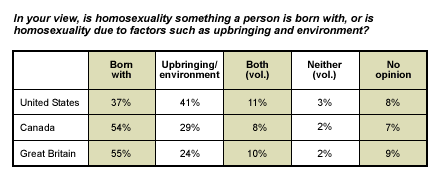
Why the Difference?
The data show that religious commitment, defined by frequency of church attendance, is related to opinion on this topic, and not just in the United States. In all three countries, people who attend church more often are less likely to believe that homosexuality is something that people are born with and more likely to believe that it stems from upbringing or environment. In the United States, a quarter (26%) of those who report that they attend church weekly believe that homosexuality is something a person is born with, whereas almost half (49%) who seldom or never attend church feel this way. Similar patterns emerge in Great Britain and Canada.
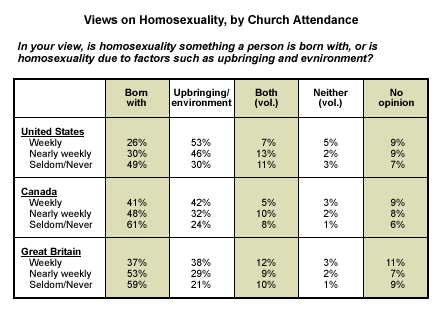
Because survey data consistently show that Americans tend to be more religious than either Canadians or Britons (see “Worlds Apart: Religion in Canada, Britain, U.S.” in Related Items), it is not surprising that Americans are more likely than those in the other two countries to favor the “nurture” argument.
Robert K. Knight is director of the Culture and Family Institute at Concerned Women for America, a conservative American public policy organization. Knight feels the media in all three countries have a left-wing bias, but says “there is a livelier, alternative press in this country [the United States], including talk radio, that directly challenges the liberal media who are biased in favor of the ‘born gay’ theory.” (Knight himself espouses the view that homosexuality results from a person’s upbringing.) ”Europe and Britain both labor under a virtual monopoly of left-wing news sources and people are only getting one side of the story.”
Mitchel Raphael, editor in chief of fab, a gay culture and lifestyle magazine based in Ontario, believes that sexuality cannot be fully explained by either nature or nurture. Although his views on the topic of homosexuality are quite different from Knight’s, Raphael agrees that the media and politics highly influence people’s opinions. “Most people have been brainwashed about sexuality for political reasons — by both the religious right and gay activists,” says Raphael. “Sexuality exists along a spectrum. Some people may be stuck at one point, many shift over time.”
“The discrepancies in the countries … simply represent who has been able to manipulate the minds of the masses best,” Raphael adds. “Environment/nature debates simplify a complicated process — but are effective as a tool of political manipulation for people who seek simple solutions.”
Bottom Line
The tendency of Americans to answer this question differently from Canadians or Britons is certainly tied to religion. But could there be other cultural reasons why Americans are less likely than others to believe that sexuality is determined at birth? Ron Inglehart is the director of the World Values Survey at the University of Michigan, a project that studies sociocultural and political change throughout the world. Inglehart believes that characteristics specific to American culture may also be influencing public opinion about homosexuality.
The U.S. results for the “nature vs. nurture” question are “very much in keeping with the American tendency to emphasize individual responsibility rather than societal responsibility for virtually any type of social issue,” Inglehart says. “This tendency is linked with the relatively limited scope of the welfare state in the U.S. by comparison with other equally developed countries. It is an aspect of American exceptionalism in which the U.S. is more likely to emphasize traditional values on such topics as religion and national pride.”
==============================
Evangelicals Warn Parents of Pro-Gay SpongeBob Video (Christian Post, 050122)
SpongeBob SquarePants, a beloved children’s cartoon character, has been exploited by an organization that’s determined to promote the acceptance of homosexuality among our nation’s youth, according to Christian evangelical and pro-family groups.
The matter arose on Thursday, when Dr. James Dobson, president and founder of Focus on the Family, was quoted by the New York Times as saying that SpongeBob’s creators enlisted him in a “pro-homosexual video” during remarks to a pre-inauguration dinner in Washington.
Dr. Dobson was referring to the recently completed music video for kids, where dozens of popular animated characters sing a rendition of Sister Sledge’s 1979 hit song “We are Family.” Nile Rogers, a veteran musician and producer of the new music video, said his We Are Family Foundation plans to give away 60,000 copies of the video to children’s schools after it is aired next month on several television networks.
According to the Mississippi-based American Family Association, the video subtly promotes homosexuality and all sexual orientations.
“On the surface, the project may appear to be a worthwhile attempt to foster greater understanding of cultural differences,” wrote Ed Vitagliano, editor of the monthly journal. “However, a short step beneath the surface reveals that one of the differences being celebrated is homosexuality.”
Vitagliano added that the Foundation’s website clearly reveals the agenda to redefine “family” to include homosexual couples and homosexual couples raising children.
“We are concerned that children who go to the Web site might encounter a moral message about homosexuality that their parents might not approve of,” said Vitagliano.
Peter Sprigg, senior director of policy studies of the Family Research Council, agreed.
“If you look at the Web site, it becomes pretty clear that a part of the agenda is to change the definition of family to include virtually anyone who chooses to be called a family, including homosexual couples and homosexual couples raising children,” said Sprigg. “Much of what they have is coded language that is regularly used by the pro homosexual movement such as ‘tolerance’ and ‘diversity.’
On the Foundation’s website, there are links to organizations that promote the gay and lesbian lifestyle.
“Ultimately we feel that this is being used as propaganda to indoctrinate very small children to accept a different definition of family,” said Sprigg.
Rogers, meanwhile, denied the assertions, and said conservatives’ focus is “ludicrous.”
“I don’t understand their motivation,” Rodgers said of his critics. “Nothing could be more devastating to the people who believe in me and our organization than to imply there’s an insidious undercurrent to it.”
“Focusing on SpongeBob is almost as ludicrous as focusing on the ‘sexual identity’ reference in the tolerance pledge,” he said to the Associated Press.
However, according to Focus on the Family, the issue is neither about the sexual identity of SpongeBob nor about the disconcerting references on the website.
“From the outset, let’s be clear that this issue is not about objections to any specific cartoon characters. Instead, Dr. Dobson is concerned that these popular animated personalities are being exploited by an organization that’s determined to promote the acceptance of homosexuality among our nation’s youth,” a statement on the Focus on the Family website read.
“We applaud the ideal of championing to children the value and dignity of every human life as well as respect for our differences. What we vehemently object to is using these beloved characters to help advance an agenda that’s beyond the comprehension of 6 and 7 year-old children, not to mention morally offensive to millions of moms and dads,” they added.
“The video in question is slated to be distributed to 61,000 public and private elementary schools throughout the United States. Where it is shown, schoolchildren will be left with the impression that their teachers are offering their endorsement of the values and agenda associated with the video’s sponsor. While some of the goals associated with this organization are noble in nature, their inclusion of the reference to “sexual identity” within their “tolerance pledge” is not only unnecessary, but it crosses a moral line.”
Focus on the Family also added that the videos should not be distributed publicly since it trumps on the authority of mothers and fathers.
“We believe that it is the privilege of parents to decide how, when and where it is appropriate to introduce their children to these types of sensitive issues. The distribution of this video trumps the authority of mothers and fathers and leaves it in the hands of strangers whose standards may very well be different than the children they teach,” the statement read.
“By calling it to light this video and its affiliation with this larger organization, we are attempting to do for parents what their busy lives often prevent them from doing themselves—connecting the dots
The We are Family Foundation Web site — www.wearefamilyfoundation.org — says the video will arrive at schools by March 11, the same day the video will air on Nickelodeon, PBS and the Disney Channel.
==============================
PBS stations to air lesbian-promoting cartoon (WorldNetDaily, 050202)
Despite criticism from education secretary, own network’s cancellation
Despite a rebuke from the new education secretary and an official cancellation by PBS, several large affiliates of the public TV network say they will air today a controversial episode of “Postcards from Buster,” a cartoon series for pre-schoolers, that portrays homosexuality.
Shortly after taking office last week, Secretary Margaret Spellings denounced PBS for using public dollars to promote the homosexual lifestyle.
In a letter to the president of PBS, Spellings said: “Many parents would not want their young children exposed to the lifestyles portrayed in this episode. Congress’ and the Department’s purpose in funding this kind of programming certainly was not to introduce this kind of subject matter to children, particularly through the powerful and intimate medium of television.”
PBS subsequently canceled the episode, entitled “Sugartime!” In the episode, Buster the rabbit visits a Vermont home headed by two lesbians.
According to a report in New York Newsday, WGBH, the powerful Boston public television station that makes the series, said it will air the program today and has offered it to other PBS stations. The paper says 18 stations plan to air it, including New York’s WNET and KQED in San Francisco. (kh: see where the most liberal cities are.)
Maryland Public Television said it will not air the program tomorrow but might show it later, Newsday reported.
“We really have delineated children’s television as a safe harbor for families,” Maryland Public Television spokesman Larry Hoffman told the paper. “But we also realize we have a commitment to tolerance. It’s a tough decision.”
Peggy Charren, a WGBH board member, effused about the program.
“I am so proud of WGBH for airing this show and making it available so that other stations can now order it,” Charren told the New York paper. “Unlike most of the people who are talking about this episode, I have actually seen it, and it is such a sweet, mild and wonderful program.”
The American Family Association is urging its supporters to thank Spellings for taking a stand against the show.
“Secretary Spellings has been ridiculed in the liberal media and bombarded by the homosexual community because of her bold stand for our children,” Don Wildmon, AFA chairman, said in a statement. “We need to let her know that mainstream America appreciates her recognition that the government should not push a homosexual agenda on children that goes against many parents’ convictions.
“Children’s videos should not be used to promote the homosexual lifestyle, and we want Margaret Spellings to know we appreciate her commitment to our children and respect for their parents.”
“Postcards from Buster,” which gets most of its $5 million budget from the taxpayers, features a rabbit whose parents are divorced and who travels with his pilot father sending video “postcards” back home.
The Education Department has paid about $100 million to PBS under a five-year contract to provide TV programming targeting preschoolers.
==============================
New Genetics Study Undermines Gay Gene Theory (Christian Post, 050211)
A study to be published in the March 2005 issue of the journal Human Genetics, and available online now, actually undermines the commonly held view that homosexual orientation is determined by genetic factors.
The study’s lead author Brian Mustanski from University of Illinois at Chicago said in a UIC news release that “There is no one ‘gay’ gene. Sexual orientation is a complex trait, so it’s not surprising that we found several DNA regions involved in its expression.”
However, a thorough examination of the actual report reveals no statistically significant findings for any of these DNA regions.
The authors describe in the article three non-X chromosomal “new regions of genetic interest” (7q36, 8p12, and 10q26). In the authors’ view, a noteworthy aspect of the study as follows: “Our strongest finding was on 7q36 with a combined mlod score of 3.45 and equal distribution from maternal and paternal allele transmission. This score falls just short of Lander and Kruglyak’s (1995) criteria for genomewide significance.” They go on to say “two additional regions (8p12 and 10q26) approached the criteria for suggestive linkage” - again pointing out that neither was statistically significant.
Thus, even the author’s “strongest finding” was not statistically significant by widely accepted scientific criteria.
The study also reexamined potential genetic contributions on the X chromosome from region Xq28. This is the region first identified by Dean Hamer as associated with homosexual orientation. However, this study re-analysis, to quote the authors, “did not find linkage to Xq28 in the full sample.”
The regions hypothesized as relating to sexual orientation by the research team appear to relate to developmental precursors to temperamental factors that have been associated with environmental theories of same sex attractions. For instance, one region identified is associated with hormones that impact sexual development. Another is linked to hemispheric development in the brain. Such genes may impact the temperamental traits of activity level and aggressiveness. Lower preferences for aggressive activities have been linked to the development of same sex attractions in men. However, currently there is no research evidence in the Mustanski study or any other of a direct pathway from genes to sexual attractions that does not involve environment interacting with individual temperamental differences.
Consistent with an environmental explanation of same sex attraction is the work of Daryl Bem. In a 2000 study, Dr. Bem demonstrated that there is no relationship between genotype and sexual orientation in men unless environmental interaction with the temperamental trait of gender nonconformity is taken in account. In other words, exploring individual temperamental factors lived out within certain environments may provide more precise areas for research into the action of potential genetic factors in the development of sexual attractions.
In summary, the Mustanski study finds no significant relationship between DNA regions and self-reported sexual orientation. Available evidence suggests that genes may be expressed via the interaction of temperament with certain environments. Practically, then, at present, one cannot know with any degree of certainty that a gene or combination of genes will distinguish why one man is homosexual and another is not.
Warren Throckmorton, Ph.D. is Associate Professor of Psychology and Durwood Ray, Ph.D. is Professor of Biology at Grove City College (PA).
References:
Bem, D.J. (2000). Exotic Becomes Erotic: Interpreting the Biological Correlates of Sexual Orientation. Archives of Sexual Behavior, 29, 531-548.
Mustanski, B.S., DuPree, M.G., Nievergelt, C.M., Bocklandt, S., Schork, N.J. & Hamer, D.H. (2005). A genomewide scan of male sexual orientation. Human Genetics, http://mypage.iu.edu/~bmustans/Mustanski_etal_2005.pdf.
UIC News Release: http://tigger.uic.edu/htbin/cgiwrap/bin/newsbureau/cgi-bin/index.cgi?from=Releases&to=Release&id=1023&start=1099192266&end=1106968266&topic=0&dept=0
ABSTRACT
A genomewide scan of male sexual orientation
Brian S. Mustanski 1, 2 Michael G. DuPree1, 3, Caroline M. Nievergelt 4, Sven Bocklandt1, 5, Nicholas J. Schork 4 and Dean H. Hamer 1
(1) Laboratory of Biochemistry, National Cancer Institute, National Institutes of Health, Bethesda, Md., USA
(2) Institute for Juvenile Research Department of Psychiatry, University of Illinois at Chicago (M/C 747), 1747 W. Roosevelt Road, Chicago, IL 60608, USA
(3) Department of Anthropology, Pennsylvania State University, University Park, Pa., USA
(4) Department of Psychiatry, University of California, San Diego, Calif., USA
(5) Department of Human Genetics, David Geffen School of Medicine at UCLA, Los Angeles, Calif., USA
Received: 16 September 2004 Accepted: 30 November 2004 Published online: 12 January 2005
Abstract This is the first report of a full genome scan of sexual orientation in men. A sample of 456 individuals from 146 families with two or more gay brothers was genotyped with 403 microsatellite markers at 10-cM intervals. Given that previously reported evidence of maternal loading of transmission of sexual orientation could indicate epigenetic factors acting on autosomal genes, maximum likelihood estimations (mlod) scores were calculated separated for maternal, paternal, and combined transmission. The highest mlod score was 3.45 at a position near D7S798 in 7q36 with approximately equivalent maternal and paternal contributions. The second highest mlod score of 1.96 was located near D8S505 in 8p12, again with equal maternal and paternal contributions. A maternal origin effect was found near marker D10S217 in 10q26, with a mlod score of 1.81 for maternal meioses and no paternal contribution. We did not find linkage to Xq28 in the full sample, but given the previously reported evidence of linkage in this region, we conducted supplemental analyses to clarify these findings. First, we re-analyzed our previously reported data and found a mlod of 6.47. We then re-analyzed our current data, after limiting the sample to those families previously reported, and found a mlod of 1.99. These Xq28 findings are discussed in detail. The results of this first genome screen for normal variation in the behavioral trait of sexual orientation in males should encourage efforts to replicate these findings in new samples with denser linkage maps in the suggested regions.
Brian S. Mustanski and Michael G. DuPree contributed equally to this work.
==============================
Metaphysics, Science, Homsexuality: Are we talking biology or choice? (National Review Online, 050216)
John Derbyshire
I have been getting an exceptional quantity of mail — paper mail, not e-mail — about a piece I wrote for National Review last December. The piece, titled “Our Crisis of Foundations,” was a loose rumination on current metaphysical confusions in the Western world.
Not many of my correspondents were interested in metaphysics. What mainly caught their eyes, and what they wanted to take issue with, were the following two sentences:
It is now taken for granted, for example, that homosexuality is a biological attribute of the human organism. “I was born this way!” the modern homosexual tells us, and science confirms that in most cases, if not exactly all, this is true.
This was just by way of illustrating a larger point:
Yet just a few decades ago, well within the memory of middle-aged people, homosexuality was thought of not as a thing people were, but as something they did.... Here, in a largish area of life and jurisprudence, the self has yielded to the organism, morality to biology.
The National Review readers who wrote to me disagreed rather strongly with what I said in those first two sentences — or actually, more often, with what they mistakenly supposed I said. They protested, sometimes quite angrily, at my implication that homosexuality is inborn. No, they said, it is chosen, and science has proved this to be so.
I had some exchanges with the editors over at the magazine (who had themselves received and read some portion of the letters) about whether I could produce a crisp reply to the generality of these readers, a representative letter from one of whom would then be printed in the “Letters” pages of NR, with my riposte underneath. After some struggles, I found I could not condense a satisfactory response to the small word-count required, and we dropped the idea.
I hate to leave things like this hanging, though, and have no time to write letters in reply to all those who took the trouble to write to me. By the magic of the Internet, however, I can answer them fully and carefully here on NRO, and I am going to give over this column to the task.
What causes homosexuality?
In the first place, the main point I was making was not about homosexuality, but about current attitudes, and the metaphysics that underlies them. Whether homosexuals are indeed “born that way” is one question; whether it is “taken for granted” in modern society that they are is a separate and independent question. Either could be true without the other’s being true. That the second is true seems to me too obvious to be worth arguing. Even the Roman Catholic Church, while condemning homosexual acts as sinful, concedes that the predilection to such acts may be inborn, in which case homosexuals “are called to chastity.” (Article 2359 of the current Catechism.)
Leaving that aside, what are the causes of homosexuality — the predilection, not the acts (which I assume to be caused by free will prompted by the predilection)? I can list a baker’s dozen of theories that I have heard or seen written up at one time or another. In very approximate order of scientific respectability, as best I can judge it, the theories are:
(1) Satan. Homosexuality may be a manifestation of Satan’s work. While the least scientific of current theories, this one is probably the most widely believed, taking the world at large. Most devout Muslims, for example, believe it, and so do many Christians.
(2) Social Construction. There is no such thing as homosexuality. There are only heterosexual and homosexual acts, which different cultures regard differently. The notion of “homosexuality” as a personality attribute is a 19th-century invention.
(3) Brain damage. Some insult to the tissues of the brain, perhaps at birth or in infancy, causes homosexuality.
(4) Choice. People choose to prefer their own sex over the other.
(5) Family influences in childhood. The Freudian belief is that having a weak father and/or dominant mother can form the child’s personality in the direction of homosexuality.
(6) Social stress. Rats kept in overpopulated environments, even when sufficient food and access to females are available, will become aggressively homosexual after the stress in the environment rises above a certain level.
(7) Imprinting. The individual’s early sexual history can “imprint” certain tendencies on animals and humans. Many homosexuals report having been same-sexually molested in childhood or youth.
(8) Socialization theories. The high levels of homosexual bonding in some ancient and primitive societies suggests that the common mores of a culture have some power to socialize large numbers of people into homosexuality.
(9) Genetics, direct. Homosexuality is the expression of some gene, or some combination of genes.
(10) Womb environment — too much of a good thing. The presence of certain hormone imbalances during critical periods of gestation can have the effect of hyper-masculinizing the brain of a male infant. Paradoxically — there are plausible biological arguments — this might lead to the infant becoming homosexual.
(11) Infection. Homosexuality may be caused by an infectious agent — a germ or a virus. This is the Cochran/Ewald theory, which made a cover story for the February 1999 Atlantic Monthly.
(12) Genetics, indirect. Homosexuality may be an undesirable (from the evolutionary point of view) side effect of some genetic defense against a disease — analogous to the sickle-cell anemia mutation, a by-product of genetic defenses against malaria, negative to the organism but nothing like as negative, net-net, as susceptibility to malaria.
(13) Womb environment — too much of the wrong thing. Here the effect of the rogue hormones is to feminize the brain of a male infant. (I assume that there are theories corresponding to 10 and 13 for female infants, though I have never seen them documented.)
Note that theories number 9, 10, 12, 13, and conditionally (depending on the age at injury or infection) 3 and 11, could all be taken as saying that homosexuality is “inborn,” while only two of these six theories have anything to do with genetics. The confusion between “genetic” and “inborn” is epidemic among the general public, however, to the despair of science writers. To readers suffering from that confusion — an actual majority of those who wrote to me suffer from it — I recommend the purchase of a good dictionary.
Which is it?
Which of these theories is true? In the current state of our understanding, I don’t believe that anyone can say for sure. From what I have seen of the scientific literature, I should say that numbers 12 and 13 currently hold the strongest positions, with much, though I think declining, interest and research in 9 and 10, modest but growing interest in 11, and some lingering residual attachment to 6, 7, and 8. The other theories are not taken seriously by anyone doing genuine science, so far as I know. If anyone has information to the contrary, I should be interested to look at it — though I should only be interested in research written up in a respectable peer-reviewed journal of the human sciences.
My own favorite is the infection theory, number 11. I favor it because it seems to me to be the most parsimonious — always a good reason for favoring a scientific theory. Until an actual agent of infection can be identified, however, the infection theory must remain speculative and the evidence circumstantial.
The theories involving genetics all suffer from mathematical problems. Homosexuality imposes such a huge “negative Darwinian load” on the affected organism that it is hard to see how genes inclining to homosexuality could persist for long in any population. Various ingenious theories have been cooked up in attempts to finesse the issue, but nobody has been able to make the evolutionary math work. Which is baffling, because there are persistent nagging hints, in identical-twin studies for instance, that homosexuality does have some genetic component. Science is full of conundrums like this, to the delight of unscientific cranks, who leap on them as evidence of supernatural intervention. History shows that these puzzles always get resolved sooner or later in a natural way, however, sending the “God of the Gaps” traipsing off to find a new place where he can hang his starry cloak for a while.
The “socialization” theories, while not scientifically contemptible, do not hold up well under rigorous examination. It is indeed true that large numbers of men and women, deprived of the companionship of the opposite sex by confinement or social custom, will form erotic bonds with their own sex. As soon as the constraints are removed, however, the great majority revert to heterosexuality. Graduates of English boys’ boarding schools marry and raise families; the convict who spent his sentence bullying weaker inmates into giving him sexual gratification will, upon his release, immediately seek out old girlfriends. Lab studies — measuring sexual arousal caused by various kinds of images, for instance — confirm that the great majority of people everywhere are, in their inner lives, heterosexual, however they may express themselves under the constraints of their immediate environment.
The “choice” theory, which most of my correspondents seem to cleave to, has as its main supporting evidence the fact that some people have been “converted” from a homosexual lifestyle to a heterosexual one, usually by counseling, often by religious conversion. I don’t myself find this very impressive. The numbers involved are small, and these conversions seem to fall into the category of fringe phenomena you are bound to get when investigating something as complex and variable as the human personality.
Strange bedfellows
My own inclination, therefore, is to believe that most homosexuality is inborn, or acquired early in life, possibly by infection, or by biochemical imbalances in the womb, perhaps helped along by some genetic predisposition. As I have said, the human personality is a thing of fantastic complexity and mystery, and I am sure there are cases of socialization, “imprinting,” and conversion (in both directions), too. These are, however, fringe phenomena, occurring in small numbers. Most homosexuality is, I believe, inborn, or acquired very early in life.
The issue is confused by the fact that homosexualists, who obviously have the biggest axe to grind here, are the most vocal proponents of the can’t-help-it school of thought. “We are born this way,” they say. “Therefore it is mean of you to discriminate against us!” Whether the second proposition follows from the first, I shall come to in a moment. That they are indeed born that way, though, I find highly probable. Since I am not a homosexualist, nor even a homosexual (the first of those words names a type of ideologue; the second, a type of personality) — and since I in fact believe that homosexual behavior is a social negative, and ought to be discouraged — it’s a bit odd to find myself in the same theoretical company as the homosexualists.
I am, though I say this with all appropriate modesty, something of a hate figure to the more fanatical kind of homosexualist, as you can easily see by Googling my name. One has for several years been running an energetic campaign to get me fired from National Review. That I am in broad agreement with these folk about the inborn nature of their homosexuality therefore puts me in company with people who hate me, and whom I myself generally dislike. There is not much point in being embarrassed about this. That’s science for you. Science is “cold,” and doesn’t care what we think or wish for. (This is a point about science that many people simply cannot grasp. The opposite of science is not religion; the opposite of science is wishful thinking.)
Majority and minority rights
As to what the consequences for our attitudes and public policies should be, supposing I am right about the causes of homosexuality, I offer the following.
I don’t think that the fact of a predilection’s being inborn should necessarily lead us to a morally neutral view of the acts it prompts. If you could prove to me that pyromania is inborn, I should not feel any better disposed towards arson. On the other hand, I should have a somewhat more sympathetic attitude towards arsonists than I had before. In that spirit, I favor a tolerant attitude towards homosexuals. I certainly do not believe, as around 40% of Americans say they do, that homosexual acts ought to be illegal.
I can’t even agree with the Roman Catholic church that homosexuals are “called to chastity.” While I have nothing against chastity per se — I think it can be an honorable choice for a person to make in some circumstances, and would even go so far as to say that I believe the very low status of chastity in popular culture is regrettable — it seems to me arrogant and unkind to tell people that they are “called to chastity” if they do not hear the call themselves.
Homosexual behavior is a social negative, suggesting as it does that normal heterosexual pairing, the bedrock institution of all societies, is merely one of a number of possible, and equally moral, “lifestyles,” and thereby devaluing that pairing — perhaps, on the evidence from Scandinavia presented by our own Stanley Kurtz on this site, fatally. Male homosexuality is also the source of public-health problems (and was so even before the rise of AIDS).
Further, homosexuality is offensive to many believers in all three of the major Western religions, who form a large majority of the American population. I think that while minority rights ought to be respected, civic majorities ought not be asked to endure offense for the sake of abstract metaphysical or juridical theories, unless dire and dramatic injustices like slavery are in play. Majorities have rights too; and while I want to see minority rights respected, I don’t think that every minor inconvenience consequent on being a member of a minority should be raised to the level of an intolerable injustice requiring drastic legislative or judicial remedy. We all have to put up with some inconveniences arising from our particular natures.
Tolerance is not approval; and while I do not agree with the pope that homosexuals are “called to chastity,” I do think that they are called to restraint, discretion, reticence, and a decent respect for the opinions of the majority. I certainly do not think that they ought to be allowed to transform long-established institutions like marriage on grounds of “fairness.” Nor do I think they should be allowed to advertise their preference to high-school students, as they do in some parts of this country. Nor should they be strutting about boasting of “pride.” (How can you feel pride in something you believe you can’t help?)
So far as those sentences in my National Review article to which so much objection has been made, though: Yes, I believe it is now taken for granted that homosexuality is a biological attribute of the human organism, either inherited or acquired in the course of early development; and yes, so far as I can judge, science does confirm that in most cases, if not exactly all, this is true.
==============================
Was Abraham Lincoln Gay? Homosexuality and History (Christian Post, 050222)
What are we to make of Abraham Lincoln? This larger-than-life figure that has cast such an enduring shadow over American history continues to defy historical analysis. The so-called “Lincoln Myth” that emerged shortly after his assassination in 1865 continues as the nation’s central memory to this day. The most interesting debate over Lincoln and his legacy has been conducted by a cadre of conservative scholars who have debated Lincoln’s real convictions on slavery and his real goal in preserving the union.
At least that was true until now. With the release of The Intimate World of Abraham Lincoln by C. A. Tripp, a new question has emerged as a matter of historical interest and immediate media scrutiny. Why? Because C. A. Tripp argues that Abraham Lincoln was “predominantly homosexual.”
Welcome to the high-octane world of revisionist history. For years, the field of academic history has been lurching into the ditch of historical revisionism, with various researchers and writers—most hoping for tenure at a major university—pursuing the sex lives of various historical personages, looking for “transgression” and scandal.
Beyond this, a group of homosexual advocates has been ransacking history, looking for traces of homosexuality in major historical figures. Their agenda is clear—to argue for the normalization of homosexuality by suggesting that some of history’s most preeminent figures were actually closeted (or not so closeted) homosexuals.
The release of The Intimate World of Abraham Lincoln caught the immediate attention of the national media. Reviews quickly appeared in major newspaper and newsmagazines, with some reviewers immediately gushing about the “refreshing” analysis offered by the book’s author, the late C. A. Tripp. Larry Kramer, a prominent writer and AIDS activist, told The New York Times that the book “will change history.” He certainly hopes so, and his hope is shared by many in the homosexual movement who would eagerly argue that a homosexual Abraham Lincoln should be a model for the normalization of homosexuality itself.
Andrew Sullivan, a prominent homosexual advocate and political commentator, quickly celebrated the book as a great work of scholarship. Even acknowledging the book’s lack of clear historical evidence, Sullivan is undeterred. “Certainly if you’re looking for clear evidence of sexual relationships between men in Lincoln’s time in the official historical record, you’ll come to the conclusion that no one was gay in the nineteenth century. But of course, many were.” Of course, this is simply not an argument. What Sullivan is really arguing is that the lack of historical evidence should not deter modern interpreters from arguing for a homosexual Lincoln.
Sullivan bases his claim on the following argument. “Here’s what I’d say are the most persuasive facts. Lincoln never developed deep emotional relations with any women, including his wife. Even the few snippets we have of early romances or his deeply strained courtship of Mary Todd suggest a painful attempt to live up to social norms, not a regular heterosexual life. His marriage was a disaster, by all accounts.” What in the world does Sullivan really mean when he simply asserts that Lincoln did not have “a regular heterosexual life?” History is replete with men who had unhappy marriages, but that hardly made them homosexual.
C. A. Tripp died before The Intimate World of Abraham Lincoln was published. The brief biological data supplied on the book’s jacket provides only a hint of Tripp’s real background and agenda. The jacket identifies Tripp as, “A psychologist, therapist, and sex researcher, [who] worked with Alfred Kinsey in the late 1940s and 1950s before obtaining a Ph.D. in Clinical Psychology from New York University. He maintained a private practice of psychology for years and taught at the State University of New York, Downstate Medical Center, from 1955 to 1964.”
That doesn’t even come close to telling the story. In reality, Tripp was a close associate of Alfred Kinsey, and he was deeply involved in Kinsey’s various experiments and eroticisms packaged to the public as sexual “research.” In one infamous case, Tripp was involved in soliciting young men from the streets of New York City to commit sex acts on film. Tripp hired a boy hustler who then solicited other young men for Kinsey and Tripp’s sex experiments. By the end of the “experiment,” over 2,000 young men had participated in the filmed sex acts.
Like Kinsey, Tripp was a deeply troubled man. He later would become author of The Homosexual Matrix, and would emerge as a major figure in the homosexual movement.
Writing in The New Republic, Christine Stansell, Professor of History at Princeton University, explains that “Tripp was determined to rescue a hidden gay hero.” The facts would simply be twisted in order to serve Tripp’s agenda.
Any careful scholar would have to acknowledge that Abraham Lincoln developed very close relationships with other men. This was especially true with respect to Joshua Speed, with whom Lincoln shared a bed for several years. The two were undoubtedly close friends, but the experience of sharing a bed was hardly unusual in the nineteenth century. Tripp simply reads a homoerotic or homosexual meaning into virtually every word Lincoln did or did not say about Joshua Speed. As Stansell explains, this allowed Tripp “to infer helter-skelter, wrenching the evidence in line to make the case.”
In the end, Stansell concluded that Tripp had compiled “a dossier of ambiguities—not truths, but ambiguities—worth considering.” As she continued, “His bullish proclamations are easily countered, and not just by the heterosexists and the homophobes whose attacks he predicts will result from his revelations.”
Stansell deals with the evidence honestly. “It mostly comes down to this: what did it really mean for people to sleep together in small beds? The practice was habitual, a convention of friendship and comradeship. Travelers piled in with each other at ends; siblings routinely shared beds; women friends often slept with each other as readily on an overnight visit as they took their tea together in the kitchen—and sometimes displaced husbands to do so.” With a flourish, Stansell reflects, “Historians who care about such things argue about them.”
Tripp actually went much further in terms of the specifics of his argument. Using psychoanalysis and his twisted reading of history, Tripp attempted to paint a picture of Abraham Lincoln as a tortured and closeted homosexual, whose deep friendships with men like Joshua Speed and Captain David Derickson were both homoerotic and homosexual. Tripp even argues that he can find references to specific homosexual acts in Lincoln’s history. At the very least, Tripp should be credited with a strangely perverse form of creativity.
The real background to Tripp’s book was revealed in a January 17, 2005 cover story published in The Weekly Standard. In that article, writer Philip Nobile described the book as “a dishonest book about Honest Abe.”
In reality, Nobile, who teaches history at the Cobble Hill School of American Studies in New York, was in a most unique position to criticize the book. It turns out that he had originally been Tripp’s co-author for the work. Offended by Tripp’s recklessness, Nobile later withdrew from the project. “The book is a hoax and a fraud,” Nobile now argues, “a historical hoax because the inaccurate parts are all shaded toward a predetermined conclusion, and a literary fraud, because significant portions of the accurate parts are plagiarized—from me, as it happens.”
The story Nobile relates is fascinating. “Tripp and I intended to be co-authors of the book, laboring together on the project from 1995 to 2000—when our partnership, already fissured by dueling manuscripts, came to a bitter end. We quarreled constantly over the evidence: I said the Gay Lincoln Theory was intriguing but impossible to prove; he said it was stone-cold fact.”
Nobile’s expose of the book is must reading for anyone inclined to take Tripp’s “research” seriously. He cites a disparaging comment made by respected author David Donald—himself a major Lincoln biographer—with regard to Tripp’s book. As Donald wrote to Tripp, “Throughout you seem to be neglecting the fundamental rule, the historian has to rely on facts . . . I don’t mean to discourage you from doing further work—but I do think it ought to be more systematic and more empirical.”
In the book, Tripp argued that Lincoln’s homosexuality can be traced to his early puberty. Tripp’s early dating of Lincoln’s puberty is, according to Nobile, “the most important ‘smoking gun’ in the whole gay Lincoln arsenal.” The importance of early puberty in males was a central concern of Alfred Kinsey, who argued that precocious puberty is linked to a higher sex drive and experience or experimentation with homosexuality.
Setting aside the dubious character of Kinsey’s argument, the noteworthy issue is that Tripp was so determined to argue for Lincoln’s precocious puberty, that he ended up arguing that Lincoln went through puberty at age nine—an absolutely remarkable and medially unsustainable argument for a boy in the nineteenth century. As Nobile acknowledges, nothing justifies this claim. Of course, that didn’t stop Tripp.
Concerned about the obvious errors in Tripp’s book, and outraged at Tripp’s plagiarism of his own written materials, Nobile contacted Tripp’s publisher, The Free Press. Nobile’s argument with the publisher—thoroughly reported in his Weekly Standard article—makes for fascinating reading. In the end, Nobile’s protests and demands were not satisfied.
Interestingly, the February 21, 2005 issue of U.S. News & World Report includes a major cover story entitled “Lincoln Revealed,” by Justin Ewers. As the magazine’s cover summarizes the story, the gay issue is foreclosed. “Passionate? More than you ever knew. Troubled? Oh yeah. Big time. Gay? Nah, forget about it.”
As Ewers explains, “The rough outlines of Lincoln’s life before the White House have never been in dispute.” He rejects C. A. Tripp’s argument, noting that Tripp is “flatly wrong” in several claims. Ewers cites David Donald as stating the obvious: “I simply cannot believe that, if the early relationship between Joshua Speed and Lincoln had been sexual, the president of the United States would so freely and publicly speak of it.”
This amounts to what I would call a “common sense” theory of history. It is simply impossible to believe and implausible to claim that a figure as controversial and preeminent as Abraham Lincoln could have engaged in homosexual relationships as characterized by C. A. Tripp without that fact becoming scandalous, notorious, and eventually disastrous. This book is a scandalous effort to twist history into service for a political cause—not that such an effort would be unprecedented. Abraham Lincoln was undoubtedly a complex, confusing, and often deeply troubled figure. But then, he lived and led in deeply troubled times.
C. A. Tripp’s book tells us a great deal about Tripp, but very little about Lincoln. It reveals the true agenda of revisionists in the academy who will use history as fodder for political movements and will twist the historical record for their own purposes.
Is there more to learn about Abraham Lincoln? Undoubtedly. But was Abraham Lincoln gay? In the words of U.S. News & World Report, “Nah, forget about it.”
____________________________________________
R. Albert Mohler, Jr. is president of The Southern Baptist Theological Seminary in Louisville, Kentucky.
==============================
Study finds disproportionate abuse by ‘gays’ (WorldNetDaily, 050303)
34% of sexual molestations of foster children were same-sex
A six-year study of sexual abuse committed by foster parents in Illinois found a highly disproportionate percentage of the cases were homosexual in nature.
About one-third were same-sex while estimates are that no more than 3% of people in the general population say they engage in homosexual acts.
An article in the March issue of the peer-reviewed publication Psychological Reports presented data analyzed by Dr. Paul Cameron, chairman of the Colorado-based Family Research Institute.
Cameron believes it’s likely the Illinois figures reflect the situation among the nation’s estimated half-million foster children.
“What’s shocking, is that 34% of the molestations were homosexual,” Cameron told the Illinois Leader.
According to a DCFS spokeswoman, the agency does not track the sexual orientation of prospective foster or adoptive parents.
“We track our foster and adoptive parents on the basis of their being single or married. That’s it,” Marjorie Newman told the paper last year.
The agency would not say whether the information would lead to a change in policy.
The study showed 1% of Illinois foster and subsidized-adoption children are molested and 3% are abused physically every year.
“Professional societies are so taken with gay rights they are ignoring the evidence,” said Cameron. “Just last year, the American Psychological Association [APA] declared opposition to ‘discrimination against lesbian or gay parents adoption, child custody and visitation, foster care and reproductive health services.’”
Cameron added, “How does the APA answer this new evidence?”
Last year, Newman said the DCFS does not “discriminate based on gender, race, sexual orientation, sexual preference. There is no law that says that a gay or lesbian person cannot adopt.”
The Leader acquired information from DCFS through the Freedom of Information Act indicating most sexual abuse of children was by foster fathers, but that foster mothers were responsible for over three-fourths of physical abuse.
The study found 966 foster parents violated their charges. Of those who engaged in both physical and sexual abuse, eight of the 15 abused children of their own sex.
Cameron said Illinois, which has about 60,000 children in 4,300 foster or adoption-subsidized homes, was the first state to disclose details about abuse.
==============================
“Bias Won Out” At the Dallas’ Love Won Out Conference on Homosexuality (Christian Post, 050303)
“Bias won out,” stated Gary Schneeberger, the editor of Citizenlink, a ministry of Focus on the Family (FOTF), as he looked back at the successful Feb. 19 Love Won Out conference on homosexuality in Dallas, Texas.
Focus on the Family’s Love Won Out conference on homosexuality just ended, and the compassionate message that “change is possible” was quite successfully delivered, despite criticism from several directions.
FOTF has come under heavy criticism from gay activists for its international Love Won Out conference series, which made its first stop in Houston recently. But according to Scheneeberger, greater “hostility” came in the form of subtle bias in the media’s coverage of the event.
“Just about every way journalists can declare their opposition to Christian worldview was on display” - both subtly and “not so subtly,” stated Gary Schneeberger in a commentary as CitizenLink editor.
An argument ensued between the two person crew from KHOU, Houston’s CBS affiliate, who were sent to cover the event when FOTF’s media relations team asked them to stop shooting footage of attendees’ faces out of respect for the people.
Despite the fact that KHOU’s reporters signed an agreement of understanding, the reporter claimed she didn’t realize what she was signing after KHOU’s videographer called a member of FOTF’s media relations team a “Nazi” and both started arguing with Mike Haley, the conference host, about protecting the identities of attendees. Security escorted KHOU out after that.
“Our message is one of hope for those struggling with unwanted homosexuality,” said Mike Haley, host of the Love Won Out conference, a former homosexual and author of the book 101 Frequently Asked Questions About Homosexuality (Exodus International website).
“You see,” Schneeberger writes, “most of the people who attend Love Won Out do so because they’re seeking answers to painful questions: either a friend or family member is gay, and they’re looking for help on how to best show their love; or they themselves are struggling with unwanted same-sex attraction and are searching for hope that there is a way out.”
“They come to Love Won Out because they consider it a safe place to work through their issues — and the last thing they need to worry about is their faces showing up on the evening news.”
He continued, “It’s hard to imagine this kind of hostility being directed at, say, the operators of a shelter for battered women who don’t want the faces of those they help to be shown on TV or in the paper.”
“Why? Because everybody — even journalists — agrees that the purpose of a shelter for battered women is to ensure that they don’t get battered anymore.” Is it fair then that the KHOU team were this aggressive with FOTF’s media team? he stated.
Since its inception in 1998, Focus on the Family’s Love Won Out conference has shared the message with more than 22,000 people in over 38 cities and has experienced around a 25% increase in attendance over the past year (FOTF press release from 2004).
FOTF wishes to “inject truth into this national debate – the truth that homosexuality is not genetic and, if you do not want to be gay, there is a way out,” said Haley (Agape Press).
“We encourage the public to come to our conference with open minds and hear the real stories behind this controversial topic,” Haley said.
When asked by The Christian Post what the problem might be in the media, Schneeberger said, “The people who come to the event have enough to be worried about, and it would be nice if the media could look at the way they cover the event and try to be fair.”
“We’re not asking for people to agree with us... All we’re asking is that you give us the opportunity to get our message out to people,” said Schneeberger.
Greater forms of bias in media coverage came with the Houston Chronicle’s coverage. The story was placed on page 6B with the title, “150 protest Focus on the Family session.” It included one picture, that of the handful of protesters, while mentioning that 900 people attended it in the eighth paragraph. The huge number of people who showed up for the event was discounted.
However, Schneeberger gives the award for the most subtle bias to the Galveston County Daily News. “The writer’s agenda is hard to miss,” wrote Schneeberger, and that’s because in nearly every other paragraph, she packs key words and phrases denoting our view of homosexuality between quotation marks.”
He states examples from the article with the bias. “The message is simple, said those behind the Christian-based event: Homosexuality is not innate, it is against the Bible and people are able to “walk away” from same-sex desires.”
Her quotations signal to readers that “I don’t want to touch the garbage being spewed by these people, and neither should you,” said Schneeberger.
The messages of the conference were of healing. Along with homosexual marriage, the Love Won Out conference addressed topics such as the clinical development of homosexuality; the relationship between homosexuality and genetics; the pro-gay agenda in public schools; and homosexual recovery.
Another of his examples where the reporter used quotations to inject bias was: “Others (among the attendees) had ‘left homosexuality’ and were there for support and information.”
In being fair to the media world, he stated that none of the bias is unique to Houston or to coverage of the issue of homosexuality.
“You’ll see the same examples of bias, more likely than not, in your hometown newspaper and on the local TV news whenever subjects like abortion or stem-cell research or euthanasia warrant a story.”
Focus on the Family sponsored the event as part of a series of conferences that will carry the ministry’s redemptive message across the nation to Louisville, Kentucky on April 16, Winnipeg, Manitoba on May 14, Seattle, Washington on June 25; and Birmingham, Alabama on September 17 (www.lovewonout.com). The date for Boston, Massachusetts is to be announced (Agape Press).
==============================
The radical homosexual agenda and the destruction of standards (Townhall.com, 050309)
Ben Shapiro
The Bisexual, Gay, Lesbian, Transgender and Supporters Alliance (BGLTSA) of Harvard University is fighting mad. Last week, actress Jada Pinkett Smith won an award from the Harvard Foundation for Intercultural and Race Relations. During her acceptance speech, she told women in the audience, “you can have it all — a loving man, devoted husband, loving children, a fabulous career … To my men, open your mind, open your eyes to new ideas.” Rather sweet, no? Not to the BGLTSA, which called for an apology from the organizers of the Cultural Rhythms show, explaining that Smith’s statements were “extremely heteronormative.” “Heteronormative,” for those who don’t speak the radical homosexual lingo, may be defined as the viewpoint that heterosexual relationships are normal, and others are not.
The organizers immediately complied with the BGLTSA’s demand, issuing a mea culpa stating, “She wasn’t trying to be offensive. But some felt she was taking a narrow view, and some people felt left out.” The Foundation also pledged to “take responsibility to inform future speakers that they will be speaking to an audience diverse in race, ethnicity, religion, sexuality, gender and class.”
The BGLTSA, as a wing of the radical homosexual movement, is looking to broaden the definition of normality to include deviant behavior. They’re not looking for passive tolerance. They’re looking for active acceptance. Now, ignoring homosexuality is no longer allowable; we must instead champion it, equating it with heterosexuality. In fact, homosexuality must be prized over heterosexuality; an open homosexual may proclaim to his heart’s content that “dreams can come true — you can find a same-sex partner,” but an open heterosexual may not state that marriage constitutes “having it all.”
Sen. Daniel Patrick Moynihan noted such a broad societal trend toward normalizing the deviant as early as 1993, when he coined the term “defining deviancy down.” He posited that “the amount of deviant behavior in American society has increased beyond the levels the community can ‘afford to recognize’ and that, accordingly, we have been re-defining deviancy so as to exempt much conduct previously stigmatized, and also quietly raising the ‘normal’ level in categories where behavior is now abnormal by any earlier standard.”
Syndicated columnist Charles Krauthammer pointed out that alongside the movement to “define deviancy down,” there was a concurrent movement to “define deviancy up”: “As part of the vast social project of moral leveling, it is not enough for the deviant to be normalized,” Krauthammer wrote. “The normal must be found to be deviant.” One of the agendas of the “defining deviancy up” movement, Krauthammer noted, was promoting “an underlying ideology about the inherent aberrancy of all heterosexual relationships.”
The Moynihan-Krauthammer prediction has come to pass. Straight men and women may no longer consider themselves normal, unless they also consider homosexuality normal. The rage against “heteronormalism” is rage against traditional societal standards as a whole. Exclusive morality has always offended the immoral. The only difference is that now offensiveness receives a stiffer societal sentence than blatant immorality. This is what political correctness — the “live and let live” societal model — has wrought.
The rise of the homosexual movement is a textbook example of societal amorality devolving into societal immorality. The rationale behind societal amorality is the myopic question: “How does my immoral behavior hurt you?” The answer is: It may not, in the short term. But when society sanctions your immoral behavior, that does hurt me. If millions of people accept the deviant as normal, that reshapes society in vastly destructive ways. Your moral self-destruction may have no consequences for me, but destruction of societal standards always has consequences.
When the stigma left single motherhood, society felt the sting in rising rates of single motherhood and juvenile crime. When the stigma left sexual licentiousness, society felt the sting in rising rates of teen pregnancy, sexually transmitted disease, emotional emptiness and nihilism. Your immoral personal behavior may not affect me, but exempting your immoral behavior from societal scrutiny certainly does. A society without standards is an unhappy, unhealthy society — a society with no future. And all of us have to live in that society.
The BGLTSA isn’t asking for tolerance on a person-to-person level. Instead, they’re asking us to continue lowering societal standards. If we must choose between alienating the immoral and ravaging societal standards for the personal comfort of the immoral, then choosing the former is the only rational decision.
==============================
Homosexual Groups Unite to Push Agenda (American Family Association, 050308)
For those who ridicule the whole notion of a homosexual “agenda,” a recent press release from a new coalition of lesbian, “gay,” bisexual, and transgendered (LGBT) groups was unwelcome news.
In a joint statement released January 13, an alliance of 22 organizations spoke of a “shared vision,” which includes the legalization of same-sex marriage, the continuation of promotional efforts throughout the nation’s public school systems, the inclusion of “sexual orientation” in federal hate crimes and nondiscrimination laws, and an end to the ban on homosexuals in the military.
The coalition consists of LGBT groups such as the Human Rights Campaign; Gay & Lesbian Alliance Against Defamation; Gay, Lesbian and Straight Education Network; the National Gay and Lesbian Task Force, and the American Civil Liberties Union Lesbian & Gay Rights Project.
“The speed with which our movement is advancing on all fronts is absolutely historic — and it hasn’t happened by chance or by accident,” said the press release. It cited the LGBT movement’s “instruments” of change: “lobbying, electoral politics, impact litigation, grassroots organizing, public education, media advocacy and more ....”
The statement also accused pro-family groups of continuing to “confuse, distort and subvert the public debate,” even while homosexuality continues to become more acceptable in the hearts and minds of the American public.
Example: PFLAG Pushes Agenda in Schools
A pro-homosexual organization began 2005 with a demand that the public school system do more to normalize “gay,” lesbian, bisexual, and transgendered lifestyles. The group Parents, Families and Friends of Lesbians and Gays (PFLAG) released a study in January that claimed public schools were failing to educate students about homosexuality and were failing to protect LGBT students.
According to PFLAG’s numbers, 95% of school counseling departments had little or no resources for homosexual children, and 70% of schools did not train faculty to stop harassment of LGBT students.
Nevertheless, some parents think their schools are, in fact, already pushing the homosexual agenda too far. In Massachusetts, one mother is upset that at her kids’ school, John Glenn Middle School, a rainbow flag flies overhead and pink triangles adorn classroom doors.
Also in Massachusetts, that state’s legalization of same-sex marriage may be emboldening homosexual teachers within the public school system to promote their own lifestyle to kids. For example, according to an interview on National Public Radio (NPR) All Thinks Considered, lesbian eighth-grade teacher Deb Allen said she explicitly teaches her students about lesbian sex, including the use of sex toys.
NPR reporter Tovia Smith said, “Already, some gay and lesbian advocates are working on a new ‘gay’-friendly curriculum for kindergarten and up.”
But this is not just a phenomenon occurring in the liberal northeast section of the U.S. In Kentucky, a federal judge ordered Boyd County middle and high schools to require all teachers and students to attend diversity and tolerance classes on the subject of homosexuality. The decision came after a lawsuit was filed by the American Civil Liberties Union, after the county school system refused to allow a Gay-Straight Alliance student group to meet on campus.
==============================
Homosexuality Struggles Mount in Mainline Churches (Christian Post, 050329)
Renewal leaders within America’s historic mainline churches say evangelicals must get invovled in church polity if they are to reclaim the majority’s voice on the sexuality front.
Leading evangelicals within America’s historic mainline denominations met in Arlington, Virginia for the biannual Association for Church Renewal (ACR) gathering earlier this month.
According to the 20 participants, mainline churches are struggling on the sexuality front and will continue to do so unless evangelicals grab key leadership positions and get actively involved in the church’s polity.
“We realized at the gathering that we are all struggling with the push on the sexuality issue,” said James Heidinger II, chairman of the ACR and president of the Good News network within the United Methodist Church (UMC).
The UMC, the Evangelical Lutheran Church in America, the Episcopal Church USA, the Presbyterian Church USA and the United Church of Christ (UCC) are all mainline denominations that have struggled in regards to the homosexuality issue for several decades.
Most of the denominations adopted statements banning the ordination of actively gay clergy and the blessing of homosexual unions. However, challenges are being made annually against such bans – although according to renewal leaders, the majority of the church remains in favor of those restrictions.
“Studies have shown time and time again that – at least in the UMC – almost 70% of Methodists define themselves as conservatives on moral and theological issues,” Heidinger explained.
In some churches, such as the UCC, the leadership adopted statements celebrating the homosexual lifestyle despite opposition in the grassroots.
“I’m afraid this pattern is continuing in many of the churches, where the bureaucracy does not really speak for the church but is often quoted as a source because there is no where else to go,” explained Heidinger.
Therefore, Heidinger said, the church needs to see the “emergence of a strong orthodox evangelical majority” that is willing to fight for the key issues facing the church today.
“We’ve always had this conservative presence, but they have not gotten involved in leadership,” said Heidinger. “We have been urging people in the church to get in the game and make their voices heard, rather than to just sit on the sidelines and watch the game play out.”
“We want to activate evangelicals who are out there to apply for the leadership of the denominations and become members of the committees that can make a difference.”
Mark Chavez, the president of the Word Alone network of Lutheran churches, agreed that evangelicals must become more actively involved in church politics if they are to change the denominations’ direction and path.
“The problem is that the people who are most active in our churches in terms of mission and evangelism don’t want to get involved in the politics,” explained Chavez. “So they tend not be even nominated for the leadership position.
“However, it would take a much higher political involvement from evangelical leaders if they want to make a difference and bring about a biblical reformation,” Chavez explained.
Heidinger agreed.
“Evangelicals have historically been more interested in local church ministry and they do that well, but it doesn’t make sense for us to leave the entire administration to people who are liberal,” said Heidinger. “So we have been urging these evangelicals to make the commitment, to give the time and energy, and to get involved at the national level.”
In the meantime, mainline denominations are continuing on a downward trend – both in membership and financial stability - according to the renewal leaders.
“I’ve not seen any evidence of [the mainline churches] bouncing back,” explained Chavez. “There are individual churches within each of those denominations that have been growing, but a couple of studies show that almost all of those churches are connected with renewal movement.”
Ultimately, if the church does not turn back from its “liberal” track, ELCA renewal members may form a “church within a church” to clearly unite the voice of the majority.
“We are on the verge of taking the first step of a new association of churches in the ELCA,” explained Chavez. “This association would essentially be a non-geographical synod, and would be one that gathers on the basis of a common confession of the Christian faith.”
The Word Alone network will consider forming the new association during its annual meeting in April.
==============================
Christian, Muslim, Jewish Leaders Launch United Campaign Against ‘World Pride 2005’ (Christian Post, 050331)
Representatives of the Jewish, Muslim and Christian faiths gathered for an unprecedented news conference on Wednesday and launched a united campaign to stop the “World Pride 2005” gay festival from running as planned in Jerusalem this August.
World Pride 2005 is a ten-day international gay festival held every five years. Some 250,000 people traveled to Rome for the World Pride 2000 event, which drew harsh criticism from the Vatican.
This year’s event is also expected to attract thousands of gay, lesbian and transgender participants from around the world. The attendees are scheduled to visit various sites that are considered sacred by all three faiths.
In light of the coming controversy, leaders of the three faiths joined their voices to keep what they called “moral terrorism” out of the Holy City.
“This is nothing less than the spiritual rape of the Holy City,” said Rabbi Yehuda Levine, from the Rabbinical Alliance of America, according to the Associated Press.
“This is not the homo land, this is the holy land,” he told a news conference in Jerusalem.
“Making this parade would not only be an offence, but a provocation to the Jews, Christians and Muslims of Jerusalem and all the world,” he added.
Archbishop Sambi, the Vatican ambassador to Israel, warned that the festival could provoke disturbances among the religious communities in Jerusalem.
Meanwhile, Armenian patriarch Aris Sharvanian explained that the Bible does not condone homosexuality.
“We know from the Holy Bible that God created Adam and Eve, but he didn’t create Adam and Steve,” said Sharvanian.
The top Palestinian Muslim cleric also joined the group in voicing his opposition to the festival.
“Don’t anger our God. If we let people who follow the wrong way (come here) we will lose this city... and there’ll be no holiness left here. We will stop it,” said Sheikh Abed el-Salem Menasra, deputy to the Grand Mufti.
Most of the conservative religious leaders in Jerusalem consider the World Pride festival to be sacrilegious. Until 17 years ago, homosexuality was illegal in Israel and Palestine still has a zero-tolerance policy towards homosexuality.
==============================
Jerusalem Homosexual “World Pride” Parade Postponed Indefinitely (WorldNetDaily, 050506)
JERUSALEM, May 5, 2005 (LifeSiteNews.com) – The homosexual “World Pride” parade scheduled for August in Jerusalem has been postponed indefinitely. Organizers cite the Israeli pullout of occupied Gaza three days before the planned event as the reason, but opposition to the parade in the city that is at the centre of three world religions has been cited as the true cause.
Shlomo Amar, Israel’s Sephardic chief rabbi described the Open House, the homosexual centre organizing the event, as “creating a deep and terrible sorrow that is unbearable” at a news conference sponsored by all major religions in protest of the event in April.
“We can’t permit anybody to come and make the Holy City dirty,” said Sufi sheik Abdel Aziz Bukhari at the same news conference last month. “This is very ugly and very nasty to have these people come to Jerusalem.”
“God destroyed those cities and everyone in them,” added Muslim cleric Abdel-Salem Menasra, presumably speaking of Sodom and Gomorrah. “I’m warning everybody, God will destroy Jerusalem together with the Jews, the Christians and the Muslims.”
Other Muslim leaders warned that, if homosexuals did not abandon their plans to march in Jerusalem, “their lives will be in danger.”
Both Latin Patriarch Michel Sabbah and Catholic Archbishop Pietro Sambi also condemned the World Pride event.
“We are shocked to have received notice that a worldwide assembly of 10 days, including an immodest parade devoid of minimal propriety, is scheduled to be held in Jerusalem this summer,” the religious leaders said in a joint statement given last month, according to a WorldNetDaily report. “It will offend the very foundations of our religious values and the character of the holy city.”
Last month, arsonists set fire to the country’s only ‘gay’ bar. Bar owner Sa’ar Netanel is one member of the group planning the event.
==============================
Gay, Straight Men’s Brain Responses Differ (Foxnews, 050509)
WASHINGTON — Gay men’s brains respond differently from those of heterosexual males when exposed to a sexual stimulus, researchers have found.
The homosexual men’s brains responded more like those of women when the men sniffed a chemical from the male hormone testosterone.
“It is one more piece of evidence ... that is showing that sexual orientation is not all learned,” said Sandra Witelson, an expert on brain anatomy and sexual orientation at the Michael G. DeGroote School of Medicine at McMaster University in Ontario, Canada.
[Kwing Hung: just like the brain, it is the result of homosexual activities, not genetical differences.]
Witelson, who was not part of the research team, said the findings clearly show a biological involvement in sexual orientation.
The study, published in Tuesday’s issue of Proceedings of the National Academy of Sciences, was done by researchers at the Karolinska Institute in Stockholm, Sweden.
They exposed heterosexual men and women and homosexual men to chemicals derived from male and female sex hormones.
These chemicals are thought to be pheromones — molecules known to trigger responses such as defense and sex in many animals.
Whether humans respond to pheromones has been debated, although in 2000 American researchers reported finding a gene that they believe directs a human pheromone receptor in the nose.
The Swedish study was one of a series looking at whether parts of the brain involved in reproduction differ in response to odors and pheromones, lead researcher Ivanka Savic said.
The brains of different groups responded similarly to ordinary odors such as lavender, but differed in their response to the chemicals thought to be pheromones, Savic said.
The Swedish researchers divided 36 subjects into three groups — heterosexual men, heterosexual women and homosexual men. They studied the brain response to sniffing the chemicals, using PET scans. All the subjects were healthy, unmedicated, right-handed and HIV negative.
When they sniffed smells like cedar or lavender, all of the subjects’ brains reacted only in the olfactory region that handles smells.
But when confronted by a chemical from testosterone, the male hormone, portions of the brains active in sexual activity were activated in straight women and in gay men, but not in straight men, the researchers found.
The response in gay men and straight women was concentrated in the hypothalamus with a maximum in the preoptic area that is active in hormonal and sensory responses necessary for sexual behavior, the researchers said.
And when estrogen, the female hormone was used, there was only a response in the olfactory portion of the brains of straight women. Homosexual men had their primary response also in the olfactory area, with a very small reaction in the hypothalamus, while heterosexual men responded strongly in the reproductive region of the brain.
Savic said the group is also doing a study involving homosexual women but those results are not yet complete.
In a separate study looking at people’s response to the body odors of others, researchers in Philadelphia found sharp differences between gay and straight men and women.
“Our findings support the contention that gender preference has a biological component that is reflected in both the production of different body odors and in the perception of and response to body odors,” said neuroscientist Charles Wysocki, who led the study.
In particular, he said, finding differences in body odors between gay and straight individuals indicates a physical difference.
It’s hard to see how a simple choice to be gay or lesbian would influence the production of body odor, he said.
Wysocki’s team at the Monell Chemical Senses Center studied the response of 82 heterosexual and homosexual men and heterosexual and homosexual women to the odors of underarm sweat collected from 24 donors of varied gender and sexual orientation.
They found that gay men differed from heterosexual men and women and from lesbian women, both in terms of which body odors gay men preferred and how their own body odors were regarded by the other groups.
Gay men preferred odors from gay men, while odors from gay men were the least preferred by heterosexual men and women and by lesbian women in the study. Their findings, released Monday, are to be published in the journal Psychological Science in September.
The Swedish research was funded by the Swedish Medical Research Council, the Karolinska Institute and the Magnus Bergvall Foundation. Wysocki’s research was supported by the Monell Center.
==============================
Experts Weary of “Homosexual Agenda” in Public Schools (Christian Post, 050517)
Some experts are saying there is a trend in public education toward pro-homosexual programs and curricula that may pose a serious danger to children.
“Radical gender and homosexual advocacy groups influence teacher-training programs dealing with ‘sexual orientation’ and ‘diversity,’ creating school environments that are heavily biased against Christian moral teachings,” stated Peter LaBarbera, founder of Americans for Truth and executive director of the Illinois Family Institute (IFI).
According to Agape Press (AP), LaBarbera has monitored the homosexual movement for 15 years, with special focus on its “campaign to penetrate schools.”
He said groups like GLSEN (Gay, Lesbian, and Straight Education Network) and PFLAG (Parents, Families and Friends of Lesbians and Gays) work with pro-homosexual student groups to promote the notion of “inherent homosexual, bisexual, or transgender identity” that may confuse students with sexuality and causing younger and younger students to “come out.”
He added that even grade-school students are being approached with programs and lesson plans about bullying and homosexual parenting.
Christian families are often completely unaware of what is already happening in their community’s schools, according to the IFI spokesman. “Most parents, especially those living near big cities, simply have no clue as to the many ways that the ‘sexual orientation’ agenda works its way into their children’s education,” he said.
Psychology professor Dr. Warren Throckmorton, who specializes in sexual orientation, noted that most parents are clueless on this is matter and or that “public school officials collaborate with political activists to attempt to alter the beliefs of school children.”
Voddie Baucham, a Christian evangelist from Texas, has recently submitted a new resolution on homosexuality in public schools to the Southern Baptist Convention (SBC) that calls the Southern Baptists to examine whether there is such pro-homosexual agenda in their local school districts.
He hopes the resolution, co-submitted by author Bruce Shortt, will help to raise awareness among Christian parents and others about what he considers “a crisis in public education.” The proposal encourages every SBC church to investigate whether the local school distric has either a homosexual club or pro-homosexual program and if it does, it further urges the church to inform parents and remove their children immediately.
The Baucham-Shortt resolution, however, does not discourage adult Christians from serving in public schools, but actually commends it, stated AP. However, it urges them to make a greater effort to provide and support Christian educational alternatives to government schools, especially for low-income and single-parent families.
“One of the complaints that is sort of levied against us because of this resolution is that we are somehow insensitive to poor families who cannot afford to send their children to private schools,” Baucham said. “One of the things we call for in the resolution is for our churches to provide affordable alternatives to government education. It is not hard to do.”
==============================
Acquiesce, Or Else (Tongue Tied, 050613)
The Ottawa Citizen says gay activists in Canada are pushing for legislation that would end the charitable tax status of churches that oppose gay unions.
Currently, private donations to religious groups are tax-privileged as long as the church refrains from partisan political activity. But gay activists say refusing to perform gay marriages amounts to partisan activity.
“We have no problem with the Catholic Church or any other faith group promoting bigotry,” said Kevin Bourassa, a gay marriage proponent. “We have a problem with the Canadian government funding that bigotry.”
==============================
Microsoft CEO: Firm Backs Gay Rights (Foxnews, 050506)
SEATTLE — After being criticized for quietly dropping support for a state gay rights bill, Microsoft Corp. (MSFT) chief executive Steve Ballmer told employees Friday that management would publicly back such legislation in the future.
Ballmer’s e-mail, posted on “Scobleizer: Microsoft Geek Blogger,” came two weeks after activists accused the company of caving to pressure from an evangelical pastor who had threatened to launch a nationwide boycott of the software company.
“After looking at the question from a diversity in the workplace is such an important issue for our business that it should be included in our legislative agenda,” Ballmer wrote.
Joe Solmonese, president of the Human Rights Campaign, the nation’s largest gay rights group, applauded Ballmer’s comments.
“We are proud that Microsoft did the right thing and has come down squarely on the side of fairness for all employees,” Solmonese said in a statement. “It is clear from Mr. Ballmer’s statement that it is a business imperative to value a diverse workforce and support public policy that reinforces that principle.”
Ballmer said he would not discuss what prompted Microsoft to take a neutral stance this year on a bill it had actively supported in the past.
Microsoft had earlier claimed that its decision preceded a meeting with the Rev. Ken Hutcherson, pastor of a local church who has organized anti-gay-marriage rallies in Seattle and Washington, D.C.
Hutcherson could not immediately be reached for comment Friday. He has said he pressured Microsoft after hearing two employees testify in favor of a bill in the Washington state legislature that would have banned discrimination against gays in housing, employment and insurance.
The bill died by a single vote in the state Senate in late April.
Bloggers called the company a corporate coward, and a prominent gay rights group asked for repossession of a civil rights award it bestowed on Microsoft four years ago.
In his e-mail Friday, Ballmer said the company would continue to focus its lobbying efforts on issues that most directly affect Microsoft, such as Internet safety, intellectual property rights, free trade and a healthy business climate.
“I’m proud of Microsoft’s commitment to non-discrimination in our internal policies and benefits, but our policies can’t cover the range of housing, education, financial and similar services that our people and their partners and families need.
“Therefore, it’s appropriate for the company to support legislation that will promote and protect diversity in the workplace.”
==============================
Blaming Homosexuals and Running from Public Schools (Christian Post, 050621)
One of the greatest fears some evangelical Christians hold in contemporary society is homosexuality, and more specifically, the acceptance of homosexuality in public schools.
This worry is at the heart of home-school resolutions pending in several conservative denominations, including the Southern Baptist Convention, where parents are being urged to remove their children from secular educational institutions.
One of the resolutions being considered lists nearly a dozen ways the homosexual lobby is working to penetrate the public school system and calls on Baptist churches to remove their children from schools that “treat homosexuality as an acceptable lifestyle” or have “one or more homosexual clubs.”
As Christians, we should view homosexuality as a sin. But homosexuality, like violence, adultery and promiscuity, is a symptom and consequence of larger societal failures within the families and schools.
Wanting to remove children from our public schools is understandable, if it is to protect their impressionable eyes, ears and minds from that fallen culture- including the one that strives to normalize the homosexual lifestyle.
If certain public schools do promote such a lifestyle, and children are too young to understand it, parents should be given the choice - without being ostracized - to educate them at home.
However, we should not blame “the homosexual agenda” for whatever societal failures exist in our school systems.
Instead, we should view ourselves as salt and light, and work as a catalyst for change in this dark world. Light is greater than darkness, just as the sword of the Gospel is sharper than that of the world. Evangelicals should, therefore, strive to teach their children the word of God, and trust the Gospel will lead them in the right direction.
The greatest prophets and strongest Christians were raised in harsh, secular environments — including the public schools. And though we should not intentionally endanger our children, we should not collectively run from the darkness of the world. It’s time we take back the culture for Christ by engaging in it. We must act as salt and light and teach our children to do the same. If not, the society will fall further away from God and evangelicals will lose all relevance in the world we were called to reach.
==============================
Exodus Launches Initiative for Youth Struggling with Homosexuality (Christian Post, 050818)
Exodus International has been ministering to adults struggling with homosexuality for 30 years and is now expanding its focus to include youth struggling with same-gender attraction.
The youth division of Exodus International is starting an initiative to teach students and youth pastors how to minister to gay-identified youth or youth struggling with unwanted same-gender attractions after numerous requests kept pouring in the office.
Exodus Youth will be presenting “Groundswell,” defined as sudden gathering of public opinion, which is an initiative to train and equip concerned youth pastors, campus ministers and students to respond to homosexuality among the youth.
Organizers of the initiative are currently discussing partnerships with several prominent campus ministries in order to rally more support behind the initiative.
According to Scott Davis, Director of Exodus Youth, the ministry is looking at Fellowship of Student Athletes, Student Venture (high school ministry of CCC), Young Life, and InterVarsity Christian Fellowship as some potential partners.
Groundswell conferences held this fall will also be part of the initiative’s plan in training students and youth pastors. Workshops during the one-day events will teach attendants how to reach out to gay-identified youth on a personal level and to promote a traditional Christian view of homosexuality on a school-wide level.
Davis, who will head a workshop on “Changing the School Atmosphere,” told The Christian Post, “We want to help them understand how to have healthy same-gender relationships without sexualizing it.”
“Part of their attraction comes from an innate need that is not happening,” he continued, saying that feelings of estrangement from peer groups lead to feelings of attraction toward peers of the same gender.
The workshops will help approaching youth with homosexual tendencies but “head knowledge only does so much,” said Davis.
The youth director believes that only when their wounds from estranged relationships with peer groups and/or parents are healed can they begin to change.
Therefore, the main approach of reaching out to them will be through mentors who can also act as a parental figure if necessary, according to Davis.
==============================
Leaders Ministering to Homosexuals React to Media Coverage (Christian Post, 050825)
Major American media outlets have recently covered the ex-homosexual ministry as an alternative perspective on the controversial issue of whether one is born gay.
Secular society is mixed in its understanding of what some call “the gay gene.” According to a Barna report released in July 2001, about half of all adults believe that homosexuality is a result of the environment. One third of Americans believe people are born gay, and 17% are not sure.
However, among Evangelical Christians, general opinion is quite clear: 85% of them believe a person is not gay from birth.
This may explain why most ex-homosexual ministries are run in a church setting by Christian leaders.
The most famous and largest ex-homosexual ministry, for example, is headed by Alan Chambers - a Christian and a former homosexual.
Chambers, president of Exodus International, who is often quoted or interviewed by the secular media, says he is grateful for the chance to air the often mitigated Christian perspective on the topic.
“Regardless of whether someone agrees with us, they are getting a different picture once they talk to us. They might not agree with us, but they can no longer think that what we’re doing is dangerous or unproductive,” he said. What the reporters are seeing is ‘hey, you know what, the people who are taking part in this is legitimate and their stories are valid.’ “
He is especially grateful because it gives the “good news of Jesus” to people who want to change themselves.
“Whether they criticize us or not, the great thing is we get to proclaim the good news about freedom in Jesus Christ,” said Chambers. “Every time that we are talked about, written about, or appear on a television broadcast, people call. People who want this alternative, call, and they get the good news that people can change.”
Another Christian leader, Stephen Bennett, head of an ex-gay ministry based in Huntington, Conn., said sometimes the Biblical perspective receives no attention, which results in an unbalanced story.
Criticizing a recent article by The Washington Post Bennett said, “I was basically just shocked at the one-sidedness of the article - how it was stating that no one can change.”
For over a year now, the homosexual issue has remained on the nation’s front page as a result of the debate over legalizing marriage between same-sex couples. The debate has also traveled to the school - the site where the nation’s youths are educated.
Chambers believes that “anyone who’s smart these days would focus on the young because the truth is those who influence the young influence the future.”
This is why Chambers plans to launch a nationwide campaign to educate the young, their parents, and youth workers through distributing literature on campuses, and by having three sets of conferences: one for the youth, one for their parents and youth workers, and one for pastors.
“Our nation’s young people should understand what is healthy sexuality, understand why homosexuality isn’t healthy for them,” said Chambers, “and at the same time, understand what’s good about sex.”
==============================
Same-Sex Marriage Supporters Protest against Focus on the Family’s ‘Ex-Gay Movement’ (Christian Post, 050908)
Over 600 religious leaders and members will gather today to protest against Focus on the Family’s stance on same sex marriage.
The Religious Coalition for the Freedom to Marry (RCFM), a pro-same sex marriage association, will gather in front of Tremont Street Baptist Church, Mass., at 12 p.m. EST to protest against Focus on the Family and its “Love Won Out” conference. RCFM will gather for a one hour protest within sight of the “pre-event” for the “Love Won Out” conference to be held in Massachusetts on Oct. 29.
In a statement released by RCFM, the coalition gave its reason for the protest: “Focus on the Family and other organizations of their ilk are trying to force their narrow, extreme religious views of sexuality and marriage on the rest of us. They display complete disregard for the separation of church and state.”
RCFM, which is based out of Boston, Mass., is made of over 600 clergies, churches, and faith-based organizations, representing 21 denominations and groups who support same-sex marriage. The pro-gay marriage coalition is encouraging its clergies to wear their religious garments to the protest.
“‘Love Won Out’ is an ‘ex-gay’ movement created by Focus on the Family,” the coalition continued in its statement. “Its goal is to prevent homosexuality and to convert gays and lesbians into heterosexual conservative Christians.”
“Love Won Out” conferences, which are held throughout the world, invite speakers who have experienced homosexuality first-hand or through friends and family to share about their personal struggles to overcome or help their loved ones overcome homosexuality. According to “Love Won Out” organizers, the conferences promote the “truth that homosexuality is preventable and treatable — a message routinely silenced today.”
“While the gay life is often glorified in ‘pride’ festivals and through the media, we offer a distinctly different message – one of hope and healing for those who don’t share that sense of pride,” commented Mike Haley, director of the Homosexuality and Gender department for Focus on the Family’s Public Policy division and a former homosexual.
Haley said in a statement released by Focus on the Family that he and thousands of others know firsthand that there is a way out of unwanted homosexuality.
Currently, Massachusetts is the only state in America that legally permits same-sex marriage. In the spring of 2004 Massachusetts had the first state-sanctioned same-sex marriage and since that time thousands of gay couples have been married by the state.
==============================
Spreading Hatred: Hate is always spread against “the other.” Christians cannot be complacent that we are somehow exempt from hate. (Tyndale College, 050921)
Compiled by Janet Epp Buckingham | Posted 9/21/05
Spreading hatred seems to be on the rise around the world. The London bombings and 9/11 were the results of hatred. Anyone who has toured Auschwitz-Birchinau, and seen the Nazi death camps, or been to Rwanda to see the results of the genocide in that country has experienced the awful reality of the ultimate end of hatred: death.
Hatred is spread against “the West,” against Jews, against Muslims, against gays and lesbians, against women, against blacks, whites, aboriginal people, and on and on. Hatred is always spread against “the other.”
How are Christians to respond to the spread of hatred?
We have to remember that in some parts of the world, Christians are hated, merely because of their Christian faith. In Islamic countries like Saudi Arabia, it is a criminal offence to hold even a private religious ceremony. In countries like India, Bangladesh, Pakistan and Sri Lanka, Christians are under constant threat of violence. In other countries, like China and Vietnam, certain Christian groups are seen as a threat to the nation, pastors are jailed and church buildings are razed.
So, Christians cannot be complacent that we are somehow exempt from hate.
Jesus gives a great deal of teaching about these kinds of issues. First, He tells us that Christians will face persecution—not might, but will (see Matthew 24:9). Second, He tells us to love our enemies and pray for those who persecute us. Third, He demonstrated this radical forgiveness by publicly forgiving His executioners when He was on the cross.
But what does Jesus have to say about persecution of others? In John 3:16, 17 Jesus makes it clear that He did not come into the world to condemn people. He tells us how much God loves everyone. We are told, “do not judge, and you will not be judged” (Luke 6:37) Clearly, Christians are not to take on the role of condemning others.
In this light, it is no wonder that it is perplexing to legislators and courts when Christians are concerned about laws that limit the spread of hatred. Is it really part of religious practice to spread hatred about others?
Of course, it is not that simple. Anyone who has read through the Old Testament is well aware that there is plenty of condemnation of others. While Christ ushered in a new approach to dealing with others, He did not sweep away the Old Testament. But when confronted with the woman caught in adultery, or when He met the Samaritan woman at the well, Jesus did not throw the Old Testament law at them to condemn them, and neither should we.
But we also must ensure that the Bible is not barred from public places on the basis that it is “offensive.” Certainly, the Bible is offensive to sin, but all have sinned and fallen short of the glory of God. The Bible offers hope to us sinners!
So, how did I end up in a courtroom in Regina last week seemingly defending someone like Hugh Owens who produced bumper stickers throwing Scripture at gays and lesbians with the message that God condemns their behaviour? Good question!
There are lots of Christians who are not temperate with their speech. Like anyone else, they get hot under the collar and rant a bit. The problem comes when this rant becomes public. And it is even more of a problem when the ranter asks others to join in the rant so that it becomes a campaign. Hugh Owens is one of the latter.
I, for one, do not believe it is particularly Christian to go around condemning people and then claim that it is part of one’s religious beliefs. Nevertheless, once an issue like this gets to court, and the courts start dealing with religious freedom, Christians need to be there to ensure that Christians do not lose the ability to distribute Scriptures or the ability to speak publicly on sexual morality as a side casualty in the legal process. At the Saskatchewan Queen’s Bench, the judge ruled that Leviticus 20:13 promotes hatred against gays.
Hugh Owens has refused to get a lawyer, and is representing himself in court. This is a good way to ensure a bad decision. The court structure is set up to have lawyers making legal arguments. I am a lawyer. I have years of training in legal research and interpreting and applying cases. I know that this is training that other people do not have. When ordinary citizens start representing themselves in court, they cannot bring the legal interpretation that has been developed in other cases (precedents) to bear on the current case. And this is the situation for Hugh Owens.
Quite honestly, Owens acted with the best of intentions. He believed God was calling him to proclaim a message that God is not okay with homosexuality. He had planned a second round of bumper stickers proclaiming that Jesus is the answer to the problem of sin. But after the complaint against the first advertisement of religious bumper stickers, the newspaper refused any more of his ads.
Owens is not the only case where Christians are facing court challenges because of their public expression about homosexuality. Bishop Henry is facing a human rights complaint in Calgary regarding his pastoral letter about same-sex marriage. Stephen Boisson, a Red Deer pastor, is facing a complaint about a letter to the editor. Teacher Chris Kempling is appealing to the Supreme Court of Canada after being disciplined by the British Columbia College of Teachers for letters to the editor about the teaching of homosexuality in the schools. Bill Whatcott is in court for distributing pamphlets about homosexuality at a university in Saskatchewan.
These cases are all important. They involve our fundamental freedoms both as Christians and as Canadians. Freedom of speech is not for expression that everyone agrees with but that which is unpopular. The majority has no need of protection. This is a protection for minorities.
What was it Martin Niemoller said?
First they came for the Communists,
and I didn’t speak up,
because I wasn’t a Communist.
Then they came for the Jews,
and I didn’t speak up,
because I wasn’t a Jew.
Then they came for the Catholics,
and I didn’t speak up,
because I was a Protestant.
Then they came for me,
and by that time there was no one
left to speak up for me.
Janet Epp Buckingham is director of Law and Public Policy and general legal counsel for the Evangelical Fellowship of Canada in Ottawa.
==============================
U.S. hate-crimes bill ‘threatens free speech’: Global movement sees it as attack on natural family (WorldNetDaily, 051014)
A bill that would add “sexual orientation” to federal hate-crimes law will make homosexuals a protected class for civil rights purposes and threaten free speech, charges the leader of a global movement supporting traditional families.
The bill, passed in the House in September and now pending in the Senate, is a “subtle attack on the natural family,” warns Allan Carlson, founder and convener of the World Congress of Families.
“While it’s presented to the public as a way to stop physical attacks on gays, adding so-called sexual orientation to existing hate-crimes law could be used to crush dissent,” said Carlson.
“After all, gay activists have told us repeatedly that objections to homosexuality spawn anti-gay violence,” he continued. “It then becomes a short step from adding an extra punishment for physical acts to penalizing controversial views.”
The companion bill in the Senate is expected to be approved soon by the Senate Judiciary Committee, paving the way for a floor vote.
Carlson noted that in Canada and Sweden similar laws have been used to punish expression.
In Sweden in 2004, Pentecostal Pastor Ake Green was sent to prison for a month for a 2003 sermon in which he described homosexual acts as “abnormal, a horrible cancerous tumor in the body of society.”
In the Canadian province of Alberta, Rev. Stephen Boissoin is being threatened with thousands of dollars in fines by the province’s Human Rights Tribunal for writing a letter to the editor decrying public school indoctrination in favor of the gay lifestyle.
Carlson points out that in the past, hate-crimes laws have been based on race, religion, ethnicity or sex – mostly immutable characteristics.
If homosexuals are added to federal law in the U.S., he said, for the first time a protected class would be designated solely on the basis of sexual behavior.
“Homosexuality isn’t biologically determined,” he insisted. “The much-touted search for a ‘gay gene’ of several years back has elicited no scientific evidence.”
Carlson contended that while everyone’s rights should be protected, and physical attacks on individuals should always be punished, “the purpose of adding gays to hate-crimes laws is to suppress dissent and legitimize conduct which all of the world’s great religions view as immoral.”
Civil-rights laws for homosexuals will lead to promotion of curricula that will press children to believe all forms of sexual expression are equally valid, he said.
“But the future of society and civilization is based exclusively on one relationship – the monogamous relationship of a man and a woman, sanctified by law and tradition,” Carlson declared. “For Congress to pass such legislation is a move fraught with danger – for families and society.”
The World Congress of Families held its third conference in Mexico City in 2004. More than 3,300 delegates from around the world adopted “The Mexico City Declaration,” an international declaration of principles affirming the natural family as the fundamental unit of society.
A congress also was held in Prague in 1997 and in Geneva in 1999. The fourth congress is planned for Warsaw in 2007.
==============================
Time magazine blasted for promoting ‘gay teens’: Publication doesn’t disclose cover story written by homosexual (WorldNetDaily, 051018)
Time magazine’s controversial cover story on “gay teens” is being denounced by critics as blatant homosexual propaganda – which is not surprising, since the Time journalist who researched and wrote the story is a homosexual with a long history of advancing “gay” causes, including the promotion of anonymous homosexual orgies.
In its Oct. 10 cover story, “The battle over gay teens,” Time fails to disclose that its reporter, John Cloud, is himself homosexual, nor does Cloud mention until near the end of his lengthy report that the key researcher on which the entire story is based is also homosexual.
In the article, Cloud positively portrays the phenomenon of ever-younger American children self-identifying as “gay,” praises the massive proliferation of Gay Straight Alliance clubs in public schools nationwide, showcases the Point Foundation, which provides scholarships to youngsters who believe they are “gay,” and categorically dismisses professional therapeutic and religious attempts to help homosexuals change their orientation.
Cloud’s key expert throughout the Time cover story is Ritch Savin-Williams, chairman of Cornell University’s human development department and author of a new book called “The New Gay Teenager.” Not until near the close of the article does Cloud slip in the fact that Savin-Williams is “a 56-year-old gay man with a slightly elfish mien.”
Cloud’s piece is particularly derisive of reparative therapy – psychiatric, psychological and religious efforts to help homosexuals change their sexual orientation. “It’s important to note,” Cloud asserts, “that nearly all mental-health professionals agree that trying to reject one’s homosexual impulses will usually be fruitless and depressing.”
But Stephen Bennett, a high-profile ex-gay, says, “This article is filled with tons of misinformation, mocking of Bible-believing Christians, of people who have come out of homosexuality such as myself and who are happily married now.”
And one of the nation’s key professional organizations involved in reparative therapy – NARTH, the National Association for Research and Therapy of Homosexuality, headed by psychologist Joseph Nicolosi, Ph.D. – isn’t surprised Cloud’s latest article is biased against it.
“In past Time articles,” notes NARTH’s website, “Cloud has promoted gay political attacks against the Boy Scouts, portrayed transgender activists as a new oppressed minority group; wrote approvingly of anonymous gay sex orgies for an alternative newspaper in Washington, D.C.; and earlier had penned a guide to gay bathhouses in Washington, D.C.”
Indeed, in the May 9, 1997, edition of the Washington City Paper, a homosexual publication, Cloud authored a piece called “The Naked City” in which he described his first-hand experiences at a Washington, D.C., group-sex party for homosexuals.
While such blatant advocacy on Time’s part has provoked outrage, it also plays a central role in advancing the radical “gay rights” agenda, says David Kupelian, who dramatically exposes the sophisticated homosexual propaganda machine in his new book, “The Marketing of Evil.”
“When it comes to homosexuality and gay rights, most Americans simply have no idea what hit them,” said Kupelian. In the book’s opening chapter, “I unveil all of the amazing techniques and strategies radical ‘gay rights’ marketers have used over the last 15 years to utterly transform Americans’ views toward homosexuality.
“An absolutely vital part of that marketing campaign,” Kupelian adds, “is played by the not-so- ‘mainstream media,’ including Time.”
EDITOR’S NOTE: In an Internet exclusive, today’s edition of WorldNetDaily includes the entire first chapter of “The Marketing of Evil” – which reveals as never before exactly how the radical “gay rights” agenda is being sold to Americans.
==============================
High school hosts ‘National Coming Out’: Parents protest campus events, including ‘gay’ film festival (WorldNetDaily, 051019)
A Maryland high school is observing “National Coming Out Week” with events organized by the campus Gay/Straight Alliance, prompting protests from parents.
The activities at Pikesville High School in Pikesville, Md., near Baltimore – all approved by school officials – include pink and rainbow shirt day and a homosexual film festival, according to local WJZ-TV.
An angry father told the station he believes students shouldn’t have to be exposed to this kind of event.
“This one sent me over the edge,” said Duane Johnson. “They’re asking the straight students to wear pink in support of the gay and lesbian agenda, coming out and coming out strong here.”
The observance, which began Monday, encourages homosexuals to admit their sexual preference to others and encourages heterosexuals to show support.
The event comes as Time magazine’s controversial cover story on “gay teens” is being denounced by critics as blatant homosexual propaganda – which is not surprising, since the Time journalist who researched and wrote the story is a homosexual with a long history of advancing “gay” causes, including the promotion of anonymous homosexual orgies.
Many Pikesville parents, noticing the police presence, found out about the observance for the first time when they arrived Monday morning at the school campus.
Parent Sherry Gholson told the Baltimore station, “I don’t think it’s something that should be done in high school. Again it’s a personal preference. I think it’s something that should be looked at at home.”
School Principal Dorothy Hardin says she understands the concerns of parents but believes they shouldn’t worry because the message is tolerance, understanding and awareness.
There won’t be any school-sponsored activities, she explained, and it’s a club event in which students are not required to participate.
“This is not a day where students were going to go on morning announcements and come out,” Hardin said. “They are not going to be presenting themselves as coming out. The message of our students are one of tolerance, understanding, awareness. Those elements are part of the American quilt.”
She said she could understand that “parents might be concerned if this was a group that was proselytizing. They are not.”
“National Coming Out Week” is observed on many college campuses nationwide. .
==============================
Bill O’Reilly is Right About Gay Teens (Christian Post, 051014)
Is there a battle over gay teens? If you can believe a recent Time magazine cover story, war is on between gay activists and social conservatives over adolescents who are declaring gay and lesbian identities at early ages. The number one cable news show, the O’Reilly Factor recently interviewed the author of the Time article, John Cloud about the issue. Both men expressed differing views on the matter and as I explain below, I believe Mr. O’Reilly to be closer to the correct view.
Central to the dispute is the impact of self-labeling. Is the proper response to same-sex feelings experienced by youth to come out as gay or lesbian or is it to wait for more mature times to declare a sexual identity due to pliability of sexual feelings and general adolescent confusion? A related issue takes us into the consequences of adolescent choices for public policy. Is the increased emphasis on gay acceptance in schools creating pressure on confused teens to declare early and become militant about gay rights to meet adult expectations?
The Time article leaves no question that teens are experiencing same-sex attraction earlier now (boys, 10; girls, 14) than in the 1960s (boys, 14; girls, 17). Whatever one thinks about the origins of homosexual attractions, there can be little debate that the rapid increase in school based clubs called gay-straight alliances has had an impact. Whereas in past years, young people might have been willing to take a wait and see attitude about same-sex attractions, now they are encouraged to find a label for themselves among an ever growing batch of terms. Gay, lesbian, bisexual, queer, transgender, and questioning are identity designations that students as young as middle school are having modeled through gay-straight alliances and popular fiction books, such as the Misfits.
On his show, Mr. O’Reilly questioned whether such early labeling was a good idea. In a cordial exchange, Mr. Cloud and Mr. O’Reilly traded perspectives.
O’Reilly: But there’s a problem here. No. 1, I think almost every teenager gets confused about sexual identity at some time. OK? So, you know, rushing out to declare yourself one thing or another, I think, is foolish. And in my book, which is better for kids than a Simon and Schuster book, I say, don’t define yourself that way…Whose business is it if you’re 13, 14, 15?...Am I wrong?
Cloud: Well, I think, you know, kids face the assumption that they’re straight, basically. So if they’re gay and they want to do something about that assumption, the only choice is to tell people that they’re gay.
Is coming out the only choice? While it is one choice, it certainly is not the only choice. Unless of course, you want to feel a part of an adult social movement.
Although the ages of coming out are dropping, when to have sex and with whom are generally considered to be decisions requiring an adult level of maturity. Declaring a gay identity long before reaching the necessary level of maturation to engage in adult sexuality requires the teen to either experiment sexually or predict what his sexual attractions will be in the distant future or both. Instead of expanding their possibilities, teens can feel cast into a social role. A case can be made that teens are less likely to explore their options if such a role is adopted and lived out in an environment that encourages solidarity to a political cause.
In his recent Time article, Mr. Cloud provides evidence of just the kind of social influence I refer to. He describes pressure experienced by gay students to embellish their applications for college scholarships with tales of victimization for their gay identity. One such benefactor, the Point Foundation exclusively awards college funds to gay students who have demonstrated scholarship and gay activism during their high school years. Thus, students are competing via how much they have done to further adult political objectives during their formative years.
Perhaps reflecting his own homosexual proclivities and his sunny outlook on the status of gay teens, Mr. Cloud further opines on the Factor, “a lot of these kids aren’t necessarily interested in gay politics or gay culture as gay activists that formed it.” I tend to agree and this is precisely why schools should not promote activist events such as Day of Silence, where students are expected to not speak for an entire day in sympathy with a gay rights program.
So in this case, Mr. O’Reilly really is looking out for teens who need time, not Time, to sort out their feelings without activists organizing among them.
_________________________________________________
Warren Throckmorton, PhD is an Associate Professor of Psychology and Fellow for Psychology and Public Policy in the Center for Vision and Values at Grove City (PA) College.
==============================
Kennedy tries another tack on ‘hate crimes’: Group says senator ‘trying to slip it in under the radar’ (WorldNetDaily, 051021)
After a failed attempt at passing “hate crimes” legislation, Sen. Edward Kennedy, D-Mass., is trying to attach an amendment favored by homosexual-rights activists to another bill, an activist group warns.
Kennedy sought to pass the controversial legislation – adding “sexual orientation” to the hate-crimes law – through the “Child Safety Act,” but this time the vehicle is “The Streamlined Procedures Act of 2005,” which deals with federal criminal procedures, says Concerned Women for America.
The group says: “Mr. Kennedy may have gotten the word that many people have been warning the Senate not to add his amendment to the Senate version of ‘The Child Safety Act,’ so he appears to be trying to slip it in under the radar.”
That strategy worked in the House of Representatives in September, CWA says, when a hate crimes amendment by Rep. John Conyers, D-Mich., adding “sexual orientation” and expanding federal power was rushed through the House in 40 minutes.
The House amendment to the Children’s Safety Act – which, among other things, creates a national website for child sex offenders and stipulates that sex felons face up to 20 years in prison for failing to comply with registration requirements – passed 223-199. Thirty Republicans, 192 Democrats and one Independent voted to add the “sexual orientation” language, while 194 Republicans and five Democrats voted no.
Current “hate crimes” law includes stiffer penalties for federal offenses when the attacker is motivated by the actual or perceived race, religion or ethnic background. The Conyers provision adds to that list sexual orientation, gender and disability.
CWA’s Robert Knight was stunned the House took up the vote with little attention.
“We had no notice that this was happening,” Knight said in an e-mail announcing the action. “The only positive thing I can say is that this was a recorded vote.”
The bill itself was approved by a 371-52 vote in the House.
Tony Perkins, president of the Family Research Council, argues “criminalizing thoughts as well as actions, and creating special categories of victims, are contrary to our entire system of laws.”
“Furthermore, granting special protections based on one’s ‘sexual orientation’ has repeatedly been rejected by Congress,” he said. “It is shocking that a bill designed to protect children from sexual predators is now being used to protect the sexual preference of homosexuals.”
CWA notes that under Pennsylvania’s newly enacted hate-crimes law, 11 Christians were arrested and jailed overnight last year for singing and preaching in a Philadelphia public park at a homosexual street festival.
Five, including a 17-year-old girl, each were charged with five felonies and three misdemeanors and faced possible 47-year prison sentences before a judge dismissed the case.
But the judge reasoned unpopular speech such as that expressed by Nazis and the Ku Klux Klan is protected, upholding the free-speech right of the Christians but placing it in the same category as fringe groups.
“Homosexual activists have redefined any opposition to homosexuality as ‘hate speech,’” CWA says. “Laws already criminalize speech that incites violence. It’s easy to imagine a scenario in which any incident involving a homosexual can be blamed on people who have publicly opposed homosexual activism.”
==============================
How staged sex crime fooled Supreme Court: Landmark sodomy case faked from start, shrouded in murder mystery, says judge (WorldNetDaily, 051024)
WASHINGTON – Was the U.S. Supreme Court fooled by a make-believe sodomy case in Lawrence v. Texas – one manufactured by homosexual activists to entrap police and ensnare the judicial system in a conspiracy to change the law of the land?
That is the compelling verdict of a new book, “Sex Appealed: Was the U.S. Supreme Court Fooled?” by Judge Janice Law.
It was in the Houston courthouse where Law presided as judge that she first heard rumors that the key figures in what became the landmark Lawrence v. Texas Supreme Court case actually invited arrest in a pre-arranged setup designed from the start to test the constitutionality of anti-sodomy laws.
What the journalist-turned-prosecutor-turned-judge-turned-journalist found, after interviewing most of the key players, including those in the Texas homosexual subculture that produced the case, is that the Supreme Court, possibly for the first time in history, ruled on a case “with virtually no factual underpinnings.”
When the Supreme Court decided to hear the challenge to Texas anti-sodomy laws in 2002, the only facts for the high court to review were Deputy Joseph Richard Quinn’s 69-word, handwritten, probable cause affidavits – written within hours of the arrests of the three principals in the case Sept. 17, 1998.
There had been no trial. There had been no stipulations to facts by the state or the defendants. The defendants simply pleaded no contest at every phase of the proceedings. It was quite simply the misdemeanor dream case homosexual activists in Texas and nationwide had been dreaming about. Or had they done more than dream about it? Had they schemed about it, too?
Nearly everyone familiar with the case that set off the nation’s same-sex marriage craze knows there were two defendants in the case – two men, John Geddes Lawrence, 60, and Tyron Garner, 36. Forgotten, until Law’s book, was a third man arrested at Lawrence’s apartment that night – Robert Eubanks, who was beaten to death three years before the case was heard by the Supreme Court.
It was Eubanks who took the fall for calling the police the night of the “incident.” He said he was the one who placed the call reporting a man firing a gun in an apartment building. When police officers responded to the felony call, Eubanks was outside Lawrence’s apartment directing police to the unit – still insisting a man with a gun was threatening neighbors.
When police approached Lawrence’s apartment, they found the front door open. When they entered the apartment, they found a man calmly talking on the telephone in the kitchen, also motioning to the officers to a bedroom in the rear.
Despite repeated shouts by officers identifying themselves as of sheriff’s deputies from the moment they entered the Houston apartment, no one seemed surprised to see them – especially not Lawrence and Garner.
The veteran police officers who entered the bedroom that night were unprepared for what they were about to see.
“You could tell me that something was happening like ‘there’s a guy walking down the street with his head in his hand,’ and I would believe it,” said Quinn, who had 13 years on the force the night he entered Lawrence’s apartment. “As a police officer, I’ve seen things that aren’t even imagined.”
But what he saw that night shocked him, searing images into his mind that seem as vivid today as the day they happened.
Quinn and his fellow officers, expecting to see an armed man, perhaps holding a hostage or in a prone position ready to fire at them, instead, found was Lawrence having anal sex with Garner.
And they didn’t stop – despite repeated warnings from officers.
“Lawrence and Garner did not seem at all surprised to see two uniformed sheriff’s deputies with drawn guns walk into their bedroom,” Quinn recalls.
Quinn shouted to them to stop. They continued.
“Most people, in situations like that, try to cover up, hide or look embarrassed,” explained Quinn. “Lawrence and Garner didn’t look at all surprised to see us. They just kept doing it.”
Finally, Quinn took action. He told them: “I don’t believe this! What are you doing? Did you not hear us announce ourselves? Don’t you have the common decency to stop?” But still Lawrence and Garner did not stop until Quinn physically moved them apart.
Lawrence and Garner would be booked that night for a class C misdemeanor punishable by only a fine. Eubanks was charged with filing a false police report because there were no guns found. Lawrence and Garner would become celebrity heroes of the homosexual activist movement. Eubanks would wind up beaten to death – with Garner a possible suspect in a case that remains unsolved.
But who was the mystery man on the phone in the kitchen? He was never identified officially because there was no reason to charge him. Law believes his identity is key to proving the pre-meditated nature of the Lawrence case setup. And she thinks she’s solved the case. Readers can be the judge.
The 6-3 U.S. Supreme Court Lawrence ruling favoring the defendants in the landmark case is the trigger event kicking away roadblocks to same-sex marriage, says Law.
The justices who voted to overturn the Texas statute and invalidate anti-sodomy laws in the rest of the U.S. were Justices Stephen Breyer, Sandra Day O’Connor, Ruth Bader Ginsburg, Anthony Kennedy, David Souter and John Paul Stevens. Justice Kennedy wrote the majority decision.
Those voting to uphold the Texas law were Chief Justice William Rehnquist and Justices Antonin Scalia and Clarence Thomas.
If the Lawrence case were known to be a setup during the five years following the arrests, then the defendants would not have a right-to-privacy claim, and the U.S. Supreme Court probably would never hear the case.
After that historic ruling, Law decided to investigate a case that had never before been subject to any investigation. By then she was a visiting judge, sitting for judges who are on vacation or ill.
“I researched and wrote ‘Sex Appealed’ because I know many of the Lawrence participants, I had the time, contacts, and the journalistic background to investigate, and, as a lawyer and judge, I felt an obligation to history to find out what really happened behind the scenes in one of the most culture-altering cases in America’s legal history,” Law said. “I am the judge who, after the internationally publicized case was concluded at the highest level, embarked on her own investigation of rumors about the case assigned to her Texas court.”
Along the way, Law is not only persuasive that Lawrence was planned from the start – that police, in effect, were entrapped into witnessing a crime because the homosexual activists needed a test case – but also gets support for her theory from other judges involved in the saga.
What would it mean, two years after Lawrence v. Texas, if Supreme Court justices learned they had been fooled, manipulated, played like a radio?
Did the justices know that a key witness in the case had been murdered and that one of the defendants appeared to be a key suspect?
Were they aware one of the lawyers that handled the sodomy case for Lawrence and Garner also represented Garner in the unsolved murder death of Eubanks?
How could there be an issue of privacy in a case in which police were invited, encouraged, begged to enter an apartment and directed to the bedroom where the unlawful sexual activity was taking place?
Law also finds that homosexual activists nationwide and, specifically, in Houston were actively searching for that “perfect” test case when Lawrence happened to come along.
As the U.S. Supreme Court is being reshaped through the retirement of Sandra Day O’Connor and the death of William Rehnquist, some are wondering if it’s possible the court could “second-guess” itself in the Lawrence ruling – one that turned out to be among the most controversial decisions in years.
==============================
Ex-homosexual to host ‘Straight Talk Radio’: Former ‘gay’ and wife, Stephen and Irene Bennett, launch daily show (WorldNetDaily, 051026)
A new, national daily radio show focused entirely on the most radioactive issue confronting Americans – homosexuality – will launch Monday, and it will be hosted by a prominent former homosexual – and his wife.
Stephen and Irene Bennett, founders of Stephen Bennett Ministries, will co-host the 30-minute program, “Straight Talk Radio,” scheduled to debut in eight states Oct. 31.
“‘Straight Talk Radio’ will feature the most outspoken guests, tackle tough issues and host very lively debates, while injecting a blend of adrenaline, compassion and a bit of humor,” said Bennett, a former homosexual who abandoned his 11-year promiscuous “gay” lifestyle after becoming a Christian in 1992.
Today, married 12 years with two children, the Bennetts travel and speak worldwide, educating people on homosexuality and dispelling what they call the “myths and misinformation promoted by homosexual activists and organizations.”
While the Bennetts’ primarily minister full-time as evangelists to the homosexual community and provide support for their families, the couple firmly believes they have a dual calling. The couple also publicly and forthrightly deal with the issues of homosexuality, the homosexual agenda and its effects on America’s culture and children.
“We have two little kids who are growing up in a very different world than we did as children. I bring to the table the undeniable truth that I was not born homosexual, and that homosexual men and women can completely change,” said Bennett.
Referring to condemnation from “gay rights” activists toward people like Stephen who have changed their sexual orientation, Irene Bennett comments: “For the last 13 years my husband has been repeatedly told he does not exist. As my loving husband and the wonderful father of our two children, I tell you Stephen does exist – and I am proud and humbled to be his wife. Stephen is a living testimony to the life-changing power of Jesus Christ.”
==============================
Conservatives Warn of ‘Third Way’ Approach to Sexuality Debate (Christian Post, 051122)
WASHINGTON – Conservative leaders from across denominational and geographic borders issued a joint letter warning against “third way” proposals that may change mainline church teachings on sexuality.
“This letter is a shot across the bow of those who, having failed in a frontal assault on biblical standards barring sex outside the marriage of man and woman, are now trying to subvert the standards indirectly,” said the Rev. James V. Heidinger, chair of the Association of Church Renewal that sent out the letter.
According to a Nov. 21 press release from ACR, the letter is meant to inform U.S. mainline Christians of the “new strategy” used by gay-rights advocates in changing current standards on ordination and marriage.
Traditionally, Christians either believed homosexuality is a sin or believed homosexuality – if examined closely in today’s context – is not a sin. This new strategy introduces a “third way” viewpoint on the sexuality debate, where churches agree that homosexuality is a sin but gives room for individuals, churches, and bodies room to dissent.
“This new strategy is less direct.” The letter stated. “Yet the effect would be the same: to undermine and ultimately to set aside the historic Christian teaching that affirms God’s good gift of sexual intimacy solely within the marriage of man and woman.”
Such a strategy has already been adopted in several denominations, including the Episcopal Church U.S.A. and the American Baptist Church. The ECUSA, which is currently embroiled in an international brawl over ordination standards, in 1996 adopted a decision that said that Christian teachings against homosexuality were not “core doctrine.” In the ABC, the denominational policies say the practice of homosexuality is incompatible to Christian teaching, but the church allows some congregations to dissent.
Similar strategies have also been introduced in the United Methodist Church, the Presbyterian Church U.S.A. and the Evangelical Lutheran Church in America – the largest Methodist, Presbyterian, and Lutheran denomination in the United States, respectively.
Each of those denominations has dedicated several years to study the thorny issue of homosexuality and has affirmed that it will remain united in spite of obvious differences.
Reformed leaders have long complained about such an approach with some suggesting the denominations split into dissenting factions. In the United Methodist Church, for example, Heidinger was involved with the circulation of a letter that called for an “amicable separation” over the differences in understanding homosexuality, during the denomination’s 2004 General Assembly.
While the UMC never adopted the informal proposal – delegates to the Assembly instead adopted a statement affirming their unity – the thought of separating continued to surface periodically among conservative circles.
The ACR reiterated such concerns.
“No promise of ecclesiastical peace and unity can justify these distortions of the church’s theology and polity,” the letter stated.
The letter also suggested that the “third way” approach signifies a “retreat” by advocates of gay rights.
“Tacitly, they are conceding that the weight of biblical and traditional Christian teaching is against them,” the letter stated. However, the statement continued, “it would set a terrible precedent of a church openly acknowledging a biblical command and then treating obedience to that command as optional.”
“We stand opposed to this false ‘third way,’ with the same firmness with which we opposed the earlier attempts to re-interpret the Bible,” the letter stated. “We warn you to beware such ‘compromises’ that give away too much.”
The Association for Church Renewal is a roundtable of leaders of renewal groups, mostly within the North American mainline Protestant churches. The ACR letter was signed by 29 individuals from 21 organizations. Among the denominations represented were: the United Methodist Church, the Presbyterian Church (U.S.A.), the United Church of Canada, the Evangelical Lutheran Church in America, the Episcopal Church, the American Baptist Churches, the Church of the Brethren, and the United Church of Christ.
The text of the ACR letter, the list of signatories, and other information on the Association for Church Renewal is available its website at ird-renew.org/acr.
==============================
Swedish Pastor Accused of Hate Crimes Acquitted (Christian Post, 051129)
Christian groups were grateful that a Pentecostal pastor in Sweden was acquitted of hate speech charges stemming from 2003 comments he made for criticizing homosexuality.
Pastor Ake Green, who had denounced homosexuality as a “cancerous tumor” in comments from the pulpit and had been scheduled to serve for one month in prison, was acquitted by the Supreme Court in Stockholm under protection of the European Convention on Human Rights.
“Pastor Green was preaching straight from the Bible on the moral degradation of homosexual behavior,” said Robert Knight, Director of the Culture and Family Institute for Concerned Women for America. Knight noted that Green was warning his congregation against “what God clearly calls sin” and invited others to repent like any other sinners.
At the center of the controversy were Hate Crime laws passed by Swedish lawmakers in 2003. In the summer of the year, Green was arrested at his church and charged with “hate speech against homosexuals.” Prosecutors had sought to increase the sentence to six months in jail, even as the case began drawing attention from all over the world.
The acquittal was called a victory for human rights and religious freedom by James Dobson, the founder of Focus on the Family.
“Pastors across that country can now exercise their human rights, without fear of going to prison for transgressing the hate-crimes law used to prosecute Pastor Green,” he said
For Green’s part, the Pentecostal pastor said he would no longer preach on the subject of homosexuals, since he had already made his stance abundantly clear.
“I don’t need to,” he said, according to the Associated Press. “I have said so clearly where I stand on the issue.”
Jan LaRue, chief counsel for CWA said it was “troubling” that an international treaty had been required to liberate Green.
“This abominable prosecution should have been prohibited by Sweden’s highest law,” said LaRue. “It’s very troubling that recourse depended on an appeal to a treaty.”
According to Knight, Green’s case should “wake up” Americans to the dangers of hate-crime legislation. He said such laws “often lead to suppression of Christians and others who hold to traditional morality.” [comments by Kwing Hung: unfortunately, it is already passed by the Liberals in Canada.]
==============================
South Africa Ready to Legalize Homosexual Marriage Despite Christian Objection (Christian Post, 051202)
[comments by Kwing Hung: again an undemocratic activist court]
Predominantly-Christian South Africa is ready to legalize same-sex unions, becoming the first country in the continent to formally accept the liberal definition of marriage.
On Thursday, the Constitutional Court – the highest court of South Africa – ruled that it is unconstitutional to prevent gay people from marrying, according to the Associated Press (AP).
“The common law definition of marriage is declared to be inconsistent with the constitution and invalid to the extent that it does not permit same-sex couples to enjoy the status and benefits it accords heterosexual couples,” said Judge Albie Sachs in delivering Thursday’s ruling, according to AP. The common law definition of marriage refers to a union between a man and a woman.
Such ruling also affirms the decision of the Supreme Court of Appeal last November to allow a lesbian couple Marie Fourie and Cecilia Bonthuys to wed, saying that the common law discriminates against homosexuals.
The Constitutional Court will give Parliament a year to extend the definitions of marriage which only holds that it is between a husband and wife. It demands the word “spouse” to be used in the law to include same-sex partners, according to Reuters.
In case no action is taken by the Parliament, the legal definition of marriage will be automatically changed to authorize same-sex unions, AP’s report added.
Christian groups expressed deep concern to the latest move by the court. South Africa’s biggest Christian party – the African Christian Democratic Party – sternly objected the decision. It warned of the disintegration and deterioration that may be resulted when “a society strays from the sexual ethic of marriage,” as previous civilizations has showed, according to Reuters.
In addition, Steven Swart, spokesman for the African Christian Democratic Party declared that “we as Christian Democrats believe we should treat all people with compassion, but there are certain guidelines that we stand by: Marriage is a union between a man and woman.”
South Africa has a very strong traditional and conservative population, noted Swart. In fact, Africa is a comparatively conservative continent in terms of its viewpoint in human sexuality. In many nations in Africa, homosexuality is outlawed. Especially in South Africa, where 80% of its population follows the Christian faith, the outcry against homosexual marriage has been led by the church leaders.
Primate of the Anglican Church of the Province of Southern Africa Njonggonkulu Ndungane is an outspoken figure against homosexuality in the debate between the Anglican Church in the western world and its Global South counterparts. He is also the Anglican Archbishop of Cape Town.
“The church valued diversity as expressed in the court ruling but would not change its stance against gay marriage,” Ndungane said in a statement after the Constitutional Court’s ruling, according to Reuters.
“We have repeatedly affirmed that we do not regard partnership between two persons of the same sex as a marriage in the eyes of God.”
Church groups in South Africa have suggested that the issue should be put to a referendum.
==============================
A Lighthouse for the Great Ships of Zion (Christian Post, 051129)
Along the shoreline of North Carolina, from Bald Head Island in the south to Currituck in the north, lighthouses are beacons of hope and life to protect great ships from the “Graveyard of the Atlantic.” When extreme danger is imminent, these lighthouses illuminate the way.
Recently, the State Baptist Convention of North Carolina, the largest religious organization in the state and the second largest in the nation, voted overwhelmingly at its annual convention to ask its board of directors to come up with a written policy that would purge from North Carolina Baptists’ ranks any member church that “knowingly affirms, approves or endorses homosexual behavior.” Such churches would not be considered “in friendly cooperation with the convention and sympathetic to its purposes and work.”
Some delegates expressed opposition to the motion. According to the Greensboro News and Record, Rob Helton, a messenger from Cherry Point Baptist Church in Havelock, argued: “Could it be that homosexuality gains our attention primarily because it’s not ‘our’ sin? If we write a policy [on homosexuality], it seems only fair and right that we write a policy on every sin in the Bible.” Jo Godfrey, a delegate from Emerywood Baptist Church in High Point, said the measure failed to show respect for the autonomy of Baptist churches.
Although such statements are reflective of some within the State Baptist Convention, they represent only a small minority. Furthermore, these remarks demonstrate a profound lack of understanding concerning the serious hazard posed for churches that would embrace the homosexual lifestyle.
Few sins in the Bible are described with the same harshness or urgency of language as homosexuality. Genesis 18:20 refers to it as a sin that cries out to God in heaven. Leviticus 18:22 says it is an “abomination.” Romans 1:26-27 describes it as “unnatural.” I Corinthians 6:19-20 declares that those who practice it will be barred from heaven. In other words, the consequences of homosexual behavior can be considerably more grievous than some other sins. Homosexuality is unique in that it is especially abhorrent to God and constitutes a significantly perverse and wicked lifestyle that clearly shows that one is far removed from Him.
Few sins have done more of late to wreak havoc among God’s people as homosexuality. Mainline churches are being pulled apart over attempts by homosexual activists to redefine biblical sexual morality. Battles are currently be fought in the Episcopal Church, Evangelical Lutheran Church in America, American Baptists, United Methodists, Presbyterian Church (USA), and other denominations. Interestingly, mainline churches that have taken a bold stand against liberal doctrine and the acceptance of homosexual sin are growing by leaps and bounds (Assemblies of God +377.1%, Southern Baptists +52.6%, Roman Catholics +45.4%). Great denominations, however — like the ones previously mentioned — are significantly diminishing in memberships because of their liberal bent (Episcopalians -35.8%, Evangelical Lutheran Church in America -12.3%, Presbyterian Church (USA) -43.5%, American Baptists -6.9%, United Methodists -25.4%).
Moreover, few sins today threaten religious freedom as does homosexuality. In his book Marriage Under Fire, Dr. James Dobson notes how homosexual activism is jeopardizing one’s right to worship according to the dictates of his own conscience. He writes:
“Canada is leading the way on this revolutionary path. I could cite dozens of examples indicating that religious freedom in that country is dying. Indeed, on April 28, 2004, the Parliament passed Bill C-250, which effectively criminalized speech or writings that criticize homosexuality. Anything deemed to be ‘homophobic’ is punishable by six months in prison or other severe penalties. Pastors and priests in Canada are wondering if they can preach from Leviticus or Romans 1 or other passages from the apostle Paul. Will a new Bible be mandated that is bereft of ‘hate speech’? Consider this: A man who owned a printing press in Canada was fined over $40,000 for refusing to print stationary for a homosexual activist organization. Censorship is already in full swing .... Is that kind of censorship coming to the United States? Yes, I believe it is. Once homosexual marriage is legalized nationwide ... laws based on ‘equality’ will bring many changes in the law. Furthermore, it is likely that non-profit organizations that refuse to hire homosexuals on religious grounds will lose their tax exemptions. Some Christian colleges and universities are already worrying about that possibility.”
Autonomy of the local church has always been a sacred cow with Southern Baptists. But the doctrine was never meant to convey that Baptists could believe and practice whatever they wanted. What it means is that Baptists are free to believe and exercise what they ought.
North Carolina Baptists have essentially agreed that no member church should ever show sympathy to the homosexual agenda. In taking this courageous stand, Southern Baptists in the Tar Heel State have become a lighthouse illuminating the way for the great denominational ships of Zion in imminent danger of sinking in the “Graveyard of the Apostates.”
______________________________________________
Rev. Mark H. Creech (calact@aol.com) is the executive director of the Christian Action League of North Carolina, Inc. Statistics on mainline church memberships were taken from a recent article entitled: “While Mainline Protestants Lose Members, Others are Gaining Them,” by John H. Adams, The Layman Online.
==============================
Belgium to Allow Homosexual Couples to Adopt Children (Christian Post, 051205)
Since the legalization of same-sex marriage, Belgium has taken another controversial step, allowing homosexual couples to adopt children.
On Friday, the lower house of Belgium’s parliament voted 77 in favor and 62 against a bill giving same-sex couples the right to adopt children, according to Reuters. The bill would allow them to adopt children of any nationality, as the laws allow in Spain and Sweden.
Proponents of the law have argued that it aimed to protect the children of homosexual couples, such that they have the same rights as children of heterosexual parents, Reuters reported
Fons Borginon, president of the lower house’s justice committee, told Reuters that there are already a lot of children who live with homosexual couples. Therefore, the law offers them a formal, legal, and clear definition of their status and rights.
Nevertheless, Christians defending the traditional basic form of family questioned whether this is a solution for the current problem.
“Every child has the right to a mother and a father. We think that a man and a woman living together is the best basis to educate a child,” said Peter De Crem, head of the Flemish Christian Democrats in the lower house, according to Reuters.
“The party is worried about the fact that it is not generally or socially acceptable for homosexual couples to raise children,” he added.
Belgium, a predominately Roman Catholic country, has some of the most liberal legislations in Europe regarding life and family, such as same-sex marriage, euthanasia and human cloning. Many Christians have expressed concern over its widespread secularism.
According to BBC, Belgium voted to approve same-sex marriage two years ago. Since then, an estimated 5,000 ceremonies have held.
In some other European countries where gay adoption is legal, some restrictions are implemented.
In the Netherlands, homosexual couples may only adopt Dutch children, while in Germany and Denmark, adoption is restricted to the biological child or children of one of the partners, sources from Reuters say.
Scotland is another place in Europe that has legalized gay adoption this year. Cardinal Keith O’Brien of Edinburgh, who criticized the decision by Scottish officials, insisted that it is “clearly not in the best interests of children,” the U.K. newspaper The Scotsman reported.
“Such a measure would distort the understanding of the family, cause harm to children and promote the status of homosexual relationships,” O’Brien was quoted by The Scotsman as saying.
“Homosexual unions are notoriously fragile and unstable, and the small number of homosexual couples living together make the suggestion that this measure would increase the number of potential adoptive parents unrealistic.”
Meanwhile, the gay adoption bill in Belgium is still awaiting to cross the final hurdle. The bill will pass into law once it wins the approval of the Senate, which is expected in March.
==============================
Focus on the Family Drops Wells Fargo Over ‘Homosexual Agenda’ (Christian Post, 051205)
Conservative Christian group Focus on the Family said it has ended its banking relationship with Wells Fargo because of the bank’s “ongoing efforts to advance the radical homosexual agenda.”
Focus on the Family, one the largest Christian ministries in the country, says it based its actions on a decision by Wells Fargo to give a matching gift donation to pro-homosexual group, GLAAD to “fight organizations like our own,” according to a press release.
“Focus on the Family has elected to end its banking relationship with Wells Fargo, motivated primarily by the bank’s ongoing efforts to advance the radical homosexual agenda,” said Focus President and CEO Jim Daly.
Focus said in its statement that it had made its objection known to Wells Fargo without receiving a “satisfactory resolution” from the bank’s corporate office. Focus did not disclose the amount of money that was held in the bank.
Chris Hammond, a vice president of business development for Wells Fargo & Co., however, said the bank gave $50,000 to the Gay and Lesbian Alliance Against Defamation, but it was not a matching gift, according to the Associated Press.
Hammond told AP that the San Francisco-based organization supports “many communities, and we’re proud to be a diverse organization.”
“We’re proud of our support for the GLBT (gay, lesbian, bisexual, transgender) community,” he added.
Glennda Testone, a GLAAD spokeswoman issued a news release saying that “[t]hankfully, corporate America knows that discriminating against a group of people based on who they love is not only bad for business, but just plain wrong,” according to AP.
Focus however, stated that, “We are not attacking the gay individual, nor are we singling out Wells Fargo employees for censure,” adding that Wells Fargo did a good job in their business relationship.
“Our decision is not personal, but principled, and we trust our constituents and others will respect it.”
==============================
‘Don’t Ask, Don’t Tell’ Hypocrisy (townhall.com, 051211)
by George Will
WASHINGTON — The entitlement mentality produces petulant insistence on an ever-higher ratio of rights to responsibilities. Unsurprisingly, this mentality flourishes on campuses, where tenured faculty and privileged students live entitled lives supported by the taxes and generosity of others. The mentality was on vivid display in the Supreme Court last Tuesday when an association of 36 law schools and faculties asserted an audacious entitlement.
Many schools bar military recruiters because the schools oppose the “don’t ask, don’t tell” policy that prevents openly gay people from serving in the military. The schools asked the court to declare unconstitutional, as a violation of the First Amendment protections of freedom of speech and association, the law that denies federal funds to any school that denies military recruiters the same access to students that any other employer enjoys.
Federal assistance to institutions of higher education was about $35 billion last year, so the schools flinch from the price tag on their gay rights principles, which in this case dovetail neatly with their anti-military prejudices. The schools cite the principle that government cannot condition receipt of a government benefit on the loss of a constitutional right. The government replies that Congress frequently makes the receipt of federal funds conditional on the recipient doing certain things to further a legitimate government interest, such as recruiting.
And the government denies that the law on recruiters’ access abridges schools’ rights of speech and association. The schools’ lawyer argued that it does because the “forced hosting” of recruiters amounts to a “crisis of conscience” over compelled and subsidized speech. The schools say they are compelled to communicate a message of support for the military’s policy regarding gays, and to subsidize the military’s message of disapproval of gays. But last week Chief Justice John Roberts said that “nobody” infers an academic institution’s support for the views and policies of every employer allowed to recruit on campus. And as Justice Sandra Day O’Connor noted, schools are free to communicate their moral and political stances constantly. Certainly schools are not bashful about doing so. But the court has held that “students may not be regarded as closed-circuit recipients of only that which the (school) chooses to communicate.”
During oral arguments last week, the schools had many occasions to wince. Regarding the schools’ theory that any conduct can be imbued with “communicative force,” Justice Antonin Scalia wondered whether the schools might also justify banning military recruiters during a war the faculty disapproved, because allowing the recruiters would be tantamount to the schools endorsing the war.
Or because the professors object to the military barring women from combat, or using land mines. The possibilities are as numerous as the professors’ reasons for interposing their moral sensibilities between Congress and its constitutional power to “raise and support armies.”
Furthermore, more than four other justices probably share Scalia’s incredulity concerning this implication of the schools’ argument: When an individual or institution gives as a reason for violating the law the fact that he or it wants to send a message, the violation acquires First Amendment protection. By such reasoning, a school barring blacks from campus could say its conduct is infused with an expressive purpose, hence shielded by the First Amendment.
The schools’ selective sensitivity about that amendment is amusing, given that many universities use speech codes to enforce “progressive” sensibilities and compel students to pay fees that finance speakers and other expressive activities offensive to many of those compelled. Schools eager to ban military recruiters from a few hours of access to students who want to meet them have faculties that expose students to a one-sided bombardment of political views. Furthermore, universities are nurseries of “progressives” who support campaign regulations by which government supervises the quantity, content and timing of political speech, and who favor public financing of campaigns, which requires millions of taxpayers to fund political advocacy they oppose.
A striking alteration of America’s political landscape since 1960 has been the marginalization — actually, the self-marginalization — of the professoriate. An inhospitable campus climate has prompted the growth of public policy think tanks and publications that sustain a conservative intelligentsia that helps elect and staff conservative administrations. And faculties have adopted increasingly adversarial stances toward an increasingly conservative public and its institutions.
Today’s schools bristle with moral principles that they urge upon the — so they think — benighted society beyond their gates. But as Roberts blandly reminded the schools regarding their desire to bar military recruiters: “You are perfectly free to do that, if you don’t take the money.”
==============================
Sexual Confusion and the End of Friendship (051214)
Nominations for the 63rd annual Golden Globe Awards were announced Tuesday, and the movie identified as a “cowboy romance” has taken the lead with seven nominations. Brokeback Mountain, starring Heath Ledger and Jake Gyllenhaal as two cowboys linked in a homosexual romance, has been nominated for Best Motion Picture Drama, Best Actor in a Drama, Best Director, Best Supporting Actress, Best Screenplay, Best Score and Best Song. Already, critics are predicting that Brokeback Mountain is the leading candidate to be chosen as Best Picture at the upcoming Academy Awards ceremony.
Directed by Ang Lee, Brokeback Mountain is based on a short story of the same title by author Annie Proulx. The story is quite graphic, depicting an unexpected homosexual romance between two cowboys who find themselves alone in a tent. As the story unfolds, the homosexual relationship is continued even as the two men get married and establish families. The story—and the movie—includes explicit sex and depicts the hurt and turmoil experienced by the families of these two men as they periodically take what are described as “fishing trips in which there is no fishing.” Nevertheless, the movie presents the homosexual romance as a relationship to be admired—insinuating that if our society could be freed of its hang-ups about homosexuality, these two could have gone on to live together happily ever after.
The movie opened in only three cities across the nation, and it is not expected to be a big winner at the box office. But as an indicator of where Hollywood thinks the culture should be headed, Brokeback Mountain is one of the most celebrated movies among Hollywood critics, the media, and the cultural elites.
In one sense, the real significance of Brokeback Mountain doesn’t have anything to do with cinematography. Instead, it has everything to do with our culture and the breakdown of sexual order. Brokeback Mountain represents something new in mainstream America—a celebration of homosexual romance on the big screen. The very fact that this movie stars two relatively well established young actors and has drawn the fawning attention of Hollywood critics indicates that something very serious is afoot. It really will not matter that most Americans are not likely to see this film. Now that this cultural barrier has been broken down, depictions of similar relationships and romances are sure to filter down into popular entertainment—and quickly.
Anthony Esolen, Professor of English at Providence College in Providence, Rhode Island, warns that this breakdown of the natural sexual order has led to the death of friendship—particularly to the death of male friendships.
In “A Requiem for Friendship: Why Boys Will Not Be Boys and Other Consequences of the Sexual Revolution,” published in the September 2005 issue of Touchstone magazine, Esolen begins by reminding readers of a scene from J. R. R. Tolkien’s great work, The Lord of the Rings. Sam Gamgee, having followed his master Frodo into Mordor, the realm of death, finds him in a small filthy cell lying half-conscious. “Frodo! Mr. Frodo, my dear!” Sam cries. “It’s Sam, I’ve come!” Frodo embraces his friend and Sam eventually cradles Frodo’s head. As Esolen suggests, a reader or viewer of this scene is likely to jump to a rather perverse conclusion: “What, are they gay?”
Esolen suggests that this question is an “ignorant but inevitable response” to the context. He goes on to recall that Shakespeare and many other great authors spoke of non-sexual love between men in strongest terms. Similarly, when David is told of the death of his friend Jonathan, he cries: “You’re love to me was finer than the love of women.”
As Esolen understands, the corruption of language has contributed to this confusion. When words like love, friend, male, female, and partner are transformed in a new sexual context, what was once understood to be pure and undefiled is now subject to sniggering and disrespect.
Esolen insists that this linguistic shift was no accident. He accuses “pansexualists” of corrupting the language in order to normalize sexual confusion and anarchy. They have used language “as a tool for establishing their own order and imposing it on everyone else,” he argues.
As Esolen explains, “The pansexualists—they who believe in the libertarian dogma that what two consenting adults do with their privates in private is nobody’s business—understand that the language had to be changed to assist the realization of their dream, and also that the realization of their dream would change the world, because it would change the language for everyone else.”
What does all this have to do with the release of Brokeback Mountain? “Open homosexuality, loudly and defiantly celebrated, changes the language for everyone,” Esolen insists. “If a man throws his arm around another man’s waist, it is now a sign—whether he is on the political right or the left, whether he believes in biblical proscriptions of homosexuality or not.” Esolen offers a blunt and haunting assessment: “If a man cradles the head of his weeping friend, the shadow of suspicion must cross your mind.”
One of the words and realities most clearly corrupted for the sake of sexual anarchy is friendship—and male friendship in particular. “For modern American men, friendship is no longer forged in the heat of battle, or in the dust of the plains as they drive their herds across half a continent, or in the choking air of a coalmine, or even in the cigar smoke of a debating club,” Esolen notes. Most men no longer find themselves in situations that encourage and inculcate straightforward male friendships. As Esolen observes, “the sexual revolution has also nearly killed male friendship as devoted to anything beyond drinking and watching sports; and the homosexual movement, a logically inevitable result of forty years of heterosexual promiscuity and feminist folly, bids fair to finish it off and nail the coffin shut.”
What this means for grown men is bad enough, but Esolen is persuasive when he argues that the most vulnerable victims of friendship’s demise are boys. “The prominence of male homosexuality changes the language for teenage boys. It is absurd and cruel to say that the boy can ignore it. Even if he would, his classmates will not let him. All boys need to prove that they are not failures. They need to prove that they are on the way to becoming men—that they are not going to relapse into the need to be protected by, and therefore identified with, their mothers.” So? Esolen argues that boys, deprived of normal recognitions of masculinity and safe friendships with other boys and men, often turn to aggressive sexual promiscuity with girls in order to prove that they are not homosexual. Boys who refuse to play this game are tagged as homosexuals.
Esolen is on to something of incredible importance here. He reminds us all that boys need the uncomplicated camaraderie of other boys in order to negotiate their own path to manhood. The friendships shared among boys and young men allowed them to come together around common interests and activities and to channel their natural curiosity and energy into participation in shared activities. As young males band together, Esolen acknowledges that they “might do a thousand things fascinatingly creative and dangerously destructive.” This is where adults must step in to guide these energies in positive directions and to erect boundaries to prevent or discourage bad behavior. In any event, these boys would not, as Esolen argues many boys do now, stagnate. “They would be alive,” he asserts.
All this requires an uncomplicated heterosexual expectation. Esolen points to the fact that Abraham Lincoln, as a young man, had often shared a bed with his friend Joshua Speed. The two shared letters that spoke of their appreciation and love for each other. Modern readers have jumped to the conclusion that Lincoln must have been a homosexual. Esolen rightly argues that this “evidence” proves exactly the opposite. Lincoln and Speed were free to share a bed together, and to speak of their deep friendship, precisely because they did not fear any revelation of this fact or of their relationship to the public. Why? Because the nearly universal understanding of all homosexual behavior as immoral and deviant created a context in which no one would have had the expectation that Lincoln would be involved in homosexuality. As Esolen explains, “The stigma against sodomy cleared away ample space for an emotionally powerful friendship that did not involve sexual intercourse, exactly as the stigma against incest allows for the physical and emotional freedom of a family.”
In a truly haunting section of his essay, Esolen asked us to imagine a society in which the taboo against incest has been removed. Under such circumstances, no uncle would be free to hug his young niece without an accusation of sexual interest. Relationships between parents and children, brothers and sisters, and relatives of all varieties would be corrupted and undermined by the imposition of sexual suspicion.
As Esolen understands, this is exactly what is happening as homosexuality is normalized in the culture. Normal, non-sexual, fraternal friendships among men now come under suspicion. This is especially true for teenage boys and young men, who are less secure about their manhood and more concerned about their own—and their peers’—sexual identity.
The normalization of homosexuality destroys the natural order of friendships among men. “Think about that friendship, the next time you see the perpetual adolescents and feather boas as they march down Main Street, making their sexual proclivities known to everybody whether everybody cares or not,” Esolen instructs. “With every chanted slogan and every blaring sign, they crowd out the words of friendship, they appropriate the healthy gestures of love between man and man. Confess—has it not left you uneasy even to read the words of that last sentence?”
Of course, we are told that those who hold such concerns are simply providing evidence of their innate homophobia and repressive sexual hang-ups. The critics will celebrate Brokeback Mountain, and we can now expect a flood of similar themes, stories, and depictions. Society at large is corrupted by the normalization of homosexuality and the bonds of normal male friendships are weakened, if not destroyed. Remember all this as Hollywood prepares to celebrate its latest cultural “achievement.”
==============================
Students ban Christians in row over gays (Times Online, 060125)
A UNIVERSITY Christian Union has been suspended and had its bank account frozen after refusing to open its membership to people of all religions.
The Christian Union, an evangelical student organisation, has instructed lawyers and is threatening court proceedings against the Birmingham Guild of Students.
The Birmingham Christian Union has more than 100 members who attend meetings regularly and has been functioning at the university for 76 years.
Members claim the actions have been taken against them after they refused on religious grounds to make “politically correct” changes to their charitable constitution, including explicitly mentioning people who are lesbian, gay, bisexual or transgendered.
The Christian Union was advised that the use of the words “men” and “women” in the constitution were causing concern because they could be seen as excluding transsexual and transgendered people.
Difficulties arose after the organisation Christians in Sport, whose supporters include Jonathan Edwards, the Olympic gold medallist, attempted to book a room in the name of the Christian Union. After checking the union’s constitution, the Guild of Students objected to a number of clauses.
Andy Weatherley, Christian Union staff worker in Birmingham, said: “The guild insists the Christian Union constitution must be amended to include mandatory clauses, insisting on more control by the guild and open membership to those who would not call themselves Christians.”
At a recent guild meeting Matthew Crouch, of the Christian Union, appealed against derecognition. He said: “All guild members can attend our meeting but only members can vote,” but Stuart Mathers, a guild vice-president, said that all student groups have to follow guild council policy. Birmingham University Christian Union is affiliated to the University and Colleges’ Christian Fellowship. Pod Bhogal, its communications director, said: “We support the Birmingham Christian Union. We would not dream of telling a Muslim group or a political society how to elect their leaders or who could or could not become a member. The same applies to a Christian Union.”
==============================
Christians slam ‘homophobia’ resolution: European Parliament’s action equates condition to racism, anti-Semitism (WorldNetDaily, 060201)
The European Parliament’s recently passed resolution “Homophobia in Europe” has raised alarms among European pro-family groups, Christians and others who worry the measure is a move to cut off public debate over same-sex unions and force universal acceptance of the homosexual lifestyle.
The controversial resolution urging member states to ban “homophobia” states that “homophobia can be defined as an irrational fear of and aversion to homosexuality and of lesbian, gay, bisexual and transgender (LGBT) people based on prejudice, similar to racism, xenophobia, anti-Semitism and sexism.”
Homosexual activists point to recent tension, including so-called “hate speech,” between traditional values and the growing public expression of homosexuality throughout Europe as the catalyst for the resolution. Last year, Premier Edmund Stoiber of Bavaria declared his intention to challenge Germany’s proposed law favoring homosexual adoption. In June, conservatives in Spain took to the streets to protest the passing of same-sex unions.
Conflict between the newer Eastern European member states of the European Union is increasing. Poland, Latvia and Estonia have refused to permit homosexual unions. Italy also voted against homosexual unions, while Britain, Belgium, Denmark, France, Germany and Spain have legalized them. Poland’s prime minister, Kazimeierz Marcinkiewicz, a founding member of the Christian-National Union Party, called for state protection against homosexual “contamination” of Polish culture. And Polish President Lech Kaczynski refused permission for “gay pride” demonstrations when he served as mayor of Warsaw. Lativa also disallowed homosexual-themed parades.
Homosexual advocates sought Parliament’s passage of the “homophobia” resolution.
“It’s a tragic thing that the term ‘homophobia’ has actually made its way into the resolution,” said, Jane Adolphe, associate professor of law at Ave Maria School of Law in Ann Arbor, Mich. “Even though a resolution is legally non-binding, if the term is used often enough in official documents it eventually becomes part of customary international law.” A nation may be bound by customary law, even when that nation has not specifically enacted into its domestic law the provisions held in international customary law.
American Family Association Center for Law & Policy agrees that the European resolution should stir American family advocates into immediate action “before it is too late.” The organization’s chief counsel, Steve Crampton, believes that the European resolution can have an impact on American Courts.
“Our Supreme Court seems enamored with citing foreign sources of law… what happens in the European Union today is going to become the law and policy of America tomorrow,” noted Crampton.
Adolphe noted that a defense against the term “homophobia” reaching binding power in treaties and thus legal force for nations such as the United States is to employ the “persistent objector principle.”
“By constantly objecting to the term in formal statements, in voting records at international fora, by inserting reservations into all documents, a nation declares its intention to be free of the term,” she said.
Though German homosexual-rights activist Jörg Litwinschuh admitted that the resolution is little more than a wish list at the moment, he predicted that sanctions against non-compliant nations will be the next step.
“If nothing changes, sanctions have to happen,” he said. Litwinschuh spearheads the Queer Nations Initiative lobby.
European Justice Minister Franco Frattini moved last week to make sanctions against those nations a reality. Frattini replaced Rocco Buttiglione at the Parliament when Buttiglione was rejected for his stand against homosexual marriages. In Strasburg, Frattini announced that nations that did not eliminate all forms of discrimination, including the approval of homosexual “marriages,” would be subject to sanctions and eventual expulsion from the European Union.
The European resolution also attempts to locate homosexuality in the category of racism by calling on member states to “fully recognize homosexuals as targets and victims of the Nazi regime.” Litwinschuh was also instrumental in pressing the city of Berlin to build a memorial for homosexuals persecuted by the Nazis.
The comparison to racism is not valid, according to Adolphe: “Race is an immutable characteristic, homosexual acts are a chosen behavior.”
Some are stunned at the speed with which the homophobia resolution has been applied to everyday life in Europe, despite its non-binding status. Of particular concern for Christians, Jews and Muslims is this statement in the resolution that mentions religious freedom and the rights of conscience: “Homophobia manifests itself in the private and public spheres in different forms such as hate speech … and unjustified and unreasonable limitations of rights, which are often hidden behind reasons of public order, religious freedom and the right to conscientious objection.”
Adolphe noted that a “phobia” is a psychiatric term and thus only a doctor could determine if a set of behaviors amounted to the condition of “homophobia.”
“We could say that homosexual advocates have an aversion to, a phobia of, heterosexuals, a ‘heterophobia,’” said Adolphe “Is it a phobia if you want to discuss outlawing homosexual ‘marriages,’ a policy only allowed in four countries in the universe? To suggest so is an infringement on the right to free expression, free speech.”
Free speech and religious freedom are uppermost in the response of people of faith. Aldo Giordano, secretary-general of the Council of European Bishops’ Conferences, told Vatican Radio: “The declaration shows an aversion for certain values of our tradition, notably religious values. … Such resolutions risk de-legitimizing the European Parliament. It should be clear that certain subjects, especially those relating to the family, are not within the direct competence of the European Union but are the recognized competence of nations.”
Cardinal Camillo Ruini denounced the “equating the rights of homosexual couples with those of true and legitimate families.”
According to Euro-Fam, an interdenominational family advocacy organization, the pressure of the resolution on free speech is ominous:
“It is important to note that quoting biblical passages dealing with homosexuality have led to imprisonment and to legal actions in the past on the basis of so-called homophobia. Hence, it is disturbing that the resolution does not clearly reaffirm the freedom of religion and even seems to want to suppress the freedom of expression (for those who wish to refer to the Bible).”
Angelika Niebler, a member of a conservative German group of MEPs voted against the resolution, saying, “I think that this is a case of Europe getting involved in things that are none of Europe’s business.”
Euro-Fam’s newsletter states: “The EU must not interfere with the EU Member States in matters which concern the right to private life and family rights, freedom of thought, of conscience and the religious freedom: it has no competence in these fields. The EU Member States must be able to preserve their national family laws.”
==============================
Why I Won’t See Brokeback Mountain (Christian Post, 060208)
With eight Oscar nominations, more than any other movie this year, Brokeback Mountain continues to gain momentum. And with the momentum comes increasing interest by evangelicals to see it.
I will avoid the movie like a slug avoids an overturned saltshaker and for the life of me, cannot understand why any evangelical would see it-though there appear to be many. But what is more disturbing to me is that many men and women I know with unwanted homosexual attractions are seeing the movie.
A reporter from The Christian Post asked my thoughts about the movie and I obliged. My comments as a former homosexual were made from the reviews I had read–comments which generated numerous emails to me from individuals arguing that I could not make an intelligent comment on a movie I had not seen.
They suggested that my viewing the movie would be beneficial in responding to the reporter’s questions. I told them and the reporter that my going to see Brokeback Mountain would be similar to asking a former alcoholic to go to a liquor store to buy his neighbor a toddy for the body.
Opponents of ex-gay ministries will immediately shout “Aha– so you are still tempted with same-sex attractions!” I do not deny it! Martin Luther said it this way, “if your head is made of butter, stay away from the fire.”
These opponents will also argue that ex-gay ministries “only teach avoidance techniques.” Indeed, avoiding anything which may cause temptation is appropriate and biblical.
“Do not set foot on the path of the wicked or walk in the way of evil men. Avoid it, do not travel on it; turn from it and go on your way.” (Proverbs 4:14-15)
“You are to abstain . . . from sexual immorality. You will do well to avoid these things.” (Acts 15:29)
“Avoid every kind of evil.” (1Thessalonians 5:22)
“Flee from sexual immorality.” (1 Cor 6:18)
“It is God’s will that you should be sanctified: that you should avoid sexual immorality.” (1Thes 4:3)
I am aware that an ultra-literalist might argue that viewing the movie does not constitute sexual immorality, but let’s remember that sexual immorality can be a thought as much as it can be an act.
On a more simplistic level, I urge people who are allergic to bee stings to avoid bees–fair skinned women to void the sun–lactose intolerant men to avoid dairy products–asthmatics to avoid perfumes–and hay fever suffers to avoid pollen.
When Dr. R. Albert Mohler, president of Southern Baptist Theological Seminary appeared as a recent guest on Larry King Live he said, “I’m going to say something that is about as counter-cultural as I can imagine, and that is I’m actually convinced that as a Christian, there are certain things I don’t need to see. And that’s the reason why, as a matter of principle, I have not gone to see the movie. I wouldn’t encourage anyone to go see the movie. I’m unembarrassed to say that.”
A self-avowed unhappy homosexual man emailed me to say he saw the movie and “cried for three days after seeing it.” Why am I not surprised?
Another wrote “As a man who has struggled with homosexuality all my life, I decided I would face it head on when I first saw the previews.” (Those previews did their work-didn’t they?) Indeed another wrote “I would rather face challenges than run from them.” These reasons may sound heroic and one can imagine a man charging into the theater refusing to avoid this issue which has caused him so much hurt.
But let me ask– is it possible the homosexuals’ continued pain results in part from continued time investment in things homosexual? When Potiphar’s wife was attempting to seduce the godly Joseph, he faced his challenge by running for the exit sign. (Genesis 39:12)
Lest I sound uncaring to homosexuals, let me say to you (and you evangelicals need to hear this also) that I am aware of the unfathomable suffering which is part of same-sex attractions–despair, depression and darkness blacker than the bottom of the Mariana Trench.
One of the reasons that evangelicals have not made much progress in reaching homosexuals with the gospel is their failure to empathize with the excruciating pain homosexuals experience.
But back to my main point–to view the movie will most likely reduce one’s defenses to future immorality.
A large man had won accolades from his co-workers by dieting. However, the man walked into the office one day with a half empty box of donuts under his arm. His colleagues, genuinely concerned as to why he had slipped-up, asked why. He told them that in his race to work he took a detour by the local donut shop and a blinking “HOT DONUTS NOW” neon sign caught his attention.
But there was a problem; the parking lot was full! He told his co-workers, “At that moment I told God that if he wanted me to stop and buy some donuts, he would have to open up a parking space right in front of the shop—and sure enough, the seventh time around the block, there it was!”
In October of 2005, The Associated Press ran an article “Study Backs Out of Sight Out of Mind Theory.”
The study, led by Brian Wansink, involved placing candy jars of Hershey’s Kisses in close proximity to a select group of secretaries.
Some of the containers were clear while other containers were opaque. Additionally, some of the containers were placed on the secretaries’ desks while other containers were placed six feet from their desk.
Ready for the results?
“Secretaries ate an average of 7.7 kisses each day when the candies were in clear containers on their desk; 4.6 when in opaque jars on the desk; 5.6 when in clear jars 6 feet away and 3.1 when in opaque jar 6 feet away.”
The study went further. “Secretaries rated candy as more than twice as hard to resist when they could see and reach it than when they could not. They were twice as likely to say that they often thought of the chocolates or that the treats kept grabbing their attention if they visible and nearby. By contrast secretaries were twice as likely to say they forget the candy was around if it was hidden and distant.”
I will not see the two hour and fourteen minute movie; rather, I will devote an additional two hours and fourteen minutes to my time with God who, when I am tempted, will also provide a way out so that I can stand up under it. (1 Cor 10:13)
_________________________________________________
Tim Wilkins is the founder of Cross Ministry.
==============================
EU Passes Resolution Banning “Homophobia” 468 -149 (LifeSiteNew.com, 060120)
STRASBOURG, January 19, 2006 (LifeSiteNews.com) – Members of the European Union passed a resolution Wednesday to ban all so-called homophobia within its member states. The resolution passed by a significant majority – 468 in favour, 149 against and 41 abstentions.
Among other things, the resolution called for action against member states who fail to implement programs directed at fair treatment of homosexuals in employment and occupation, and to “ensure that same-sex partners enjoy the same respect, dignity and protection as the rest of society.”
Polish MEP Konrad Szymanski called the debate a “waste of time.” “Member states have their legal instruments to protect the rights of their citizens, and there is no need to organise some sort of union to protect homosexuals, as it would – quite on the contrary – undermine European integration,” he said.
Franco Frattini, EU commissioner for justice, freedom and security riled homosexual activists when he suggested that a resolution was unnecessary. He argued that the European Community already has the power to prosecute hatred against homosexuals through Article 13 of its Treaty on discrimination. Discrimination is already “expressly forbidden” by the Treaty, he said, adding that the Commission would continue to “fight against homophobia and discrimination based on sexual orientation.”
One commentator, former MEP and homosexual rights advocate, Joke Swiebel, commended Christians and conservatives, who she referred to as “lunatics,” for not being more vocal against the resolution. “Another positive point is that the lunatic fringe was apparently very silent,” she said. “It does not pay anymore to shout against gays and lesbians in the Parliament itself.”
==============================
European Bishops Speak Out Against EU’s ‘Homophobia’ Resolution (LifeSiteNew.com, 060120)
STRASBOURG, January 20, 2006 – The secretary-general of the Council of European Bishops’ Conferences said the EU has overstepped its role in urging all states to stamp out “homophobia” and enshrine homosexual ‘rights’ through legislation, in an interview on Radio Vatican.
The EU’s adoption of the resolution showed “an aversion for certain values of our tradition, notably religious values,” said Aldo Giordano.
“It should be clear that certain subjects, especially those relating to the family, are not within the direct competence of the European Union but are the recognized competence of nations. Such resolutions risk de-legitimizing the European Parliament.”
The resolution, which was passed on Wednesday by a majority of 468 to 149, has been sharply criticized by concerned groups, including the pro-family organization Euro-Fam. In particular, Euro-Fam said in a newsletter, members are alarmed by the resolution’s condemnation of “hate speech” against homosexuals, without offering any definition of the term.
“It is important to note that quoting biblical passages dealing with homosexuality have led to imprisonment and to legal actions in the past on the basis of so-called homophobia,” Euro-Fam’s statement said. “It is disturbing that the resolution does not clearly re-affirm the freedom of religion…for those who wish to refer to the Bible.”
Writing in the Vatican newspaper L’Osservatore Romano last November, Msgr. Tony Anatrella, a French Jesuit who is a consultant to the Pontifical Council on the Family, stated that the term “homophobia” is nothing more than “a slogan of intimidation” to silence critics.
Euro-Fam has additionally expressed concern over the dubious manner in which the EU resolution was presented for approval. The document was not made available to Members of European Parliaments before the imposed deadline to submit amendments, and the text was only accessible in their languages on the official website of the European Parliament on the eve of the vote.
==============================
European Union Seeks To Criminalize ‘Homophobia’ (NARTH, 060203)
February 3, 2006 - Leaders in the European Union (EU) have passed a resolution stating that “homophobia” is a social evil and an irrational fear of homosexuals. The “Homophobia In Europe” resolution compares homophobia to racism, xenophobia, anti-Semitism, and sexism” and calls for its criminalization.
The leader of this effort is Franco Frattini, the justice minister of the EU. He stated: “Homophobia is a violation of human rights and we are watching member states on this issue and reporting on cases in which our efforts have been unsuccessful.” The resolution warns that any refusal to grant homosexuals same-sex marriage status will be considered a crime of homophobia.
Catholic leaders in Europe are particularly outspoken about this latest decision by the EU. Msgr. Aldo Giordano told Vatican Radio on January 19 that the Catholic Church opposes discrimination but that the resolution was an attempt to “equate the homosexual experience with the family.” He continued: “Sometimes it seems there is the domination (within the European Parliament) of a certain ideology of pluralism which sees everything that exists as something good. There really is lacking a reflection on what is truly human, what is human richness, what is good and evil, what is truth.”
Criminalization Of Homophobia Is Trending In North America
Canada is leading this trend to criminalize criticism of homosexual behavior. There are also efforts here in the U.S. to add “extreme bias” against homosexuals as a mental illness to the Diagnostic and Statistical Manual Of Mental Disorders (DSM).
Dr. Chris Kempling, a Christian school counselor and NARTH member recently described the situation in Canada including his own persecution over alleged “homophobia”:
In Canada, “homophobia” is already illegal. Homosexual activist Member of Parliament Svend Robinson worked for 10 years to get Bill C-250, a private members bill (which almost never get passed into law) through parliament (equivalent to the US House of Representatives). The bill added “sexual orientation” to the pre-existing hate crimes and genocide bills. Opponents of the bill argued that sexual orientation was not fully defined, and existing legislation already offered legal protection. Their protests fell on deaf ears.
Passages of the Bible condemning homosexuality, in Leviticus and Romans, have been declared akin to “hate literature” by a judge in Saskatchewan. Hugh Owen, who is a prison guard by profession, placed an ad in the Saskatoon newspaper. It was an image of two stick men holding hands, with a red circle with a bar through it superimposed, and listing four scripture references (not the verses themselves). Three homosexual men filed a Human Rights Complaint, and won the case. Mr. Owen was forced to pay the men $1500 each for hurting their feelings.
According to Dr. Kempling, on January 19th, the Supreme Court of Canada denied his appeal in a homophobia case.
Dr. Kempling was fighting discipline imposed by his professional body, the BC College of Teachers, over letters to the editor he wrote on his own time as a private citizen, objecting to the promotion of a gay pride day. Although no evidence was found that anyone was negatively affected at any school, the College imposed a one month suspension without pay. In Canada, evidence of harm is no longer necessary to impose discipline on professionals, and freedom of speech rights for professionals is now severely curtailed. Dr. Kempling was also suspended for three months without pay by his school for writing a letter to the editor explaining his political party’s stand on the same sex marriage bill, which was later passed into law. He was also disciplined for speaking to a radio reporter on his own time about the orientation change services of his private practice.
According to Dr. Kempling:
In Canada, oppression against those who speak up for traditional values, and point out factual information about the consequences of homosexual behavior is widespread. American judges will not need to look to Europe for legal precedents to condemn “homophobia”—there are plenty of them north of the border.
The Vanderbilt Law School Journal Of Transnational Law published a lengthy discussion of the situation in Canada. The article, “The ‘Privilege of Speech’ in a ‘Pleasantly Authoritarian Country’: How Canada’s Judiciary Allowed Laws Proscribing Discourse Critical of Homosexuality to Trump Free Speech and Religious Liberty” is available on NARTH’s web site.
==============================
Russia’s first gay parade vetoed by ‘outraged’ city (The Independent, UK, 060216)
Plans to stage Russia’s first gay pride parade have been vetoed by Moscow’s city government on the grounds that the idea has caused “outrage” in society.
Mayor Yuri Luzhkov’s administration said yesterday it would not even consider an application for a parade, prompting Russia’s gay community to threaten legal action in the European Court of Human Rights.
Gay and lesbian activists have been campaigning for permission to stage the country’s first gay pride event on Saturday 27 May.
The date marks the 13th anniversary of the decriminalisation of homosexuality in Russia in 1993. But the plans have drawn a furious reaction from religious leaders and been condemned as “suicidal” by other gay activists .
Earlier this week Chief Mufti Talgat Tadzhuddin warned that Russia’s Muslims would stage violent protests if the march went ahead. “If they come out on to the streets anyway they should be flogged. Any normal person would do that - Muslims and Orthodox Christians alike ... [The protests] might be even more intense than protests abroad against those controversial cartoons.”
The cleric said the Koran taught that homosexuals should be killed because their lifestyle spells the extinction of the human race and said that gays had no human rights.
The Russian Orthodox Church has called it “the propaganda of sin”. Bishop Daniil of Yuzhno-Sakhalinsk yesterday condemned the plans as a “cynical mockery” and likened homosexuality to leprosy.
The mayor’s spokesman, Sergei Tsoi, said a parade would not be allowed. “[The plans] have caused outrage in society, particularly among religious leaders,” he said.
In the Communist era Russian homosexuals were jailed for five years and their “condition” was classed as a mental disorder. In post-Soviet Russia public acceptance of homosexuality has been glacial. An opinion poll last year showed 43 per cent of Russians believed gay men should be incarcerated.
Nikolai Alekseev, head of GayRussia.Ru and one of the parade organisers, said banning such meetings was a criminal offence. He said the organisers were considering going to the European Court of Human Rights. Preparations will continue and an official application will be made in May.
==============================
Sexual Orientation: When Conflict Rules the School (Christian Post, 060408)
For over a decade, parents have warred with gay advocacy groups who want to infuse school curriculum with messages about homosexuality. Groups like the Gay, Lesbian and Straight Education Network (GLSEN) say that society must address the abuse and ridicule that gay and lesbian kids face in school in order to create a safe environment for learning. However, many parents believe instruction that teaches respect for gay-identified youth is actually a Trojan Horse that advocacy groups like GLSEN use to indoctrinate kids with favorable messages about homosexuality.
To address the rancor that attends these debates, representatives from the Christian Educators Association International (CEAI) recently sat down with members of GLSEN to hammer out ways to discuss sexual orientation in schools. These groups were brought to the table by the First Amendment Center and another group called Bridgebuilders. The First Amendment Center seeks to apply principles of free speech to resolve problems and Bridebuilders has had success in resolving disputes in the public schools. If there was ever an issue where conflict is the rule, it is sexual orientation and how to present it in school.
Recently, these organizations crafted a framework that could provide school districts and parents with principles of dialogue when conflicting groups square off over sexual orientation. The paper is called Public Schools and Sexual Orientation: A First Amendment Framework for Finding Common Ground (“The Framework”) and has aroused significant conflict from both sides of the ideological spectrum.
The level of emotion and conviction that people feel about the things which influence the morals and beliefs of their children make it difficult to find consensus on matters of conscience. Thus, the framers of the Framework did not attempt to form common ground on matters of ideology. The Framework states: “No ideological or religious consensus is possible – or perhaps even desirable – in our diverse society.” Rather, based on the First Amendment, the writers of the Framework attempt to develop what could be considered rules of engagement in the culture war.
Thus far, the guidelines have built very few bridges. Groups on the political right and left have found fault with them. One recent headline from a conservative source said: “Christian education group caves to homosexuals.” Conversely, liberal Parents and Friends of Lesbians and Gays (PFLAG) said the Framework was designed to foster discussion of gay issues in schools and that the views of ex-gays should not be considered. We believe critics are missing the central aim of the guidelines: “Educators can and should require that all viewpoints be expressed in a respectful manner, but they may not exclude some views merely because they don’t agree with them.”
We believe agreement on First Amendment principles will address concerns of people on all sides of the debate. While agreement on substance may never occur, promoting free speech principles could address two issues which concern both the right and the left: ideological coercion and personal safety.
The Framework says that parents should be given information about any and all resources, books, video’s, and curricula that are introduced to their students. As the most infamous scandals of homosexual propagandizing have historically taken place behind closed doors, schools promoting common ground communication should take steps to prevent teachers from introducing controversial classroom materials without due process.
Conservatives have often pointed out that much of the curricula designed to foster discussions about sexual orientation in public schools are biased against traditional views of sexuality. For instance, we know of only one curriculum that contains any mention of homosexuals who have re-directed their sexual orientation to conform with traditional religious beliefs. When mentioned in school, the lives of former homosexuals are often either discredited or ridiculed.
Where discussed in school, we believe a comprehensive perspective on the nature of sexual orientation should be offered. And that is exactly what the Framework suggests: “School officials should address the controversy fairly and openly by including all of the stakeholders in an effort to develop policies that promote fairness for all…” (emphasis ours).
We believe that the public school system has become a social climate where conservative and Christian views are frequently bullied into silence. This Framework supports the right of social conservatives to freely express these perspectives in schools by sending a clear statement to educators that if they introduce a gay advocacy perspective, they should also allow a countering voice.
In contrast, it appears to us that social conservatives and others who oppose the introduction of programs which teach respect for gay and lesbian students often minimize the legitimate struggles faced by students who identify as gay or are perceived to be gay. Everything from name-calling to vandalism is aimed at young men whose demeanor is even slightly feminine, or young women who come across as “butch” or masculine. Yet conservative commentator, Linda Harvey, responded to the Framework’s release with these words: “While no one doubts that some bullying of students who believe they are homosexual does occur, these are sad, yet isolated incidents with no uniform characteristics. They are not the fault of Christian values.”
We while agree that harassment of gay and gender nonconforming students is not the fault of “Christian values,” we are not persuaded that such bullying is isolated. One of us (Thompson) has experienced such harassment first hand as an ex-gay and the other (Throckmorton) is a counselor who deals with the fallout of such harassment on a daily basis.
If we want Christian values to be taken seriously, we must start by acknowledging the true suffering experienced by young men and women who are perceived to be or do identify as gay. And we must take a stand against their mistreatment even if we disagree with homosexuality on religious or moral grounds. Any other approach only increases the likelihood that impressionable and confused kids will join up with these gay advocacy groups. Conservatives who fail to compassionately address this issue further alienate the very kids we need to help, while the open arms of gay advocacy groups appear to be a place where these kids can be understood.
==============================
Calif. Senate Passes Gay Education Law (Christian Post, 060512)
WASHINGTON – The California State Senate passed a law Thursday that would require public schools to teach homosexual, bisexual, and transgender history, prompting immediate criticism from pro-family groups across the nation.
“This is just another example of how radical the State Senate has become,” said Karen England, Executive Director of Capitol Resource Institute, whose group said the legislation “seeks to indoctrinate innocent children caught in the tug-of-war between traditional families and the outrageous homosexual agenda.”
Senate Bill 1437, sponsored by democratic senator Sheila Kuehl, modifies current law to prohibit the state Board of Education or any public school body from adopting texts that contain information that reflects negatively on race, ethnicity, gender, disability, nationality, religion, or sexual orientation.
Current law only prohibits texts that reflect adversely on people based on race, sex, color, creed, handicap, national origin or ancestry.
The law also requires textbooks to include “the contributions of people who are lesbian, gay, bisexual, or transgender to the total development of California and the United States.”
According to Randy Thomasson, president of the Campaign for Children and Families, the bill would “turn every California school into a sexual indoctrination center.” He added that he plans to urge the governor to veto the bill.
“This bill isn’t about ‘safety’ or ‘discrimination,’ it’s about leading children into sexual confusion and destroying their respect for the natural family,” he said.
The Washington-based Family Research Council also criticized the bill, calling it an “absurd” effort that would eventually impact school textbooks across the nation.
“The impact of this legislation will be felt far beyond the borders of California,” a statement from the FRC read. “As one of the largest purchasers of textbooks they have tremendous influence over what textbook publishers offer other states.”
The Senate voted 22-15 in favor of SB 1437. The bill now moves to the Assembly for debate.
==============================
Democratic Chairman Retracts ‘Misstated’ Marriage Definition (Christian Post, 060512)
WASHINGTON (AP) - Democratic chairman Howard Dean mischaracterized his party’s platform on gay rights in an interview courting evangelicals, then set the record straight Thursday when an advocacy group called him on it.
Dean told Christian Broadcasting Network News that the 2004 Democratic platform declares “marriage is between a man and a woman” — just one of the points he made in reaching out to religious conservatives who are largely hostile to the party.
But the platform does not define marriage that way, and his remarks prompted the National Gay and Lesbian Task Force to return a $5,000 donation from the Democratic National Committee.
Dean later acknowledged his misstatement, but the group sent back the money anyway. “We need for Governor Dean to demonstrate real leadership on our issues,” executive director Matt Foreman said in an interview, “not to equivocate depending on the audience.”
Dean sought to establish common ground with religious conservatives in the interview on Pat Robertson’s network, a tall order considering their opposition to the Democratic Party’s positions on abortion rights, gay rights and some other social issues.
Dean said that “one of the misconceptions about the Democratic Party is that we’re godless and that we don’t have any values.”
He went on: “The truth is, we have an enormous amount in common with the Christian community, and particularly with the evangelical Christian community. And one of the biggest things that Democrats worry about is the materialism of our country, what’s on television that our kids are seeing, and the lack of spirituality.”
With Republicans embracing the traditional definition of marriage in 2004, Democrats sought to appeal to such traditionalists without giving up their support for gay rights.
The result: a platform plank that left the central question about what defines marriage to the states, and specifically rejected President Bush’s support for a constitutional amendment to ban same-sex marriage.
It asserted: “We support full inclusion of gay and lesbian families in the life of our nation and seek equal responsibilities, benefits, and protections for these families.”
Dean stated in the interview: “The Democratic Party platform from 2004 says that marriage is between a man and a woman. That’s what it says.”
He added that the party differs with some religious leaders in believing “everybody deserves to live with dignity and respect, and that equal rights under the law are important.”
After the gay rights group went public with its complaints about his remarks, Dean acknowledged: “I misstated the Democratic Party’s platform, which does not say marriage should be limited to a man and a woman,” and reasserted the party’s commitment to equal protection for all.
Foreman said Dean should be persuading Democrats to fight against ballot initiatives seeking to ban gay marriage, but instead has misrepresented the party’s “important and affirming plank” several times.
“There has been a disturbing lack of clarity from Governor Dean about where we fit into the party and the country,” he said after Dean corrected himself.
Foreman said the $5,000 was for sponsorship of the group’s leadership awards dinner in Washington last week, and will be missed.
==============================
Judge Strikes Down Georgia Gay ‘Marriage’ Ban (Christian Post, 060517)
ATLANTA - A judge on Tuesday struck down Georgia’s ban on same-sex “marriage,” saying a measure overwhelmingly approved by voters in 2004 violated a rule that limits ballot questions to a single subject.
Fulton County Superior Court Judge Constance C. Russell said the state’s voters must first decide whether same-sex relationships should have any legal status before they can be asked whether to ban same-sex marriages.
“People who believe marriages between men and women should have a unique and privileged place in our society may also believe that same-sex relationships should have some place — although not marriage,” she wrote.
The single-subject rule in the state constitution “protects the right of those people to hold both views and reflect both judgments by their vote,” the judge said.
Such procedural requirements “rarely enjoy popular support,” she said, but they “ensure that the actions of government are constrained by the rule of law.”
The decision had been eagerly awaited by gay-rights supporters who filed the challenge in November 2004, soon after the ban was approved.
Jack Senterfitt of the gay-rights organization Lambda Legal said the ruling “protects the right of voters to make independent decisions on each independent issue.”
Gov. Sonny Perdue said the decision ran counter to the voice of Georgia voters in defining marriage as a union between a man and a woman.
“The people of Georgia knew exactly what they were doing when an overwhelming 76% voted in support of this constitutional amendment,” he said. “It is sad that a single judge has chosen to reverse this decision.”
Perdue said the state is considering its options, which include appealing directly to the Georgia Supreme Court.
Perdue spokesman Dan McLagan would not say if other options include calling a special session of the Legislature to place a revised question on the ballot in time for the November election.
==============================
Suicide and the textbooks (townhall.com, 060530)
by Jennifer Roback Morse
The California State Senate recently passed the “Bias-Free Curriculum Act,” requiring textbooks in California to include the contributions of gays and lesbians. While Governor Schwarzenneger has said he will veto the bill, it is worth examining the justifications its sponsors offer, because the arguments will be back.
Openly lesbian State Senator Sheila Kuehl, says gay, lesbian, bisexual and transgender students face violence and harassment and this “places them at greater risk for suicide, skipping school, drug and alcohol abuse and other risk-taking behavior.” Citing studies that “show a bias-free and LGBT-inclusive curriculum fosters tolerance, resulting in greater feelings of student safety and less bullying of students who are perceived to be lesbian, gay, bisexual or transgender,” she leaves the impression that her bill will reduce the suicide rate for gay teens.
The sound-bites are appealing: gay students are suffering. Mean straight kids are to blame. But the facts don’t support these claims.
Studies do show that gay and lesbian teens have higher rates of suicidal thoughts and suicide attempts. But studies don’t show that this is because of being bullied, harassed or otherwise victimized by straights. Repeating assertions do not constitute proof.
Equality California, an organization supporting SB 1437, cites a study on its website, called “A Safe Place to Learn.” Among the five authors are the Executive Director of the Gay-Straight Alliance Network and the Deputy Director of Public Policy for the ACLU of Southern California.
This report presents the alarmist findings which presumably motivated Senator Kuehl:
• “7.5% of California students reported being harassed on the basis of actual or perceived sexual orientation....
• Compared with students who are not harassed, students harassed based on actual or perceived sexual orientation are more than twice as likely to report seriously considering suicide and more than twice as likely to report making a plan for suicide.”
This number tickled my memory, but something about it wasn’t quite right. So, I opened my filing cabinet and found what I was looking for: gay teens are two to three times more likely to report suicidal thoughts and attempts. Comparing students who report anti-gay harassment with those who do not, is pretty much the same thing as comparing gay students with straight students. This is not proof that victimization causes suicidal thoughts. This is just substituting one variable (having been harassed for sexual orientation) for another (sexual orientation).
By this logic, we could ask whether people regularly read gay newspapers. When we find those who do have twice the rate of suicidal thoughts those who don’t, we could conclude that reading The Blade or The Advocate makes people suicidal.
I checked the footnotes to the section of the report called, “Research on LGBT youth, risk, and the school environment.” Some were reports from groups like Safe Schools Coalition of Washington, and the Gay Lesbian Straight Education Network, a group that organizes Gay Straight Alliance Clubs on high school campuses. One of the key recommendations of all these reports is, “Identify and eliminate barriers to the formation of Gay Straight Alliances and other student anti-bias clubs, and support their formation on every campus.” In other words, these reports are marketing documents for GLSEN, and should be taken with a grain of salt.
I found six of the seven academic articles cited. Not a single one proved that harassment causes students to become suicidal. Some didn’t even address the question of whether discrimination was to blame. Of the ones that did address the question, none came near showing a significant causal link. Most simply documented the higher rates of suicidal thoughts and plans and attempts among gay studentz. It is actually an open question whether the rates of actual suicide, as opposed to suicide attempts or fantasy, are greater for gay teens than for straight.
You might think the advocates of changing all the textbooks for all the students in California would report the best evidence they have. If this is their best shot, it isn’t very good.
A policy that wanted to help a group that is afflicted with suicidal thoughts, would focus on men. Three-quarters of all completed suicides are committed by males. And if textbooks are appropriate vehicles for making an oppressed group feel better about themselves, we ought to add a section on the contributions of divorced fathers. They have twice the suicide rate as married men. Many of them wanted to keep their marriages together, were divorced against their will, and are cut off from contact with their children. I somehow doubt that male disadvantage carries much weight with Senator Kuehl and her allies.
Even though the governor has said he will veto the “Bias-Free Curriculum Act,” the ideas behind it still deserve to be refuted. You may be sure these factoids will be recycled for use in another round of guerilla political warfare. But they won’t be any more true the next time they are repeated.
==============================
Most Americans Support Gay Rights, Oppose Gay Marriage (Christian Post, 060601)
WASHINGTON – The majority of Americans still opposes gay marriage and believes homosexuality is morally wrong despite a cultural shift that has drastically raised public support for gay rights, revealed a Gallup Poll released Wednesday.
According to Gallup, trends reveal that public support for gay rights considerably expanded over the past three decades. This is seen in the percentage considering homosexuality an acceptable lifestyle, growing from 34% in 1982 to a majority by 2001, and the percentage of those who believe homosexual men and women should have equal rights in the workplace, which also grew from 56% 30 years ago to 88% in 2003.
However, data collected from a May 8-11 survey of 1,002 randomly selected adults aged 18 and above shows that 51% of Americans still say homosexuality is morally wrong and only 39% believe gay marriage should be legalized.
The support for gay rights has primarily come from women under 50, self-described “liberals,” and non religious Americans. On the opposition stands seniors, men over 50, self-described “conservatives,” and highly religious Americans.
The dichotomy stems from big gaps in the perceived morality of homosexuality. Whereas 74% of liberals view homosexuality as morally acceptable, only 18% of frequent churchgoers say the same.
The survey also revealed a strong generational split, with 54% of those under 40 years old accepting the morality of homosexuality compared to 32% of seniors.
According to Peter Brigg, Vice President of Policy at the Washington, D.C.-based Family Research Council, the generational gap is “not surprising.”
“The homosexual activists have made a concerted effort to propagandize the younger generation and the public schools themselves,” Brigg said. “There is an effort to inject pro-homosexual policies into the curriculum and an attempt to silence people who will present an alternative point of view.”
The new Gallup poll was released as the Senate prepares to take up the Federal Marriage Amendment next week.
Brigg said that despite the younger generation’s opposition, Congress should pass the amendment on behalf of the general public.
“I think it’s clear that we have a majority of people who believe that marriage should be defined as a union between a man and a woman,” said Brigg. “We don’t want the courts to redefine marriage, and that’s why we need this amendment now.”
==============================
Commission: Christian OK to Refuse Gay Video Copying (Christian Post, 060614)
McLEAN, Va. (AP) - An Arlington businessman who had been ordered by a local government commission to duplicate videos of gay-rights marches that he found offensive won a reprieve after the commission rescinded its initial order.
Tim Bono, of Bono Film and Video, sued the Arlington County government last week after its Human Rights Commission found him in violation of the county’s anti-discrimination laws.
The commission said he denied services to a gay-rights activist based on her sexual orientation. The activist, Lilli Vincenz, had asked Bono to duplicate some archival footage of early gay-rights marches that she had on Betamax tapes.
Bono refused. He said his refusal had nothing to do with Vincenz’s sexual orientation but with the content of the videos, which he deemed antithetical to his Christian values.
In April, the Human Rights Commission sided with Vincenz, and ordered Bono to either duplicate the videos or find someone else to do it at Bono’s expense.
Bono filed a lawsuit challenging not only the commission’s decision but also the county’s anti-discrimination law. The lawsuit contends that state law prohibits counties like Arlington from adding sexual orientation to the list of categories that receive antidiscrimination protection, like race and sex.
The day after Bono filed the lawsuit in Arlington Circuit Court, the Human Rights Commission decided on its own initiative to vacate its earlier order against Bono.
In doing so, the commission said it reaffirmed the validity of the county’s anti-discrimination laws, but also emphasized that businesses are free to make content-based discrimination decisions.
Bono’s lawyer, Rena Lindevaldsen, said Monday she has no plans to withdraw the lawsuit and still wants to challenge the validity of the Arlington law under Virginia’s constitution.
She said Bono still has legal standing to make such a challenge because he is an Arlington taxpayer.
The Virginia Attorney General’s Office has issued advisory opinions that local governments are overstepping their bounds by extending anti-discrimination protections to gays and lesbians. A lawsuit could provide a direct challenge to the ordinances passed by Arlington and a handful of other Virginia localities.
“The opinion of this office is absent enabling legislation no locality can include sexual orientation in its nondiscrimination policy,” said Tucker Martin, spokesman for Attorney General Bob McDonnell, adding that the General Assembly would have to approve such inclusion.
Vincenz said Monday she actually felt a sense of relief that the commission had changed course because she was worried her complaint could serve as a vehicle to have the ban on sexual orientation discrimination overturned.
“I really hope there will be no lawsuit now,” she said.
Vincenz said she was taken aback last year when Bono told her he wouldn’t duplicate the videos, titled “Second Largest Minority” and “Gay and Proud.” She said Bono’s father had made copies of the exact same videos, which include rare footage of gay-rights marches in 1968 and 1970 in Philadelphia and New York.
The 1968 march preceded by a year the Stonewall riots, considered by many as the birth of the modern gay-rights movement.
“When Tim heard the title ‘Gay and Proud’ he turned 180 degrees. He had been very polite to me up until then,” she said. When he refused to accept her business, “I felt discriminated against as a customer,” Vincenz said. “I never felt so insulted in my whole life.”
Bono did not return a call seeking comment.
It is not clear why the commission initially believed Vincenz had been discriminated against because of her sexual orientation as opposed to the content of her videos. Vincenz said she never discussed her orientation with Bono.
The commission’s investigation said Bono’s objection to the video’s content “resulted in a denial of public accommodation ... based on sexual orientation.”
Arlington County Attorney Stephen MacIsaac did not return phone calls seeking comment.
==============================
Canadian Professor Fined for Stating Opposition to Homosexuality (WorldNetDaily, 060726)
(AgapePress) - A Canadian professor has been fined two weeks pay by a Nova Scotia university for telling a student that homosexuality is an unnatural lifestyle. But despite the disciplinary measures imposed against the educator, he says he refuses to succumb to the administration’s “intimidation.”
Cape Breton University (CBU) fined veteran history professor David Mullan $2,100 in response to two human rights complaints filed by a homosexual student who coordinates the campus’ Sexual Diversity Office. The student took umbrage at two letters the professor had written to his former Anglican bishop two years ago.
The letters posted on Mullan’s website criticized the bishop and the Anglican Church of Canada for their acceptance of homosexual “marriage.” CBU student Shane Wallis was offended by the content of the professor’s letters and lodged a formal human rights complaint with the university.
After the first complaint was lodged, Mullan responded to an unsolicited e-mail from Wallis, responding to the charge of a human rights offense and stating that “homosexuality is a repudiation of nature and the apotheosis of unbridled desire.” The student then filed another complaint, and CBU officials decided to punish the professor.
Mullan claims CBU has “declared war on free speech.” University officials “are trying to send a message about their seriousness concerning this harassment and discrimination policy,” he says, “and I do believe the administration wants to use me ‘pour encourages les autres’ (to encourage the others) to toe the line. Well, it’s an outrage, and I am grieving it.”
The history scholar suggests that the same pro-homosexual attitude behind the university’s actions seems to be at work throughout his country. He says giving protected status to homosexuals is a “national obsession” in Canada.
“I think a lot of the human rights material and also the substance of many cases in this country, that substance does seem to revolve around the ‘homosex’ business,” Mullan observes. “And there have been many cases across the country,” he adds, “both in institutional and provincial human rights tribunals, and also a number of cases going to provincial Supreme Courts and even to the Supreme Court of Canada.”
Despite being punished by Cape Breton University officials, Professor Mullan says he does not intend to stop speaking his mind. The school’s Faculty Association, which is recognized as a union, is filing a grievance on his behalf.
==============================
Homosexual-activist cop threatens Christians: Officer orders pro-marriage petitions removed from Promise Keepers event (WorldNetDaily, 060804)
A homosexual-activist police officer assigned to security at a Promise Keepers men’s conference in Florida is being investigated for threatening members of a Christian organization petitioning for a state constitutional marriage amendment.
“I have never in my life seen such unprofessional and bizarre behavior from a law enforcement officer,” said John Stemberger, the president and general counsel of the Florida Family Policy Council.
“This kind of ridiculous harassment and intimidation was meant to thwart the effort to protect marriage in Florida. It should remind all of us that we are engaged in a culture war. …”
His group had rented a display table at a June Promise Keepers conference in the Fort Lauderdale area to publicize its effort to collect more than 611,000 signatures on petitions to call for a vote of Florida people. The goal is to protect traditional marriage – between one man and one woman – in the state constitution.
But as the signatures were being collected, officers of the Sunrise city police department ordered volunteers for Florida4Marriage.org to stop accepting names.
“Officers then physically removed the petitions from ‘public view’ on the table at the exhibitors tent,” the council said in a website update of the situation. “Two of the male officers mocked the volunteers by kissing each other after they initially removed all the petitions from the area.”
Stemberger yesterday told WorldNetDaily the situation now is on hold while the police department fulfills its obligation to do an investigation.
“I have filed the complaint with internal affairs. They are doing a good-faith investigation because they’ve called me several times. I know that the officer’s retained counsel,” he said.
“No one would have ever believed our story without that photograph. That photograph really captures the attitude that we were approached with,” he said.
The camera was a fortunate circumstance, he said, because one volunteer said she always carried one around. Her tape recorder, however, didn’t work, he said.
Stemberger said without a significant result from the police department’s investigation, it would produce a “chilling” effect on any Christian activities in public areas.
“Marriage is the picture God gives in the Scripture about Christ and the church,” he said.
In the actual confrontation, Stemberger was called after the officers removed the petitions. He sought further legal counsel from Rick Nelson of American Liberties Institute and then confronted Sgt. Allen.
He said he asked the sergeant what law or ordinance was being violated by the petitions and Allen simply responded with a not-entirely accurate lecture on Jesus’ view of homosexuality in the New Testament and the statement that the petition was a “waste of time.”
The sergeant then proclaimed he was the authority and “the Bible says that Christians should obey the authorities.”
Allen was backed up by four other Sunrise officers and continued to argue “theology” even after Promise Keepers’ own security and event officials arrived and explained the petitions were authorized.
Allen also threatened to arrest Stemberger, who stood his ground.
The situation ultimately cooled down when managers for the arena told the sergeant to stand down, the council said.
WND’s calls to the city manager’s office yesterday were referred to the police chief, whose secretary said he was out of town and unavailable to provide an update on the investigation. The police agency’s website does speak of a “diversified” team of officers.
The petition drive is trying to collect 611,009 signatures to put the issue on the 2008 election ballot. Similar constitutional amendments already have been endorsed by voters in 20 states, with another half dozen on the ballot this year already.
“We always have great relationships with the venues and the security details (at the conferences) and that’s the first time we ever saw that level of partisanship from security,” Promise Keepers spokesman Steve Chavis told WND.
==============================
The Gay Study the Media Ignored (Christian Post, 060811)
By Warren Throckmorton, PhD, and Gary Welton, PhD
Does family birth order predict homosexual orientation?
If you read the popular press, you might think so. A recent report from Canadian psychologist, Anthony Bogaert, in the Proceedings of the National Academy of Sciences suggests a link for males, but not females, between adult sexual orientation and the number of older biological brothers. In other words, the more older biological brothers one has the more likely one is to be gay. Dr. Bogaert speculates a pre-natal cause for this observation, in part because the brothers had to be biologically related. Growing up with adopted or step-brothers did not predict sexual orientation. If the effect proves valid, then some gay little brothers might owe their sexuality in some way to the blood brothers who came before them.
However, the potential causal mechanism(s) for the fraternal birth order effect (FBOE) is unknown. Dr. Bogaert offers a theory he dubbed the maternal immune response. He speculates that when pregnant with a male, a woman’s body may identify proteins in male cells as foreign. With each new son, her body may develop a stronger immunity by producing antibodies which may in some way turn the fetus toward a homosexual outcome. Although there is no direct evidence for this hypothesis, news services worldwide validated the pre-natal theory with such headlines as “Sexual orientation of men determined before birth” (Reuters), “Men with older brothers more likely to be gay” (AP), and simply, “Born Gay: The Brother Factor” (Time Magazine).
So did the mainstream press get this one right? Does this study prove gay orientation is inborn?
Not really. First of all, in the studies where the FBOE has been found, the relationship explains very little. One effort to assess the extent of this effect estimates that only about 14% of gay men in North America, or about 1 million gay men, might owe their sexual orientation to the older brother effect. At best, this is highly speculative. Second, the reasons why even these men might be gay are not fully explained by this study. Stated technically, the study explains as little as 1% of the variation among all factors that might lead to homosexuality. For example, imagine a man without a coat standing outside in a howling snowstorm with an ice cube in his hand. (The news headline might read: “Hypothermia determined by ice cubes.”) However, the ice cube explains only a tiny fraction of why he might be shivering, a factor that sheds little insight on the larger picture. In context, the FBOE is an ice cube in the big picture of why someone might become gay.
Given the media treatment of the relatively small FBOE, what do you think the reaction would be to a larger but contradictory study that found no genetic or pre-natal effects? If you guessed the study would garner as much or more media interest, you’re not getting the point here.
Actually, we don’t have to guess. Another investigation, completely ignored by the media in 2002, casts doubt on the FBOE. Published in the American Journal of Sociology, Peter Bearman (Columbia) and Hannah Brückner (Yale) studied factors related to same-sex attraction in a large group of 20,745 adolescents. In contrast to Dr. Bogaert’s study of adults, the FBOE was not found. In fact, Bearman and Brückner identified only one significant sibling factor: males with an opposite-sex twin were more than twice as likely to report same-sex attraction compared to males with a male or female non-twin sibling. In direct contradiction to the FBOE, Bearman and Brückner found this caveat: the opposite-sex twin effect was eliminated by the presence of an older brother. Furthermore, they found no evidence for genetic or pre-natal effects.
Bearman and Brückner propose that in some cases, the presence of a twin sister with no older brother could push family and peer life away from culturally specific male gendered activities. Reviewing their results, they state: “Our results support the hypothesis that less gendered socialization in early childhood and preadolescence shapes subsequent same-sex romantic attraction.” They added, “If same-sex romantic attraction has a genetic component, it is massively overwhelmed by other factors.”
How many newspapers reported on this study? None. According to Dr. Bearman, the study received no press. When I (Throckmorton) emailed to ask him about his study, he said I was only the second researcher to contact him. He could offer no reason for this oversight, other than the conclusions of his work were in direct contrast to conventional, dare we say, mainstream media wisdom.
The point here is not that biology is unimportant. It is possible that temperamental factors do have an impact in some, probably indirect, manner. Both nature and nurture research programs are important and since there are conflicting results, we must be open to additional study. This much is sure: sexuality is incredibly complex and socialization factors cannot be dismissed. Readers beware; one would never know that by reading the newswire.
Here’s a question: why is it that one study that finds a weak sibling relationship and speculates a biological effect gets worldwide attention but another study that finds a weak sibling relationship but no evidence for a biological effect is completely ignored.
The answer to that question is probably worth a headline of its own.
_________________________________________________
Dr Warren Throckmorton and Dr. Gary Welton are on the psychology faculty at Grove City College in the USA (Pennsylvania).
==============================
Ex-Gay Group Releases Guide on Handling Homosexuals in Church (Christian Post, 060909)
“To most heterosexual Christians, the idea of being attracted to your own sex is mystifying. Unimaginable. Not natural,” starts a new book released by Exodus International, a major ex-gay ministry.
Exodus came out with its first book, God’s Grace and the Homosexual Next Door, this week to help evangelical churches and individuals practically demonstrate compassion to gay men and women.
The comprehensive guide written by Exodus President Alan Chambers and the ministry staff, addresses the behavioral complexities and roots of homosexuality; how to deal with the topic and the hurting individuals affected by it; the fear and ignorance within the church; how to lead gay men and women to Christ; and how to mentor repentant homosexuals in the church. It also offers tips on what “not to do when reaching out to gays.”
“Many of us are here today because someone in the church had the courage to demonstrate the loving, uncompromising truth of the Gospel,” said Chambers, a former homosexual, in a released statement. “It is our great hope that countless more will reach out to the gay men and women in their lives who might otherwise be ignored.”
Several notable authors and speakers such as Coral Ridge Ministries Founder Dr. D. James Kennedy and Christian recording artist Sheila Walsh endorsed the new book.
“Myth 1: Homosexuality is the worst of all sins,” reads a subtopic in the book. “Myth 2: Homosexuality is a choice,” the book later continues.
“I haven’t ever met anyone who woke up one morning and simply decided, out of life’s great big buffet, to be gay,” Chambers wrote. “Homosexuality is a multicausal in that there are numerous factors and issues that over the course of years cause someone to develop same-sex attractions.”
The new book is released as a multi-site church, LifeChurch.tv, launched a website for people, mainly people who attend the 18,000-member church in multiple locations, to confess their secrets. And many have revealed struggles with homosexuality and same-sex attractions as they are loyally attending church each week. Some writings requested prayers, some declared a path away from homosexuality and toward healing, and others admitted to continuing a homosexual lifestyle.
Addressing churches, Chambers wrote, “...we shouldn’t let [fighting homosexuality] become more important than praying for the souls of the lost and hurting.
“Our number one goal as Christians should always be to love souls.”
==============================
Gays Use ‘Sleight of Hand’ to Promote Agenda (townhall.com, 061002)
By Harry R. Jackson, Jr.
Last Monday morning I sat on the set of the prestigious Washington Journal program on C-SPAN. Most folks have seen this program which features phone calls and e-mails from the Democratic, Independent, or Republican perspective. In this way many points of view are aired. The topic was religion in politics. My fellow guest (opponent) was an ordained minister who runs a politically liberal non-profit organization. It was a great discussion, but I came away troubled about several things.
My opponent’s opening salvos attempted to say that same–sex marriage and abortion were wedge issues. He stated that conservatives were polarizing the country. He intimated that fair-minded folks, like himself, wanted to avoid these incendiary topics in order to “keep the political peace.” During the program, I thought that the rhetoric being used by the liberal clergy man was similar to some things I had heard before. Further research revealed that he was speaking from a “pro-gay marriage, pro-abortion script.”
Let me explain. The Washington Blade (a leading gay newspaper) reported that gay leaders from around the country planned to meet in Washington, D.C. September 8, 2006 in order to strategize how to enlist non-gay people into their cause. The Blade reported that 16 national organizations were expected along with state gay civil rights groups.
Gay rights attorney, Evan Wolfson, defined the purpose of the meeting as follows, “It’s really less about a meeting and more about what we are doing to enlist non-gay people and to move public opinion.” They would like to get one million people to sign their petition which states, “I support the right of every American to marry, including gay, lesbian, bi-sexual, and transgender couples. I believe that marriage and other civil rights protections are essential to making all families safer and more secure.” The goal of the radical gay fringe is to receive “legal recognition for a wide range of relationships, households, and families, and for the children in all of those households and families, including same-sex marriage, domestic partner benefits, second-parent adoptions, and others”(according to Beyondmarriage.org).
To add insult to injury, despite the long speeches made by the Democrats in both Congress and the Senate this summer; there is a five-point plan in place to block any legislation prohibiting homosexual marriage. Last summer, in morally condescending tones, we were told that the war, gas prices, and immigration were the most important issues of the day. All the while, Democrats were using rhetoric to make conservatives and evangelicals seem petty and bigoted. Damien Lavera, spokesperson for the DNC, articulated these five strategic points to the Washington Blade. My best representation of these points is as follows:
1. Label anti-gay ballot measures as divisive.
2. Train state party operatives in all 50 states on how to campaign against anti-gay ballot measures.
3. Work with National Stonewall Democrats to develop talking points.
4. Equate pro-family values arguments with racism.
5. Enlist celebrity backing and endorsements.
Despite the rhetoric of Democratic legislators this summer, they were working feverishly behind the scenes on an anti-marriage agenda. Their language was rehearsed and unified. Unfortunately, most of them lied to the public about their motives for not wanting to fully discuss a constitutional amendment to protect marriage. The DNC allowed the protection of marriage to become a Republican issue. They let the RNC own the role of protector of family values. Unfortunately, their apathetic approach contributed to Bush’s victory in 2004. Values voters who came to the polls to support marriage also voted Republican. This was painfully obvious to the Democrats in the Ohio 2004 race.
The Democratic Party could have chosen to honor the role of tradition family and fragment the bi-partisan support Republicans have garnered. It is widely rumored that President Clinton offered John Kerry a winning strategy just before the 2004 election. This strategy was simply to declare that he wanted to protect traditional marriage, while offering gays several civil rights concessions – instead of advocating complete acceptance of gay marriage. If this story is correct, Clinton’s advice would have diffused the moral fury that the prospect of same sex marriage had released in many of the Red States.
Instead, Kerry pandered to his party’s most liberal fringe element, while attempting to deceive mainstream voters. The entire party has continued with this approach, even though it doesn’t make sense. They march out Barack Obama and others to talk publicly about spirituality and a broad moral agenda; while intentionally abandoning many of the very values they public espouse. When the moderate democratic base fully grasps the magnitude of the moral values deception, there will be some political fall out.
Sleight of hand only works in magic!
==============================
‘Gay’ groups: We have rights to your children! Brief filed in lawsuit over school promotion of homosexuality (WorldNetDaily, 061006)
A collection of ‘gay’ organizations has filed a friend-of-the-court brief in a Massachusetts lawsuit, claiming they have every right to teach their doctrine to grade-school students.
Parental rights, according to the brief filed this week, “have never meant that a parent can demand prior notice and the right to opt a child out of mere exposure to ideas in the public schools that a parent disapproves of.”
That includes, according to the brief, religious or any other ideas.
The new brief was filed in a Massachusetts District Court lawsuit by Lexington parent David Parker, whose civil rights case is pending, by the Human Rights Campaign, the ACLU, Massachusetts Teachers Association, Gay & Lesbian Advocates & Defenders and others.
“The amici organizations urge this court to grant the school defendants’ motion to dismiss because the scope of the rights of religious freedom and parental control over the upbringing of children, as asserted by the plaintiffs, would undermine teaching and learning in the Lexington public schools,” the brief alleges.
“Why are all these groups – especially the national groups – so interested in a parent’s right to decide what moral issues are taught to his children by adults in elementary schools, especially regarding homosexuality,” asked Brian Camenker, president of MassResistance.
That group said it is a “pro-family action center for Massachusetts” which equips citizens to fight attacks on freedoms, constitutional government, children and parental rights.
“This is outrageous and very frightening. They must see David Parker’s case as quite a threat to their ability to push their message on children,” he said.
He said the “true agenda” of the sponsors of the brief is apparent in the demands that the state has a legal obligation to teach homosexual issues to young children in the public schools – and parents do not even have the right to remove their kids or be notified.
Parker was arrested and jailed in Lexington in April 2005 over his request – and the school’s refusal – to notify him when adults discuss homosexuality or transgenderism with his 6-year-old kindergartner. That despite a state law requiring such notification.
The incident made news around the nation and even Gov. Mitt Romney agreed with Parker.
However, in April 2006 the same school presented the book “King and King,” about homosexual romances and marriage, to second-graders and again refused to provide notification.
Parker and other parents followed with the federal civil rights lawsuit, alleging school officials and the town were refusing to follow state law.
Just days later, David Parker’s now-first-grade son, Jacob, was beaten up at Estabrook Elementary in Lexington, officials said. MassResistance said a group of 8-10 kids surrounded him and took him out of sight of “patrolling aides,” then pummeled and beat him.
Joining David and Tonia Parker in the lawsuit were Joseph and Robin Wirthlin. They allege district officials and staff at Estabrook Elementary School in Lexington violated state law and civil rights by indoctrinating their children about an immoral lifestyle, circumventing parental responsibilities.
The school is claiming a state law permitting parents to pull their children applies only to classes in which such sensitive topics are the main focus, and the books promoting homosexuality were not the main focus.
In Massachusetts, the ‘gay’ groups said: “If a parent chooses to have his or her child attend the public schools, that child has a right to a broad and high quality public education, not one constrained by individual parental beliefs.”
The Massachusetts arguments were remarkably similar to a recent European court’s conclusion.
The European Human Rights Court just a few weeks ago concluded in a case involving similar objections that parents do not have an “exclusive” right to lead their children’s education and any parental “wish” to have their children grow up without adverse influences “could not take priority over compulsory school attendance.”
That court said a German family had no right to provide homeschooling for their children.
In the case that originated in Germany, homeschooling parents Fritz and Marianna Konrad argued for that right because they said Germany’s compulsory school attendance endangered their children’s religious upbringing and promotes teaching inconsistent with the family’s Christian faith.
But the court conclude, “The parents’ right to education did not go as far as to deprive their children of that experience.”
“The (German) Federal Constitutional Court stressed the general interest of society to avoid the emergence of parallel societies based on separate philosophical convictions and the importance of integrating minorities into society,” the European ruling said.
==============================
Can we talk? (townhall.com, 061017)
By Thomas Sowell
There are very few saints among people of any race, religion, national origin, or sexual orientation. None should be above criticism.
Increasingly, however, there are tighter and tighter restrictions on what you can say about more and more groups. San Francisco radio talk show host Pete Wilson discovered this recently when he criticized a city Supervisor and his female friend — but not lover — who had a baby together.
The man is gay and the woman is a lesbian, so they are not lovers in a committed relationship.
Raising a child is no piece of cake, even when the parents are married and committed to staying together. Raising a child where there is no stable, committed relationship may be cutting edge stuff but Pete Wilson’s point was that a child is not an experiment.
The same could be said of heterosexuals like the woman who recently had a baby in her sixties. That’s great for making a splash in the media but what is going to happen when the baby becomes a teenager and the mother’s energy level has declined with age, if she is still around at all?
The real issue, however, is neither heterosexual or homosexual, and it extends even beyond the important question of the best interests of the child.
The larger question for American society is, as Joan Rivers has often said: “Can we talk?”
Political bigwigs in San Francisco say “No.” They are demanding that Pete Wilson resign. In San Francisco, no one is supposed to criticize anything done by homosexuals.
Moreover, this attitude is not confined to San Francisco or to gays. On the other side of the country, Columbia University students stormed the stage when one of the Minuteman critics of our lax immigration laws was trying to speak.
At many other colleges and universities, he would not even have been allowed on campus in the first place. Many campuses have speech codes where it is called creating a “hostile environment” if you say things that make various racial, sexual, or other protected groups unhappy.
Young people educated at our most prestigious colleges and universities are learning the lesson that storm trooper tactics can silence those who are not in vogue on campus, and honest expressions of opinion about issues involving anything from affirmative action to women in the military can get you suspended if you refuse the humiliation and hypocrisy of being “re-educated.”
Meanwhile, liberals in Congress have long been advocating a return to the so-called “fairness” doctrine requiring “balance” in broadcasting. Talk radio is overwhelmingly conservative simply because liberal talk radio has failed repeatedly to attract comparable-sized audiences.
The listeners have spoken but the politicians want to overrule them. Some call it “hush Rush” legislation.
“Fairness” here, as in so many other contexts, means nothing more and nothing less than the exercise of arbitrary power by third parties, since everyone has a different definition of what “fairness” means.
Free speech is not a luxury but a necessity if we are to hear the various sides of issues before we decide what to do.
It is not a question of Pete Wilson’s rights or even of the rights of all the people who speak or write on public issues. Such people are not even ten percent of the population and probably not even one percent.
Their individual rights matter. But among the pressing problems of our time, their interests alone rank far down the list.
Free speech rights exist for the whole society, not for writers and speakers. When you say that we can hear only what a growing number of censors want us to hear, you are condemning us to grope in the dark when making all sorts of decisions — about ourselves, our families and the future of our society.
Whether Pete Wilson’s opinion was right or wrong is a very small issue compared to blinding us all for the sake of political correctness. Can we talk? Apparently, for some people, the answer is “No.”
==============================
Ultra-Orthodox Jews protest Jerusalem gay march plan (WorldNetDaily, 061030)
JERUSALEM (Reuters) - Groups of ultra-Orthodox Jews torched trash bins and hurled stones at police in Jerusalem on Tuesday in protests against plans to hold a gay rights march in the holy city.
Three policemen were hurt and five protesters arrested in what Israeli media said was one of the most violent demonstrations in the city in recent times.
Protesters wore torn burlap sacks, resembling those worn by the bereaved of their community, and held signs saying “Jerusalem won’t be Sodom and Gomorrah,” referring to towns the Bible says were destroyed by God because of their residents’ sinful ways.
They overturned trash bins and set them alight, and blocked a main city road, throwing stones at police who came to disperse them, according to footage broadcast by Israeli television.
Some religious Jews have vowed to disrupt the march expected to take place in mid-November, and there have also been threats of violence, in a dispute that threatens to create new tension between the Orthodox and Israel’s secular Jewish majority.
An ultra-Orthodox Jew stabbed and wounded three people taking part in a gay pride march in Jerusalem last year.
Some Muslim and Christian leaders have joined ranks with Jewish clerics in common opposition to public expressions of homosexuality in a city revered as holy by all three religions.
==============================
Saving the Conservative Soul: Don’t take the wrong lesson from Ted Haggard’s fall. (National Review Online, 061106)
By David Klinghoffer
The meaning of evangelical leader Ted Haggard’s downfall needs to be well understood by religious conservatives, lest the tragedy be compounded. The pain that has befallen the man — now resigned as president of the National Association of Evangelicals — along with his family and church is the consequence of his poor decisions.
What would be worse than his personal destruction, however, is if the side of the culture war that Haggard ably fought against in his public life were allowed to define his sins as a final proof that religious conservatism itself is cruel, stupid, and morally corrupt. On the contrary, the Haggard story confirms some truths of the worldview he defended.
Accused of conducting a sordid homosexual affair, he admitted on Sunday, “The fact is I am guilty of sexual immorality. And I take responsibility for the entire problem. I am a deceiver and a liar. There’s a part of my life that is so repulsive and dark that I have been warring against it for all of my adult life.”
Liberals descended like vultures. “I’m praying for Haggard,” Time-magazine blogger Andrew Sullivan assured his readers, “as I hope he is praying for me and every sinner. But the lesson of this to the religious right surely is: go and sin no more. Stop the lies. Stop the bigotry. Deal with the reality of gay people, our souls, our wounded hearts, our humanity, our right to be treated equally by our own government. It’s what Jesus did. And it is your true calling now.”
The key point in this spinning of Haggard’s humiliation is that the story exposes the “lies” underlying the conservative religious view especially as it pertains to gay matrimony.
What lies? The conservative case against redefining marriage is based on the observation of human vulnerability to temptation. Haggard confirms what we’ve said all along. It is pervasive moral weakness that makes such things necessary.
If everyone were in control of his appetites, there would be no need for the government to be involved in endorsing some sexual relationships while withholding endorsement from others. The more society undermines ancient standards of moral conduct, the harder it becomes to withstand temptation. This is why gay marriage threatens heterosexual marriage. When the awe in which people once held matrimony is diluted, by treating it as a man-made and thus amendable institution rather than a divinely determined one, heterosexuals find sexual sins of all sorts harder to resist.
So the experience of Ted Haggard strengthens the case for legally constituted social institutions like traditional marriage. Did the acceptability of gay love in today’s culture hasten Haggard’s fall? No doubt it did. It’s possible that the same man in a better time and place would have been beset by no such temptation.
But if even Haggard, this Christian fighter against homosexual culture, succumbed, doesn’t that prove that gay identity is natural, inborn, and therefore normal? Well, yes, in a way it does. But all temptations are natural, many are inborn, and to be called to fight against them in ourselves, according to a religious view, is the most normal thing in the world.
We know from experience that people have demons. Some of these are merely pesky, verging on the trivial. I have friends who keep kosher, for example, who confess they feel tempted by the smell of pepperoni pizza when passing by a non-kosher pizza store.
Other temptations go incomparably deeper in the human personality. There appears to be spectrum, from the easiest to fight (for a Jew, pepperoni pizza?), to the moderately difficult (gossip, perhaps), to the very difficult (alcoholism, anger, pornography, adultery, you name it). If temptations fall along such a spectrum, there must be one end that represents the sin or sins that pose the toughest challenge to those affected by them. At this extreme end, perhaps we would locate homosexuality. Partly that’s because traditional morality provides it no legitimate outlet at all. Possibly, another thing that makes a homosexual temptation difficult to resist is that, at least until the advent of AIDS, it produced no physical ravages (as alcoholism and anger do).
These are some of the reasons that all homosexuals deserve not our condemnation but only our most sincere compassion.
The Haggard story, in short, recalls and thus confirms a traditional understanding of how God sees humanity and our struggles. Christianity has its own teachings on this theme, which possess their own integrity. You can find a neat overview of Judaism’s perspective in a classic 18th-century work of religious philosophy by an Italian mystic and sage, Rabbi Moshe Chaim Luzzatto’s The Way of God.
Luzzatto compactly explains that “God’s purpose in creation was to bestow of His good to another.” For this goodness to be meaningful to us, He set certain challenges to allow us to feel we had merited it: “God therefore decreed and arranged that creation contain elements of both perfection and deficiency, as well as a creature with equal access to both. This creature would then be given the means to both acquire perfection and avoid deficiency.
“By clinging to the elements of perfection, this unique creature would make itself resemble its Creator, at least to the degree that this is possible for it. As a consequence, it becomes worthy of being drawn close to God, to derive pleasure from His goodness.”
Choosing between perfection and deficiency, good and evil, is the human condition in a nutshell. Admittedly, it doesn’t seem fair that some people appear to be given easier challenges than others are. But God’s thoughts are not our thoughts.
When we fail, it hardly impugns the Biblical framework. This basic religious view, whether in its Christian or Jewish version, stands at loggerheads with secularism. The latter denies personal moral responsibility, which may in turn be the bottom-line point of disagreement between conservatives and liberals.
Gay advocates reason that because a man has a temptation to homosexuality, he has little moral choice other than to obey it. This view of morality goes back to Darwin, who reduced behavior to biologically determined instincts. In The Descent of Man he wrote, “At the moment of action, man will no doubt be apt to follow the stronger impulse; and though this may occasionally prompt him to the noblest deeds, it will far more commonly lead him to gratify his own desires at the expense of other men.” In his private notebooks, Darwin was more blunt, commenting that “the general delusion about free will [is] obvious.”
In the Ted Haggard affair, then, we are confronted with questions not only of right and wrong but, more fundamentally, of moral responsibility versus biological determinism. Conservatives, not only religious ones, need to be very clear where we come down on this.
For surely the greatest intellectual and spiritual corruption is not the failure to fight off your demons, but the decision to urge upon other people a view that tells them they are justified in giving up their own moral fight. In that sense, I hope Ted Haggard does pray for Andrew Sullivan, because it is Sullivan and those on his side of the culture war who do much greater damage to our lives.
— David Klinghoffer is a senior fellow at the Discovery Institute, a columnist for the Forward, and the author of Why the Jews Rejected Jesus: The Turning Point in Western History.
==============================
The Ted Haggard Scandal...No Laughing Matter (Christian Post, 061106)
By Greg Stier
I met Ted Haggard on my first national television interview just over a year ago. He interviewed me in a long line of guests that night. During my segment I talked with Pastor Haggard about teenagers and the need of reaching and training every young person who claims the name of Christ to know, live, share and own their faith. He seemed genuinely interested and excited about what Dare 2 Share was doing to reach the youth of America. Ted Haggard struck me as a man of God who genuinely cared about the kingdom of God and others.
Now that the scandal of an alleged three year long homosexual “affair” between Ted Haggard and a gay escort is unfolding on every news show and newspaper across the country, my heart is breaking. With every updated press release I get sicker and sicker. Here I am, just a few hours before a conference in Charlotte and I can’t concentrate. This scandal bothers me badly…as it should you.
Did he or didn’t he? He admitted to buying drugs but did he take them or, as he claimed, throw them away? He admitted to getting a massage from this gay man but did he pay this man to have sex with him over the course of three years? Only Ted, Mike and God knows for sure.
All I know is this, either way the name of Christ is being dragged through the mud. One of the most influential Christians on the planet has been accused of a lot and has admitted to some. If the purchase of drugs was all that happened then that’s bad enough. If drugs were taken then it’s worse yet. If homosexual sex was involved then that’s simply horrible.
There’s no winner in any scenario. As a matter of fact there are losers all around. Ted Haggard loses credibility and maybe his position of immense spiritual influence. Ted’s family loses. The Christian community loses. But more than anything else the Name and fame of Jesus loses ground. In an already spiritually cynical culture more logs of doubt about Christianity are thrown on the fire of skepticism.
How should we as Christians respond to this scandal?
1. Pray. We need to pray for Ted Haggard, Ted’s family, New Life Church and, yes, Mike Jones (the gay accuser). We need to pray that, from the ashes of this scandal, there will be genuine repentance and restoration no matter what the actual sins and transgressions were. We need to pray for the name of Christ to regain renown in spite of this setback.
2. Be careful. Galatians 6:1 reminds us, “Brothers, if someone is caught in a sin, you who are spiritual should restore him gently. But watch yourself, or you also may be tempted.” That last sentence should make us all take heed. We need to watch ourselves. Maybe our sin is not in the meth or Homosexual category but we all have our battlefields where we wage war against our own spiritual nemesis. In addition to warning us this passage reminds us that our heart should always to be to restore the fallen brother. If there was sin and there is genuine repentance our sole goal should be to see his spiritual life and family life completely restored. Does that mean that, if there was flagrant sin, that Ted Haggard will automatically or eventually be restored to his position of leadership? That is for the leadership of Ted’s church and denomination to, under God’s guidance, figure out. We need to pray for them as they seek God’s guidance.
3. Remember that this is no laughing matter. I joke around alot on these blogs but not on this particular post. Why? There is nothing funny about this scandal. The name and fame of Christ are at stake with the watching world.
Pray with me, “Dear God, we lift up this situation to you. We pray that you bring the truth to light. Whatever that truth is we pray that you use it for your glory. We pray for Ted and his family. We pray for New Life Church as they struggle through this as a church body. We pray for the leadership at New Life to have your divine wisdom. We pray for Mike Jones to put his faith and trust in Jesus as his Savior. And, finally, we pray that, in spite of this scandal, your Name and fame will triumph. Forgive us for our own iniquities and sins. May we not live in judgment over others but judge ourselves. Purify our hearts, souls and minds. May our lives reflect the light of your Son in a dark and cynical world. Bring your light through this darkness. In Jesus’ Name, Amen.”
==============================
3 Christian Groups Move To Condemn Gay Sex (Washington Post, 061114)
BALTIMORE, Nov. 14 — Faced with rising public acceptance of same-sex relationships, three U.S. Christian denominations are taking strong measures this week to condemn homosexual acts as sinful.
The nation’s Roman Catholic bishops, meeting in Baltimore, declared Tuesday that Catholics who minister to gays must firmly adhere to the church’s teaching that same-sex attractions are “disordered.” Catholics with “a homosexual inclination” should be encouraged to live in chastity and discouraged from making “general public announcements” about their sexual orientation, the bishops said.
The largest Baptist group in North Carolina, meanwhile, moved to expel any congregation that condones homosexuality, adopting a policy that allows the Baptist State Convention to investigate complaints that member churches are too “gay-friendly.”
And on Wednesday in Pittsburgh, the Presbyterian Church (U.S.A.), a mainline Protestant denomination with about 3 million members, will put a minister on trial for conducting a marriage ceremony for two women.
The decisions are part of a mounting backlash in many U.S. denominations against church groups whose stated goal is not only to welcome but also to “affirm” gay congregants. For many religious groups, the biblical injunction to hate the sin but love the sinner is no longer sufficient, because many believers do not view homosexuality as a sin.
The impulse to restate traditional teachings against same-sex activity is complicated by the simultaneous desire to minister to gays. Thus, Bishop Arthur J. Serratelli of Paterson, N.J., chairman of the U.S. Conference of Catholic Bishops’ committee on doctrine, stressed that the tone of the bishops’ statement was intended to be “positive, pastoral and welcoming,” even as it compared same-sex attractions to the temptations of “envy, malice or greed.”
Asked how he could square those two messages, Serratelli told reporters that “the truth is always welcoming.”
The bishops’ statement came in the form of new guidelines for Catholic ministries aimed at gay men and lesbians. Bishops must take care, it says, “to ensure that those carrying out the ministry of the Church not use their position of leadership to advocate positions or behaviors not in keeping with the teachings of the Church.”
It is not sufficient, the document adds, for those ministering to gays to take a position of “distant neutrality” toward the church’s teachings.
Donald W. Wuerl, Washington’s new archbishop, said the document should not be seen as a crackdown on pro-gay ministries. Rather, he said, “the starting point is the church living in a culture in which these things are being promoted, and our task is to keep saying: ‘Remember, here are the true teachings of the church.’ “
Serratelli, summarizing the document, said the church considers same-sex attractions to be “objectively disordered” because “they do not accord with the natural purpose of sexuality.” Although “simply experiencing a homosexual inclination is not in itself a sin,” he said, homosexual acts are “sinful,” “never morally acceptable” and “do not lead to true human happiness.”
A coalition of 15 Catholic groups that support the full inclusion of gays in the church, including Call to Action and DignityUSA, denounced the document as “not at all pastoral, but rather harmful.”
“These guidelines try to make gay and lesbian people invisible in the church. The plan here is not to minister but to make a ‘problem’ disappear,” said Francis DeBernardo, executive director of New Ways Ministry, a Catholic outreach group for gays.
In North Carolina, the state Baptist Convention voted to broaden its fight against homosexuality by moving to expel churches that “affirm,” “approve,” or “bless” same-sex relationships.
The measure targets as many as a dozen Baptist churches in the state that position themselves as actively welcoming gays, but it could exclude any church that enrolls openly gay members.
The growing acceptance of gays in popular culture and the fact that homosexuality has powerful advocacy groups made the stance necessary, Baptist leaders said.
“In our day and time, no other sin marches so defiantly across our national landscape,” Mark Harris, the head of the committee that introduced the measure, told the 2,600 delegates, or “messengers,” assembled at a convention hall in Greensboro, N.C.
But while the proposal was approved by the required two-thirds majority, hundreds held up their hands to object. Some worried that churches would spy and report on one another. Others said the measure impinged on local church autonomy and reflected an unfounded obsession with homosexuality.
“It seems so contrary, at least to me, to the picture and posture of Jesus in the gospels,” Nathan Parrish, from a church in Winston-Salem, N.C., told the assembly. “Jesus’s life and ministry were marked by radical hospitality, openness, vulnerability, humility. By contrast, the Baptist State Convention is recommending that we . . . magnify the message that certain types of people, as well as their friends and perhaps their fellow believers and family members, are neither welcome nor worthy of a place at the table of this community.”
What made the measure extraordinary, church members on both sides said, is that for what may be the first time in the convention’s 176-year history, membership in the group would be contingent upon a specific policy — that is, treatment of gays.
“This issue has emerged as a litmus test,” said Andrew Wakefield, professor of biblical studies at Campbell University, in Buies Creek, N.C., which is affiliated with the Baptist State Convention.
On Wednesday in Pittsburgh, the Rev. Janet Edwards will go on trial before a Presbyterian Church tribunal for officiating at a same-sex marriage ceremony. Earlier this year, the Redwoods Presbytery in Northern California acquitted a minister in a similar trial, ruling that ceremonies for same-sex couples are not “contrary to the essentials of the Reformed faith.”
Jimmy Creech, who was defrocked as a United Methodist minister in 1999 for performing a marriage ceremony for two men, said the number of U.S. churches that welcome openly gay members has been rising steadily, including many congregations in the Methodist Church, the Episcopal Church and the United Church of Christ.
“But it’s a social change that, for many, has theological implications they just are not willing to accept,” he said.
==============================
N.C. Baptist Delegates OK Barring of Pro-Gay Churches (Christian Post, 061114)
GREENSBORO, N.C. (AP) - The Baptist State Convention of North Carolina voted Tuesday to cut ties with congregations that affirm or approve of homosexuality, enacting one of the most rigid anti-gay policies among the nation’s Christian churches.
The vote changes the convention’s long-standing laws, which previously only required its members to support the convention through cooperation and financial contributions. Now any churches that “knowingly act to affirm, approve, endorse, promote, support or bless homosexual behavior” will be barred from membership.
“This action does not mean that you should avoid ministry to the homosexual community,” said convention executive director Milton Hollifield Jr. “Even though we believe that homosexuality is wrong, we still love and engage those in this lifestyle.”
With over 4,000 member churches and 1.2 million members, the North Carolina Baptist convention is the second-largest association of Baptist churches in the nation.
The convention’s board of directors adopted a similar anti-gay policy in 1992, but its members had never voted to include the policy in its written articles of incorporation. And that past rule, unlike the one approved Tuesday, didn’t give the convention the authority to investigate gay-friendly churches.
“It did not have teeth in it like it needed to have,” said convention president Stan Welch. “There was a general policy in place, and we needed something to say, ‘We’re going to act upon this and we’re going to follow through with it.”‘
Seventeen churches in North Carolina will come under immediate scrutiny under the policy, convention spokesman Norman Jameson said. Those churches are associated with the Alliance of Baptists, a Washington D.C.-based group that welcomes gays as equal members.
They contribute just $185,000 to the Convention’s $36 million budget, Jameson said.
“It’s not something that we wanted to do, but homosexuality is the only sin that has its own advocacy group,” Jameson said. “Those advocacy groups are pushing us into this stance. Other denominations that waffle and waver on the issue year after year are getting torn apart.”
The new law is even stronger than a similar policy adopted by the Nashville, Tenn.-based Southern Baptist Convention - the nation’s largest Protestant organization. The Southern Baptists changed their constitution in 1993 to say that “churches which act to affirm, approve, or endorse homosexual behavior” are not eligible for membership.
“But the Southern Baptist Convention didn’t go around trying to meddle with and investigate churches,” said Jeanette Holt, associate director for The Alliance of Baptists. “This new policy sounds to me like an interfering witch hunt.”
State Baptist conventions in Georgia and Florida also have anti-gay policies.
The proposal in North Carolina needed a two-thirds majority from the convention’s 3,500 participants to pass. No precise count of the hand vote was taken, but convention officials said that the measure had passed.
Several delegates criticized the convention for breaching the autonomy of individual churches and focusing on such a polarizing issue.
“Let’s spend more time confessing our own sins than exposing the sins of others,” said Don Gordon, senior pastor of Yates Baptist Church in Durham, who still labeled homosexuality as sinful behavior. “Let’s let the whole world know that God loves every person.”
==============================
The Credibility Question (Mohler, 061201)
 Is Christianity in America losing its credibility? Oliver “Buzz” Thomas obviously thinks so. In his view,
Christianity is losing credibility because so many Christians believe that
homosexuality is a sin.
Is Christianity in America losing its credibility? Oliver “Buzz” Thomas obviously thinks so. In his view,
Christianity is losing credibility because so many Christians believe that
homosexuality is a sin.
He doesn’t mince words. In an op-ed column published in USA Today, Thomas (a minister and attorney) set out his case:
Last week, U.S. Roman Catholic bishops took the position that homosexual attractions are “disordered” and that gays should live closeted lives of chastity. At the same time, North Carolina’s Baptist State Convention was preparing to investigate churches that are too gay-friendly. Even the more liberal Presbyterian Church (USA) had been planning to put a minister on trial for conducting a marriage ceremony for two women before the charges were dismissed on a technicality. All this brings me back to the question: What if we’re wrong?
Religion’s only real commodity, after all, is its moral authority. Lose that, and we lose our credibility. Lose credibility, and we might as well close up shop.
It’s happened to Christianity before, most famously when we dug in our heels over Galileo’s challenge to the biblical view that the Earth, rather than the sun, was at the center of our solar system. You know the story. Galileo was persecuted for what turned out to be incontrovertibly true. For many, especially in the scientific community, Christianity never recovered.
This time, Christianity is in danger of squandering its moral authority by continuing its pattern of discrimination against gays and lesbians in the face of mounting scientific evidence that sexual orientation has little or nothing to do with choice. To the contrary, whether sexual orientation arises as a result of the mother’s hormones or the child’s brain structure or DNA, it is almost certainly an accident of birth. The point is this: Without choice, there can be no moral culpability.
His argument is not subtle. He is confident that homosexuality is a natural factor and that it is foolish to suggest that it is sinful. Christians who persist in pushing the foolish case that homosexual behavior is sin are robbing the church of its “only real commodity.”
You can quickly see how Thomas’s logic works. The world will increasingly see Christians who insist on the sinfulness of homosexuality as foolish, repressive, and mean-spirited, costing the church (and the Gospel) dearly in terms of public opinion and credibility.
He suggests that the church will one day have to offer a public correction something like this:
Correction: Despite what you might have read, heard or been taught throughout your churchgoing life, homosexuality is, in fact, determined at birth and is not to be condemned by God’s followers.
Clearly, this is a serious charge. We need to take a close look at his argument at two levels.
At the first level, his argument assumes that science has now proved that homosexuality is biologically determined. In his words, “whether sexual orientation arises as a result of the mother’s hormones or the child’s brain structure or DNA, it is almost certainly an accident of birth.”
But science has “proved” no such thing. Yet, assume for a moment that it has. Let’s assume that some incontrovertible proof is offered that undeniably indicates that an orientation toward same-sex sexual desire is related to or established in biological factors. What then? Buzz Thomas is sure that biology determines destiny and eliminates the moral question. As he puts it, “Without choice, there can be no moral culpability.”
This argument cannot be sustained. Biological factors may play a role in any number of behaviors that are immoral. The human being is a complex of urges, desires, and “orientations.” Just consider where Thomas’s argument will take us. What if incontrovertible proof is offered that any number of sexual orientations are rooted in some manner in biological causation? What then? After all, the homosexual rights movement has already expanded and divided into separate categories including transsexualism, transgendered persons, etc. What if we discover that pedophilia, incest, polyamory and any number of other sexual desires are rooted in biological factors? Would that then mean that such behaviors were not sinful? Most persons, homosexuals included, would recoil at the suggestion.
But, if the existence of biological factors or causation means “there can be no moral culpability,” there is no way to avoid that conclusion.
As for Thomas’s use of the Bible, it is sloppy and reckless. He simply accepts the arguments of liberal critics that, for example, Paul’s condemnation of homosexuality was really just a condemnation of pederasty. This is just not a smart argument. Paul’s language does not allow this and it would defeat the entire force of Paul’s argument.
Beyond this, those who argue that Paul does not condemn homosexuality per se are in the intellectually indefensible position of arguing that the earliest Christians—those who inhabited Paul’s own world and used his own language—grossly misunderstood Paul, while postmodern Western academics suddenly get him right. Poor Paul, misunderstood for centuries, only to be rescued after 2,000 years by liberal theologians. How can that argument be made with a straight face?
Thomas is also sure that a reference to Galileo should suffice to show us the error of our ways. After all, Galileo was right—the universe is heliocentric not geocentric—and the Catholic Church, according to the popular account, wasted its credibility trying to argue otherwise. In reality, the case of Galileo was a convoluted historical event. But, in any case, no clear teachings of Scripture were ever at stake. The Bible never condemns belief in a heliocentric universe. It does condemn homosexual behavior.
Buzz Thomas is right to argue that Christians who insist that homosexual behavior is sinful do so because we believe the Bible to require this belief—something the Christian church in all its branches has accepted for 2,000 years.
This brings us to an even more important question. At the second level, Thomas’s point about credibility deserves a closer look. Credibility in whose eyes? Credibility related to which truth claims?
The claim that homosexual behavior is sinful may prompt a credibility crisis in the current cultural context, but this is true of any number of essential Christian teachings. The exclusivity of the Gospel? Atonement through the death of Christ? The veracity of the miracle accounts? The deity of Christ? Propositional revelation? All these represent credibility crises in terms of the contemporary intellectual climate.
Christianity has always faced a credibility crisis. Paul himself made this clear when he reminded the Corinthian Christians that the intellectual class sees the cross of Christ as “foolishness” while others see it as a scandal.
From the beginning, liberal theology has been a series of rescue attempts on the part of theologians who have sought to rescue the church from its credibility crisis in the eyes of the modern academy and culture. That project is a denial of the faith and a route to disaster. If you sincerely believe that Christianity must change its position on homosexuality, you will hardly be able to stop there.
The credibility crisis on the issue on homosexuality that really matters is the loss of credibility suffered by the church when it fails to tell the truth with love, recoils from homosexuals instead of reaching out with God’s love, and buries its head in the sand. This is the credibility crisis we must quickly address and where the Gospel is truly at stake.
==============================
U.K. Christians Oppose New Regulations on Gay Rights (Christian Post, 070109)
LONDON (AP) - Christian activists submitted a petition to Queen Elizabeth II on Tuesday to protest a new gay rights law they claim will force them to promote and condone gay sex.
The activists, who say such laws violate Biblical teaching, also planned to hold a candlelit vigil outside Parliament as the House of Lords debated the new law Tuesday night.
The section of the Equality Act 2006 banning businesses from discriminating against gay people in the provision of goods and services came into force in Northern Ireland on Jan. 1, and is scheduled to be introduced in England, Wales and Scotland in April.
In March, Britain’s High Court will hear an attempt by a Christian group, the Christian Institute, to overturn the legislation.
Andrea Minichello Williams, a protest organizer, said Tuesday that the petition submitted to the queen through a side door at Buckingham Palace has been signed by 10,000 Christians and urges the monarch to use her “power and position” to demand that the British government protect the freedom of Christians to live according to the Bible’s teaching.
Queen Elizabeth II is the titular head of state in Britain and supreme governor of the Church of England, but she has no binding powers on either front.
“The regulations are a serious affront to the profession of the gospel and to the freedom of religion which this country has cherished for many generations,” said a copy of the petition provided to The Associated Press.
“The regulations will force Christians to facilitate and encourage the practice of homosexual relationships and will force them to support the view that homosexual relationships are equivalent in worth and moral standing to heterosexual relationships,” it said.
The regulations would mean that organizations such as hotels that refuse to rent rooms to gays and parishes that do not allow their halls to be used for civil unions of gay couples could be prosecuted on discrimination charges. By the same token, gays would not be allowed to bar heterosexual couples from being served in their establishments.
Some black churches have said that pastors and churchgoers would go to jail rather than accept rules that would mean they had to open their meeting halls to gay lobby groups. Catholic adoption agencies have said they fear they may be forced to allow gay couples to adopt.
Last year, the Roman Catholic Archbishop of Birmingham, the Most Rev. Vincent Nichols, accused government ministers of being engaged in an “intense and, at times, aggressive reshaping” of Britain’s moral framework.
Gay rights campaigner Peter Tatchell of the group OutRage! said Tuesday that the demonstration outside Parliament was the result of “scaremongering, lies and hypocrisy.”
The Lesbian and Gay Christian Movement group said that all reasonable objections against the new law had been answered, and it accused the demonstrators of pursuing a “deeply disturbing” agenda against gay men and women.
Outrage! said the new regulations would “protect lesbian and gay people against discrimination in the same way that the law already prohibits discrimination against women, black people, the disabled and people of faith.”
==============================
Michigan Court: No Same-Sex Benefits (Christian Post, 070205)
LANSING, Mich. (AP) - Public universities and state and local governments can’t provide health insurance to the partners of gay employees without violating the state constitution, the Michigan Court of Appeals ruled Friday.
A three-judge panel said a 2004 voter-approved ban on gay marriage also applies to same-sex domestic partner benefits.
“The marriage amendment’s plain language prohibits public employers from recognizing same-sex unions for any purpose,” the court wrote.
The decision reverses a 2005 ruling from a county judge who said universities and government agencies could provide the benefits.
A constitutional amendment passed by Michigan voters in November 2004 made the union between a man and a woman the only agreement recognized as a marriage “or similar union for any purpose.” Those six words led to the court fight over benefits for gay couples.
Gay couples and others had argued that the public intended to ban gay marriage but not block benefits for unmarried opposite sex or same-sex domestic partners.
The appeals court agreed with the Michigan attorney general, Republican Mike Cox, who said in a March 2005 opinion that same-sex benefits are not allowed in a state that does not recognize same-sex unions.
The legal challenge was mounted by 21 gay couples who work for the city of Kalamazoo, universities and the state.
“The protection of the institution of marriage is a long-standing public policy and tradition in the law of Michigan,” Judges Kurtis Wilder, Joel Hoekstra and Brian Zahra noted in the unanimous ruling.
Jeffrey Montgomery, executive director of the Triangle Foundation, a leading gay and lesbian advocacy group in Michigan, said the legal sanctity of marriage was not in question. “This ruling will result in families being robbed of their health care and other basic necessities that are fundamental to protecting their well being,” he said.
==============================
Gay Conversion Not Biblical, Says Former Homosexual (Christian Post, 070215)
The debate over Ted Haggard’s claim that he is now “completely heterosexual” incited a surge of reports on gay therapy and if it really frees people from homosexual feelings. And at the center of the debate are evangelicals, one of whom says many people, including Christians, have faulty thinking on the controversial matter.
“I think we (evangelicals) have relegated the issue over the last 40 to 50 years to the clinical sciences - psychology, psychotherapy,” said Tim Wilkins, a former homosexual who speaks at more than 120 events each year, telling Christians how to deal with the issue of homosexuality. “We’ve allowed them to define the terms and come up with terms such as ‘reorientation’ and ‘reparative therapy.’ And evangelicals have since adopted the terminology.”
While Haggard, who resigned as head of the National Association of Evangelicals after a former male prostitute alleged the pastor paid him for sex and methamphetamine for three years, came out of three intense weeks of counseling and “restoration” reportedly healed from his homosexual desires, Wilkins says the entire concept of converting homosexuals to become heterosexuals is not biblical.
“Same-sex attraction is not an orientation,” he told The Christian Post. “It is a temptation. But we have been fed that it’s an orientation from the clinical sciences.”
Such a mindset would place the focus on “reorienting” or “converting” people. “That’s faulty thinking,” said Wilkins, who does not believe Haggard could be restored in three weeks.
More than 100 groups around the country give counseling that can cost up to $200 a session, according to a CNN report.
“People are already heterosexual - physiologically, anatomically and biologically,” Wilkins explained. “My point being that same-sex attraction is a temptation. We are not exempt from temptation in this life.”
Wilkins, a Southern Baptist, struggled with homosexual feelings at a young age – a time when books on coming out of homosexuality were rare. Abandoned emotionally and felt unloved by his father, Wilkins turned to male friends for gratification. The attraction went on through his early 20s until he began seminary where he discovered on his own that it’s not a matter of turning attraction from men to women but rather getting his relationship right with God.
Many homosexuals, however, are told that they must be attracted to the opposite sex. Wilkins called that “unbiblical.”
“It is not a sin to not be attracted to the opposite sex (being single is not a sin). The goal is not to be attracted to the opposite sex.”
Wilkins, who is trying to write a book on the issue, brought in Scripture to his argument. “Before God gave Adam Eve, God gave Adam Himself.” In other words, a relationship with God must become preeminent in order for all other relationships to fall into place.
Another unbiblical concept, Wilkins pointed out, is the thinking that people who find freedom from homosexuality should never ever have a same-sex thought ever again in their life.
Alan Chambers, president of the nation’s largest ex-gay group Exodus International, recently told CNN’s Anderson Cooper that his same-sex attractions have “greatly diminished.” Yet he’s a human being, Chambers said.
“For me to say that I could never be attracted to men again, or that I couldn’t be tempted would mean that I’m not human, and that’s just not the case.”
Both Chambers and Wilkins are happily married men and after decades of freedom from homosexuality, they still admit to being human. But Wilkins believes Haggard, also married, is doing a “disservice” to evangelicals by claiming to be completely straight and not admitting that his struggle is with same-sex attraction.
Amid skepticism on Haggard’s claim, associate pastor Rob Brendle of New Life Church, which Haggard formerly pastored, said what the evangelical leader meant to communicate was that his choice is to be married to his wife and to love her.
Nevertheless, as one of the most influential evangelicals in the nation, Haggard is being watched closely by Christians all around the world, said Wilkins, who hopes the former church leader will not lead people erroneously into perpetuating a “quick fix” type of mentality.
The struggle with same-sex attraction and the inadequate responses Christians have been finding in evangelical churches have led some homosexuals seeking therapy, some adopting gay theology, some becoming disillusioned, and some leaving the Christian faith altogether, noted Wilkins.
Still, Wilkins sees improvement in the churches. Invitations are coming in more frequently for him to speak at Christian venues. He was even invited this year to a United Methodist Church which he says has fought “a long, hard battle” on homosexuality.
==============================
Furor Over Baptist’s Gay-Baby Article (Christian Post, 070314)
NEW YORK (AP) - The president of the leading Southern Baptist seminary has incurred sharp attacks from both the left and right by suggesting that a biological basis for homosexuality may be proven, and that prenatal treatment to reverse gay orientation would be biblically justified.
The Rev. R. Albert Mohler Jr., one of the country’s pre-eminent evangelical leaders, acknowledged that he irked many fellow conservatives with an article earlier this month saying scientific research “points to some level of biological causation” for homosexuality.
Proof of a biological basis would challenge the belief of many conservative Christians that homosexuality — which they view as sinful — is a matter of choice that can be overcome through prayer and counseling.
However, Mohler, president of the Southern Baptist Theological Seminary in Louisville, Ky., was assailed even more harshly by gay-rights supporters. They were upset by his assertion that homosexuality would remain a sin even if it were biologically based, and by his support for possible medical treatment that could switch an unborn gay baby’s sexual orientation to heterosexual.
Mohler said he was aware of the invective being directed at him on gay-rights blogs, where some participants have likened him to Josef Mengele, the Nazi doctor notorious for death-camp experimentation.
“I wonder if people actually read what I wrote,” Mohler said in a telephone interview. “But I wrote the article intending to start a conversation, and I think I’ve been successful at that.”
The article, published March 2 on Mohler’s personal Web site, carried a long but intriguing title: “Is Your Baby Gay? What If You Could Know? What If You Could Do Something About It?”
Mohler began by summarizing some recent research into sexual orientation, and advising his Christian readership that they should brace for the possibility that a biological basis for homosexuality may be proven.
Mohler wrote that such proof would not alter the Bible’s condemnation of homosexuality, but said the discovery would be “of great pastoral significance, allowing for a greater understanding of why certain persons struggle with these particular sexual temptations.”
He also referred to a recent article in the pop-culture magazine Radar, which explored the possibility that sexual orientation could be detected in unborn babies and raised the question of whether parents — even liberals who support gay rights — might be open to trying future prenatal techniques that would reverse homosexuality.
Mohler said he would strongly oppose any move to encourage abortion or genetic manipulation of fetuses on grounds of sexual orientation, but he would endorse prenatal hormonal treatment — if such a technology were developed — to reverse homosexuality. He said this would no different, in moral terms, to using technology that would restore vision to a blind fetus.
“I realize this sounds very offensive to homosexuals, but it’s the only way a Christian can look at it,” Mohler said. “We should have no more problem with that than treating any medical problem.”
Mohler’s argument was endorsed by a prominent Roman Catholic thinker, the Rev. Joseph Fessio, provost of Ave Maria University in Naples, Fla., and editor of Ignatius Press, Pope Benedict XVI’s U.S. publisher.
“Same-sex activity is considered disordered,” Fessio said. “If there are ways of detecting diseases or disorders of children in the womb, and a way of treating them that respected the dignity of the child and mother, it would be a wonderful advancement of science.”
Such logic dismayed Jennifer Chrisler of Family Pride, a group that supports gay and lesbian families.
“What bothers me is the hypocrisy,” she said. “In one breath, they say the sanctity of an unborn life is unconditional, and in the next breath, it’s OK to perform medical treatments on them because of their own moral convictions, not because there’s anything wrong with the child.”
Paul Myers, a biology professor at the University of Minnesota-Morris, wrote a detailed critique of Mohler’s column, contending that there could be many genes contributing to sexual orientation and that medical attempts to alter it could be risky.
“If there are such genes, they will also contribute to other aspects of social and sexual interactions,” Myers wrote. “Disentangling the nuances of preference from the whole damn problem of loving people might well be impossible.”
Not all reaction to Mohler’s article has been negative.
Dr. Jack Drescher, a New York City psychiatrist critical of those who consider homosexuality a disorder, commended Mohler’s openness to the prospect that it is biologically based.
“This represents a major shift,” Drescher said. “This is a man who actually has an open mind, who is struggling to reconcile his religious beliefs with facts that contradict it.”
==============================
“A Strictly Christian Policy?” — Linda Hirshman Strikes Again (Mohler, 070404)
Linda Hirshman, whose recent book suggesting that women should abandon motherhood for meaningful employment in the workplace caused such an uproar, is at it again. This time, she is aiming her guns at the U.S. military’s “Don’t Ask, Don’t Tell” policy on homosexuality. Her outrage toward women who actually love being mothers is now matched by her argument that calling homosexuality immoral is patently ridiculous.
Writing in The New Republic, Hirshman referred (with amazement) to General Peter Pace’s recent comments to the effect that he considered homosexual acts to be immoral. General Pace, chairman of the Joint Chiefs of Staff, had uttered the unthinkable.
In her words:
“Immoral” seemed an odd phrase. In most western moral systems, immorality requires an element of harm to, or disregard for, others. The obvious examples are robbery or murder—though even sexual conduct that some call immoral supposedly degrades the moral climate of the community. That’s mostly nonsense; on the rare instances when sexual conduct should be an object of moral scrutiny, it involves harming another—as (in Pace’s other example) adultery does—through a hurtful breach of trust. But no one is actually harmed—and no civil liberties are trampled—by homosexuality.
Evidently, Ms. Hirshman defines morality exclusively in terms of “a hurtful breach of trust” or the trampling of civil liberties. Thus, so long as no trust is breached (defined in exclusively private terms) and no civil liberty is trampled, sexual behavior cannot be considered immoral and, presumably, should not be outlawed or regulated by the state.
Hirshman sees the culprit in this outrage to be Christianity. As she explains, the Old Testament does include some rather negative statements about sodomy, but these are dismissed as relics of an outdated past, along with Kosher rules and laws against mixing fibers in fabric.
This is where her argument takes a bizarre turn:
But why do Christians pay the Old Testament’s commandments any mind? After all they stopped keeping Kosher centuries ago, when Jesus wiped the rulebook clean except for the ethical code—e.g., the Ten Commandments. And the Judeo-Christian ethics don’t say anything about sodomy. The whole apparatus of condemnation rests on three letters from Paul, decades later, in which he called homosexuality “against nature.”
Those who would write about Christianity in public ought at least to have some knowledge of the subject. Ms. Hirshman obviously does not. An actual reading of the New Testament reveals that Jesus did not, to use her expression, “wipe the rulebook clean” except for the Ten Commandments. See, for example, Matthew 5, where Jesus declared that He had come to fulfill the Law, not to abolish it, adding:
For truly, I say to you, until heaven and earth pass away, not an iota, not a dot, will pass from the Law until all is accomplished. Therefore whoever relaxes one of the least of these commandments and teaches others to do the same will be called least in the kingdom of heaven, but whoever does them and teaches them will be called great in the kingdom of heaven. [Matthew 5:18-19]
As she sees it, Jesus had no problem with sodomy. The entire blame for the bad press about sodomy lies with the Apostle Paul and his “three letters” in which he argues that homosexuality is “against nature.” In other words, the belief that homosexual acts are immoral is exclusively a Christian hangup.
In her words:
Homosexuality thus presents the purest instance of whether a democratic republic should enforce a purely theological (rather than ethical) prohibition—one with not the slightest secular defense. It’s as if Pace had said the Army would not take people who eat bacon.
She minces no words here. Homosexuality is “the purest instance” of determining whether a democratic republic is truly democratic. A proscription of homosexual behavior is “a purely theological prohibition” — and the offending theology is a Christian theology.
She concludes:
Because America is a country of many people and cultures; because the Armed Services have historically served as an avenue to full citizenship; because prejudices like Pace’s have never survived the test of time; and because the diversity of people willing to make great sacrifices for their society is a source of strength, not weakness, there are only two immoralities a secular society should recognize when considering excluding gays from service—bigotry and ingratitude.
Ms. Hirshman’s argument — bizarre as it is — is important precisely because it is likely to become a prime focal point in the debate over marriage, gender, sexuality, and sexual morality. The distinctive morality of Christianity — the morality that allowed the emergence of Western civilization — is now seen as the last bastion of oppressive sexual prohibition.
Note carefully that Hirshman’s argument about homosexuality could be extended to any sexual acts committed by consenting adults. According to her logic, no sexual act can be prohibited unless it breaks a trust or tramples on a civil right.
Is the belief that homosexual acts are immoral “a strictly Christian policy?” What about prohibitions against polygamy, non-reproductive incest, or anything else done between fully consenting, trust-keeping, civil rights-respecting adults?
This line of argument — that the immorality of homosexual acts is nothing but a Christian policy — has been on the horizon for some time. Now, it lands squarely on the pages of The New Republic. Expect to meet this argument again and again in days to come.
==============================
Disney to Allow Same-Sex Couples to Have Fairy Tale Weddings (Foxnews, 070405)
LOS ANGELES — The Walt Disney Co. has changed its policy to allow same-sex couples to participate in a popular Fairy Tale Wedding program it runs mainly at its two U.S. resorts and cruise line, a Disney spokesman said on Thursday.
Disney previously allowed gay couples to organize their own weddings or commitment ceremonies at rented meeting rooms at the resorts, but had barred them from purchasing its Fairy Tale Wedding package and holding the event at locations at Disneyland and Walt Disney World set aside specifically for weddings.
“We are updating our Fairy Tale Wedding guidelines to include commitment ceremonies,” Disney Parks and Resorts spokesman Donn Walker said. “This is consistent with our policy of creating a welcoming, respectful and inclusive environment for all of our guests.”
Walker said the change was prompted by “an inquiry from a guest that asked about this service.”
Disney had allowed gay couples to take part in its vow renewals program but excluded them from buying wedding packages by requiring a valid marriage license from California or Florida, which do not permit or recognize gay marriages.
Last month, gay Web site AfterElton.com criticized Disney for not allowing same-sex couples to participate in the Fairy Tale Weddings and Honeymoons program.
Disney’s Fairy Tale Wedding packages start at $8,000 and include a wedding planner, the ceremony, food and beverages, flowers and table decorations.
The Lavish Wedding Option also includes a ride to the ceremony in the Cinderella coach, costumed trumpeters heralding the couple’s arrival, and attendance by Mickey and Minnie Mouse characters dressed in formal attire.
Disney has come under fire from religious conservatives, including the Southern Baptist Convention, who have accused the company of promoting a gay agenda.
The groups, which lifted an eight-year boycott of Disney in 2005, had criticized the company for such corporate policies as giving health benefits to same-sex partners of employees, allowing “Gay Day” celebrations at its theme parks and airing a prime-time television show on its ABC network featuring openly gay comedian Ellen DeGeneres.
“We are not in the business of making judgments about the lifestyle of our guests. We are in the hospitality business and our parks and resorts are open to everyone,” Walker said.
==============================
Gay Advocacy Group Wants Apology From Pentagon Top General After Homosexuality Comment (Foxnews, 070313)
WASHINGTON — A gay advocacy group Tuesday demanded an apology from the Pentagon’s top general for calling homosexuality immoral.
In a newspaper interview Monday, Marine Gen. Peter Pace had likened homosexuality to adultery and said the military should not condone it by allowing gays to serve openly in the military.
“General Pace’s comments are outrageous, insensitive and disrespectful to the 65,000 lesbian and gay troops now serving in our armed forces,” the advocacy group Servicemembers Legal Defense Network said in a statement on its Web site.
The group has represented some service members dismissed from the military for their sexual orientation.
Pace, chairman of the military Joint Chiefs of Staff, made his remarks in an interview Monday with the Chicago Tribune. He was responding to a question about the “don’t ask, don’t tell” policy that allows gays and lesbians to serve if they keep their sexual orientation private and don’t engage in homosexual acts.
Pace said he supports the policy, which prohibits commanders from asking about a person’s sexual orientation. Over the years thousands have been dismissed under this policy, signed into law by President Clinton in 1994.
“I believe homosexual acts between two individuals are immoral and that we should not condone immoral acts,” Pace said in the interview. “I do not believe the United States is well served by a policy that says it is OK to be immoral in any way.”
Pace, a native of Brooklyn, N.Y., and a 1967 graduate of the U.S. Naval Academy, said he based his views on his upbringing.
“As an individual, I would not want (acceptance of gay behavior) to be our policy, just like I would not want it to be our policy that if we were to find out that so-and-so was sleeping with somebody else’s wife, that we would just look the other way, which we do not. We prosecute that kind of immoral behavior,” Pace was quoted as saying.
The newspaper said Pace did not address concerns raised by a 2005 government audit that showed some 10,000 troops, including more than 50 specialists in Arabic, have been discharged because of the policy.
==============================
Was it Something I Said? Continuing to Think About Homosexuality (Mohler, 070316)
Well, never doubt the power of the media. My recent article on homosexuality ignited a firestorm in the public square. Why? We may never know — but the controversy represents both a challenge and an opportunity.
Several thoughts:
I must admit much frustration about the way many in the media have handled the issue. Headlines proclaimed “Seminary President Says Babies Born Gay” — something I neither believe nor said. Other articles and reports claimed that I suggested that homosexuality may be genetic in origin and that genetic therapies should be used to create customized and corrected babies. I never even mentioned genetic therapies or germ-line experiments, and I am adamantly opposed to genetic therapies of such a sort — real or hypothetical. Reading these reports and headlines was a painful and exasperating experience. If I believed those things attributed to me, I would not agree with myself and would condemn myself.
I am even more frustrated with many conservative Christians who read the secular headlines without even bothering to read my article. They jumped to conclusions that I do not hold and castigated me for advocating things I have opposed all my life. I have received a great deal of hate mail from those identifying themselves as homosexuals outraged that I believe homosexual acts to be unconditionally sinful. But I also received mail that can only be described as hateful from those who identified themselves as Christians — people who clearly had never read my article and simply jumped to conclusions or accepted misrepresentations. Furthermore, some who identified themselves as Christians spoke of homosexuality and homosexuals with hate-filled language that literally made me shudder. Do we really love sinners? Do we not understand ourselves to be sinners saved by grace?
I have been gratified by those who have articulated serious concerns, but who later, after reading my actual article, expressed gratitude for a serious attempt to think through these urgent issues from a biblical perspective.
There is no way that I can answer the avalanche of questions and issues individually, but here are a few thoughts that might help us think together.
To my fellow evangelical Christians:
1. Let’s get this straight — God’s condemnation of sin is not determined by science, but by God’s Word. The Bible could not be more clear — all forms of homosexual behavior are expressly condemned as sin. In so doing the Bible uses its strongest vocabulary and places this condemnation in the larger context of the Creator’s rightful expectation of our stewardship of the sexual gift. All manifestations of homosexuality are thus representations of human sinfulness and rebellion against God’s expressed will. Nothing can alter this fact, and no discovery in science or any other human endeavor can change God’s verdict.
2. There is no conclusive research that indicates any biological basis for sexual orientation. But — and this is a big “if” here — if science were ever to discover a correlation or causation with biological factors, Christians should not be surprised. We believe in the catastrophic and comprehensive effects of the Fall and God’s judgment upon sin.
3. Such a discovery, if it were to be accepted, would not change God’s condemnation of all forms of homosexual behavior, nor would it mean that this represents the inviolable “identity” of any individual. As I argued previously, moral responsibility does not require absolute moral choice. A soldier in battle may not have chosen to be in a situation of moral anguish, but he is still absolutely responsible for his decisions and actions. Those who commit homosexual acts, whoever they are and whatever their biological profile, are absolutely responsible for their sin. Regardless of any actual or hypothetical orientation, those who commit same-sex acts are responsible for the choice to commit the sinful act. Those who claim that they did not choose their sexual attraction are nevertheless fully responsible for choosing to perform sexual acts the Bible condemns as sin — period.
4. Some Christians seem absolutely convinced that there is no such thing as sexual orientation. There is a point to be made here. No “orientation” can alter the sinful status of sinful acts. Some have written me to say that there is no such reality as a homosexual, only those who perform homosexual acts. This flies in the face of the Bible, however, which speaks of those who commit such sins by their sin — murderers, liars, adulterers, gossips, etc. It does not help to deny this. But, even though no “orientation” can alter the moral status of actions, the fact remains that some persons are sexually attracted to persons of the same sex while the majority are sexually attracted to persons of the opposite sex. There are other terms to use here, ranging from “sexual attraction pattern” to “sexual arousal profile,” but sexual orientation seems a bit less explicit and is generally understood within the culture.
5. Research into the human genome and the possibility of germ-line therapies raises all kinds of moral concerns, ranging from the creation of designer babies to the redefinition of humanity. In one article, I was said to advocate genetic therapies. I never said that, and I resolutely oppose such proposals. I would not advocate the use of genetic therapies to create heterosexual babies — or any other therapy of this type. The hypothetical question I addressed had nothing to do with genetic factors at all. Furthermore, genetic factors are likely to be so complex and inter-related that no single genetic factor or set of factors is likely to be found to cause anything as complex as sexual attraction.
6. Caring Christians will be aware of the fact that many persons who struggle with homosexuality — males and females — testify as Christian believers or as those troubled in conscience that they simply have no idea where same-sex desire originated in their lives. They do know that they did not choose this pattern of attraction. Again, that does not reduce their moral responsibility in any way or to any degree. But caring Christians, fully committed to the sole authority of the Bible, must want to help persons to understand and deal with this specific temptation to sin.
7. The causes of same-sex attraction are likely to be very complex. The research of Joseph Nicolosi and others points to specific social and environmental factors as a prime cause. Boys who do not identify themselves with Dad by age two are clearly at risk. Dr. James Dobson addresses many of these factors in his book, Bringing Up Boys. Given the devastating impact of the Fall, we should not be shaken to our foundations if other causative factors are found. In any event, Christian compassion must lead us to want to know how this would happen in order that we can help those struggling with this sin. We should be thankful for those who, through biblical counsel and guidance, are helping homosexuals to find victory in Christ.
8. Let’s remember that all of us are born with a huge moral defect — we are sinners from the start. Christians who have responded with claims that God would not allow a person to be born with a bent toward sin miss the clear biblical teaching that all of us are born with a bent toward sin and with a sin nature. We are born marked by Adam’s sin and already under God’s just condemnation for that sin.
9. The only cure for sin itself is the cross of Christ. No therapy will cleanse us of sin, no treatment will atone. Only the shed blood of Jesus Christ will save, and salvation is found in Him alone.
10. Thanks are due to all who wrote or contacted me about these issues. That is not an easy thing to write, given the caustic tone of many communications and the fact that so many did not even bother to read my article. Nevertheless, I learned from your responses, and I am sure that God intended them for my good. I also want to be humble in asking fellow believers to join me in thinking about these crucial questions. If I have missed something, point it out. If I have violated Scripture in any way, bring this to my attention. If I am confused in any way, point to clarification.
We must be committed to being relentless in seeking to ground our thinking in biblical truth. The issues we face are daunting. The issue of homosexuality will not go away. Bromides and careless thinking will not serve the church well.
Christian families are struggling with sons and daughters, brothers and sisters, and a myriad of others who are themselves struggling with this sin or caught in its grasp. Many homosexual persons are waiting anxiously to see if Christians really love the sinner even as we hate the sin. When it comes to homosexuality, the Christian church has often violated its Gospel by appearing to hate both this sin and the sinners who involve themselves in homosexuality.
Here is a haunting question to consider. In 1 Corinthians 6:9-11 the Apostle Paul condemns an entire list of sins, including explicit references to homosexuality. Then he reminds the church, “such were some of you.” The complete text reads: “Such were some of you; but you were washed, but you were sanctified, but you were justified in the name of the Lord Jesus Christ and in the Spirit of our God” [1 Corinthians 6:11]. God brings glory to himself through the salvation of sinners — and Paul includes homosexuality in that list. Why do we not see more redeemed sinners testifying to the grace of God in bringing them out of the sin of homosexuality? Could it be because many churches would rather just isolate themselves from persons in this category of sin?
As John Newton, author of the hymn “Amazing Grace,” once testified: “I know that I am a great sinner and that Jesus is a great Savior.” We should seek the glory of God in the salvation of sinners — sinners of every type and temptation.
To those identifying themselves as homosexuals:
Again, I am thankful for your communications. Some were filled with hate and with language that is unrepeatable here. Some of you consider any claim that homosexual acts are sinful to be hateful. Others would insist that declaring heterosexual marriage to be a resolute norm is hateful. Many claim that trying to help a person out of homosexuality is hateful.
I do not expect that anything I can say or write will change that determined response. All I can do is be clear about what the Bible reveals about God’s verdict on all homosexual acts. Christians are called to love homosexual persons, but we cannot love homosexuality. That is simply not an option. We cannot mislead you by telling you anything other than what the Bible says about homosexuality. The greatest act of compassion a biblical Christian can offer is to tell the truth about our sin, and point all persons to redemption through faith in Christ.
Furthermore, I have heard from so many persons who struggle in their consciences with homosexuality — persons who claim with obvious sincerity of heart that they do not know the origin of this temptation and deny that they consciously chose it. I am trying to take this into serious account and not to misrepresent what you say and know about yourselves.
From a biblical perspective, it makes no sense to say that homosexuality is normative supposedly because God “makes” people that way. God does not allow any of us to escape his righteous judgment on our sin, whatever the biological, environmental, social, or historical factors that we may claim as explanatory factors.
My purpose in writing my previous article was, in the main, to draw attention to a very real threat to human dignity that lurks as a possibility on our horizon — a possibility explicitly described in the Radar magazine article. This is the possibility that, if a biological marker (real or not) is ever claimed to mark homosexuality in prenatal testing, widespread abortion of such babies might well follow. As the author of the magazine article I cited explained, the liberal commitment to unrestricted abortion rights might well run into direct conflict with liberal commitment to the normalization of homosexuality. In that event, hypothetical in the present time, it will be biblical Christians, opposed to all elective abortions, who will stand for the full human dignity of all human beings, born and unborn.
Keep the communications coming. As I said to my evangelical brothers and sisters, I am sure God means for me to learn much from what you say.
==============================
Evangelical Leader Responds to Attacks on Gay Baby Article (Christian Post, 070319)
The media storm over an evangelical leader’s blog post on babies and homosexuality prompted him to set the record straight on Friday.
Recent media reports have claimed that the Rev. R. Albert Mohler Jr., president of Southern Baptist Theological Seminary, suggested that homosexuality may be genetic in origin and that he would support “treatment” of it.
In response, Mohler stated, “My purpose in writing my previous article was, in the main, to draw attention to a very real threat to human dignity that lurks as a possibility on our horizon ... This is the possibility that, if a biological marker (real or not) is ever claimed to mark homosexuality in prenatal testing, widespread abortion of such babies might well follow,” according to his latest blog post. “In that event, hypothetical in the present time, it will be biblical Christians, opposed to all elective abortions, who will stand for the full human dignity of all human beings, born and unborn.”
His March 2 post – titled “Is Your Baby Gay? What If You Could Know? What If You Could Do Something About It?” – drew fire from both homosexual activists and Christians, the latter of which has frustrated the Southern Baptist more than the inaccurate media reports and protests by homosexuals.
“I am even more frustrated with many conservative Christians who read the secular headlines without even bothering to read my article. They jumped to conclusions that I do not hold and castigated me for advocating things I have opposed all my life,” wrote Mohler, adding that he received hate mail from both homosexuals and those who identified themselves as Christians.
“Furthermore, some who identified themselves as Christians spoke of homosexuality and homosexuals with hate-filled language that literally made me shudder. Do we really love sinners? Do we not understand ourselves to be sinners saved by grace?”
The sharp attacks come after Mohler’s earlier blog suggested a challenge to the belief of conservative Christians that homosexuality is a matter of choice that can be overcome through prayer and counseling.
“We sin against homosexuals by insisting that sexual temptation and attraction are predominately chosen,” Mohler wrote. “We do not always (or even generally) choose our temptations.”
Some Christians raised concerns over Mohler’s other comments over science. Mohler implied that Christians should not rule out the possibility that science can prove a biological basis for sexual orientation. Moreover, if a biological basis is found and then a successful treatment is ever developed, he wrote, “we would support its use as we should unapologetically support the use of any appropriate means to avoid sexual temptation and the inevitable effects of sin.”
He clarified with Time magazine that he opposes genetic manipulation of all kinds and that if a hormone therapy were developed for fetuses that would help them be born straight rather than gay, he would support its use, just as he would support medical treatment to give sight to the blind fetus.
Such comments have upset gay-rights supporters as well who say Mohler’s arguments imply there is something wrong with being gay. Mohler had affirmed his belief that homosexuality is a sin and the Bible’s moral verdict on homosexual behavior wouldn’t change even if it were biologically based.
In his latest response to sharp criticism from both sides of the homosexual debate, Mohler directed some thoughts to both evangelical Christians and homosexuals.
One of the points he wrote to evangelical Christians stated: “Some Christians seem absolutely convinced that there is no such thing as sexual orientation. There is a point to be made here. No ‘orientation’ can alter the sinful status of sinful acts. Some have written me to say that there is no such reality as a homosexual, only those who perform homosexual acts. This flies in the face of the Bible, however, which speaks of those who commit such sins by their sin - murderers, liars, adulterers, gossips, etc. It does not help to deny this. But, even though no ‘orientation’ can alter the moral status of actions, the fact remains that some persons are sexually attracted to persons of the same sex while the majority are sexually attracted to persons of the opposite sex. There are other terms to use here, ranging from ‘sexual attraction pattern’ to ‘sexual arousal profile,’ but sexual orientation seems a bit less explicit and is generally understood within the culture.”
Mohler also reminded Christians that everyone is a sinner “from the start” and all are born “marked by Adam’s sin and already under God’s just condemnation for that sin.”
“The only cure for sin itself is the cross of Christ,” he added.
To those identifying themselves as homosexuals, Mohler wrote, “All I can do is be clear about what the Bible reveals about God’s verdict on all homosexual acts. Christians are called to love homosexual persons, but we cannot love homosexuality. That is simply not an option. We cannot mislead you by telling you anything other than what the Bible says about homosexuality. The greatest act of compassion a biblical Christian can offer is to tell the truth about our sin, and point all persons to redemption through faith in Christ.”
Despite the fiery attacks, Mohler said he welcomes further responses from and continued communication with evangelicals and homosexuals.
“I am sure God means for me to learn much from what you say.”
==============================
Why real men confuse and anger Liberals (townhall.com, 070318)
By Kevin McCullough
Real men, the kind that understand their roles of protection and provision in this life, to their families, and for our world, confuse liberals. They also make them really mad.
They don’t intend to, it’s just a side product that can’t be helped.
When a real man speaks with plainness and honesty it sends shivers down the spines of those who oppose him, and in a sense reveals their weakness and inadequacies. It exposes the fact that girly men are better at studying their navel than slaying dragons. Naturally when one then encounters a dragon slayer, a girly man finds it difficult even uncomfortable to deal with.
Since the modern feminists began marching in the 1960s - and everything became feminized - real men have dwindled in number. But every now and then they pop back up rearing the ugly head of truth, confidence, and unrepentant strength.
Chairman of the Joint Chiefs, General Peter Pace proved to be just such a man this week.
In the renewed debate being pushed by the radical sexual mafia amongst the liberal elements of our government the issue of altering the current policy of “Don’t Ask, Don’t Tell” is being discussed. It would seem natural that the press would take interest in whether actual military members desire to see the rule changed. Turns out the overwhelming majority don’t. So when a liberal propaganda machine, cleverly disguised as a Midwest newspaper asks the very top military man in the nation his opinion on such a rule - its bound to cause people to take note.
In an interview with the Chicago Tribune this week General Pace stated:
“I believe homosexual acts between two individuals are immoral and that we should not condone immoral acts,” he said. “I do not believe the United States is well served by a policy that says it is OK to be immoral in any way.”
Of course this simple statement which is easy to understand and of its own context is self explanatory riled the feathers of the girly men, the manly women, and members of both political parties who are seeking the White House.
Hillary and Obama both decided at first to avoid a position on the substance of the remarks. They then both released statements stating something completely different saying, “homosexuality was not immoral” to them. (Of course the General had been very clear in what he labeled as immoral - it was the specific acts.) On the GOP side, John McCain and Rudy Giuliani have both long expressed a desire to see “open” service for homosexuals. “Open service” has become defined as being allowed to act on those homosexual inclinations that some feel. The military’s current policy does not ban how one thinks, how they allow their emotions to pulse through their bodies, or even what they believe spiritually or politically about homosexual acts. The current policy merely holds in place the rule that they are not to be acted upon.
The comparison, for those of you who are liberal and still deeply confused by such blatant simple truth, goes like this. As a married man a soldier may believe that adultery is ok. He may have no pang of conscience within him that restrains him from doing it. He may often in his mind greatly crave another officer’s wife, and even contemplate how he would approach it. But the military has designated acting on such impulses as being unallowable.
The General understands that were the military to lift such strict codes of behavior and to in essence allow some Godless, immoral viewpoint to become the basis for actions - that it would have devastating impact on the mental, physical, and intellectual discipline that the greatest fighting force on planet earth in such need of. Pace understands that to begin giving in to a society that argues its military should be run under the same feminized and immoral feelings of “if it feels good - do it”, would be to invite disaster.
==============================
Ex-Gay Backs Mohler: Homosexuality is a Sin (Christian Post, 070320)
In response to an evangelical leader’s controversial article on the possibility of a biological marker on homosexuality, one ex-gay argues that homosexuality is already a changeable trait.
“The fact is homosexuality – having no scientific, biological basis whatsoever – is already a changeable trait without a patch or injection, one that I have personally received 14 years ago: Jesus Christ,” said Stephen Bennett, founder of the pro-family Stephen Bennett Ministries, in a released statement.
Bennett was responding to a recent blog post written by the Rev. R. Albert Mohler Jr., president of Southern Baptist Theological Seminary, that was blasted by both Christians and homosexual advocates. The March 2 post that suggested homosexuality may be genetic in origin was seen as a challenge to conservative Christian belief that homosexuality is a matter of choice that can be overcome. And while opposed to genetic manipulations of all kinds, Mohler said if a hormone therapy were developed for fetuses that would help them be born straight rather than gay, he would support its use as he would support medical treatment to give sight to the blind fetus, according to Time magazine.
Bennett attributed the media storm over the blog post - which he says is based on pure speculation, questionable research and science fiction - to the premise that the reader could walk away with: “if someone is born a certain way, who are we to ‘play God’ and change nature?”
In a follow-up post last Friday, Mohler stated that if – “a big ‘if’” - science were ever to discover a biological basis for sexual orientation, Christians should not be surprised.
“Such a discovery, if it were to be accepted, would not change God’s condemnation of all forms of homosexual behavior, nor would it mean that this represents the inviolable ‘identity’ of any individual,” he wrote. “As I argued previously, moral responsibility does not require absolute moral choice. A soldier in battle may not have chosen to be in a situation of moral anguish, but he is still absolutely responsible for his decisions and actions.”
Mohler further reaffirmed that homosexual behavior, even if genetic in origin, is still a sin.
Bennett, a former gay man for 11 years, agreed with Mohler. “No matter the future’s findings or lack thereof, homosexuality is, was and always will be ‘sin’ in God’s eyes – an immoral, sexually behavior based lifestyle that should and can be changed,” he stated.
While homosexual activists were upset over Mohler’s position on homosexual behavior, Bennett gave reason to it being immoral.
“I agree with Dr. Mohler – all human beings are created in the image of God and deserve respect. However, as long as people like me – former homosexual individuals – exist and testify to God’s life changing grace (and there are no doubt numerous men and women all around the world who have abandoned the practice of homosexual behavior), homosexual persons can never escape the real truth about their immoral lifestyle.”
Bennett claims to have been sexually involved with over 100 men as a gay man. He now has a wife and two children and runs an organization to educate the world about the issue of homosexuality and how to compassionately minister to those affected.
To individuals such as Bennett, Mohler had expressed gratitude, urging all Christians to show compassion to those struggling with homosexuality.
“We should be thankful for those who, through biblical counsel and guidance, are helping homosexuals to find victory in Christ,” he said on his blog as he reminded evangelical Christians that all are born sinners but cured with the cross of Christ.
The evangelical leader also acknowledged many persons struggling with homosexuality who do not know the origin of “this temptation” and “deny that they consciously chose it.”
Regarding the struggle he faced as a homosexual and the temptation he overcame, Bennett put it simply:
“I had two choices set before me: what the world said about homosexuality – and what God and His Word said. Based upon God’s truth that homosexuality is immoral, sinful and unnatural and same-sex attracted persons can change, as well as the eternal destiny in a place called Hell for unrepentant, practicing homosexuals, I have no regrets about choosing God’s way over the world’s when I abandoned my homosexuality in 1992. There are numerous other people just like me worldwide who made the same choice – and guess what: we have no regrets.”
==============================
Homosexual Practice Trumps Religious Belief: Outlawing Conscience (Christian Post, 070320)
You may think the day would never come when preaching the Gospel would be illegal in a Western country—when governments would restrict what Christians can teach.
You would be wrong. The persecution against the Church has taken a decisive turn in the cradle of civil liberty—the United Kingdom (UK). And it will happen in America, also, if we do not wake up to the danger.
In London last month, the Parliamentary Joint Committee on Human Rights recommended regulations that would make it illegal for private, religious schools to teach that homosexual conduct is immoral. The committee claimed the regulations are needed to combat discrimination against homosexuals.
And we know about this. Last summer, the British government closed down our IFI unit because we teach that sex should be limited to heterosexual marriage. And if these regulations violate the rights of Christians—what does the government say? “Too bad.”
Luke Gormally, a fellow at London’s Linacre Centre, a Christian bioethics institute, put it this way: “The Committee could not be clearer in saying that they believe the freedom to live a practicing homosexual lifestyle trumps the freedom to live a religious lifestyle.”
The committee explicitly said that no exemption should be made for Christian schools. So, unbelievable though it sounds, Gormally notes, when it comes to sexual morality, the committee would make it illegal for Christian schools “to teach that Christianity and its principles are ‘objectively true.’”
Christian schools will not be alone in seeing their religious freedom stripped away. If this law passes, it will be difficult, if not impossible, for ministers to share the Bible’s teachings on sexual morality. Property owners who do not want, for moral reasons, to rent property to homosexuals will be breaking the law. So will Christian printers who refuse to print pro-gay literature.
Last Thursday, a House of Commons committee met to decide on the Sexual Orientation Regulations. Many MPs protested the Blair government’s refusal to allow a full debate in the House of Commons. And despite repeated appeals for a postponement, the chairperson insisted on taking an immediate vote: The regulations were upheld.
Now, the Blair government is attempting to rush the law through both houses of Parliament before opponents have time to organize. The vote will take place on Wednesday.
On that day, many Christians will be found at a prayer vigil in Old Palace Yard near the entrance to the House of Lords. We need to be praying with them, because it is going to take a miracle to keep this law from passing.
We must also realize that we are going to face this same kind of persecution if same-sex “marriage” is legalized in America. It’s already begun, especially in Massachusetts, where same-sex “marriage” was imposed by judges. For instance, a federal judge recently decreed that Christian parents cannot opt their kindergarteners out of public school classes that normalize homosexuality. And last year Catholic Charities shut down its adoption agencies rather than agree to send innocent children into homosexual homes.
This is why we desperately need to be vigilant—especially our religious liberty groups. This is why, for example, we need to pass a federal marriage amendment. If we do nothing, we are going to be facing the same future that Christians in the UK are facing: a future in which preaching the truths of the Gospel is against the law.
==============================
What about the morality of homosexual behavior? (townhall.com, 070320)
By Janice Shaw Crouse
Pity poor Peter Pace. When asked point blank by the Chicago Tribune if he thought that homosexual behavior was immoral, he had the temerity, the audacity, the impertinence, the gall and the bad judgment to respond — get this — in the affirmative. Predictably, he set off shock waves among the politically correct. Can you imagine someone of his level of experience –– you don’t get to be Chairman of the Joint Chiefs of Staff overnight or by making off-the-cuff remarks –– painting himself into such a corner? What was he thinking, poor fellow? Surely he knows better than to give his personal opinions when asked for his personal beliefs on a matter.
I suppose it just goes to show what can happen to a person’s thinking if he spends his professional life in the military with all those rules and stuff about obeying orders. Too much Marine discipline can influence the way you think. I mean, calling homosexual behavior immoral is so old fashioned, so rigid, so moralistic, so Judeo-Christian. What a throwback to the antiquated ideas of the nineteenth century or earlier. You have to wonder how someone at his level could be such a quaint, old fashioned, fuddy-duddy straight arrow.
Never mind that Pace’s views represent the teaching of all the major religions of the world. Never mind that Pace’s views are mainstream for virtually all cultures in human history. Never mind that polls clearly show that Americans are consistent in their agreement with Pace toward homosexual behavior. Never mind that Charles Moskos, a military sociologist at Northwestern University, told the Tribune that he has repeatedly heard enlisted members oppose gays in the military because “it’s a question of cohesion, but morality is something they always bring up.” Never mind that in 1993 General Colin Powell viewed homosexuality as “incompatible” with a military setting.
Certainly, expressing views based in morality is not a good career move for anyone in today’s non-judgmental society –– especially a military man –– what with the left in control of Congress and liberals under the control of the lavender lobby.
I’m guessing that General Pace’s world view is so out-of-date that if you asked him what he thought about to two neighbors unhappy in their own marriages who found understanding, solace and comfort in each others arms, he’d probably think that was immoral as well. Actually, I don’t have to guess. He likened homosexual behavior (forbidden in the military in 1993 by Section 654, Title 10) to a heterosexual soldier committing adultery (an offense prohibited by the Uniform Code of Military Justice, Article 134). What a Neanderthal. Heaven only knows what else he’s against.
Fortunately, Hillary and Obama are around to correct the flaws in his thinking. Can’t have people in positions of leadership letting their own particular personal convictions — grounded in centuries-old near-universal religious teaching about sodomy — cloud their judgment. It took Hillary a try or two to get things properly triangulated, but she finally came down squarely adjacent to the side that says homosexual behavior is most certainly not immoral (her traditional Methodist heritage notwithstanding). She and her friends in the denomination have had plenty of experience in contradicting Methodism’s Book of Discipline. Given her extensive experience in adjudicating moral matters, I guess she knows a thing or two about what “is” and “is” not immoral.
By the way, it was Hillary Clinton’s husband who promulgated the disastrous “don’t ask, don’t tell” policy in 1994 –– the very policy that General Pace was addressing when he made his remarks. You’ll recall that the policy prohibits commanders from asking about a service person’s sexual preference, just as it prohibits service personnel from revealing their sexual preference.
A gaggle of amateur, self-appointed theologians dismiss the General’s views as “controversial.” Miami Herald columnist Leonard Pitts, Jr., demanded, “Don’t Lecture us on Morals, General!” He dismissed General Pace’s comments as a “detour around critical reasoning,” reducing Pace’s stance to a simplistic “wrong because it’s wrong.” Further, Pitts called anyone with Pace’s views “bigots.” The New York Times, long the nation’s reliable arbiter of morality, weighed in also, calling Pace’s views “wrong,” “bigoted” and “out of step.” That’s what it means to be non-judgmental and anti-bigotry today. It also exemplifies the left’s respect for free speech and religious liberty as foundations for discourse in the United States.
On the Hill, House Speaker Nancy Pelosi (D-California) declared, “We don’t need moral judgment from the chairman of the Joint Chiefs.” On a similar note, Senator John Warner (R-Virginia), a former Navy secretary, chimed in that he “strongly disagree(s)” that homosexuality is immoral.
Of course, the lavender lobby roared its outrage. C. Dixon Osburn, executive director of The Servicemembers Legal Defense Network described the General’s comments as “outrageous, insensitive and disrespectful.” Others called Pace’s remarks “retrograde” and “offensive.”
In the face of all the self-righteous outrage, General Pace has refused to issue a fake apology. His decision was supported by Senator Sam Brownback (R-Kansas) who said, “We should not expect someone as qualified, accomplished and articulate as General Pace to lack personal views on important moral issues. In fact, we should expect that anyone entrusted with such great responsibility will have strong moral views.” Such views are part of our nation’s history all the way back to George Washington. We used to call leaders with strong morals “statesmen.”
Marines don’t retreat without orders. It would be a crime if General Pace were given such orders in this case. The Marine motto is “Semper Fidelis” — Latin for “Always faithful.” As the daughter of a Marine, I am proud of General Pace for being faithful to Biblical truth as well as having the courage to espouse sound military policy.
==============================
Church Challenged to Be ‘Safe Place’ for Homosexuals, Says Anglican Head (Christian Post, 070329)
The Church is challenged to show that it is truly a safe place for people to be honest and where they may be confident that they will have their human dignity respected, said the head of the worldwide Anglican Communion.
Archbishop of Canterbury Rowan Williams spoke just after the Anglican Communion made available an interim report on churches’ commitment to listen to the experience of homosexual people.
“The commitments of the Communion are not only to certain theological positions on the question of sexual ethics but also to a manifest and credible respect for the proper liberties of homosexual people,” Williams stated.
The Communion had passed resolutions over the past several decades, recognizing the need to study the question of homosexuality, which has wracked churches worldwide. In 1998, the decennial Lambeth Conference called each of the global body’s 38 provinces to minister pastorally to all people, including homosexuals, and listen to their experience.
“There are contexts where it is difficult to find a safe place for gay and lesbian people to speak about their lives openly,” said the Anglican leader. “There are contexts where people assume the debate is over. The report shows that listening is possible, but also that there is a great deal still to be done. The work continues, but we have a solid start here.”
Summaries detailing the progress of listening and the stance on homosexuality from all Anglican provinces were made fully available Tuesday on the Internet for the entire Communion to have access to. Some have reported their start to “The Listening Process” but have also affirmed their position against homosexuality is not being compromised by listening to homosexual persons.
Primates (Anglican leaders) recently gave the Episcopal Church – the U.S. wing of Anglicanism – a Sept. 30 deadline to respond to a moratorium on consecrating homosexuals and blessing same-sex unions. The Episcopal Church had heightened controversy over homosexuality when it consecrated an openly gay bishop in 2003.
While the Anglican churches affirm that homosexuality is incompatible to Scripture, Williams expressed concern about violence and abuse against homosexual people.
“I share the concerns expressed about situations where the Church is seen to be underwriting social or legal attitudes which threaten these proper liberties [of homosexual people],” stated Williams. “It is impossible to read this [interim] report without being aware that in many places – including Western countries with supposedly ‘liberal’ attitudes – hate crimes against homosexual people have increased in recent years and have taken horrifying and disturbing forms.”
In America, there is a new push to reintroduce a hate-crimes bill in hopes of expanding the definition of hate crimes to include gays. The death of a 72-year-old gay man has spurred a campaign to amend federal and state hate-crime laws to protect gays.
Some conservatives say, however, there are too few instances of hate crimes against homosexuals and that the bill is trying to silence people of faith.
Matt Barber, policy director for Cultural Issues for Concerned Women of America, cited FBI statistics noting there were only around 1,000 hate crimes last year and of those, 14% were supposedly motivated by bias toward homosexuals or cross-dressers. And of those, a third was harassment by only words.
The new bill is really “an attempt to silence people of faith to silence any opposition, essentially, of the homosexual lifestyle,” said Barber.
Nevertheless, the Anglican head said “no one reading this [interim] report can be complacent” about the hate crimes situation. And The Listening Process is challenging Anglican churches to offer safety, security and freedom from censure for gay and lesbian people to share their experience without ridicule.
==============================
Evangelical Leader Urges Prayer for Gay Rights Activists (Christian Post, 070329)
These are difficult days and they are only likely to get more difficult, said an evangelical leader whose recent comments on homosexuality drew wide criticism.
A day after a sit-in that resulted in the arrests of 12 gay rights activists, the Rev. R. Albert Mohler, Jr., president of Southern Baptist Theological Seminary, told students and faculty members to pray for the people who staged the protest.
Twenty-two members of a homosexual activist group called Soulforce protested outside Mohler’s office on Monday, demanding an apology from the Southern Baptist president for his March 2 blog post on homosexuality and genetic origin.
Gay rights activists were outraged by Mohler’s article that stated homosexuality is a sin even if a biological basis for sexual orientation was ever to be found. Such a discovery would not change the Bible’s moral verdict on homosexual behavior, he stated.
Aware of Mohler’s “tremendous influence” in the evangelical community, the Soulforce group took a detour to the Louisville, Ky., campus during their national tour protesting on campuses of conservative religious schools.
Noting that the protest was purposefully orchestrated to gain media attention, Mohler said in a chapel sermon on Tuesday, “We are given every once in a while a foretaste of what is likely to come.
“I can only say that I believe any ministry that stands upon biblical authority and actually applies the whole counsel of God to all of life is going to confront moments like these,” he stated, according to Baptist Press.
Despite the difficult moments, Mohler encouraged the students and faculty to continue to speak the Christian truth.
“We should always be ready to give an answer for the hope that is in us,” he said. “We should always be ready to speak on behalf of Christian truth, on behalf of the truth of God’s Word. We should always, above all things, be ready to speak about the Gospel.”
Just as he urged evangelical Christians in his blog to show compassion to those struggling with homosexuality, Mohler encouraged the Baptist students and faculty to pray for Soulforce. He said they need to pray not only for their “salvation from homosexuality” but also for “their salvation from sin and death.”
The chapel attendants were reminded that all were born sinners and that they have “a salvation from sin equally as ugly, equally as deadly.”
Mohler was not on campus when Soulforce staged the sit-in. The 12 protestors who remained on campus were arrested on charges of criminal trespassing.
==============================
On “Outing” Gay Conservatives (townhall.com, 070403)
By Dennis Prager
The reason given by same-sex marriage activists for “outing” conservative gays is that these people are “hypocrites” who therefore deserve to have their sexual orientation revealed to the world.
Decent people instinctively recoil at the idea of exposing someone’s most personal sexual secrets to the world. Yet, many activists on behalf of gay rights engage in such behavior.
Movements are often better than their leaders — and the movement to treat gays as fellow human beings created in God’s image is a noble one — but to the extent that a social agenda can be measured by its spokesmen and leaders, gay rights activism would have to be considered one of the least morally appealing movements of our time.
It is difficult to identify a more morally repellent act — outside of violence — than “outing” a gay person for political gain. Yet, those who “out” gay conservatives defend their actions — and they do so by blaming their victims. The victims deserve it, the outers contend.
And why do gay Republicans and conservatives deserve to have the most private part of themselves revealed to the world?
Because, the activists argue, conservative gays are hypocrites, and hypocrites deserve no mercy.
But this argument is nonsensical. If the activists believe this argument, they do not think clearly. If they don’t believe it, then they “out” gay conservatives for another reason: They wish to punish gays who do not follow the leftist party line on same-sex marriage and other gay-related issues, and they wish to intimidate other non-outed gays from adopting conservative values on such matters.
Why is the hypocrite argument nonsense? Because it is a non sequitur. Gay opposition to same-sex marriage has nothing whatsoever to do with hypocrisy.
Why can’t a gay person oppose redefining marriage to include two people of the same sex?
Why can’t a gay person believe that it is best for children to start out life with a mother and father as opposed to two fathers and no mother or two mothers and no father?
Why does one have to be a heterosexual in order to make that argument?
Why is one’s value system shaped by one’s sexual orientation?
Why does the fact that one is gay and engages in homosexual behavior mean that he must advocate redefining marriage?
Why can heterosexuals think outside their sexual orientation and advocate same-sex marriage but homosexuals cannot think outside their sexual orientation and advocate retaining opposite-sex marriage?
All of this is characteristic of leftist thinking — that one’s thought processes and values are shaped by one’s race, sex or sexual orientation. Thus, one routinely hears from liberal spokesmen that a black person who opposes affirmative action based on race is a traitor to his race, an Uncle Tom, and probably a hypocrite since he or she must have benefited from affirmative action.
We are told by feminists that men should have no say on the morality or legality of abortion since men lack a uterus.
And a gay who does not hold liberal views on all matters pertaining to gays is a hypocrite.
And, therefore, such people can be treated with great cruelty. Liberals publicly humiliated Supreme Court Justice Clarence Thomas in ways no public figure of our generation had ever been humiliated because he was a conservative black. Recently, Bill Maher and gay activists decided to “out” a leading Republican, who may or may not be gay, because he had the audacity to dissent from the left’s views on same-sex marriage and some other matters regarding gays.
Why do so many on the left believe it is OK to damage the lives of gay conservatives? Because they are certain that conservatives in general are bad people, not merely wrong on the issues. And because they particularly wish to punish any gay or black person who dissents from the liberal positions on gay and race issues.
For the left, it is a virtue for an American to differ with American leaders, a virtue for a Catholic to differ with Rome, a virtue for a Jew to differ with Israel. But it is utterly unacceptable for a homosexual to differ with gay organizations. Such a person must be crushed. And the way to achieve that is by exposing his sexual life to the world. And then justify it by declaring him a “hypocrite.”
==============================
Gay Rights Bill Passes Oregon House (Foxnews, 070418)
SALEM, Ore. — Same-sex couples would receive the same benefits as married couples, and gays and lesbians would be protected against discrimination under bills approved Tuesday by the Oregon House.
The Senate is expected to pass the two bills and Gov. Ted Kulongoski plans to sign both.
The first bill would enable same-sex couples to enter into contractual relationships that grant them the same benefits offered to married couples under state law. The bill refers to the relationships as “domestic partnerships.”
Oregon would join Vermont, Connecticut, California and New Jersey in offering civil unions or domestic partnerships to same-sex couples. Massachusetts allows gay couples to marry. Hawaii extends certain spousal rights to same-sex couples, along with cohabitating heterosexual pairs. The Washington Legislature last week approved a limited domestic partnership bill that’s expected to be signed into law soon.
A national gay rights group called the Oregon vote part of a larger movement by state lawmakers to provide recognition for gay and lesbian couples.
“The country seems to be taking a fresh look at this issue,” said Evan Wolfson of Freedom to Marry.
An opponent of the bill, state Rep. Dennis Richardson, said a fairer approach would be to allow a more limited range of marriage-style benefits to two people who live together.
“This bill is in fact marriage by another name,” Richardson said.
The other bill that passed Tuesday would ban discrimination against gays, lesbians, bisexuals and transgendered people in employment, housing and access to public accommodations. If it passes, Oregon would become one of 18 states with laws banning discrimination based on sexual orientation.
==============================
‘Truth’ Counters Pro-Gay ‘Silence’ (Christian Post, 070419)
Today marks the third annual “Day of Truth,” a date which encourages Christian students in public schools to speak out against homosexuality.
Sponsored by the Alliance Defense Fund (ADF) – a legal organization that defends the right to speak the “Truth,” the event is in direct opposition to the pro-homosexual “Day of Silence” which took place yesterday.
The creators of the initiative wanted to “counter the promotion of the homosexual agenda and express an opposing viewpoint from a Christian perspective,” according to the ADF website.
In its eleventh year, the “Day of Silence” was first started as a way for homosexual students to draw attention to bigotry they have felt they received while at school. Students in support of the cause refuse to speak throughout the day.
The project is also sponsored by the Gay, Lesbian and Straight Education Network (GLSEN), an organization that wants children to respect and accept all people, regardless of their sexual orientation or gender identity.
“Every day I go to school and I notice the same thing that everyone notices – students saying ‘that’s so gay, and stuff like that,’ explained Ashleigh Pippin, a 17-year-old junior from Sanderson High School in Raleigh, N.C., according to a report. “I wish I would say something every time, but it’s hard to stand up and say don’t do that every time someone makes an offensive comment. The ‘Day of Silence’ is the one day I can stand up, without having to say something every five seconds, and make a difference.”
Several Christian groups have largely disagreed with the “Day of Silence,” however, arguing that it is just a way for schools to show support for homosexuality and normalize the practice on school grounds. It also targets peers who may be unclear about their sexuality.
They also feel that it is unfair, because students who try to voice their religious opinion on school are often stopped - for allegedly violating the “separation of church and state” – or ridiculed by staff or other peers.
“In the past, students who have attempted to speak against the promotion of the homosexual agenda have been censored or, in some cases, punished for their beliefs,” explained the ADF promotional site for the “Day of Truth.” “It is important that students stand up for their First Amendment right to hear and speak the Truth about human sexuality in order to protect that freedom for future generations. The ‘Day of Truth’ provides an opportunity to publicly exercise our free speech rights.”
Students who wish to participate in the “Day of Truth” will do it in a variety of ways, including wearing shirts with the “Day of Truth” logo, handing out Christian literature to other students, holding events that support the Biblical perspective of homosexuality, and initiating media coverage to gain exposure for the movement.
ADF explains that a positive aspect of the activism is that it does not include techniques that disrupt class or other school activities, which the organization suggests the “Day of Silence” does do.
Other Christian groups have also protested the “Day of Silence” by encouraging boycotts against the affair and keeping their children from going to school.
David Smith, executive director of the Illinois Family Institute (IFI), made the following statement in favor of a boycott: “[T]eachers and school administrators that allow students to be ‘silent’ in class and not participate, by default, give their endorsement to the politicization of sexual behavior – something that teenage students have no business promoting. Parents should be concerned about how schools are being used to push the pro-homosexual and pro-bisexual message on young, impressionable minds.”
According to ADF, more than 2,800 students participated in the “Day of Truth” last year. They expect many more partakers this year.
==============================
New Paradigm Helps Gays with Conflicting Religious Values (Christian Post, 070419)
A new paradigm was released to help people struggling with sexual identity reach a place of congruence with their religious beliefs and values.
In the wake of ongoing debates on homosexual identity and gay therapy, Warren Throckmorton – fellow for Psychology and Public Policy at the Center for Vision and Values at Grove City College – and Mark Yarhouse – professor of Psychology at Regent University and director of the Institute for the Study of Sexual Identity – crafted a framework that provides support for clinical interventions that could lead to sexual identity outcomes that respect a client’s personal values, religious beliefs and sexual attractions.
“We believe the mental health professions could provide more specific guidance about situations where clients experience religious and value conflicts over sexual attractions to the same sex,” said Throckmorton in a statement.
The American Psychological Association says homosexuality is not a mental disorder and does not need to be treated. Some evangelicals say same-sex attraction is not an orientation but rather a temptation, such as ex-gay Tim Wilkins, who speaks at churches and campuses on how to deal with homosexuality.
In any case, there are Christians struggling even to the point of hating themselves with their conflicting Christian faith and homosexual attractions.
Shawn O’Donnell was six years old when he first realized he was “different” from other boys, he told CNN. With his parents being Catholic and kids at school being “merciless,” O’Donnell had very low self-esteem and hated himself around the age of 10, he said.
When he became a born-again Christian and joined an evangelical church, religion was “extremely important” to him.
“It was the top of my list,” he said on CNN. “I mean, I was always at church.”
But having homosexual attractions and being a born-again believer at the same time, O’Donnell began cutting himself and attempted suicide. He tried therapy at a local ex-gay organization and then a live-in program for gay men trying to become straight, CNN reported. Although he started out committed to the programs and felt he was making progress, he would have a slip with a guy and hit another low point.
“God, if anybody tried to do this, I tried. I … I did pray so many hours and sweat so many tears,” he said.
In the end after a few slips, O’Donnell decided, “That was it. I was done. I had given it the good old college try. I decided I was going to come out again.”
Throckmorton and Yarhouse crafted a sexual identity paradigm to help clinicians work collaboratively with their clients to ultimately arrive at a place of congruence “so that clients’ behavior and identity lines up with their beliefs and values,” stated Yarhouse.
“Some religious individuals will determine that their religious identity is the preferred organizing principle for them, even if it means choosing to live with sexual feelings they do not value. Conversely, some religious individuals will determine that their religious beliefs may become modified to allow integration of same-sex eroticism within their valued identity,” the authors acknowledged. “We seek to provide therapy recommendations that respect these options.”
Endorsed by the past president of the American Psychological Association, Dr. Nicholas Cummings, the framework – “Sexual Identity Therapy: Practice Framework for Managing Sexual Identity Conflicts” – provides clinicians with a general map to navigate such difficult conflicts as religious values.
“Drs. Throckmorton and Yarhouse have brilliantly resolved contention in psychotherapy by providing the field with unbiased guidelines that are responsive to scientific evidence, are sensitive to professional practice, and which restore patient determination in choosing his/her goals in psychotherapy.”
Currently, there are no other means of sexual orientation assessment has found wide acceptance, according to the two authors. They stressed in their report that their recommendations “are not sexual reorientation therapy protocols in disguise.”
“We don’t know what causes homosexual behavior for any given individual nor do we know how much, if any, change in attractions might be possible but what we can do is help clients to pursue lives they value. In our application of this paradigm with clients, we have found clients to have high levels of satisfaction with this approach.”
==============================
Gay Conversion Not Biblical, Says Former Homosexual (Christian Post, 070414)
The debate over Ted Haggard’s claim that he is now “completely heterosexual” incited a surge of reports on gay therapy and if it really frees people from homosexual feelings. And at the center of the debate are evangelicals, one of whom says many people, including Christians, have faulty thinking on the controversial matter.
“I think we (evangelicals) have relegated the issue over the last 40 to 50 years to the clinical sciences - psychology, psychotherapy,” said Tim Wilkins, a former homosexual who speaks at more than 120 events each year, telling Christians how to deal with the issue of homosexuality. “We’ve allowed them to define the terms and come up with terms such as ‘reorientation’ and ‘reparative therapy.’ And evangelicals have since adopted the terminology.”
While Haggard, who resigned as head of the National Association of Evangelicals after a former male prostitute alleged the pastor paid him for sex and methamphetamine for three years, came out of three intense weeks of counseling and “restoration” reportedly healed from his homosexual desires, Wilkins says the entire concept of converting homosexuals to become heterosexuals is not biblical.
“Same-sex attraction is not an orientation,” he told The Christian Post. “It is a temptation. But we have been fed that it’s an orientation from the clinical sciences.”
Such a mindset would place the focus on “reorienting” or “converting” people. “That’s faulty thinking,” said Wilkins, who does not believe Haggard could be restored in three weeks.
More than 100 groups around the country give counseling that can cost up to $200 a session, according to a CNN report.
“People are already heterosexual - physiologically, anatomically and biologically,” Wilkins explained. “My point being that same-sex attraction is a temptation. We are not exempt from temptation in this life.”
Wilkins, a Southern Baptist, struggled with homosexual feelings at a young age – a time when books on coming out of homosexuality were rare. Abandoned emotionally and felt unloved by his father, Wilkins turned to male friends for gratification. The attraction went on through his early 20s until he began seminary where he discovered on his own that it’s not a matter of turning attraction from men to women but rather getting his relationship right with God.
Many homosexuals, however, are told that they must be attracted to the opposite sex. Wilkins called that “unbiblical.”
“It is not a sin to not be attracted to the opposite sex (being single is not a sin). The goal is not to be attracted to the opposite sex.”
Wilkins, who is trying to write a book on the issue, brought in Scripture to his argument. “Before God gave Adam Eve, God gave Adam Himself.” In other words, a relationship with God must become preeminent in order for all other relationships to fall into place.
Another unbiblical concept, Wilkins pointed out, is the thinking that people who find freedom from homosexuality should never ever have a same-sex thought ever again in their life.
Alan Chambers, president of the nation’s largest ex-gay group Exodus International, recently told CNN’s Anderson Cooper that his same-sex attractions have “greatly diminished.” Yet he’s a human being, Chambers said.
“For me to say that I could never be attracted to men again, or that I couldn’t be tempted would mean that I’m not human, and that’s just not the case.”
Both Chambers and Wilkins are happily married men and after decades of freedom from homosexuality, they still admit to being human. But Wilkins believes Haggard, also married, is doing a “disservice” to evangelicals by claiming to be completely straight and not admitting that his struggle is with same-sex attraction.
Amid skepticism on Haggard’s claim, associate pastor Rob Brendle of New Life Church, which Haggard formerly pastored, said what the evangelical leader meant to communicate was that his choice is to be married to his wife and to love her.
Nevertheless, as one of the most influential evangelicals in the nation, Haggard is being watched closely by Christians all around the world, said Wilkins, who hopes the former church leader will not lead people erroneously into perpetuating a “quick fix” type of mentality.
The struggle with same-sex attraction and the inadequate responses Christians have been finding in evangelical churches have led some homosexuals seeking therapy, some adopting gay theology, some becoming disillusioned, and some leaving the Christian faith altogether, noted Wilkins.
Still, Wilkins sees improvement in the churches. Invitations are coming in more frequently for him to speak at Christian venues. He was even invited this year to a United Methodist Church which he says has fought “a long, hard battle” on homosexuality.
==============================
Expert Blasts Study on Gays Dying Younger as ‘Severely’ Flawed (Christian Post, 070418)
A recent report claiming that homosexuals have significantly shorter life spans than heterosexuals is drawing fire from an expert who describes the study as “severely methodologically flawed.”
“It is no wonder why this pseudo-scientific report claiming a drastically shorter life expectancy in homosexuals compared with heterosexuals has been published on the internet without preceding scientific peer-review,” criticized Danish epidemiologist Morten Frisch, according to a statement that appeared in the weblog of Dr. Warren Throckmorton. Throckmorton is a psychology professor at the Grove City College and a noted expert on sexuality issues.
“The methodological flaws are of such a grave nature that no decent peer-reviewed scientific journal should let it pass for publication,” said Frisch, the main author of a recent report on environmental influences on marriage decisions among heterosexuals and homosexuals.
Recently, Dr. Paul Cameron and his son Dr. Kirk Cameron of the conservative Colorado-based Family Research Institute released a report that asserted that “gay-adopted” children may be in a more vulnerable family situation because homosexuals have a significantly shorter life span. Therefore, the child may be in greater danger of losing one or both parents at an earlier age than children with heterosexual parents.
The psychologists had analyzed the life spans and census registries from Denmark – which has the longest history of gay “marriages” in the world – and Norway, concluding that gay couples lived about 24 years less than heterosexual couples.
Frisch criticized the researchers’ method of gathering information for failing to take into account factors such as stigmatization. The Danish epidemiologist noted that most homosexuals, even in countries considered liberal, do not openly discuss their sexuality in public. In particular, older homosexuals who grew up when homosexuality was either a crime or a psychiatric diagnosis are even less likely to admit that they are homosexual.
As a result, Frisch and critics have argued that the researchers’ conclusion that homosexuals die younger because fewer people over the age of 60 reported that they are gay is flawed. Instead, the epidemiologist said the report rather reveals that younger people tend to be more open about their homosexuality moreso than life expectancies in gays and non-gays.
“All it reflects is the skewed age distribution towards younger people among those who are openly homosexual,” concluded Frisch.
The Family Research Institute was founded in 1982 with the goal to generate empirical research on issues viewed as threatening to the traditional family, in particular homosexuality, AIDS, sexual social policy, and drug abuse. Dr. Paul Cameron, chairman of FRI, was nominated in 1985 by the national gay magazine The Advocate as “the most dangerous man in America.
==============================
The I’s Have It: Three cheers for pro-life incrementalism. (National Review Online, 070419)
By Michael J. New
Wednesday’s Gonzales v. Carhart decision upholding the federal partial-birth-abortion ban has been well received by pro-lifers. Indeed, the Judiciary has been a consistent thorn in the side of the pro-life movement and Supreme Court decisions that uphold pro-life laws should rightfully be applauded. More importantly, this decision demonstrates that the incremental strategy pursued by the pro-life movement continues to pay some real dividends. The ruling is a good indication pro-lifers would do well to continue this strategy of incrementalism in the future.
Indeed Wednesday’s decision was made possible by pro-lifers whose hard work resulted in a Congress, a president, and a Judiciary who were all supportive of the partial-birth-abortion ban. This decision builds on the Casey v. Planned Parenthood decision, argued almost exactly 15 years ago. Casey strengthened constitutional protection for public-funding bans, parental-involvement laws, waiting periods, and informed-consent laws. The Supreme Court’s decision on Wednesday extends constitutional protection to yet another piece of pro-life legislation.
Now some critics may correctly point out that this decision by itself may not have a large impact on national abortion trends. About 12 states had enacted partial-birth-abortion bans prior to the Stenberg v. Carhart decision in 2000. Since most of these laws were enacted during the late 1990s, there is relatively little data with which to evaluate their effectiveness. However, my research indicates that there are better legislative strategies to protect the unborn than banning partial-birth abortion.
Regardless, incremental legislation often serves an important informational purpose. Many people pay little attention to politics and are unaware of the permissive polices the United States has regarding abortion. Many do not know that in many states a minor can obtain an abortion with out her parents’ knowledge. Furthermore, many do not know that a woman can obtain a legal abortion during her ninth month of pregnancy. As such, it is undeniable that the national campaign to end partial-birth abortion gained a considerable amount of publicity and was effective in moving the general public toward a more pro-life direction.
Indeed, during the 1990s the abortion rates fall the fastest in states that were passing lots of pro-life legislation. However, abortion numbers fell in almost every state — even states that did not pass any pro-life laws. There is a good chance that the national campaign to end partial-birth abortion played a large role in this nationwide decline.
As such, the pro-life movement would do well to continue this strategy of incrementalism. While this may seem relatively uncontroversial in pro-life circles today, the battle between incrementalists and purists at one point was extremely divisive. Many pro-lifers are too young to remember the bitter battles within the pro-life movement during the late 1970s and the early 1980s about the best way to design a human-life amendment.
Now by the mid 1980s most pro-lifers realized that a constitutional amendment was not a realistic short term political goal. As such, the strategy of most pro-life groups shifted toward changing the Supreme Court. This enjoyed somewhat broader support and tensions cooled somewhat. However, it is possible that a reversal of Roe v. Wade could reignite these tensions. Legislators may be called to dismiss incremental legislation in favor of politically infeasible laws that would eliminate abortion entirely.
However, the pro-life movement would do well to remain united. Many do not realize the political difficulties that Roe v. Wade has imposed on the pro-life movement. Roe not only legalized abortion on demand and make abortion policy resistant to change. It also changed societal sexual and cultural mores in such a way as to make subsequent restrictions on abortion more difficult to enact. It gave abortion rights mainstream political legitimacy. It also created a national network of abortion providers with a financial interest in easy access to abortion. These have been difficult hurdles for the pro-life movement to overcome.
Regardless, the pro-life movement has made some real progress — progress that pro-lifers could at times do a better job of advertising. During the 1990s more states enacted parental-involvement laws, waiting periods, and informed-consent laws. More importantly, abortions have fallen by 20% since 1990 and the number of abortions has fallen 13 out of the past 14 years. These gains were due to both political victories in the states and court decisions that gave these laws constitutional protection. Wednesday’s Supreme Court decision provides evidence that gains like this can continue — if pro-lifers stay the course.
— Michael J. New is an assistant professor at the University of Alabama.
==============================
Partial Victory (National Review Online, 070419)
By The Editors
In 2000, when the Supreme Court ruled that states could not prohibit partial-birth abortion, Justice John Paul Stevens wrote a concurring opinion in which Justice Ruth Bader Ginsburg joined. “Although much ink is spilled today describing the gruesome nature of late-term abortion procedures, that rhetoric does not provide me a reason to believe that the procedure Nebraska here claims it seeks to ban is more brutal, more gruesome, or less respectful of ‘potential life’ than the equally gruesome procedure Nebraska claims it still allows. . . . [T]he notion that either of these two equally gruesome procedures performed at this late stage of gestation is more akin to infanticide than the other, or that the State furthers any legitimate interest by banning one but not the other, is simply irrational.”
The line-up on the Supreme Court has changed: Justice Samuel Alito has, mercifully, replaced Justice Sandra Day O’Connor. So the result has changed as well: Earlier today the Court ruled that laws against partial-birth abortion are constitutional (while leaving open the possibility that they could be applied unconstitutionally). This time, Justice Ginsburg wrote in dissent, joined by Stevens and the other two liberal justices. The dissenters raise the same objection that Ginsburg and Stevens had seven years ago, albeit a bit less pithily. They even quote the earlier opinion. Their argument deserves an answer.
Partial-birth abortions are not really worse than other methods of late-term abortion. There is indeed something irrational about concluding that a method of killing a seven-month-old fetus should depend on the location of his foot. But just who is responsible for making a fetish of location in the first place? It is the Supreme Court itself that has declared — with no support in the Constitution — that what distinguishes a fetus with no claim to legal protection from an infant with such a claim is whether it is in the womb. The child’s stage of development does not really matter in this jurisprudence: A premature baby has more legal protections than a full-term fetus. In an earlier abortion case, Justice Stevens himself has suggested that a “9-month-gestated, fully sentient fetus on the eve of birth” is not “a human being.”
Legislators seeking to ban partial-birth abortion are, therefore, trying to work around the irrational policy the Supreme Court, with the blessing of these dissenters, has created. They are trying to mark an outer limit to that policy: If children within the womb are not going to be protected, then at least children partway outside it should be.
The liberal dissenters have not merely made a minor logical error here. Take their argument seriously for a moment. They claim that it is conceivable that in some cases, partial-birth abortion is the safest method of abortion, and therefore it has to be allowed. (And it has to be allowed whether or not the pregnancy itself threatens the mother’s health.) They further claim that it should make no difference to anyone where the child’s feet are positioned when he is aborted.
Let’s apply this argument to infanticide. It is conceivable that in some cases removing the child from the womb completely before killing it is the safest option. And surely it should make no difference to any rational person whether the infant was fully within the womb, partly inside it, or all the way out when his skull is crushed? Four justices on the Supreme Court have accepted all the premises for a constitutional right to infanticide. They lack only the nerve to take their reasoning to its logical conclusion.
It is good that the Court has offered back a limited measure of democratic authority over abortion policy. The major theoretical concession in Justice Anthony Kennedy’s majority opinion — that the courts should make sure laws against partial-birth abortion are not misapplied — may not in practice prove important. Pro-abortion litigators, we suspect, are going to have a hard time finding cases in which laws against partial-birth abortion can plausibly be said to have been applied too broadly. But let’s not forget how far four justices are willing to go in defense of abortion.
==============================
The Massacre of the Pulpit (townhall.com, 070423)
By Harry R. Jackson, Jr.
Last week, the news was filled with the tragic events of the Virginia Tech massacre. I personally attended a national press conference sponsored by evangelical Christian leaders to express our corporate sorrow and condolences to the faculty, friends, and families of the slain and traumatized students at this important national institution. Unfortunately, while the nation appropriately grieves about the fate of these kids and their loved ones, another massacre is being planned.
The massacre I am referring to deals with the surreptitious attempt by the Congress and Senate to strip the nation of religious freedom and the ability to preach the gospel from our church pulpits. This may sound incredulous at first blush but it is true. The Hate Crimes Prevention bills which are currently being put forth can be used in the future to censor the church and its ministers. Let me explain.
Similar laws have are being enforced around the world with an anti-Christian bias. Here are several noticeable cases:
In Sweden, Pastor Ake Greens was indicted, convicted and sentenced to 30 days because of a hate crime violation. The laws of Sweden are very strict with regard to hate speech and expressing contempt towards a person’s sexual orientation. Pastor Greens simply read from the Bible and gave the Bible’s view on homosexual practices at his Borgholm, Sweden church. No riots were incited or accounts of personal brutality towards gays occurred after his statements. He was punished based upon statements he made in a normal weekly service. (Washington Post; January 29, 2005: Swede’s Sermon on Gays: Bigotry or Free Speech?)
In Australia, two evangelical pastors were charged with violating the State of Victoria’s “hate crimes” laws last year for criticizing Islam. This “offense” took place as part of a Christian conference. Once again, there were no riots or personal injury to Muslims as a result of the statements. The judge, contrary to logic, ruled that the pastors had incited “hatred and fear” against Muslims. (The Becket Fund for Religious Liberty, August 14, 2006: Aussie Pastors Face Jail Sentences for Expressing Beliefs)
In Canada, a Catholic city councilor was fined $1,000 for simply restating the church’s teaching on homosexuality. He publicly stated that a gay couple’s lifestyle was “not normal and not natural.” his personal beliefs were deemed “hate speech” under Canada’s hate crimes law. (LifeSite News, January 19, 2007: Canadian City Councilor Fined $1000 for Saying Homosexuality Not Normal or Natural)
As the nation mourned last week, HR 1592 “Local Law Enforcement Hate Crimes Prevention Act of 2007” was being discussed in a congressional subcommittee. The points that I have brought up were discussed and dismissed. Next week, the subcommittee is scheduled to bring its report back to the full committee. This legislation will grant protected status to “sexual orientation” and “gender identity.” Further, it will mandate unequal protection under the law and will pave the way for the criminalization of thoughts and religious beliefs contrary to “politically correct” ideas.
As an African American, I have long questioned the attempts of the gay community to piggy back on the legislative breakthroughs blacks have achieved in civil rights. As I think about hate crime legislation in the past, I think about a judicial system that refused to give blacks equal justice under the law. The historic problem for blacks was that racist groups conspired with law enforcement groups. Additional legislation would have never been necessary if the existing laws of the land had been enforced fairly.
In contrast, gays already are a formidable force in the legal arena and courts are often extremely deferential to their cases. Additional protection for gays is not necessary. This legislation will not just over-protect them, it will bring the threat of invasive, governmental interference with the doctrines and practice of the Church. We have faced the removal of crosses and commandments from every public facility; this same pressure could be felt within the four walls of the church.
Religious liberty battles have most recently been championed by white evangelical groups. It’s important at this juncture that all Americans lift their voices concerning this legislation. This week I am calling a press conference which will involve some of the nation’s most influential black religious leaders. The proponents of this bill have assumed that black religious leaders will not catch on to the long term implications of the legislation. Without a massive public outcry, this act may be put into force within a few weeks.
My alarm about the hate crimes bill is bigger than my concerns about the gay movement. The question we must ask ourselves is this, “Do we want an America in which no one can express their true religious views”? Isn’t freedom of speech a major value of our nation?
Some gays chant, “Stay out of our bedrooms!” Pro-abortion advocates say, “Keep your hands off my reproductive organs!” Evangelicals can rightfully say, “Stay out of my pulpit!”
==============================
Normalizing Homosexuality: Coming to a School Near You (Christian Post, 070424)
Chuck Colson
Note: Today’s commentary may not be suitable for young children. Please use parental discretion.
They are called “Personal Statements on Being Different.” One of them, from “Esperanza,” reads: “I’ve known for a long time that I am a lesbian.” As a little girl hearing fairy tales about a princess, Esperanza says she knew that, when she grew up, “I would marry the beautiful princess, not the prince.”
Another story involves “Portia,” a boy who grew up feeling like a girl. He changed his name and told his high school principal that he was a transgender. The understanding principal gave him an ID card with his new name on it. Now, “Portia” writes, “I speak about transgender concerns at school” and help other transgender youths get through “the challenges they face.”
These stories are part of the new Montgomery County, Maryland, health classes on homosexuality. They are an illustration of how gay activists are attempting to use public schools to spread pro-gay propaganda—and silence opposition.
These so-called “personal statements”—all supportive of homosexuality and other disorders—are just the beginning. Students are also told that homosexuality is “innate” and permanent—despite much evidence to the contrary. They are taught that the homosexual lifestyle is not only to be tolerated, but also celebrated. Students are told about “transgendered persons” and so-called sex-reassignment surgery. But they are not informed that reputable medical organizations regard transgendered persons as mentally ill and the operation useless.
Some of the lessons are downright dangerous. For example, kids are encouraged to identify their sexual orientation early. But doing so is linked to increased rates of suicide among adolescents, according to some psychologists.
Worst of all, there is no mention whatsoever of the many health hazards associated with the gay lifestyle. A Montgomery County parent group, called Citizens for a Responsible Curriculum, includes an infectious disease specialist, Dr. Ruth Jacobs. Dr. Jacobs put forward a petition signed by 270 doctors asking Montgomery County to warn kids of the health dangers related to homosexuality. Montgomery County ignored it.
This is what we end up with when we have a “health” curriculum developed, not by medical experts, but with the help of determined homosexual activists.
Sadly, these programs offer nothing to teens desperate for help in overcoming homosexual feelings. They don’t learn how successful reparative therapy is, and where they can find it. They are simply told to “celebrate” their homosexuality. Teens with same-sex desires are condemned to a life of confusion, misery, disease, and early death.
A majority of Americans believe that homosexual behavior is immoral, which is why activist gays are targeting our kids with their propaganda, hoping to change them.
We need to make sure that we have accurate, factual information to counteract what is being taught in the schools—and in films, and on television, and on college campuses. And we ought to share this with our kids and grandkids and offer classes at our churches. If you visit our “BreakPoint” website, you will find excellent resources, including books by Harvard psychologist Dr. Joseph Nicolosi.
We need to make sure our children hear some real-life “personal statements” about homosexuality: by those who overcame same-sex attraction, left the gay lifestyle, and entered a joyful—and healthy—new life.
==============================
‘Day of Silence’ Protesters Defended After School Suspensions (Christian Post, 070427)
A legal defense organization has been working to overturn the school suspensions that dozens of students received after they protested the “Day of Silence” last week.
Students in at least three school districts in the Sacramento area were told to go home, suspended, or given “Saturday school” by school officials. Pacific Justice Institute (PJI) has been working with the schools to reverse any penalties incurred by affected students and has threatened legal action if it is not resolved.
“Basic First Amendment freedoms have been violated, and it is imperative that schools realize dialogue is not possible when only one side of the debate is allowed to speak,” explained Kevin Snider, chief counsel of PJI, in a statement. “We’re encouraged by the headway which has been made with some schools, and we are hopeful that all of these suspensions will be fully rescinded.”
The “Day of Silence” is a date of activism that is sponsored by the Gay, Lesbian and Straight Education Network (GLSEN) in response to alleged bigotry that homosexual students receive at school. Students who support the day choose to remain silent throughout their classes to represent how gays are often unheard. This year’s protest was held on Apr. 18.
Several groups have opposed the day, however, saying that it normalizes homosexual behavior at school, and gives an unfair voice to homosexuals while Christians are censored over their religious speech.
“Every year, the Day of Silence grows more threatening to people of faith,” added Snider. “We can’t afford to back down from this fight.”
A number of Sacramento students attempted to protest the “Day of Silence” through a variety of means, including literature distribution, holding signs on sidewalks near the schools, and wearing shirts that had biblical viewpoints of homosexuality written on them. Around 3,000-4,000 students also refused to come to school to show their opposition.
Dozens of protesting students at Inderkum High School, Rio Linda High School, and San Juan High School were disciplined by their school administrators in reaction to the protests, which PJI says violates their rights to free speech.
At Rio Linda alone, around 30 students were given some sort of disciplinary action. Many of the involved peers there had worn shirts that said “Sodomy is sin” and were asked to remove them.
Officials this week have changed their official ruling on the shirts, allowing students to wear them as long as they cover up the word “sodomy” with duct tape. The local school board does not allow clothing with “crude, vulgar, profane or sexually suggestive” written on them, but had no problems with the rest of the shirt.
Gay-rights groups are angry about the decision, however, since gay students will still feel attacked by the altered shirts.
“All the kids know what the shirt says,” said Jade Baranski, a Sacramento gay youth activist, in the Detroit News. “I was in high school three years ago. There’s no way putting a piece of duct tape over a word was going to fool me.”
Local students and religious leaders who were upset over the suspensions last week also held several protests on Thursday and Monday outside of Rio Linda High School after the “Day of Silence” ended Wednesday.
After being contacted by PJI, both Inderkum and Rio Linda High School have fully resolved the situations and removed the suspensions from student records.
PJI is still awaiting a response from San Juan High School after it sent a demand letter, and will use litigation if necessary. The law institute has pledged to monitor the situation as well as any other that may arise.
“If young voices of conscience are silenced, who will lead the next generation?” Snider concluded.
==============================
Teachers insist: Being ‘gay’ good: ‘Educators’ promoting homosexuality no matter what children learn at home (WorldNetDaily, 070429)
A nationally distributed training video produced by a “gay” advocacy group – which claims it’s been shown on more than 100 public television stations – advises teachers to promote homosexuality as normal and healthy to children as young as kindergarten age, regardless of what values the child has been taught at home.
“We are asking kids to believe this [homosexuality] is right. Not as a matter of moral principle, but as a matter of, we’re educating them and this is part of what we consider to be a healthy education,” one unidentified teacher said during the videotaped meeting of educators preparing to teach – or as their critics charge, “brainwash” – their students.
That particular response was to a question from another teacher who wondered how to approach homosexual advocacy when a student comes from a background of biblical teaching, that is, that homosexuality is a sin.
“I don’t know what to do about this but, as a school are we saying that kids have to support this? I guess that’s what it sounds like to me that we’re saying. If a child comes from a background that says homosexuality is not correct, are we telling that child that they’re supposed to, this is what you are supposed to do?” asked the teacher.
The answer was a resounding yes.
The comments are just some of what is horrifying parents who now are seeing video clips of the “It’s Elementary” video prepared for use in schools.
Brian Camenker, who heads the Mass Resistance organization, has publicized the videos, and told WND said people are flooding his office with calls, asking what they can do.
“They’re physically sickened by watching that. People with kids are wondering is this what’s going to happen to them in schools in America,” Camenker told WND. “The reaction we’ve gotten has been overwhelming.
“It’s one thing in the abstract to read about what’s happening in the schools, it’s another thing to actually see it,” he said.
The videos are available for viewing on the Mass Resistance website.
The excerpts show actual footage of teachers indoctrinating children that homosexuality is “healthy education.”
As WND has reported, California lawmakers currently are considering a bill that would not only promote homosexuality, it would ban anything from public schools that could be perceived as “reflecting adversely” on the homosexual lifestyle choice.
Could that target a statement of Christian belief, or a Bible verse? Sure, say those battling the issue.
Camenker said the videos originally were posted on Youtube, but were taken down suddenly to be replaced with some pro-homosexual promotions. “It’s some really nasty stuff. The gays have put up things calling anybody who doesn’t [endorse homosexuality] bigots,” he said.
Camenker said the 78-minute video was produced and distributed by homosexual activists and is “meant to be a training video for homosexual activist teachers across the country.”
The video shows administrators telling teachers to talk “about gay and lesbian issues” and teachers showing students pictures of celebrity homosexuals.
Students are grilled by teachers about how they would feel if someone told them they couldn’t have two moms. “What do you mean by open-minded?” a teacher asks what appears to be about a 1st-grader.
“If you’re not very open-minded, say there’s a new vegetable, then you won’t try it. If you are open-minded, then you would try it,” the student responds.
Another teacher asks students to think about words that would “make a gay person feel bad.”
Another adult is quoted, “I don’t think it’s appropriate that values only be taught at home …”
Still another segment shows young children applauding wildly as a teacher publicly announces his homosexuality.
“Although ‘It’s Elementary’ was made over a decade ago, it’s still a major training film for homosexual activists, is still being shown in schools across the country, and has become a standard feature at homosexual teachers’ conferences,” the Mass Resistance site says. “How much further has that agenda reached since then? How many more young children are being desensitized to homosexuality in their young years by these sophisticated techniques. And more importantly, when are you going to get involved to do something about it?”
A LifeSiteNews report quoted Stephen Bennett, who runs Stephen Bennett Ministries as warning about the “brainwashing” shown in the video.
Bennett told LifeSiteNews he was horrified, and “had tears in my eyes” after watching. “It’s so heartbreaking to see little kids brainwashed,” he said.
The online company that still sells the video notes that it has been shown on more than 100 public television stations and “model’s excellent teaching about family diversity, name-calling, stereotypes, community building and more.”
“We make films that make change,” said Women’s Educational Media, the maker. “We ensure that our films are used to inspire meaningful social change.”
It also has produced films promoting homosexuals as parents and the 2004 San Francisco debacle where thousands of same-sex couples were given marriage licenses that later were declared invalid by the state Supreme Court.
The homosexual activist strategy is stated plainly in the film’s promotion. “Waiting to teach children to accept differences of all kinds until middle school or high school is too late; statistics show that by sixth, seventh and eight grades, harmful stereotypes already have begun to take hold …”
==============================
House Passes Expanded Hate Crimes Bill (Christian Post, 070504)
WASHINGTON (AP) - The House voted Thursday to expand federal hate crime categories to include violent attacks against gays and people targeted because of gender, acting just hours after the White House threatened a veto.
The legislation, passed 237-180, also would make it easier for federal law enforcement to take part in or assist local prosecutions involving bias-motivated attacks. Similar legislation is also moving through the Senate, setting the stage for a possible veto showdown with President Bush.
“This is an important vote of conscience, of a statement of what America is, a society that understands that we accept differences,” said House Majority Leader Steny Hoyer, D-Md.
Rep. Barney Frank, D-Mass., the only openly gay man in the House, presided over the chamber as the final vote was taken.
The vote came after fierce lobbying from opposite sides by civil rights groups, who have been pushing for years for added protections against hate crimes, and social conservatives, who say the bill threatens the right to express moral opposition to homosexuality and singles out groups of citizens for special protection.
The White House said state and local criminal laws already cover the new crimes defined under the bill and there was “no persuasive demonstration of any need to federalize such a potentially large range of violent crime enforcement.”
It also noted that the bill leaves other classes, such as the elderly, the military and police officers, without similar special status.
“Our criminal justice system has been built on the ideal of equal justice for all,” said Rep. Lamar Smith of Texas, top Republican on the Judiciary Committee. “Under this bill justice will no longer be equal, but depend on the race, sex, sexual orientation, disability or status of the victim.”
Republicans, in a parliamentary move that would have effectively killed the bill, tried to add seniors and the military to those qualifying for hate crimes protection. It was defeated on a mainly party-line vote.
Hate crimes under current federal law apply to acts of violence against individuals on the basis of race, religion, color, or national origin. Federal prosecutors have jurisdiction only if the victim is engaged in a specific federally protected activity such as voting.
The House bill would extend the hate crimes category to include sexual orientation, gender, gender identity or disability and give federal authorities greater leeway to participate in hate crime investigations. It would approve $10 million over the next two years to help local law enforcement officials cover the cost of hate crime prosecutions.
Federal investigators could step in if local authorities were unwilling or unable to act. The Human Rights Campaign, the country’s largest gay rights group, said this federal intervention could have made a difference in the case of Brandon Teena, the young Nebraska transsexual depicted in the movie “Boys Don’t Cry” who was raped after two friends discovered that he was biologically female and then murdered after local police did not arrest those responsible.
But Dr. James C. Dobson, founder of Focus on the Family, warned that the true intent of the bill was “to muzzle people of faith who dare to express their moral and biblical concerns about homosexuality.” If you read the Bible in a certain way, he told his broadcast listeners, “you may be guilty of committing a ‘thought crime.’”
“It does not impinge on public speech or writing in any way,” countered Judiciary Committee Chairman John Conyers, D-Mich., pointing out that the bill reaffirms First Amendment and free speech rights.
Conyers said in a statement that state and local authorities will continue to prosecute the overwhelming majority of such cases and the bill requires the attorney general or another high-ranking Justice Department official to approve any federal prosecutions.
The legislation restates already-enacted penalties. Those using guns to commit crimes defined under the bill face prison terms of up to 10 years. Crimes involving kidnapping or sexual assault or resulting in death can bring life terms.
The Senate bill, sponsored by Sen. Edward Kennedy, D-Mass., is named for Matthew Shepard, the gay college student who died after he was beaten and tied to a fence in Wyoming in 1998. His mother Judy, who heads a foundation in her son’s name and has been a leading advocate of the legislation, addressed House Democrats before the vote to ask for their backing.
The Judiciary Committee cited FBI figures that there have been more than 113,000 hate crimes since 1991, including 7,163 in 1995. It said that racially motivated bias accounted for 55% of those incidents, religious bias for 17%, sexual orientation bias for 14% and ethnicity bias for 14%.
==============================
Bush to Kill Pro-”Gay” Bill? (townhall.com, 070510)
By Matt Barber
Liberals in the House of Representatives have passed the “hate crimes” bill, H.R. 1592, the Local Law Enforcement Hate Crimes Prevention Act, by a margin of 237 to 180. The Senate version (S. 1105) deceptively and sensationally titled “The Matthew Shepard Act” is expected to be voted on soon. But to the consternation of the bill’s proponents on the left, and to the relief of those who value the constitutional mandate of “equal protection under the law,” the President’s office has signaled that a veto is likely should the bill arrive on his desk.
This clearly unconstitutional piece of legislation would grant individuals who choose to engage in homosexual behavior (“sexual orientation”) or cross-dressers suffering from gender identity disorder (“gender identity”) favored treatment over other citizens by elevating them to a preferentially protected class of victim.
The 14th Amendment of the U.S. Constitution guarantees “equal protection under the law” for all citizens — regardless of their sexual preference. This legislation flies in the face of the 14th Amendment creating a two-tier justice system made up of first-class victims such as homosexuals and cross-dressers, and second-class victims such as the elderly, children, pregnant women, the homeless and others who choose not to engage in homosexual or cross-dressing behaviors.
There is no evidence whatsoever to suggest that homosexuals or cross-dressers do not receive equal protection under the law. In fact, you need only look to the most famous “hate crime” of all — Matthew Shepard — to arrive at that conclusion. Although the evidence determined that Shepard’s murder was not a “hate crime” by definition (a misconception still widely propagated by the homosexual lobby, the media and liberal lawmakers) the two thugs who committed the crime nonetheless received life in prison, and rightfully so. (Shepard’s murder turned out to be the end result of a robbery for drug money gone from bad to horrible).
By the same token, the murderer of Mary Stachowicz, a devout Catholic grandmother who was brutally killed by a homosexual man in Chicago merely for sharing the Bible, was also given a life sentence. The system worked in both cases, and both victims received equal justice under the law apart from any “hate crimes” legislation.
Epidemic Schmepidemic
The facts don’t lie. There is no epidemic of “hate crimes” violence against homosexuals or cross-dressers as the left would have you believe. In fact, such alleged “hate crimes” are few and far between and on the decline. According to the latest FBI statistics, in 2005 there were nearly 1.4 million violent crimes in the U.S. Of those, little more than 1,000 were reported as “hate crimes” directed against homosexuals or cross dressers. Well over half of those were reports of “intimidation,” “hateful” words or pushing and shoving, with only 177 cases of aggravated assault nationwide. There were ZERO “hate crimes” murders committed against homosexuals or cross-dressers in 2005.
H.R. 1592’s entire foundation is built upon fraud. Consider that investigators have determined that the very “hate crime” (Andrew Anthos in Michigan) exploited by liberals in Congress to whip up an emotional frenzy to justify introduction of the bill, was a false report from the start. It never even happened. And instances of such fabricated and apparently politically-motivated “hate crimes” reports keep piling up one after another.
But even more of a sham is the “interstate commerce” language within the bill which proves that it’s rotten to the core. In order for the federal government to usurp the states’ police power, liberals in Congress have had to openly lie in order to circumvent the 10th Amendment which limits the federal government’s authority in such matters to those powers expressly delegated by the Constitution.
How’d they get around that pesky ol’ Constitution? The same way they always do — by disingenuously invoking the Commerce Clause.
In order to achieve the federal power grab that this legislation represents, proponents of the bill were forced to essentially claim — despite indisputable evidence to the contrary — that droves of homosexuals and cross-dressers have had to flee like Afghan refugees across state lines to escape “hate crimes” victimization by the “American Taliban” (that would be Christians). Furthermore, that those who would commit those crimes are crossing state lines in hot pursuit.
I know, ridiculous — but read it for yourself, and while you do, remember once again that out of 1.4 million violent crimes in 2005, there were only 177 reported cases of aggrevated assault against homosexuals and ZERO “hate crimes” murders.
Here’s the bill’s language: “The incidence of violence motivated by the actual or perceived… sexual orientation, gender identity, or disability of the victim poses a serious national problem. Such violence substantially affects interstate commerce in many ways, including the following: The movement of members of targeted groups is impeded, and members of such groups are forced to move across State lines to escape the incidence or risk of such violence… Members of targeted groups are prevented from purchasing goods and services, obtaining or sustaining employment, or participating in other commercial activity… Perpetrators cross State lines to commit such violence.” (Emphasis added)
Boloney! Even the thickest of left-wing hacks has to admit that this is an out-and-out lie. The weight of the evidence in no way supports these dishonest, politically-motivated and fatally-exaggerated assertions.
Unequal Protection Under the Law
Although the outlandish claim that “hate crimes” committed against homosexuals and cross-dressers “substantially affects interstate commerce” is laughable, there is an economic element to this bill that’s not so amusing. Namely, that this legislation would require the federal government to invest more money and resources to investigate and prosecute alleged crimes against homosexuals and cross-dressers than it would lesser victims of violent crime.
For instance, under this legislation the victims at Virginia Tech would officially be considered less valuable to society than homosexuals or cross-dressers who are the alleged targets of insults, intimidation, simple assault or other “violent acts.” If the Virginia Tech victims had all been “gay,” we’d have a high-dollar federal “hate crime” on our hands. But they weren’t — so tough luck. … Sorry, no federal “hate crimes” dollars for you Virginia Tech.
This is both unconstitutional and un-American. All violent crimes are “hate crimes.” If Seung-Hui Cho’s horrific actions weren’t an act of “hate,” then what were they? By this bill’s definition, Cho’s actions would have constituted a “hate crime” except that he targeted his victims with the wrong kind of bias. In this case, Cho “perceived” his victims to be “rich kids.” However, under this bill “rich kids” are not a special protected class like homosexuals, so Cho’s crime is second tier and would be considered less egregious. It’s unconscionable that the government would refuse to grant equal government resources, concern and respect to the victims at Virginia Tech and their families as they do the demands of liberal homosexual activists.
Attempts by Republicans to make this legislation more inclusive by adding additional classes of citizens such as children, members of the military, the elderly or the homeless were flatly refused by congressional liberals in committee. That refusal underscores the exclusionary and discriminatory nature of this bill. It unequivocally treats one class of citizens preferentially over others.
But perhaps most frightening is the fact that liberal lawmakers have refused any amendment which would substantively protect religious expression in association with this legislation. Similar laws have been used around the world — and even right here at home — to silence sincere and reasonable opposition to the homosexual lifestyle. That refusal speaks volumes about the true agenda behind this bill, which is to grant official government recognition to both homosexual and cross-dressing behaviors, and to silence any criticism of those behaviors.
So, with their experimental “hate crimes” excursion into the merry world of quasi-Stalinism, liberals in Congress have essentially taken Wite-Out to the 14th, 10th and 1st Amendments. Makes you wonder if there are any constitutional rights they intend to leave in.
==============================
Poll: Gay Tolerance Reaching Record Marks in America (Christian Post, 070529)
Pro-gay rights attitudes have reached high points this year, according to a new poll, with more Americans expressing tolerance.
Today, 57% of the American public believes homosexuality should be sanctioned as an acceptable alternative lifestyle – the highest the Gallup Poll has recorded since 1982. Also indicating higher tolerance, 59% of Americans believe homosexual relations should be legal.
The Gallup Poll has recorded a general increase over the past 20 years of those who believe homosexual relations should be legal. The statistic reached an all-time high in May 2003 at 60% but then fell to 50% in July of that year and has remained level through 2005. A June 2003 Supreme Court decision that struck down a Texas law banning homosexual sodomy appeared to have produced a backlash of public opposition to gay rights, the Gallup report noted. The leveled trend began rising again last year with 56% saying homosexual relations should be legal and today, the statistic is nearly at the record 60% mark.
Revealing a long-term increase in pro-gay rights attitudes, 46% (up from 27% in 1996) believe same-sex couples should be recognized by the law as valid with the same rights as traditional marriages. And the percentage of those who say they should not be recognized by the law as valid fell from 68% in 1996 to 53% today.
On the question of morality, Americans were found to be nearly evenly divided. Since 2001, the percentage of those who say homosexual relations are morally acceptable has increased from 40% to 47%. And for the first time in the 21st century, less than the majority of Americans say homosexual relations are morally wrong (49%). Last year, 51% said such relations are morally wrong.
At the same time, the majority of Americans say sex between an unmarried man and woman (59%), divorce (65%), and having a baby outside or marriage (54%) is morally acceptable.
As debates continue over the origin or cause of homosexuality, the Gallup Poll found that an increasing percentage of Americans believe homosexuality is something a person is born with. The poll showed 42% express such a view compared to 13% in 1977. And the percentage of Americans who believe homosexuality is due to factors such as upbringing and environment fell from 56% in 1977 to 35% today.
Among those who believe homosexuals are born that way, 78% say homosexuality should be considered an acceptable lifestyle. In contrast, among those who believe homosexuality is caused by upbringing or environmental factors, only 30% say it should be acceptable.
Gallup’s results support other surveys that indicate more open and accepting attitudes among today’s young adults. A recent Pew survey found 58% of 18-25-year-olds say homosexuality should be accepted.
The Gallup Poll found younger Americans aged 18-34 years old (75%) are more likely to express the same view than older Americans aged 55 years and older (45%). Women (61%) are also more likely than men (53%) to say homosexuality should be an acceptable alternative lifestyle, the poll further found.
Results from the Gallup Poll are based on telephone interviews with 1,003 adults, aged 18 and older, conducted May 10-13, 2007.
==============================
Gallup Poll on hate crimes measures feelings versus facts (Townhall.com, 070529)
By Harry R. Jackson, Jr.
An article released by the Gallup News Service on May 17, 2007 ran the following headline: “Public Favors Expansion of Hate Crime Law to Include Sexual Orientation.” The author of the article, Frank Newport, asserted that a substantial majority of Americans are in favor of adding sexual orientation as a protected class of people under new the hate crimes legislation.
As most of my readers are aware, the U.S. House of Representatives has already passed HR 1592 — the Local Law Enforcement Hate Crimes Prevention Act of 2007 — in early May. The bill was whisked through Congress in less than one month —this is record timing. The Senate version of the bill is called the “Matthew Shepard Act”, named after the Wyoming college student who was murdered in 1998.
The average person does not know the details of the bills. Instead of using the powerful polling tool to tease out heartfelt thoughts about the legislation, Mr. Newport says, “Although many Americans may be unfamiliar with the pending new law, there appears to be little hesitation to offer an opinion. Only 5% of Americans say they don’t have an opinion about the expansion of the law.”
Once again, misinformation leads to poor uninformed opinions. Uninformed opinions inspire poor decisions, and poor decisions perpetuate mediocrity in our nation.
Although I was incensed by the bias this so-called “objective tool” will introduce into the public dialogue and the body politic, I decided to look closer at the questions. Not surprisingly, there were two glaring mistakes in the poll’s construction. First of all, the misguided pollster failed to address the freedom of speech and/or religious liberties issues about which opponents of the legislation are concerned. Second, the two simple questions used in the poll did not address any specifics of the legislation.
The questions were:
1. Now, thinking about what have been called “hate crimes” — those crimes committed because the criminal hates the group of people to which the victim belongs. As you may know, federal law currently allows prosecution of hate crimes committed on the basis of the victim’s race, color, religion or national origin. Do you favor or oppose these laws?
2. There is a proposal to expand federal hate crime laws to include crimes committed on the basis of the victim’s gender, sexual orientation, or gender identity. Would you favor or oppose expanding the federal hate crime laws in this way?
If I wanted an editorial based upon personal opinions, I would go to the editorial pages of the paper. When I am in need of hard data, I want to go to Gallup and other services to obtain facts — not warmed over personal feelings dressed up as statistical analysis. Both journalism and polling have dipped into a biased “yellow paper” approach to the news. If you want a conservative slant on the news, everyone knows which news programs to tune into and which to avoid. Liberals are just as guilty of having their favorite news sources or media watering holes. Fortunately for our country, things are going to change.
Most objective polls say that Americans are tired of the current polarization of politics and media in the public forum. In fact, a recent Zogby poll says that most Americans want our next president to be a strong manager that brings people together. The public’s desire for objectivity may also force the media back into reporting on the news instead of creating the news.
Polling techniques aside, let’s return to the legislation in question. As an African American who has fought discrimination all my life, I understand that racially motivated violence can be a form of internal terrorism. No one wants to allow women or gays to experience the trauma of such crimes. Singling out one group of Americans to persecute is morally wrong and should not be condoned. Most Americans agree on this point. The point of debate lies in the arena of implementation. The true question is how to make America safe for everyone. How do we ensure that Lady Justice is working for every person, equally. The unintended side affects of the wrong kind of legislation may be more damaging than the problem the legislation is attempting to solve.
Opponents to the proposed hate crimes legislation want to slow down the approval of new laws until all the bugs are removed from their language and content. We want avoid the legal version of what has just happened in the medical field with the drug Avandia. Avandia (a diabetic medicine) solves blood sugar problems in a very effective way, but may adversely affect the heart function of some patients. Similarly, the laws in their present form will eventually muzzle the mouth of the Church and create a chilling affect upon kind-hearted teachers of biblical truth. These side effects are dangerous to our society.
In addition, these bills may be used as a “feel good elixir” by political hucksters, while not addressing the real needs of our society. True justice has often been compromised by the impatience of rich political lobbies and the backroom influence of powerful, special interest groups.
Let’s vie for justice!
==============================
Largest Ex-Gay Group Expanding Reach, Redemptive Message (Christian Post, 070530)
Exodus International, the largest Christian outreach to ex-gays and those dealing with unwanted homosexuality, has entered a new phase of expansion – expanded vision, expanded network and expanded influence.
“Exodus is expanding its message to reach more arenas in the public sector,” said Randy Thomas, executive vice president of Exodus International. “We’re finding that people are wanting our perspectives on a variety of cultural, social as well as spiritual issues.”
In the past three decades, Exodus has challenged churches and the wider public who respond to homosexuals with ignorance and fear as well as those who uphold homosexuality as a valid orientation. And over the last five years since Alan Chambers stepped into presidency, the ex-gay organization has increased its number of member ministries to over 130 as well as its involvement in public policy issues and has become a prominent voice on gender issues, particularly in the wake of the Ted Haggard sex-and-drugs scandal.
“I think the media exposure is a result of our expanded vision,” Thomas explained. “I think they’re seeing our willingness to speak a redemptive message to the public sector. People are interested in a new opinion and so we bring that to the table and the media has been willing to report.”
Chambers has been a leading voice in the ex-gay debate as America continues to argue if homosexuals can overcome same-sex attractions through therapy. Chambers himself is a former homosexual who overcame his unwanted same-sex attractions through prayer-based counseling. He is now married and the father of two children and says he represents thousands of others who have experienced the same change.
Amid increasing attention on the homosexual debate, Exodus has launched new efforts to expand its professional network of counselors, create an online resource center, streamline operations within the organization’s national network and increase its influence on public policy issues such as the latest Hate Crimes bill which is being reviewed by the Senate.
“But all of that really is encapsulated by our heart for the church,” said Thomas.
Last summer, Exodus launched the Exodus Church Network, declaring itself a ministry of the church. Currently with 40 churches aligned to its network, Exodus helps churches to stand boldly on the truth of Scripture with regard to homosexuality, to minister to individuals struggling with unwanted homosexuality, and to create a nationwide referral list of churches for those searching for a church that will walk alongside them in their journey.
“These are churches that agree with Exodus are aligned with what we believe and are willing to help those who come to their church dealing with this issue,” Thomas added.
Over the past seven or eight years, Thomas says the church has been very willing to hear what Exodus has to say.
“We find reluctance often, but not quite as often as we used to.”
As the Fla.-based organization undergoes a period of expansion and development, Thomas doesn’t see Exodus going away any time soon.
“I think that there is a desire within our society to get truth of same-sex attraction. I think people are getting tired of the polarized talking points and they’re realizing that sexuality is a lot more complex and that people do change,” he said. “People are wanting to understand that instead of hearing these typical cultural mantras.”
And as people seek answers, Thomas believes Exodus is at the “forefront of providing redemptive homosexuality to our culture.”
==============================
Change for Homosexuals Still Debated, Increasingly Acknowledged (Christian Post, 070619)
Change from a homosexual to a heterosexual lifestyle doesn’t happen overnight. And when change does occur, some opt not to use the term “ex-gay.”
“For too long, many have gotten the impression that transformation is an overnight process,” said Alan Chambers, head of Exodus International, the nation’s largest Christian organization that promotes the message of freedom from homosexuality. “In reality, it is an extremely difficult journey.”
For the most part, former homosexuals have conquered their same-sex desires but admit they are not completely rid of the homosexual attraction even when happily married and with kids, like Chambers.
“By no means would we ever say change can be sudden or complete,” said Chambers, a former homosexual, in an interview with The Los Angeles Times.
Although Exodus is often referred to as the nation’s largest ex-gay ministry, Chambers denounces the term “ex-gay,” according to the LA Times. He has said that to never be attracted to men again or never be tempted again would mean “I’m not human.”
His comments come as more churches are teaching congregants to love homosexuals. Southern Baptists just came out of an annual meeting where they announced efforts to step up ministry to the homosexual community and to share the love of Jesus Christ with them. And increasingly popular are Tim Wilkins’ Cross Ministry and Focus on the Family’s Love Won Out conferences, which teach Christians how to love the homosexual who is often rejected by the church community.
And people do change, whether it’s through the love of Jesus Christ poured forth by a church or their own religious convictions.
“Jeff,” a 41-year-old patient who asked that his last name not be used, has been undergoing therapy for 20 months with Christian therapist Dr. Warren Throckmorton of Grove City College to sort out a conflict between his religious values and homosexual urges.
Although his attraction toward males still exists, Jeff told The Chicago Tribune that the therapy has worked for him.
“He’s helped me to put the same-sex attraction in the same category as any other sin,” he said, according to the Tribune.
Throckmorton came out with a new paradigm this year with Mark Yarhouse, professor of Psychology at Regent University, on sexual identity conflicts. The paradigm helps clinicians to work collaboratively with their clients who want to align their behavior with their religious values and beliefs. It ultimately makes that option available to help people pursue lives they value.
Also this year, the American Psychological Association, which says homosexuality is not a mental disorder and does not need to be treated, announced that it had appointed a Task Force to revise the group’s policy on sexual orientation therapy. The new policy statement, expected to be adopted early to mid next year, would respect the autonomy and dignity of the patient which may give patients who are unhappy with their same-sex attraction the right to seek therapy. At the same time, the policy would respect a duty to do no harm.
And now, by a vote last month, the American Academy of Physician Assistants, provides leeway for patients who seek therapy for their homosexual desires.
“For many years, mental-health professionals have taken the view that since homosexuality is not a mental disorder, any attempt to change sexual orientation is unwise,” said prominent Psychiatrist Dr. Robert Spitzer, according to the LA Times. “But for healthcare professionals to tell someone they don’t have the right to make an effort to bring their actions into harmony with their values is hubris.”
Spitzer noted there are cases where people have had bad experiences with “reorientation” approaches and more research is needed to determine the beneficial and harmful aspects of aligning sexual behavior with religious beliefs. But even if people cannot change their homosexual feelings, Chambers said they can “live in accord with their beliefs and faith” by renouncing homosexuality and not engaging in same-sex relationships, according to the Orange County Register.
And there are success stories, Spitzer acknowledged.
“[I]nstead of being harmful to these individuals, they felt they were helped by having therapy available that took their religious values seriously,” he stated earlier. “In my study, the majority of subjects reported moderate to severe depression before they went into therapy. After therapy, there was a marked change – very few were depressed.”
“For thousands of us ... [change] has resulted in lives that have been transformed and characterized by the mercy and compassion of Jesus Christ,” said Chambers. “The definition of change will always be debated when it comes to this topic, but for those of us who are living remarkably different lives, we know what it is because we are living it.”
==============================
Exodus Freedom Speaker Warns of ‘The Gay Gospel’ (Christian Post, 070625)
Hundreds of men and women will be hearing from former homosexuals who found freedom through Jesus Christ when Exodus International opens its 32nd annual Freedom Conference Tuesday in Irvine, Calif.
The conference theme is “Revolution: Radically Change Your World,” but Alan Chambers, head of Exodus International – the nation’s largest evangelical referral ministry on homosexual issues, clarifies that the theme does not imply belief in change from homosexuality that is sudden or complete. Rather, the theme is about calling for change within the evangelical church and how it has typically dealt with the issue of homosexuality.
While the conference expects to draw some 1,000 people to show that change is possible, gay activists and those opposed to the ex-gay movement plan to draw their own crowd nearby at “The Ex-Gay Survivor Conference: Undoing the Damage and Affirming Our Lives Together,” sponsored by www.BeyondExGay.com, Soulforce and the LBGT Resource Center at University of California, Irvine. The conference will feature workshop leaders who will unpack the ex-gay experience and consider both the good and the harm that came out of those experiences. Among the conference participants is Michael Bussee, one of the original founders of the Exodus movement who failed in leaving the homosexual lifestyle and says he is still a practicing Christian.
J. Larry Rivera, a Mission Viejo hospital nurse and Christian musician who sought ex-gay counseling, now believes such counseling is harmful.
“When you get fed the message that ‘God loves you but He hates your sexuality,’ that is a very nasty mixed message,” he said, according to The Orange County Register.
Rivera now accepts himself as a gay man and claims to be a practicing Christian.
“The Gay Gospel”
There is a growing movement today to legitimize homosexuality not only in the eyes of the culture but also in the eyes of the church, according to Joe Dallas, a featured speaker at Exodus’ Freedom Conference this week.
Seeing a pro-gay theology or “the gay gospel” growing in prominence, Dallas released a book titled The Gay Gospel: How Pro-Gay Advocates Misread the Bible earlier this year to equip the average believer to be able to answer the claims of those who say they are gay and a Christian and believe that’s fine with God.
“There is, in essence, a new gospel being preached which teaches that homosexuality not only is legitimate but is even God-ordained, and that the church which believes homosexuality is wrong needs to change its position,” Dallas said in a recent interview with Concerned Women for America.
Just as many are struggling with today, Dallas had conflicting desires and values as a Christian and being sexually attracted to men 30 years ago.
“I wanted to believe that somehow God would condone my homosexuality,” he said.
While he heard pro-gay interpretations of the Bible, he didn’t find them very convincing.
“I believe that the pro-gay theology ... is a symptom of the problem of people wanting to believe something and then imposing that desire on the Bible. Rather than reading the Bible for what it says, they interpret it for what they want it to mean,” Dallas explained in the interview.
But what makes pro-gay theology distinct from other false teachings is that it has a very powerful lobby behind it; it is gaining popularity and it has media support, Hollywood support, academic support, and psychological support, Dallas added.
“So there’s more pressure on the church to either adopt a pro-gay interpretation of the Bible or be silenced.”
While some argue that Jesus did not specifically speak of homosexual behavior, Dallas argues that when Jesus was asked about sexual ethics and divorce, he went back to the account of Genesis where God made man male and female. “For this reason a man will leave his father and mother and be united to his wife, and they will become one flesh” (Genesis 2:24).
“While [Jesus] did not mention all of the many sexual sins that existed at his time, he certainly did state the standard for human sexuality, that it’s meant to be independent, and monogamous, and heterosexual, and anything falling short of that is the definition of sin,” said Dallas, who encourages Christians to lovingly but clearly speak the Truth without regard for the culture’s response.
Randy Thomas, executive vice president of Exodus International, told CitizenLink, the news publication of Focus on the Family, that nothing will be forced on anyone at the Freedom conference and that it has to be their choice.
There are many people, however, at the conference who have “been there, done that” and can share what God has done in their life and in bringing about freedom, according to Thomas.
“We are all in this life wrestling with a struggle between the flesh and the spirit,” said Dallas. “I think that what God requires of all of us is to live a disciple’s life where we recognize that our primary goal in life is not our own satisfaction but rather what we can do to please our Master. And the great irony is in doing that, we find the greatest satisfaction.”
==============================
Tony Campolo (Wikipedia, 0706)
Anthony “Tony” Campolo (born 1935) is a well-known American pastor, author, public speaker known for challenging Christians by illustrating how their faith can offer solutions in a world of complexity. With his liberal political and social attitudes, he has been a major proponent for progressive thought and reform in the evangelical community. He has become a leader of the Christian Left, often called a member of the “Evangelical left”.
Career
Campolo is an alumnus of, and currently a Professor Emeritus of Sociology at Eastern University in St Davids, Pennsylvania. He is a 1956 graduate of Eastern and earned a Ph.D. from Temple University. He is also an ordained Baptist minister and evangelist, presently serving as an associate pastor of the Mount Carmel Baptist Church in West Philadelphia, which is affiliated both with the National Baptist Convention, USA, Inc. and with the American Baptist Churches USA. He was also a professor of sociology at the University of Pennsylvania.
Campolo founded the Evangelical Association for the Promotion of Education (EAPE), which works to help “at-risk” youth in the US and Canada, and has helped to establish several schools and universities. EAPE merged with Kingdomworks to form Mission year.
His best known work is a speech entitled It’s Friday, But Sunday’s Coming!; recordings of which have been widely circulated in evangelical circles. He is a frequent speaker at Christian conferences.
He was also the spiritual adviser to President Bill Clinton during the Monica Lewinsky scandal.
Although he has associated himself with the Democratic Party and several “left wing” groups and causes, he has publicly stated his opposition to abortion and to same-sex marriage. Campolo’s left leaning political beliefs have put him at odds with several leaders of the Christian right such as Gary Bauer and Jerry Falwell.
Campolo was the subject of an informal heresy hearing in 1985 brought about by several assertions in his 1983 book A Reasonable Faith, particularly his claim that, “Jesus is actually present in each other person.” The book became a hot button and the swirling controversy caused Campus Crusade for Christ and Youth for Christ to block a planned speaking engagement by Campolo. The Christian Legal Society empowered a “reconciliation panel”, led by noted theologian J. I. Packer, to examine the issue and resolve the controversy. The panel examined the book and questioned Campolo. The panel later issued a statement saying that although it found Campolo’s statements “methodologically naïve and verbally incautious,” it did not find them to be heretical.
Sexuality debates
Tony Campolo and his wife Peggy, a gay rights advocate, have participated in very public debates and discussions about the place of lesbians and gays within church and society. Tony Campolo contends that homosexuality is a sin in practice, though not in orientation — though he also argues that gay people living together in a committed, sexually active relationship, is morally preferable to less than monogamous relationships.
Peggy Campolo argues, as an Evangelical, that the church’s traditional teaching on homosexuality is mistaken — just as the church’s traditional teaching on the role of women, slavery, and divorce is also mistaken. - (source: Straight But Not Narrow, Keynote address, Evangelicals Concerned Western Region 1994 - audio cassette) Peggy Campolo attends Central Baptist Church in Wayne, PA. Central Baptist identifies itself as an open and affirming congregation. [2]
Quotes
If the content can be changed to be more encyclopedic rather than just a list of quotes, please do so and remove this message. Otherwise, you can help by formatting it per the Wikiquote guidelines in preparation for the duplication.
“I think that Christianity has two emphases. One is a social emphasis to impart the values of the kingdom of God in society - to relieve the sufferings of the poor, to stand up for the oppressed, to be a voice for those who have no voice. The other emphasis is to bring people into a personal, transforming relationship with Christ, where they feel the joy and the love of God in their lives. That they manifest what the fifth chapter of Galatians calls ‘the fruit of the Spirit’. Fundamentalism has emphasized the latter, mainline churches have emphasized the former. We cannot neglect one for the other.” (Source: www.beliefnet.com)
“I have three things I’d like to say today. First, while you were sleeping last night, 30,000 kids died of starvation or diseases related to malnutrition. Second, most of you don’t give a shit. What’s worse is that you’re more upset with the fact that I said shit than the fact that 30,000 kids died last night.” [3]
“There are 2,000 verses of Scripture that tell us we must be committed to protecting the poor and the oppressed... There is no concern of Scripture that is addressed so often and so powerfully as reaching out to the poor.”
“Jesus transcends partisan politics. That’s what’s wrong with the religious right... they have made Jesus into a Republican, and he’s not!” on The Colbert Report, 2/27/06
“I have serious problems with fundamentalist Christians and their creationist theories. Although I believe that scripture is divinely inspired and infallible, I have a hard time going along with the belief that the whole creation process occurred in six twenty-four hour days. My skepticism is due, in part, to the fact that the Bible says that the sun wasn’t created until the fourth day of creation (Genesis 1:16-19). I have a hard time figuring how twenty-four hour days could have been measured before that.”
“Those in favor of Darwin’s theory usually act as though his explanation of evolution has empirical validation. It doesn’t! It’s just a theory. A very reasonable theory, to be sure, but still a theory. The highly-touted biologist, Kenneth R. Miller, supports evolution and not ID. But even he claims that rabid Darwinists go ‘well beyond any reasonable scientific conclusions that might emerge from evolutionary theory.’ To prevent discussion of any other explanations of human origins is hardly what I would expect from open-minded educators.”
“Evangelicals shouldn’t be afraid of science. There are many ways Einstein’s theory of relativity can be applied to the Cross.”
==============================
Homosexual Curriculum Bill Passes Calif. Assembly Committee (Christian Post, 070628)
A controversial legislation, nicknamed the “sexual indoctrination bill” by some conservative groups, that would ban bias against homosexuals, transgenders, and bisexuals at public school passed the California Assembly Judiciary Committee on Tuesday morning.
Senate Bill 777 (S.B. 777), which already has passed the state Senate, was passed by a 7-3 vote along party lines and, should it go into law, would prohibit textbooks, instructors, and classes from teaching anything that “reflects or promotes bias against” those perceived with gender issues.
Christian groups have been concerned about the bill since it would force the school systems to positively portray non-traditional lifestyles to children who attend California schools. They feel that their children should have a right to disagree, however.
“S.B. 777 is an astounding assault on traditional values in California, especially for religious students,” explained Karen England, executive director of Capitol Resource Institute (CRI), in a statement. “These types of laws that favor someone simply because of their sexual orientation will inevitably result in reverse discrimination against religious students.”
All 7 Democrats on the Judiciary Committee voted to move S.B. 777 along onto the Assembly floor while all 3 Republicans voted against it.
The bill’s author, Sen. Sheila Kuehl (D-Santa Monica), argues that the bill will give homosexuals and other alternative students equal rights and protect them from being persecuted in school. She also explained that the bill has been revised so it is not prejudiced toward another group in the process.
Several pro-family groups feel that the bill will only improperly move harassment onto religious students at school, however. They argue that there are better ways to reduce the persecution towards homosexuals without involving the legislation system.
“Proponents of this bill claim that it is necessary to end bullying. In fact, S.B. 777 will not end bullying, it will instead confuse students at an already confusing time in their adolescence,” stated Meredith Turney, legislative liaison for CRI who spoke in front of the committee. “We wholeheartedly believe that any bullying and taunting, regardless of the motivation, should be punished. The best way to deal with bullying in schools is to restore classroom discipline. Passing more laws that discriminate against religious students will not end bullying or discrimination.”
S.B. 777 is much like a previous bill, S.B. 1437, that was passed by the California legislature during the last session but later vetoed by Gov. Arnold Schwarzenegger - a fate likely to await the new bill should it go through the Assembly.
Set out in the language of the new bill, the word “gender” would be redefined as “sex” but not in the traditional sense. “Sex” could either mean a person’s assigned “sex” at birth or, instead, a person’s gender identity and related appearance can constitute “sex.” “Sex” currently is defined in California as the biological condition of being male or female but would be erased if S.B. 777 passes.
As part of the legislation, all school materials and activities would have to positively portray sexually alternative lifestyles. Instructors would also not need parental permission to teach these subjects to their children – a result that many pro-family groups object to.
“Parents get angry when politicians dream of sexually indoctrinating their children in the classroom,” said Randy Thomasson, president of Campaign for Children and Families (CCF), a California-based pro-family organization, in a statement. “Kindergarteners and first-graders learning about transsexuality, bisexuality and homosexuality from their teachers? This is not what parents want or children need.”
According to CRI, the Los Angeles Unified School District has already implemented the policies in this bill.
“CRI knows that the average citizen opposes the unbelievable policies this bill will enact statewide – many are simply shocked when they learn of its implications,” added England. “Parents do not want their young daughters in the same restroom or locker room with a boy who ‘perceives’ himself as a girl.”
Students up to the twelfth grade would be affected by the bill.
==============================
‘Gay’-rights leader quits homosexuality: Rising star in movement says God liberated him from lifestyle (WorldNetToday, 070703)
Glatze – who had become a frequent media source as founding editor of Young Gay America magazine – tells the story of his transformation in an exclusive column published today by WND.
Although Glatze cut himself off from the homosexual community about a year and a half ago, he says the column likely will surprise some people.
“This will actually be news to anybody I used to relate to,” he told WND.
The radical change in his life, Glatze recalls, began with inner “promptings” he now attributes to God.
“I hope I can share my story,” he said. “I feel strongly God has put me here for a reason. Even in the darkest days of late-night parties, substance abuse and all kinds of things – when I felt like, ‘Why am I here, what am I doing?’ – there was always a voice there.
“I didn’t know what to call it, or if I could trust it, but it said ‘hold on.’”
Glatze said he became aware of homosexual feelings at about the age of 14 and publicly declared himself “gay” at age 20. Finally, after a decade in which his leadership role in the homosexual activist world grew – but alongside it, a mysterious inner conflict – he says he finally was “liberated.”
In fact, he writes in his WND column today, “‘coming out’ from under the influence of the homosexual mindset was the most liberating, beautiful and astonishing thing I’ve ever experienced in my entire life.”
Before “coming out” in his column today, Glatze contacted WND Managing Editor David Kupelian after reading his book, “The Marketing of Evil, which Glatze said “has given me so much help in my process of healing from the profound influences of evil in our current society.”
“There is nothing that would give me more pleasure,” he wrote to Kupelian, “than to say the Truth about ‘homosexuality’ and atone for my sins in that regard.”
Glatze’s transformation calls to mind that of another prominent “gay” magazine publisher who also has renounced her former lifestyle. Lesbian activist Charlene Cothran, longtime publisher of Venus magazine, became a Christian and gave her magazine a new mission “to encourage, educate and assist those who desire to leave a life of homosexuality.” She adds: “Our ultimate mission is to win souls for Christ, and to do so by showing love to all God’s people.”
In his column, Glatze doesn’t mince words, calling homosexual sex purely “lust-based,” meaning it can never fully satisfy.
“It’s a neurotic process rather than a natural, normal one,” he writes. “Normal is normal – and has been called normal for a reason.”
After becoming editor of Young Gay America magazine at age 22, Glatze received numerous awards and recognition, including the National Role Model Award from the major homosexual-rights organization Equality Forum. Media gravitated toward him, leading to appearances on PBS television and MSNBC and quotes in a cover story in Time magazine called “The Battle Over Gay Teens.”
He produced, with the help of PBS affiliates and Equality Forum, the first major documentary film to address homosexual teen suicide, “Jim In Bold,” which toured the world and received numerous “best in festival” awards. Young Gay America’s photo exhibit, telling the story of young people across North America, toured Europe, Canada and parts of the U.S.
In 2004, Glatze moved from San Francisco to Halifax in eastern Canada where his partner, Young Gay America magazine’s publisher, had family. The magazine, he said, sought to provide a “virtuous counterpart” to the other newsstand media aimed at homosexual youth.
But Glatze contends “the truth was, YGA was as damaging as anything else out there, just not overtly pornographic, so more ‘respected.’”
In 2005, Glatze was featured in a panel with Judy Shepard, mother of slain homosexual Matthew Shepard, at the prestigious JFK Jr. Forum at Harvard’s Kennedy School of Government.
“It was after viewing my words on a videotape of that ‘performance,’” he writes, “that I began to seriously doubt what I was doing with my life and influence.”
“Knowing no one who I could approach with my questions and my doubts, I turned to God,” he says. “I’d developed a growing relationship with God, thanks to a debilitating bout with intestinal cramps caused by the upset stomach-inducing behaviors I’d been engaged in.”
Toward the end of his time with Young Gay America, Glatze said, colleagues began to notice he was going through some kind of religious experience.
Just before leaving, not fully realizing what he was doing, he wrote on his office computer his thoughts, ending with the declaration: “Homosexuality is death, and I choose life.”
“I was so nervous, it was like I wasn’t even writing it myself,” he said.
Inexplicably, he told WND, he left the words on the screen for others to see.
“People who looked at it were stunned; they thought it was crazy,” he said.
But he left his co-workers wondering about where he stood, never having fully explained his decision to step down.
Looking back on his old lifestyle, Glatze told WND whenever he had a sense that he was doing something wrong, “I would I just attribute it to, ‘that’s just the way life is.’”
“If ever I were to question anything, [my colleagues] would say, ‘You’re such an idealist.’”
Glatze said he thought opponents of homosexual activism were “mean and crazy, and they wanted to hurt me.”
“I thought they were out to get me,” he said. “They made me really, really mad – and scared, I think. I wanted them to go away.”
Glatze said he couldn’t allow himself to think they were sincere in their beliefs.
But he now has deep respect for a Christian aunt who disapproved of his lifestyle.
She “was never judgmental, but always firm,” he said.
==============================
How a ‘gay rights’ leader became straight (WorldNetToday, 070703)
By Michael Glatze
Homosexuality came easy to me, because I was already weak.
My mom died when I was 19. My father had died when I was 13. At an early age, I was already confused about who I was and how I felt about others.
My confusion about “desire” and the fact that I noticed I was “attracted” to guys made me put myself into the “gay” category at age 14. At age 20, I came out as gay to everybody else around me.
At age 22, I became an editor of the first magazine aimed at a young, gay male audience. It bordered on pornography in its photographic content, but I figured I could use it as a platform to bigger and better things.
Sure enough, Young Gay America came around. It was meant to fill the void that the other magazine I’d worked for had created – namely, anything not-so-pornographic, aimed at the population of young, gay Americans. Young Gay America took off.
Gay people responded happily to Young Gay America. It received awards, recognition, respectability and great honors, including the National Role Model Award from major gay organization Equality Forum – which was given to Canadian Prime Minister Jean Chrétien a year later – and a whole host of appearances in the media, from PBS to the Seattle Times, from MSNBC to the cover story in Time magazine.
I produced, with the help of PBS-affiliates and Equality Forum, the first major documentary film to tackle gay teen suicide, “Jim In Bold,” which toured the world and received numerous “best in festival” awards.
Young Gay America created a photo exhibit, full of photographs and stories of gay youth all across the North American continent, which toured Europe, Canada and parts of the United States.
Young Gay America launched YGA Magazine in 2004, to pretend to provide a “virtuous counterpart” to the other newsstand media aimed at gay youth. I say “pretend” because the truth was, YGA was as damaging as anything else out there, just not overtly pornographic, so it was more “respected.”
It took me almost 16 years to discover that homosexuality itself is not exactly “virtuous.” It was difficult for me to clarify my feelings on the issue, given that my life was so caught up in it.
Homosexuality, delivered to young minds, is by its very nature pornographic. It destroys impressionable minds and confuses their developing sexuality; I did not realize this, however, until I was 30 years old.
YGA Magazine sold out of its first issue in several North American cities. There was extreme support, by all sides, for YGA Magazine; schools, parent groups, libraries, governmental associations, everyone seemed to want it. It tapped right into the zeitgeist of “accepting and promoting” homosexuality, and I was considered a leader. I was asked to speak on the prestigious JFK Jr. Forum at Harvard’s Kennedy School of Government in 2005.
It was, after viewing my words on a videotape of that “performance,” that I began to seriously doubt what I was doing with my life and influence.
Knowing no one who I could approach with my questions and my doubts, I turned to God; I’d developed a growing relationship with God, thanks to a debilitating bout with intestinal cramps caused by the upset stomach-inducing behaviors I’d been engaged in.
Soon, I began to understand things I’d never known could possibly be real, such as the fact that I was leading a movement of sin and corruption – which is not to sound as though my discovery was based on dogma, because decidedly it was not.
I came to the conclusions on my own.
It became clear to me, as I really thought about it – and really prayed about it – that homosexuality prevents us from finding our true self within. We cannot see the truth when we’re blinded by homosexuality.
We believe, under the influence of homosexuality, that lust is not just acceptable, but a virtue. But there is no homosexual “desire” that is apart from lust.
In denial of this fact, I’d fought to erase such truth at all costs, and participated in the various popular ways of taking responsibility out of human hands for challenging the temptations of lust and other behaviors. I was sure – thanks to culture and world leaders – that I was doing the right thing.
Driven to look for truth, because nothing felt right, I looked within. Jesus Christ repeatedly advises us not to trust anybody other than Him. I did what He said, knowing that the Kingdom of God does reside in the heart and mind of every man. [KH: bad theology]
What I discovered – what I learned – about homosexuality was amazing. How I’d first “discovered” homosexual desires back in high school was by noticing that I looked at other guys. How I healed, when it became decidedly clear that I should – or risk hurting more people – is that I paid attention to myself.
Every time I was tempted to lust, I noticed it, caught it, dealt with it. I called it what it was, and then just let it disappear on its own. A huge and vital difference exists between superficial admiration – of yourself, or others – and integral admiration. In loving ourselves fully, we no longer need anything from the “outside” world of lustful desire, recognition from others, or physical satisfaction. Our drives become intrinsic to our very essence, unbridled by neurotic distractions.
Homosexuality allows us to avoid digging deeper, through superficiality and lust-inspired attractions – at least, as long as it remains “accepted” by law. As a result, countless miss out on their truest self, their God-given Christ-self.
Homosexuality, for me, began at age 13 and ended – once I “cut myself off” from outside influences and intensely focused on inner truth – when I discovered the depths of my God-given self at age 30.
God is regarded as an enemy by many in the grip of homosexuality or other lustful behavior, because He reminds them of who and what they truly are meant to be. People caught in the act would rather stay “blissfully ignorant” by silencing truth and those who speak it, through antagonism, condemnation and calling them words like “racist,” “insensitive,” “evil” and “discriminatory.”
Healing from the wounds caused by homosexuality is not easy – there’s little obvious support. What support remains is shamed, ridiculed, silenced by rhetoric or made illegal by twisting of laws. I had to sift through my own embarrassment and the disapproving “voices” of all I’d ever known to find it. Part of the homosexual agenda is getting people to stop considering that conversion is even a viable question to be asked, let alone whether or not it works.
In my experience, “coming out” from under the influence of the homosexual mindset was the most liberating, beautiful and astonishing thing I’ve ever experienced in my entire life.
Lust takes us out of our bodies, “attaching” our psyche onto someone else’s physical form. That’s why homosexual sex – and all other lust-based sex – is never satisfactory: It’s a neurotic process rather than a natural, normal one. Normal is normal – and has been called normal for a reason.
Abnormal means “that which hurts us, hurts normal.” Homosexuality takes us out of our normal state, of being perfectly united in all things, and divides us, causing us to forever pine for an outside physical object that we can never possess. Homosexual people – like all people – yearn for the mythical true love, which does actually exist. The problem with homosexuality is that true love only comes when we have nothing preventing us from letting it shine forth from within. We cannot fully be ourselves when our minds are trapped in a cycle and group-mentality of sanctioned, protected and celebrated lust.
God came to me when I was confused and lost, alone, afraid and upset. He told me – through prayer – that I had nothing at all to be afraid of, and that I was home; I just needed to do a little house cleaning in my mind.
I believe that all people, intrinsically, know the truth. I believe that is why Christianity scares people so much. It reminds them of their conscience, which we all possess.
Conscience tells us right from wrong and is a guide by which we can grow and become stronger and freer human beings. Healing from sin and ignorance is always possible, but the first thing anyone must do is get out of the mentalities that divide and conquer humanity.
Sexual truth can be found, provided we’re all willing and driven to accept that our culture sanctions behaviors that harm life. Guilt should be no reason to avoid the difficult questions.
Homosexuality took almost 16 years of my life and compromised them with one lie or another, perpetuated through national media targeted at children. In European countries, homosexuality is considered so normal that grade-school children are being provided “gay” children’s books as required reading in public schools.
Poland, a country all-too familiar with the destruction of its people by outside influences, is bravely attempting to stop the European Union from indoctrinating its children with homosexual propaganda. In response, the European Union has called the prime minister of Poland “repulsive.”
I was repulsive for quite some time; I am still dealing with all of my guilt.
As a leader in the “gay rights” movement, I was given the opportunity to address the public many times. If I could take back some of the things I said, I would. Now I know that homosexuality is lust and pornography wrapped into one. I’ll never let anybody try to convince me otherwise, no matter how slick their tongues or how sad their story. I have seen it. I know the truth.
God gave us truth for a reason. It exists so we could be ourselves. It exists so we could share that perfect self with the world, to make the perfect world. These are not fanciful schemes or strange ideals – these are the Truth.
Healing from the sins of the world will not happen in an instant; but, it will happen – if we don’t pridefully block it. God wins in the end, in case you didn’t know.
==============================
Pro-Homosexuality Classes to Hit Md. Schools (Christian Post, 070818)
This fall, Maryland’s Montgomery County will begin teaching middle and high school students about homosexuality as a normal sexual identity amid an appeal by pro-family groups.
Montgomery’s 8th and 10th graders will be taught in their health education courses that homosexuality is “innate,” anal sex is just another sexual option, children who hold traditional religious views about homosexuality are labeled “homophobic,” and that transgenderism is just another “sexual orientation,” according to Thomas More Law Center.
The law center is assisting pro-family groups – Citizens for a Responsible Curriculum, Parents and Friends of Ex-Gays and Gays, and the Family Leader Network – in a last-minute appeal against the Maryland State Board of Education’s decision last month to approve the homosexual-friendly curriculum.
“This curriculum is full of factual inaccuracies and runs counter to sound educational policy,” Edward L. White III, trial counsel with Thomas More Law Center, said in a released statement. “It should not be taught in the public school.”
Barring last-minute court action, the county will go ahead in its teaching of homosexuality, according to The New York Times.
While the lessons are to promote respect and acceptance of the various forms of sexual identity, pro-family groups argue that the lessons will indoctrinate children with negative influences and that parents should have a right to decide what their child should learn.
John Garza, president of the Citizens for a Responsible Curriculum, a group leading the opposition, said parents can block television shows they deem morally questionable “but then we have the schoolteacher affirming unhealthy behavior,” according to the Times.
Coral Ridge Ministries, a prominent conservative Christian organization, recently ran a media campaign against declining moral and academic excellence in public schools, shedding light on “how America’s courts are stripping parents of their rights to oversee what their children learn in classrooms.”
In the new curriculum, Montgomery students will be exposed to individual testimonies from GLBT (Gay, Lesbian, Bisexual, Transsexual) persons, according to Citizens for a Responsible Curriculum.
“I’ve known for a long time that I am a lesbian,” reads one of the testimonies. “When I was a little girl, my grandfather would read me a bedtime story before I went to sleep.
“When he read those stories, I knew that when I grew up, I would marry the beautiful princess, not the prince.”
Candi Cushman, an education analyst for Focus on the Family, quoted a mother of six – two of whom are in the school district. “They are essentially telling the kids that unless they accept homosexuality, there is something wrong with them,” said Michelle Turner. “These kids have no ability to voice their objection. These lessons are so tightly scripted, there is really no discussion that is permitted to take place in the classroom.”
A 2004 survey by the Kaiser Family Foundation, Harvard University’s Kennedy School of Government and National Public Radio found that more than 50% of high school and middle school parents supported teaching what homosexuality is about “without discussing whether it is wrong or acceptable.”
==============================
Radical Gay Activist: ‘We Lose’ (Townhall.com, 070819)
By Kevin McCullough
This week, in her own words, for an ABC News story that was to be written in support of a more tolerant view towards college campus bisexual liberality, radical gay activist Roberta Sklar conceded the entire debate of the radical homosexual activist agenda. In doing so she conceded the most important truth of the matter to the people who have argued the biblio-centric view of marriage and family. She also caved in her own chances of furthering her radical beliefs. Beliefs that only thirty years ago were considered abnormalities in human behavior.
In other words - gay activist Roberta Sklar - lost the gay debate.
How’d she do it?
Here’s what she said this week:
“These young women see sexuality as a fluid thing,” said National Gay and Lesbian Task Force spokeswoman Roberta Sklar. “It’s not just between your legs. These relationships are physical, emotional and intellectual, and the boundaries are not hard set,” she said.
Sklar said a growing number of young women have a “more flexible view” of their sexual partners, and their early choices of gender may not be a “fixed path.”
“I know a woman who had relationships of depth with members of both sexes,” said Sklar. “She didn’t put a tag on what her sexuality identity was. Recently, I saw her at her wedding to a young, lovely man. In no way does she deny her history or say she has found her true sexuality. It was all her true sexuality.”
Checkmate!
Sklar loses, here’s why:
For the past thirty years radical homosexual activists have sought out a way to justify their desires and behaviors beyond pure human choice. And by all measure they have been quite effective - at least in moving public opinion - though they’ve made little headway on fact. They have sought from science a biological explanation of their sexual behavior. They have sought to find medical, genetic, even DNA related origins. These searches have been in vain as there is still no biological, genetic, or cellular explanation for their sexually related behaviors.
This did not stop them from making the broader assumption in pop culture and media that an explanation would be found. Thusly a thirty year PR effort to redefine and hi-jack the civil rights movement to include people who engage in homosexual actions has succeeded in making people “think gays are ‘born that way’” regardless of what science says.
The indignity that the African-American community has expressed on this point is completely legitimate. Why should a person who engages in homosexual activity be given preferential treatment (i.e. status for treatment they otherwise would not receive) based purely on who they choose to sexually engage? There is nothing a black man can (nor should) do about the color of his skin. Unjust treatment for such a condition is abhorrent and unbiblical. But there is not one person that has ever been born who did not enter into a consensual sex act without choosing to do so. And if one is able to choose between who they do or do not copulate with - then there is NO similarity between the civil rights movement and the progressive preferential rights movement of today’s homosexual activists.
Liberals recognized that weakness in their arguments some time back and thus began attempting to also eliminate the idea of “the right to choose” when it came to sexuality. They have spent millions attempting to smear legitimate psychologists who have determined that homosexuals can “change their orientation” (fancy words for “choose who to sleep with”). Activists have ridiculed prominent former homosexuals who no longer engage in homosexual behavior but rather have healthy and loving families and marriages.
Radical homosexual activists have also attempted to slander my voice for speaking so openly (and here, here, here, and here) about the comparisons of homosexual behavior to other sexual deviancy such as adultery, the use of pornography, incest, and pedophilia. All are sexual actions, all are chosen to be engaged in by the adult parties involved.
Long explanation short is - if homosexuals are not biologically compelled to act on their urges, but rather make them based on choice - then the discussion is over. The “born that way” argument is dead, and does not apply. And if THAT is true - then the debate about marriage is equally already settled. Marriage is a sexual union that God has established, and that society has recognized as having certain benefits. Homosexual unions by their design don’t measure up - because they are missing the key ingredients.
What was shocking about Sklar’s comments is that in her eagerness to appear uber-tolerant to the very sexual chic movement of the day (bisexual twenty somethings) she passes condemnation on her own “belief system.”
With sexual relationships being “more fluid” with no “boundaries that are hard set”, girls with more “flexible views” towards their sex partners, gender choices not being on a “fixed path”, and woman who are leaving their lesbian amores for the security of a traditional marriage - Sklar is arguing choice, not biology.
In doing so she is arguing for the foundational view that we humans choose to control who we engage in sexual acts with. And in arguing that she ends the debate on the radical agenda she has been working towards for the last three decades.
The jig is up.
Game, set, match.
You can put it on the board...yes!
Even though she didn’t intend to it’s refreshing to see a radical homosexual activist like Roberta Sklar finally admit the truth.
I’m confident however, it will not become a habit.
==============================
Leading Gay Rights Activist Comes Out of Homosexuality, Tells His Story (Christian Post, 070705)
Young Gay America Magazine is on hiatus. Its founding editor has left the magazine and gay activism and has now publicly announced that he’s been “healed.”
Michael Glatze, who had become a leading activist in the homosexual community, made the shocking announcement on Tuesday in a World Net Daily column entitled “How A ‘Gay Rights’ Leader Became Straight.”
“It became clear to me, as I really thought about it – and really prayed about it – that homosexuality prevents us from finding our true self within. We cannot see the truth when we’re blinded by homosexuality,” he wrote.
Glatze grew up with a Christian mom and a father who was possibly agnostic or atheist. His father died when Glatze was only 13, followed by his mother when he was 19.
The mixed religious messages already confused him of who he was.
When he entered college, Glatze described the campus environment as hostile to Christianity and more supportive of the homosexual community.
Glatze came out as gay at age 20 and when he did, “instantly you gain a sense of community,” he said in an interview with Concerned Women for America.
“You gain also a sense that you’re doing something important, that you’re fighting prejudice and you’re raising awareness, and I felt invigorated by that and I felt emboldened to want to fight for that,” he said.
For Glatze, coming out was about “opening the doors” and “breaking down barriers” as is the standard gay activist mantra, he noted.
After starting Young Gay America, Glatze gained popularity and prominence and was a frequent media go-to person on homosexuality issues.
At the same time, however, he started feeling “strange” about something.
“I felt maybe that I hadn’t thought about everything 100%,” he said in the interview.
When he came out of what he called a near-death experience with intestinal cramps and stomach pains, he found himself turning to and thanking God.
“I realized at that point in time that it was actually God that was the actual thing that I had always been relying on, the core, the center of truth that I had always been turning to, writing on and living my entire life for,” Glatze said.
He opened up the Bible and realized the Word of God was not only “good,” but also “intelligent, earth-shattering, topical” and “so true.”
Today, he wants to share his story and says it’s his duty to tell people the truth. He equates homosexuality with death – death to one’s soul; that those struggling with same-sex desires are wanting a part of them that they do not have; and that basically, they are not completely whole.
In a society where gay tolerance is increasing and more than half of Americans say they do not believe homosexuality is changeable, according to a recent CNN poll, Glatze posed, “If there had not been homosexuality condoned in the culture, would I have developed the notion that I had such an identity because we know the nature of that identity is suspect?”
The culture tells him he should be proud of his gay identity, he said, but such a culture prevents him from “fully growing.”
“In my experience, ‘coming out’ from under the influence of the homosexual mindset was the most liberating, beautiful and astonishing thing I’ve ever experienced in my entire life,” Glatze wrote in his column.
Glatze has always believed in trying to fight for the truth. As he read the Bible more, he said he tried to “actually open my mind.”
“People often call themselves open-minded when they would absolutely never listen to certain aspects of the literature that’s out there,” he noted.
“I believe that all people, intrinsically, know the truth. I believe that is why Christianity scares people so much. It reminds them of their conscience, which we all possess.”
In an earlier interview with Time magazine in 2005, when he was still a rising gay activist, he had stated, “I don’t think the gay movement understands the extent to which the next generation just wants to be normal kids. The people who are getting that are the Christian right.”
Earlier this year, Glatze was baptized into the Mormon church, according to Dr. Warren Throckmorton, a noted expert in sexuality counseling whose interview with Glatze on Wednesday is featured on his blog. And he now calls the Bible the “number one self-help book” that teaches you how to be yourself – genuine and true,” although Mormons have been criticized by most Christians for also following the Book of Mormon. [Read a recent debate on Mormonism]
Glatze’s testimony comes months after a prominent black lesbian activist also came out of the closet as an ex-homosexual. Charlene E. Cothran, 48, also ran a pro-homosexual magazine (Venus) and was at the forefront in gay pride movements and lobbying efforts for homosexual persons. She too abandoned the homosexual lifestyle and the belief that one can be a homosexual and a Christian through the teachings of Jesus Christ.
“When you know the truth, you don’t want to see it,” she said. “I didn’t go to church, I didn’t read the Bible.”
When Glatze pondered about remaining a homosexual and being a born-again Christian at the same time, he said realized he couldn’t be both.
“Truth resonated so much that ... I realized you can’t actually have it both ways,” he said.
Glatze left what he said some homosexuals considered an ideal gay relationship. He now realizes that “when you see another guy, you can lust. But you can also recognize that that lust is nothing more than a craving need and a grasping desire that holds you in its grip.”
His “coming out” testimony is not an attempt to hurt anybody, Glatze explained. But he just wants people to “think about” what he’s saying and to ask themselves “what if…?”
==============================
Texas Megachurch Harassed for Refusing to Host Pro-Gay Memorial (Christian Post, 070815)
A Texas megachurch is drawing fire from the homosexual community for refusing to host a gay man’s memorial service, which the church says goes against its church policy.
What started out as a small local dispute has evolved into a national controversy with worldwide media appeal as High Point Church in Arlington, Texas, remains firm in its decision to rescind its invitation to hold the memorial amid heavy criticism from pro-gay supporters.
“With all the negative e-mail we are receiving right now, it seems that the homosexual community – God bless them all – are very organized,” said the Rev. Gary Simons, senior pastor at High Point Church, during his Sunday sermon, according to The Dallas Morning News.
He emphasized the decision was not based on hatred.
“We did decline to host the service – not based on hatred, not based on discrimination, but based on principle,” Simons told The Associated Press. “Had we known it on the day they first spoke about it - yes, we would have declined then. It’s not that we didn’t love the family.”
Simons is the brother-in-law of well-known megachurch pastor and author Joel Osteen of Lakewood Church in Houston.
High Point Church backed out on its commitment to host the memorial of a former Navy veteran Wednesday evening – less than 24-hours before it was scheduled to take place.
The church said their decision was based upon several factors including photos turned over to them to create a multimedia presentation which made it clear that the deceased – 46-year-old Cecil Sinclair – was homosexual.
However, there has been contention between the church and Sinclair’s family over whether the photos explicitly promote homosexuality.
The church said in its issued statement that one photo shows a man with his hand touching another man’s genitalia. The family, however, has denied those accusations and said there was only a picture of Sinclair sitting with another man, but there was nothing sexual about the photo.
In addition to the photos, the family wanted to have a member of the openly homosexual choir Turtle Creek Chorale to officiate the service and for the choir to sing. They also wanted an open microphone format to allow anyone to speak.
“It became clear to the church staff that the family was requesting an openly homosexual service at High Point Church – which is not our policy to allow,” said the church’s statement.
“Allowing an openly homosexual service in our facility would condone homosexuality as a lifestyle,” read the statement. “We could not allow the homosexual lifestyle to be celebrated, flaunted or glorified in our church facility. We could not put inappropriate images on our screens or subject our members and possibly even our children to an openly homosexual service. We cannot condone what the Word of God condemns.”
Despite the differences, the church has repeatedly said that it is committed to caring and showing compassion to homosexuals and their families.
Many High Point Church members spent hours to prepare food for the 100 guests at Sinclair’s memorial service, which was moved to a nearby funeral home, and delivered the multimedia presentation, with the inappropriate photos removed, to the service. The church even offered to pay for another facility to hold the memorial service but the family declined.
“Even though we could not condone that lifestyle, we went above and beyond for the family through many acts of love and kindness,” Simons said, according to AP.
None of the Sinclair family attended High Point Church but the deceased’s brother, who is mentally disabled, is a staff member working as a janitor and member at the nondenominational megachurch.
At the brother’s request, the church had been praying for Sinclair for six years since he became ill and sent someone to minister to the family when he was in critical condition and died in the hospital.
Brian Ware, 32, who attended the Sunday morning service at High Point Church said he was satisfied with the pastor’s explanation on the church’s decision last week.
“The Bible does say it’s wrong,” said Ware, according to the Dallas Morning News. “You wouldn’t go to someone’s house who doesn’t smoke and smoke there.”
The controversy has added to the growing fear over the pending hate crimes bill currently in the U.S. Senate. Many Christian leaders oppose the bill, which adds sexual orientation, gender, and gender identity to the existing list of hate crimes protected under law. Opponents argue that not only is the hate crimes bill redundant of state and local laws, but it also infringes on the right of pastors and churches to speak against the sin of homosexuality.
Conservative Christian groups such as Focus on the Family have warned that if a pastor preached against homosexuality and then one of his congregants later commits violence against a homosexual, then the pastor could be charged for inducing a hate crime.
In Canada, a pastor is currently facing charges for writing a letter in June to a local newspaper calling the homosexual agenda “wicked.” Meanwhile, other hate-crime cases in Europe have charged pastors and Christians for speaking out against homosexuality.
“If those pushing the homosexual agenda get their ‘hate crimes’ bill passed into law, this is only a sample of what churches, pastors and Christians can expect,” warned the American Family Association in it newsletter referring to the High Point Church case.
High Point Church concluded: “The issue was not whether we would hold a memorial service for someone in a lifestyle of sin. We have assisted many families in this regard. The issue was whether we would allow an openly homosexual service that celebrated and emphasized homosexuality in our church.
“We love the homosexual, but cannot condone the homosexual lifestyle. We could not allow homosexuality to be glorified in this house of worship.”
==============================
Ministry Sues to Bar Same-Sex ‘Marriage’ in Church Facilities (Christian Post, 070819)
A ministry associated with the United Methodist Church is suing New Jersey officials who threatened to prosecute the ministry for refusing to allow a same-sex civil union ceremony in one of its worship facilities.
The Ocean Grove Camp Meeting Association of the United Methodist Church filed the federal lawsuit Aug. 11 after a lesbian couple filed a complaint with the state’s civil rights office. The Camp Meeting Association prohibited the lesbians from using its facility for a civil union ceremony.
“Religious groups have the right to make their own decisions without government interference. The government can’t force a private Christian organization to use its property in a way that would violate its own religious beliefs,” said Brian Raum, senior legal counsel for the Alliance Defense Fund, which is representing the Camp Meeting Association.
The ministry argues that civil union ceremonies are specifically prohibited according to the doctrines and beliefs of the United Methodist Church.
Furthermore, the Camp Meeting Association says the New Jersey Division on Civil Rights, which has threatened to prosecute the ministry over the civil union, has violated its First Amendment rights to free speech, freedom of expressive association, and free exercise of religion.
The Camp Meeting Association, which has owned the property since the 1870s, is currently facing an investigation by the state of New Jersey on whether it violated the state’s anti-discrimination law.
New Jersey has threatened to declare the historic worship facility known as Boardwalk Pavilion as a public place simply because it is located on a boardwalk. The boardwalk and the beach have all been owned by the Camp Meeting Association.
Boardwalk Pavilion and other buildings on the same site have hosted church and worship services for over 100 years. Currently, the facility is used for Sunday worship services, a weekday middle-school and high-school Bible program, a weekly summer band program, evening association meetings, and two to three Gospel music ministry programs each day during the summer season.
==============================
Hundreds in Uganda Denounce Homosexuality in Wide Protest (Christian Post, 070822)
Hundreds of people in Uganda joined rallies on Tuesday to denounce homosexuality, a practice they fear is growing in the largely conservative African state.
“Homosexuality breaks the laws of God, the laws of nature and the laws of Uganda,” said Pastor Martin Ssempa, spokesman for the Interfaith Rainbow Coalition Against Homosexuality, which organized the anti-gay rally in Uganda’s capital, according to The Associated Press.
Homosexuality carries a maximum sentence of life imprisonment in Uganda, like in most African states.
Protestors from various religious groups, including Christians, Muslims and Bahai, held signs that read “Homosexuality is crime. That’s the law. Keep it.” and “God loves homos, he hates homosexuality.” They were in Kampala trying to urge the government to uphold the country’s ban against what conservatives have called a “repugnant practice” ahead of November’s Commonwealth Summit.
Ssempa, a Pentecostal pastor, believes homosexuals are using the summit to intimidate Uganda into changing the country’s laws, he told BBC’s Focus on Africa. Homosexuals from the Sexual Minorities Uganda group launched a media campaign last week to demand respect and their rights.
In protest, ethics and integrity minister Nsaba Buturo said the government would not change its law.
“They should not be allowed to pursue an agenda of indoctrinating our children to homosexuality,” said Buturo, according to Uganda’s The New Vision.
Uganda’s government rejected the homosexuals’ call for recognition and equal rights. Ssempa and his coalition urged the government not to bow to external pressure to relax its laws.
“Government should learn from the Church of Uganda, which has withstood international pressure and had to do without donor funds in order to uphold morality,” said a statement by the Interfaith Rainbow Coalition Against Homosexuality.
The gay community is estimated by activists to number 500,000 in Uganda, according to BBC.
“We want everyone to know that we are disappointed. Homosexuality is a terrible thing. It’s illegal under our laws,” Aaron Mwesigye, the provincial secretary of the Anglican Church of Uganda told Ecumenical News International from Kampala. “They (the government) must make a clear policy over the issue, as they have done with HIV and AIDS.”
Mwesigye spoke at a churches’ rally held on Tuesday to mobilize action against homosexuality.
“God’s design and intention is for humanity to express itself only in male and female relationship and for procreation. We condemn homosexuality,” he said at last week’s press conference.
==============================
x-Gay Study: ‘Conversion’ is Possible (Christian Post, 070915)
Change for the homosexual is difficult, but still possible, researchers of a newly released study say.
“The Thomas Project: A Study of Religiously-Mediated Change in Exodus Group Participants” presents evidence that there are people who have successfully changed, or experienced “conversion,” from homosexuality to heterosexuality.
The study, conducted by longtime Wheaton College professor of psychology and provost Stanton L. Jones and Regent University professor Mark Yarhouse, followed about 100 people entering ex-gay programs under the umbrella of Exodus International – the nation’s largest Christian organization dealing with homosexuality issues – for over four years.
The researchers, who presented the results on Thursday in Nashville, found that not everyone experienced a successful change through the religious ministry.
“Not even a majority is successful,” Jones pointed out to CitizenLink, a publication of Focus on the Family, “but a very substantial group of people report fairly dramatic change.”
Results showed that 15% of the sample claimed to have successfully changed their sexual orientation, reporting substantial reduction in homosexual desire and addition of heterosexual attraction. These subjects were grouped as “Success: Conversion.”
There were also a higher percentage of people (23%) who experienced satisfactory reductions in homosexual desire as they embraced the Christian discipline of chastity. This group is described as “Success: Chastity.”
Together, 38% of the sample experienced significant change while another 29% experienced only modest change in the desired direction but expressed commitment to continue.
Additionally, 15% experienced no change and were conflicted about the future even though they had not given up; 4% reported no change, were confused and had given up but did not label themselves as gay; and 8% reported no change, no pursuit and had entered as gay – a group described as “Failure: Gay Identity.”
Jones pointed out that change does not come easy even for the successful ones.
“It needs to be said that this process is not like a light switch that switches from one switch point to the other,” the professor said, according to CitizenLink. “Life is still complicated for these people, and some still have some residuals of their homosexual attractions. However, they are people who report being able to function as heterosexuals, they’re happy with their marriages and they feel that their lives have changed dramatically.”
Jones and Yarhouse wrote in their upcoming book Ex-Gays?: A Continuing Study of Religiously Mediated Sexual Orientation Change in Exodus Participants that change was complex for most of the individuals who did report successful conversion to heterosexuality and that sexual orientation for those in the study may be considerably more complicated than commonly conceived.
“We believe the individuals who presented themselves as heterosexual success stories at Time 3 (end of the study period) are heterosexual in some meaningful but complicated sense of the term,” they write.
Also addressing the highly disputed question of whether the attempt to change causes harm to the individual, Jones and Yarhouse found no change in their psychological distress over time and thus felt there is no evidence that the change attempt is harmful.
They did not hasten to conclude that anyone can change their sexual orientation or that no one has ever been harmed from the attempt to change. But Jones said the study results suggested that “the forceful way in which the secular mental-health community is saying change is impossible and harmful is just not well-advised.”
“My response is that even some change with little evidence of harm is of great importance to people who are seeking great congruence with their values and beliefs,” commented Dr. Warren Throckmorton, a noted expert in sexuality counseling.
Many professional organizations, including the American Psychiatric Association and the American Medical Association, are critical of what some call “reparative” or conversion therapies. The American Psychological Association is currently revising its 10-year-old policy on counseling homosexuals after years of pressure from pro-gay groups that say such therapy is harmful. Religious groups have expressed concern that the revised policy, due out next year, may ban all reparative therapies and have called psychologists to respect religious commitments and allow those who are seeking change out of same-sex desires to be offered the help.
Jones was prompted to conduct his research, which is said to be the most rigorous ever conducted on this subject, to address the “ever-increasing pessimism expressed in the profession world that sexual orientation cold ever be changed,” he told CitizenLink.
“This was in contrast to the fact that I occasionally met individuals in Christian circles who claim to have experienced precisely such change,” he added. “When the mental-health field actually began to say that change is impossible – that sexual orientation cannot be changed – it formed the perfect scientific hypothesis to be able to conduct a study.”
Dousing doubts by gay activists and other skeptics of the study who believe the evangelical researchers were biased in their approach, Jones said he and his colleague set out to follow the data wherever it took them. Their methodology was both prospective and longitudinal, catching people right before they entered the changed process and following their over a period of time to see if any change that occurred is stable.
While the Jones-Yarhouse study is not expected to dramatically change the way the ex-gay movement is regarded, as Christianity Today put it, the researchers are just hoping the study would convince people to keep an open mind. Having presented evidence that change is possible particularly on the basis of religious values and that there is no harm, they hope professionals will not continue the movement toward banning attempts to change sexual orientation.
The researchers hope for respect for “the autonomy of individuals who, because of their personal values, religious or not, desire to seek change of their sexual orientation as well as those who desire to affirm and consolidate their sexual orientation.”
“For an individual who feels they need to pursue change, particularly on a religious basis, our study encourages them to pursue that path,” they said.
==============================
Pro-Gay Legislation Fuels Concerns Over England’s Anti-Faith Trend (Christian Post, 070909)
The Church of England has expressed fear over a newly proposed law that could allow homosexuals to sue the church if they felt discriminated against by religious authorities.
Under the proposal, a gay individual could sue the church if he heard a sermon that condemned homosexuality. The law is meant to protect homosexuals from hostile or humiliating “environments” as part of a revision of discrimination legislations.
“To deny Christians (and followers of other faiths which take a similar view) such a right (to preach on the sin of homosexuality) would amount to an unjustified interference with the right to manifest religious belief,” read a statement by the Church of England, according to the Telegraph.
The Church of England in its official statement to the government regarding the bill has said the proposed harassment laws are unnecessary. The Church also said that Christian schools and believers should retain the right to teach on homosexuality according to the school’s religious beliefs.
The Lawyers’ Christian Fellowship in England further warned that an unrepentant, practicing homosexual could sue the church if it refused him membership under the proposed law.
“We have been concerned at what has seemed in some recent debates to be a trend towards regarding religion and belief as deserving of a lesser priority in discrimination legislation than the other strands where the law seeks to bring protection,” expressed the Church.
“This does not amount to, or achieve, equal respect for different religious groups and those of no religion; rather it amounts to an enforced secularism that fails to respect religious belief at all,” according to the Telegraph.
An additional fear is local authorities who feel obligated to promote gay equality might cut state funding for Christian projects.
Overall, opponents of the law fear that religious freedom will be trampled as the government emphasizes other rights.
England’s anti-discriminatory proposal is similar to the hate crimes debate raging in the United States.
Christian leaders and pastors in America are protesting the hate crimes bill in Congress that would add sexual orientation, gender and gender identity to the existing list of hate crimes protected under law.
Conservative Christian groups such as Focus on the Family warn that if a pastor preached against homosexuality and one of his congregants later commits violence against a homosexual, then the pastor could be charged for inducing a hate crime.
In Europe and Canada, pastors have already been charged and even threatened with imprisonment for preaching against homosexuality under these countries’ hate crimes laws.
“This kind of head-on collision occurs when anti-discrimination laws include sexual orientation and behavioral issues,” commented Dr. R. Albert Mohler Jr., the president of The Southern Baptist Theological Seminary and one of America’s pre-eminent evangelical leaders, in response to England’s proposed discriminatory law.
. “This is where the inevitable collision occurs – when religious liberty is sacrificed on the altar of political correctness. This is what the Church of England sees when it speaks of ‘a trend towards regarding religion and belief as deserving of a lesser priority in discrimination legislation,’” he added.
“Religious liberty is meaningless if the pulpit is not free to preach the Word of God, if churches cannot determine their own membership, and if Christians are silenced in their Christian testimony.”
==============================
Job Bias Bill Privileges Gays Over Faithful, Warn Christians (Christian Post, 070919)
WASHINGTON – As a bill banning job discrimination against gay, lesbian and transgender workers moves closer to a House vote, conservative groups are alerting Christians to take action against what they say would create a crisis for faithful Americans.
Gay rights advocates expect the Employment Non-Discrimination Act (ENDA) to win House approval in coming weeks but are unable to predict how the narrowly divided Senate will vote.
“We know it’s going to be very close,” said Matt Barber, policy director for cultural issues for Concerned Women for America, according to The Associated Press.
Barber argues that while ENDA proponents say the bill is a mere extension of the 1964 Civil Rights Act, banning employment discrimination based upon “sexual orientation,” the legislation would “actually violate the Civil Rights Act by codifying the very thing it purports to prevent - workplace discrimination.”
“The bill pits the government directly against religion which is unconstitutional on its face,” he stated.
The Employment Non-Discrimination Act, if passed, would make it illegal for employers to make decisions about hiring, firing, promoting or paying an employee based on sexual orientation or gender identity.
And while churches and the military would be exempt, conservative Christians argue that the exemption is not guaranteed and could always be modified by lawmakers or courts. But even the exemption would not protect faith-based organizations other than churches, at best, according to Barber.
“Groups such as Christian schools, Christian camps, faith-based soup kitchens and Bible book stores would be forced to adopt a view of human sexuality which directly conflicts with fundamental tenets of their faith,” he stated.
“Not being able to hire people based on their agreement with your sense of the principles and values of the institution would be devastating,” said Rep. Roby Blunt (R-Mo.), according to CitizenLink, a publication of Focus on the Family.
Focus on the Family, one of the largest and most influential Christian organizations promoting family and biblical values, is calling its millions of listeners and supporters to take action to oppose the legislation.
CitizenLink managing editor Stuart Shepard said that the bill is “another attempt to shut up Christians who take a stand for morality.”
Warning that the title of the bill may draw supporters, Shepard preferred to “more truthfully” name the bill the “Give special rights to a few based on a ‘particular behavior’ and take rights away from employers – particularly Christian employers – Act.”
Other critics of the bill say gay rights advocates are exaggerating the extent of anti-gay discrimination in hopes of boosting their political agenda, according to AP.
“It is affording extra protection to a group that has not been disadvantaged,” said Tom McClusky, vice president of government affairs for the Family Research Council, a socially conservative group.
The bill needs 60 votes, rather than a simple majority, to pass the Senate. President Bush has not said where he stands.
==============================
‘Gays’ mock Jesus with Last Supper take-off: Taxpayers subsidize event with nudity, orgies under watch of police (WorldNetDaily, 070925)
A taxpayer-supported “gay” celebration in San Francisco, featuring a poster portraying Jesus Christ and his disciples as “half-naked homosexual sadomasochists,” has come under heavy fire from major Christian groups demanding that California lawmakers condemn it.
The poster by organizers of the Folsom Street Fair, sponsored in part by Miller Brewing, replaces the bread and wine representing Christ’s blood and body with sadomasochistic sex toys.
“A picture’s worth a thousand words,” said Matt Barber, policy director for cultural issues with Concerned Women for America.
Barber said his group wants California’s elected officials – including House Speaker Nancy Pelosi, Gov. Arnold Schwarzenegger and Sens. Dianne Feinstein and Barbara Boxer – to “publicly condemn this unprovoked attack against Christ and His followers.”
The annual street event, which includes displays of nudity and sexual activity – is scheduled for Sept. 30.
“We further challenge the media to cover this affront to Christianity with the same vigor as recent stories about cartoon depictions of Muhammad and other items offensive to the Muslim community,” he said.
Barber said homosexual activists “disingenuously call Christians ‘haters’ and ‘homophobes’ for honoring the Bible, but then lash out in this hateful manner toward the very people they accuse.”
He pointed out San Francisco taxpayers help foot the bill for the fair by providing police support – to shut down several city blocks and provide security.
A police lieutenant confirmed officers are on the clock during the event, not paid for by the organizers.
The Folsom Street Fair website also lists San Francisco’s environment department and its Grants for the Arts –which comes out of the hotel tax fund – as sponsors.
“The most unimaginable and vile acts of debauchery are commonplace during the fair,” Barber said.
“Senator Larry Craig was arrested and driven out of the Senate for allegedly soliciting public ‘gay’ sex, yet during this event the city of San Francisco suspends the law and allows ‘gay’ men and women to parade the streets fully nude, many having sex – even group orgies – in broad daylight, while taxpayer-funded police officers look on and do absolutely nothing.”
Barber encouraged mainstream media to cover the event with cameras in hand.
“There’s an unbelievable news story here,” he said. “The Folsom Street Fair is reminiscent of biblical Sodom and Gomorrah, and the media should document exactly what the city of San Francisco is allowing to occur – in public – in the name of ‘tolerance.’”
Catholic League president Bill Donohue urged Miller to pull its sponsorship of the event.
Donohue says his group is targeting Miller because it’s the only national household sponsor.
“Furthermore, Miller has a record of acceding to requests from various segments of the population that have objected to certain ads: it has bowed to the wishes of Muslims, African-American clergy, lawyers and feminists by pulling ads deemed offensive,” he said. “Surely it will do the same in this instance: the ad, like the event, is morally depraved. Indeed, it is the kind of ad that only the enemies of Christians would entertain.”
Donohue said, “We have contacted Miller Brewing and expect that they will cooperate and do what is ethically right.”
==============================
Folsom Street Fair Reminds U.S. of What “Gay Pride” Means (townhall.com, 070930)
By Frank Pastore
Quick! What’s the first image that jumps to mind when you hear the phrase “gay pride?”
For millions of Americans it might be a rainbow sticker on a rear window, or perhaps an image of a smartly-dressed gay couple at a social event, or maybe the snapshot of a polite and funny gay character from a comedy show.
But, thanks to the most recent Folsom County Street Fair in San Francisco, it’s likely now an image of men doing in public what they’d get arrested for doing in a public restroom anywhere else in America. Only worse. Because not only did they not get arrested, they did “it”—numerous times and in every way and combination—under the protection of law enforcement and city leaders. And nothing happened.
Obviously, participants play dress-up and act out primarily for the shock value. And Americans are rightfully shocked—shocked back to our senses as to why it is that this in-your-face approach repulses us. We’re reminded of why we oppose all the efforts to normalize homosexuality, gay marriage and “alternative lifestyles”—and why we will never give them direct access to our children and their curricula.
I’d like to thank the organizers of these types of events for reminding Americans what’s at stake in our culture war, why politics is important and what it means to be a San Francisco liberal. Each of us can now more easily think of our town, our school or our local park being the site of one of these obscene events. Of course they have the right to project their deviance—within the parameters of the law—as an expression of their free speech. But, every other American also has the right to protest and say, “Oh no. Not here. Not in our community!”
And thanks again for reminding the whole world, and especially Christians, why the words “homosexual” and “anti-Christian” are—in practical terms—synonyms.
In case you haven’t heard, the poster for this year’s fair was a mockery of Da Vinci’s “The Last Supper,” with gays dressed in leather and chains surrounding a beefcake Jesus, with, instead of wine and food laid out on the table before them, a selection of adult “toys” and “gadgets.”
Caution: Don’t let your kids see the poster unless you want to try and answer the question, “Mommy, what’s that for?”
Liberals have really tried to pretend to “get religion” these last few years in an attempt to sway a few values voters over to their side of the aisle. Their message: “Care less about homosexuality and abortion and more about our social agenda of poverty, AIDS and global warming.”
With an event like the Folsom County Street Fair, all that hard work is at risk. You just know liberal strategists are holding their breath hoping their buddies in the mainstream media don’t show too many clips from the fair, that the papers don’t run any more pictures of the poster and that everyone will get back to the Iraq quagmire, the wonderfulness of HillaryCare and, of course, the baseball playoffs.
If Americans connect the Democrats and their support for same-sex marriage with these Folsom Freaks then there will be in the electorate a collective revulsion of the whole movement—as there has been every time same-sex marriage has been put honestly before the voters, except for last year in Arizona.
How many Democrats and members of the Christian left who say they’re champions of gay marriage and religious tolerance have you heard coming out and condemning the gay street sex and Jesus bashing that went on at the Folsom County Street Fair?
Where are the leaders of those mainline “homosexuality-is-not-a-sin” denominations? Are they too conflicted to appear? On the one hand they’ve got their cover as Christians. On the other is their true social agenda. Should they blow their covers, come out and support their friends?—Or should they remain silent and hope nobody calls them on it?
Well, I’m calling them on it.
Dear National Council of Churches and all you gay-friendly denominations, will you condemn what happened at the Folsom County Street Fair? If you won’t condemn homosexuality as a sin, what about the mockery of Christ, adultery, fornication and lust? Are these no longer sins in your denominations either?
The silence is deafening.
Imagine a heterosexual group dressing up and acting out like this way under the guise of “straight pride.” There would be numerous arrests for indecent exposure, lewd behavior and public drunkenness—just go to Mardi Gras. Why is it these guys get to run around half dressed, simulating sex in public without any consequences? Why the double standard?
I wish three things would happen that would stop a lot of this nonsense.
I wish San Francisco would stop their moral and legal secession from the United States and simply enforce the law.
I wish on the eve of every national election in America there was a Gay Pride Day in San Francisco that was covered by the national media.
And I wish every sports fan in America was reminded of the fact that when ordering their next beer or when buying their next six-pack that it’s the Miller Brewing Company who is the proud sponsor of the biggest Gay Pride Festival in America.
Maybe Budweiser and Coors will pick up on that theme. I can see the Super Bowl commercials now…
==============================
Poll: Majority of Americans Back Equality for Gays (Christian Post, 071012)
WASHINGTON – More than half of Americans back equal treatment for gays, according to a recent poll.
In a Harris Interactive study of straight Americans, 56% said people should be more supportive of gay equality. Young Americans, ages 18 to 44, expressed more support with 60% backing equal treatment for the homosexual community.
“People’s attitudes are changing, particularly the younger generation, and people who don’t have a direct connection to a gay person are speaking up and they think it’s right to speak up,” said Jean-Marie Navetta, spokeswoman for Parents, Families and Friends of Lesbians and Gays (PFLAG) National, which commission the poll.
According to the poll’s findings, a majority of Americans (71%) said they have spoken out against anti-gay comments, saying they felt it was “the right thing to do.” And about 18% cited religious or moral grounds for doing so. At the same time, about 20% also cited the same reasons for not speaking out in defense of gays.
The poll was released Thursday in conjunction with the launch of PFLAG’s Straight for Equality campaign in Washington. The campaign aims to teach Americans to speak up against verbal attacks on gays and lesbians and to “curb homophobia in their daily lives.”
And kicking off the PFLAG National Convention is “Dear Abby” columnist Jeanne Phillips, who will be recognized with the first-ever Straight for Equality award for her longtime support of PFLAG and her sending a message of inclusion to her readers.
“In my column and in my daily life, I have always promoted fairness for all people, and I admire the work that PFLAG does for the friends and families of gay, lesbian, bisexual and transgender individuals,” said Phillips in a statement.
Christians also express support for treating homosexuals with love, responded one conservative ex-gay. But Phillips, he said, goes too far.
“Homosexual family members need to be loved and be treated with respect, yet going as far out on a limb as Phillips did, is showing false love and is actually harmful,” said Stephen Bennett, founder of www.TheParentsGroup.com, a worldwide support group for parents, family members and friends who have loved ones who are homosexual.
“We encourage families to love their ‘gay’ identified loved ones unconditionally, yet without ever condoning or accepting the behavior,” he added.
Most Christians say homosexuality is a sin based on Scripture.
According to the Harris poll, almost 70% of Americans believe others don’t speak up on behalf of gays and lesbians based on their religious and moral grounds. Another recent poll, released by the Barna Group, also found many young Christians to be critical of churches for showing excessive contempt toward the gay and lesbian community and making homosexuality a “bigger sin” than anything else. They also say the church has not helped them apply the biblical teaching on homosexuality to their friendships with gays and lesbians.
More churches now, however, have invited speakers such as Bennett, along with other ex-gays and Christian groups, to teach the congregation about how to deal with loved ones who are homosexual. Bennett speaks around the country preaching a message of love and compassion when reaching out to homosexual individuals while affirming the biblical stand against the promotion and acceptance of homosexuality.
TheParentsGroup.com provides a confidential, Christian, online support community for those who have friends or family members who are homosexual.
==============================
Schwarzenegger Vetoes Same-Sex ‘Marriage’ Bill; Battle Continues (Christian Post, 071014)
California Gov. Arnold Schwarzenegger vetoed a same-sex “marriage” bill on Friday, giving pro-family groups a second win in the battle to protect traditional marriage in the state.
The measure, if signed, would have defined marriage as a union between “two persons” rather than a man and a woman, granting homosexual couples the same rights and benefits as married heterosexual couples. Schwarzenegger said voters and the state Supreme Court, not lawmakers, should decide the issue.
Schwarzenegger turned down a similar bill in 2005.
Gay rights advocates denounced the veto and accused the governor of hypocrisy.
“We find it shocking for the governor to say he opposes discrimination based on sexual orientation and then veto a bill that would have ended discrimination based on sexual orientation,” said Geoff Kors, executive director of Equality California, a gay rights group, according to The Associated Press.
In his veto message, Schwarzenegger wrote that Californians “should not be discriminated against based upon their sexual orientation.”
The governor expressed continued support for domestic partnership rights and said Friday that he would continue to “vigorously” defend and enforce those rights.
The California Supreme Court is likely to decide next year on the constitutionality of Proposition 22, which defines marriage between a man and a woman and bans homosexual “marriage.”
Schwarzenegger said it is up to the state Supreme Court and then, if necessary, voters to alter Prop. 22.
Pro-family groups have stated earlier that Californians already and clearly decided on the issue of same-sex “marriage when they passed the ban in 2000, which was to protect traditional marriage.
Although the majority of voters passed Prop. 22, Kors said voters have changed their stance over the years and polls indicate California is nearly equally split on the issue now. According to a poll last year by the Policy Institute California, 48% oppose homosexual “marriage” – down from 55% in 2000 – and 46% express support.
Kors’ pro-gay group is currently running a multi-million-dollar TV advertising campaign throughout California to sway undecided voters toward support for same-sex “marriage.”
While pro-family groups applauded Schwarzenegger’s veto Friday, they are still disappointed over two bills signed the week before. One of the bills, SB 777, bans teacher instruction or school activity that promotes a discriminatory bias because of gender of sexual orientation, while the other, AB 394, requires each school district to have a process to investigate “harassment” or “discrimination” incidents.
Conservatives argue that the measures will ban any moral viewpoint contrary or unfavorable to the homosexual, bisexual and transgender lifestyles and demand that they be portrayed as normal and acceptable. They further argue that these alternative sexual lifestyles will be promoted “under the guise of ‘safety’” and, through increased exposure, will normalize them in front of young children.
==============================
Boy Scouts’ Rent Skyrockets in Philadelphia to $200K Over Gay Ban (Foxnews, 071018)
The Boy Scouts’ anti-gay policy is turning out to be a pricey proposition for its Philadelphia chapter — one that will cost about $200,000 a year, to be exact.
The city has ordered the organization to pay a fair-market rent of $200,000 — $199,999 more than its current $1 annual rate — to maintain its longtime offices in a landmark Philadelphia building because of its refusal to allow openly gay Scouts and Scout leaders.
City Solicitor says Romulo L. Diaz Jr. contends that Mayor John Street, City Council and the Fairmount Park Commission (which oversees historic properties) have been asking the Scouts for the past year to submit a clear-cut anti-discrimination policy, and they haven’t done so. In order to comply with Philadelphia laws, he said, he has given the Scouts a choice: agree definitively in writing to stop discriminating, or pay a new rent at market value.
“They had been put on notice over the last year by the mayor, the City Council and the Fairmount Park Commission that they had a choice to make,” Diaz said in a phone interview. “They need to provide evidence that they would not engage in discriminatory practices against gays as either Scout masters or Boy Scouts. .... They have either not responded or essentially played the victim.”
The Boy Scouts’ Philadelphia branch, called the Cradle of Liberty Council, argues that its hands are tied because of the national chapter’s refusal to reverse its anti-gay policy — even though, it says, it tried to fight it a few years ago.
The city Scouts say they agreed on a compromise with the prior solicitor — which involved the adoption of a promise not to engage in “unlawful discrimination” similar to one the New York chapter has — and claims the current solicitor has an ulterior motive because he himself is openly gay.
“We adopted a non-discrimination policy in 2005 with the city’s help, which is ironic now,” said Cradle of Liberty spokesman Jeff Jubelirer. “Since that time, there’s been no one challenging the policy, no reports of discrimination. Nothing has come to the public’s attention. And yet the current solicitor thinks this language is not clear enough.
“It’s been reported that the solicitor is openly homosexual — and who cares — but I wonder if it’s something that he and members of the activist gay community want: to kick the Boy Scouts out of their building.”
Diaz declined to answer questions about his sexual orientation, but said it was irrelevant because his job was to enforce what the city has voted and agreed on.
“I’m doing my job,” he said. “I’m taking it on because I was directed by the mayor, City Council and the Fairmount Park Commission.”
The Beaux Arts 1928-era building stands on land owned by the city, and Philadelphia officials say they can’t legally rent taxpayer-owned property for such a low sum to a private group known to discriminate. The Boy Scouts have use of the entire historic building and its parking lot, according to Diaz.
“Wouldn’t you expect the Cradle of Liberty Council to really set the example for what in 2007 we would expect in a modern civil society, to be inclusive and welcome everyone to their ranks?” the solicitor said.
The Cradle of Liberty Council has until Dec. 3 of this year to either accept the new $200,000 rent or vacate the building. They will have to start paying the spiked rent in order to avoid being evicted from Beaux Arts, located at 22nd and Winter streets, after May 31, 2008.
Jubelirer said that though the Boy Scouts of America won’t allow openly gay members or leaders, there is something of a “don’t ask, don’t tell” policy within the organization.
“We know there are gay Scouts,” he said. “Of course there are. We don’t care. Nobody cares. We tried to change the policy. National wouldn’t allow us. We’re trying to do the right thing as all parties are concerned.”
Diaz said such a philosophy is contradictory, and is still flat-out discrimination.
“You cannot welcome people when you say to them publicly, you’re not welcome if you’re gay, but privately you can come in,” he said. “No one is going to feel welcome or want to apply. It’s like (posting a job and saying), if you’re a homosexual, don’t apply here. That should enrage people.”
The Girl Scouts of America — including the Philadelphia chapter — has no such anti-gay policy.
“The Girl Scouts of America do not discriminate,” Diaz said. “They pay for the use of city facilities. Why wouldn’t you expect the Boy Scouts of America to meet the standards of the Girl Scouts? There is no major non-profit that I’m aware of in Philadelphia that allows that kind of discrimination.”
Scouting officials will ask the city solicitor for details on the appraisals that yielded the $200,000 figure, which Jubelirer called “shocking.”
The higher rent money “would have to come from programs. That’s 30 new Cub Scout packs, or 800 needy kids going to our summer camp,” he said.
The city and the Scouts have been disputing the matter for years, but haven’t been able to reach an agreement. Diaz contends that his office has sent numerous letters since the summer of 2006 informing the Scouts of the city’s stance, but to no avail.
The Supreme Court ruled in 2000 that the Scouts, as a private group, have a First Amendment right to bar gays from membership.
The Philadelphia branch adopted a nondiscrimination policy in 2003, but was ordered to revoke it by the National Council, which said local chapters cannot deviate from national rules barring participation by anyone who is openly gay.
Jubelirer said he isn’t sure why the national Boy Scouts refuse to change the anti-homosexual policy.
“There’s a long history, whether it be morals or what have you,” he said. “It’s just something they feel very strongly about.”
The Cradle of Liberty Council serves about 64,000 scouts in Philadelphia and its suburbs in two nearby counties.
They’ve been at the Beaux Arts building since it went up in 1928.
==============================
Ex-Gay Study: ‘Conversion’ is Possible (Christian Post, 070915)
Change for the homosexual is difficult, but still possible, researchers of a newly released study say.
“The Thomas Project: A Study of Religiously-Mediated Change in Exodus Group Participants” presents evidence that there are people who have successfully changed, or experienced “conversion,” from homosexuality to heterosexuality.
The study, conducted by longtime Wheaton College professor of psychology and provost Stanton L. Jones and Regent University professor Mark Yarhouse, followed about 100 people entering ex-gay programs under the umbrella of Exodus International – the nation’s largest Christian organization dealing with homosexuality issues – for over four years.
The researchers, who presented the results on Thursday in Nashville, found that not everyone experienced a successful change through the religious ministry.
“Not even a majority is successful,” Jones pointed out to CitizenLink, a publication of Focus on the Family, “but a very substantial group of people report fairly dramatic change.”
Results showed that 15% of the sample claimed to have successfully changed their sexual orientation, reporting substantial reduction in homosexual desire and addition of heterosexual attraction. These subjects were grouped as “Success: Conversion.”
There were also a higher percentage of people (23%) who experienced satisfactory reductions in homosexual desire as they embraced the Christian discipline of chastity. This group is described as “Success: Chastity.”
Together, 38% of the sample experienced significant change while another 29% experienced only modest change in the desired direction but expressed commitment to continue.
Additionally, 15% experienced no change and were conflicted about the future even though they had not given up; 4% reported no change, were confused and had given up but did not label themselves as gay; and 8% reported no change, no pursuit and had entered as gay – a group described as “Failure: Gay Identity.”
Jones pointed out that change does not come easy even for the successful ones.
“It needs to be said that this process is not like a light switch that switches from one switch point to the other,” the professor said, according to CitizenLink. “Life is still complicated for these people, and some still have some residuals of their homosexual attractions. However, they are people who report being able to function as heterosexuals, they’re happy with their marriages and they feel that their lives have changed dramatically.”
Jones and Yarhouse wrote in their upcoming book Ex-Gays?: A Continuing Study of Religiously Mediated Sexual Orientation Change in Exodus Participants that change was complex for most of the individuals who did report successful conversion to heterosexuality and that sexual orientation for those in the study may be considerably more complicated than commonly conceived.
“We believe the individuals who presented themselves as heterosexual success stories at Time 3 (end of the study period) are heterosexual in some meaningful but complicated sense of the term,” they write.
Also addressing the highly disputed question of whether the attempt to change causes harm to the individual, Jones and Yarhouse found no change in their psychological distress over time and thus felt there is no evidence that the change attempt is harmful.
They did not hasten to conclude that anyone can change their sexual orientation or that no one has ever been harmed from the attempt to change. But Jones said the study results suggested that “the forceful way in which the secular mental-health community is saying change is impossible and harmful is just not well-advised.”
“My response is that even some change with little evidence of harm is of great importance to people who are seeking great congruence with their values and beliefs,” commented Dr. Warren Throckmorton, a noted expert in sexuality counseling.
Many professional organizations, including the American Psychiatric Association and the American Medical Association, are critical of what some call “reparative” or conversion therapies. The American Psychological Association is currently revising its 10-year-old policy on counseling homosexuals after years of pressure from pro-gay groups that say such therapy is harmful. Religious groups have expressed concern that the revised policy, due out next year, may ban all reparative therapies and have called psychologists to respect religious commitments and allow those who are seeking change out of same-sex desires to be offered the help.
Jones was prompted to conduct his research, which is said to be the most rigorous ever conducted on this subject, to address the “ever-increasing pessimism expressed in the profession world that sexual orientation cold ever be changed,” he told CitizenLink.
“This was in contrast to the fact that I occasionally met individuals in Christian circles who claim to have experienced precisely such change,” he added. “When the mental-health field actually began to say that change is impossible – that sexual orientation cannot be changed – it formed the perfect scientific hypothesis to be able to conduct a study.”
Dousing doubts by gay activists and other skeptics of the study who believe the evangelical researchers were biased in their approach, Jones said he and his colleague set out to follow the data wherever it took them. Their methodology was both prospective and longitudinal, catching people right before they entered the changed process and following their over a period of time to see if any change that occurred is stable.
While the Jones-Yarhouse study is not expected to dramatically change the way the ex-gay movement is regarded, as Christianity Today put it, the researchers are just hoping the study would convince people to keep an open mind. Having presented evidence that change is possible particularly on the basis of religious values and that there is no harm, they hope professionals will not continue the movement toward banning attempts to change sexual orientation.
The researchers hope for respect for “the autonomy of individuals who, because of their personal values, religious or not, desire to seek change of their sexual orientation as well as those who desire to affirm and consolidate their sexual orientation.”
“For an individual who feels they need to pursue change, particularly on a religious basis, our study encourages them to pursue that path,” they said.
==============================
‘Gay Gene?’ No Big Deal, Says Ex-Gay (Christian Post, 071023)
Even if science does prove that a “gay gene” exists, one ex-gay says it doesn’t change anything for him.
Randy Thomas – executive vice president of Exodus International, one of the world’s largest outreaches to those affected by unwanted homosexual attraction – has been free from same-sex desires for some 15 years.
He said he was once an out-and-proud gay man who was fully supportive of gay socio/political goals but has now embraced a healthy heterosexual approach to relationships.
“If they prove that a ‘gay gene’ exists in my DNA, why then aren’t those genes controlling my life now?” Thomas posed in a column on WorldNetDaily.
New research is being conducted at Northwestern University in Chicago in a search for genetic clues to the origins of homosexuality. The federally-funded study, reported to be the largest study to date seeking genes that may influence whether people are gay, will rely on blood or saliva samples of 1,000 pairs of gay brothers.
Lead researcher Dr. Alan Sanders of Evanston Northwestern Healthcare Research Institute believes it is more likely there are several genes along with nongenetic factors that influence sexual orientation rather than one “gay gene.”
But “if there’s one gene that makes a sizable contribution, we have a pretty good chance” of finding it, said Sanders, according to The Associated Press.
And if no genetic markers are found, Sanders says that won’t mean genetics play no role but that it may mean individual genes have a smaller effect.
Alan Chambers, president of Exodus International and a former homosexual, said even if genetics are found to play a bigger role, it “will never be something that forces people to behave a certain way,” according to AP.
“We all have the freedom to choose,” said Chambers.
For Thomas, homosexuality is also a choice. He says if a “gay gene” is discovered, it “did not impede my ability to pursue such a dramatic change” from homosexuality to a heterosexuality.
“The truth is that we all have the freedom to make decisions about our sexual behavior,” he said. “I’ve chosen to live in congruence with my faith.”
To most Christians, homosexual behavior is a sin.
Earlier this year, a pre-eminent evangelical had caused uproar among conservatives when he suggested that there is a possibility that a biological basis for homosexuality may be proven. The Rev. R. Albert Mohler Jr., president of Southern Baptist Theological Seminary, stressed a big “if” when stating that Christians should not be surprised if science were ever to discover a correlation or causation with biological factors.
He also stated that if such a discovery were made, it would not change God’s condemnation of all forms of homosexual behavior, essentially saying that homosexuality would remain a sin.
“Regardless of any actual or hypothetical orientation, those who commit same-sex acts are responsible for the choice to commit the sinful act. Those who claim that they did not choose their sexual attraction are nevertheless fully responsible for choosing to perform sexual acts the Bible condemns as sin – period,” Mohler stated in his blog in March, while acknowledging that “the fact remains” that some persons are sexually attracted to the same sex.
And some, like Thomas, have chosen to embrace their faith and leave homosexuality.
A recent study by Stanton L. Jones of Wheaton College and Mark Yarhouse of Regent University showed that change for homosexual persons is possible. Although not all successfully “converted,” 15% of the sample claimed to have changed their sexual orientation, substantially reducing their homosexual desire and acquiring heterosexual attraction, the study revealed.
What turned Thomas around from his identity as a gay man was a relationship with Jesus Christ and the help of Exodus, he said.
“I now live a content life as a single man and fulfilled, hopeful individual,” said Thomas. “Genetics? No big deal to me. I remember who I was, and more importantly – I know who I am now.”
==============================
Ex-Gay Group Calls Psychiatrist to Retract False Comments (Christian Post, 071025)
Exodus International, one of the largest outreaches to those struggling with same-sex attraction, filed an ethics complaint against a psychiatrist who premiered a controversial documentary on Wednesday against the ex-gay movement.
“Abomination: Homosexuality and the Ex-Gay Movement” opened in New York detailing the stories of four gay Christians for whom reparative or ex-gay therapy have so far been unsuccessful. Director and producer Alicia Salzer, a psychiatrist, created the film to counter the increasingly prominent efforts of evangelical ministries like Exodus that are reaching out to help people with unwanted homosexual desires.
“They’ve been spending enormous amounts of money trying to get the word out, and touting their success rates on billboards and TV and radio ads across the country,” said Salzer. “We were aware that this type of therapy very rarely, if ever, worked and is often associated with great harm. We felt that we had to counter their media presence with something that gave the other side.”
Exodus’ complaint isn’t directed toward the release of the film itself but to Salzer’s claim that 96% of people cannot change their sexual orientation. Salzer stated the statistic during The Montel Williams Show in March when Exodus president Alan Chambers was invited as a guest to talk about “homosexuality ... can it be cured?”
“Science has shown us that 96% of people cannot change and along the way, absorb an enormous amount of self-loathing, a lot of confusion, a lot of family conflict; so I know the harm,” Salzer said on the show of which she is the After Care director.
The psychiatrist said she was citing a 2002 study by Ariel Shidlo and Michael Schroeder who interviewed 202 consumers of sexual orientation conversion interventions. The study found that only 4% of participants reported conversion therapy provided help in shifting their sexual orientation; 13% were still struggling; and 87% failed. And many reported psychological and interpersonal harm.
But the study cannot provide a basis for Salzer’s claim, argues Dr. Warren Throckmorton, a noted expert in sexuality counseling who was surprised by Salzer’s “dogmatic” statement.
The researchers had also included a disclaimer stating that the data presented in their study “do not provide information on the incidence and the prevalence of failure, success, harm, help, or ethical violations in conversion therapy,” Throckmorton citied.
“The cautious rendering of the research would be that some people report being harmed and some people report benefit from efforts to modify aspects of their sexuality. At present, we do not know with precision how likely either outcome is to occur for anyone,” he said.
The claim is also reportedly featured in Salzer’s documentary, which presents the study “as if one can have confidence in their findings being representative of those who have sought out ex-gay style ministries or therapy,” Throckmorton noted.
Chambers has asked The Montel Williams Show and Salzer to make a public retraction and apology for her comments. He and Throckmorton cited the American Psychiatric Association’s Code of Ethics that denounces psychiatrists making public statements “with the authority of the profession” (e.g. “psychiatrists know that ...” or in this case, “science has shown ...”).
“While we welcome more research and debate on this important social issue, professionals, such as Dr. Salzer have a responsibility to be honest about what science does and does not say,” said Chambers in a statement. “The public deserves an honest look at the facts on this topic instead of dogmatic, unreliable claims that support one’s personal suppositions.”
A recent study by Wheaton College professor of psychology and provost Stanton L. Jones and Regent University professor Mark Yarhouse revealed that religiously mediated sexual orientation change is possible. While the study was not aimed at changing the way the ex-gay movement is regarded, Jones and Yarhouse hope it will convince professionals to allow individuals who want to pursue change to do so.
==============================
House Passes Ban on Job Discrimination Against Gays (Foxnews, 071108)
WASHINGTON — The House on Wednesday approved the first federal ban on job discrimination against gays, lesbians and bisexuals.
Passage of the Employment Non-Discrimination Act came despite protests from some gay rights supporters that the bill does not protect transgender workers. That term covers transsexuals, cross-dressers and others whose outward appearance does not match their gender at birth.
The measure would make it illegal for employers to make decisions about hiring, firing, promoting or paying an employee based on sexual orientation. It would exempt churches and the military.
After the 235-184 vote, supporters are expecting a tough fight in the narrowly divided Senate, where Massachusetts Democrat Edward Kennedy plans to introduce a similar version.
A veto from President Bush is expected if the proposal does pass the Senate. The White House has cited constitutional concerns and said the proposal could trample religious rights.
Backers of the House bill proclaimed it a major civil rights advance for gays. “Bigotry and homophobia are sentiments that should never be allowed to permeate the American workplace,” said House Majority Whip James Clyburn, D-S.C.
The decision by Democratic leaders to exclude protections based on gender identity created sharp divisions in the party and among gay rights activists.
Republicans, meanwhile, said the bill could undermine the rights of people who oppose homosexuality for religious reasons and lead to an onslaught of dubious discrimination lawsuits.
“This is, frankly, a trial lawyer’s dream,” said Rep. John Kline, R-Minn.
Protections for transgender workers were in the original bill. But Democratic leaders found they would lose support from moderate and conservative Democrats by including transgender employees in the final bill.
“That’s a bridge too far,” said Rep. Rick Boucher, D-Va. “It’s better to take it one step at a time.”
Rep. Jerrold Nadler, however, said excluding transgender workers was shortsighted.
“As we have seen in many states, the failure to include the transgender community in civil rights legislation from the beginning makes it more difficult to extend protections later,” said Nadler, D-N.Y.
Rep. Barney Frank, one of two openly gay members of Congress and an important supporter of the bill, urged colleagues not to let the dispute over transgender workers doom an important gain in civil rights.
Frank, D-Mass., said he hoped the bill would send a message to “millions of Americans who are gay and lesbian that they are not bad people, that it is not legitimate to fire them simply because of who they are.”
He also pledged to continue to fight for a bill to protect transgender workers.
Job discrimination based on factors such as race, gender and religion are banned under federal law. Nineteen states and the District of Columbia have laws against sexual-orientation discrimination.
Only nine states specifically protect transgender people from discrimination: New Jersey, Minnesota, Rhode Island, New Mexico, California, Illinois, Maine, Hawaii, Washington. The District of Columbia has a similar law.
By January, laws also will be in effect in Iowa, Vermont, Colorado and Oregon.
==============================
Church of Norway Votes in Favor of Homosexual Ordination (Christian Post, 071119)
The Lutheran Church of Norway has voted in favor of allowing members in same-sex partnerships to serve in ordained ministry.
The 50-34 vote on Friday came near the end of a difficult week of debate on the issue during the church body’s General Synod, held last Tuesday to Saturday.
The Church of Norway, to which 83% of Norwegians are members, remains deeply divided over homosexuality, with many feeling that the acceptance of homosexuals as clergy goes against Scripture.
Last Friday’s compromise vote was a testimony of the lack of clear consensus over homosexuality within the state church of Norway.
General Synods in 1995 and 1997 had established general guidelines that members living in registered same-sex partners were allowed to hold some positions in the church body, but not positions of ordained ministry.
In September, however, the Church of Norway’s National Council told the General Synod, the highest decision-making body, that the split on homosexuality was so close that it now found it “difficult” to uphold earlier Synod decisions maintaining an outright ban and therefore recommended that general guidelines on appointments no longer be issued from the center to bishops or appointing bodies.
This, ultimately, led to last Friday’s vote in favor of admitting homosexuals to ordained ministry.
Reactions to the vote remain mixed. Marit Tingelstad, head of the Bishop’s Council for southeastern Norway’s Hamar district, told Norwegian radio network NRK: “This will create peace in the Church, and security for homosexual clergy.”
Bishop Ole D Hagesaeter of the Bjoergvin district was quoted by the International Herald Tribune as saying, “This is a sad day for the Church. It will be a splitting factor and lead to many feeling homeless in the Church.”
While the long-standing absolute ban on employing homosexuals in the clergy has been lifted, the ultimate decision on whether or not to appoint them has been left for individual bishops to make.
==============================
Philadelphia Sets Deadline for Boy Scouts to Renounce Anti-Gay Policy (Christian Post, 071123)
The city of Philadelphia is threatening to end a nearly 80-year building agreement with the nation’s third Boy Scouts chapter if the group doesn’t change its policy to accommodate gay employees.
All members of the local Scouts chapter, which operates as the Cradle of Liberty Council, must take the Scout Oath and Law in which they promise to do their duty to God and to be morally straight, as well as to be clean in their thoughts, words and deeds.
While the organization does not inquire about sexual orientation at the time of membership, the group bars an avowed homosexual from leadership because they believe such an individual would not be a role model for the values espoused in the Oath and Law, according to a past news release from Boy Scouts of America.
A 2000 Supreme Court ruling upheld the right of the national Boy Scouts to exclude openly gay members from its ranks since it was a private organization.
However, Philadelphia City Solicitor Romulo Diaz said the group’s currently policy amounts to discrimination and has set a Dec. 3 deadline for the Boy Scouts to either renounce their moral standards or lose the headquarters they have rented from the city for $1 a year since 1928, reported the Washington Post.
According to Diaz, the Boy Scouts’ policy conflicts with a local 1982 “fair practice” law which prohibits employers from conditioning employment on the basis of “sexual orientation.”
“While we respect the right of the Boy Scouts to prohibit participation in its activities by homosexuals, we will not subsidize that discrimination by passing on the costs to the people of Philadelphia,” the Post reported Diaz as saying.
City officials have suggested that the Scouts can stay at the Beaux-Arts building if they agree to pay the building’s market value price which is tentatively set at $200,000 a year.
If the Scouts refuse the ultimatum, Diaz said he will begin looking for alternative tenants to take over the property June 1, 2008.
While the offer may seem fair, Robert Knight of the Media Research Center wrote in a column posted on TownHall.com Tuesday that the Post report left out many key facts to the dispute.
The Beaux-Arts building was in fact built by the Scouts and later given to the city in 1928, noted Knight.
He added that the Scouts had a lease “in perpetuity” with the city, an agreement that was not upheld by the City Council.
Knight also suggested that that the city stands to benefit greatly from the youth organization, noting that most of the crimes dealing with murder and violence are committed by fatherless young men.
In an interview on “Hannity & Colmes” Tuesday, Jeff Jubelirer, spokesman for Boy Scouts of America, said the group had already modified its policy with a non-discrimination statement issued by city officials.
The non-discrimination statement reads: “Prejudice, intolerance and unlawful discrimination in any form are unacceptable within the ranks of Cradle of Liberty Council.”
According to Jubelirer, the group was assured “that if you adopt this, we’ll be fine, and nothing has happened since that time.”
The local chapter has also in the past tried to renounce an affiliation with the national policy in hopes of saving its headquarters but has met difficulties.
“We were trying to be amendable to all sides, but National would not allow us to keep that language, so we rescinded it,” said Jubelirer in the Post report. “We can’t have a policy where we put in specific words that National won’t allow or we’ll loose our charter. We can’t afford not to be part of the national Boy Scouts.”
==============================
Baptist Church Grapples Over Including Gay Couples Photos in Directory (Christian Post, 071204)
Homosexuals have been part of a Baptist church in Texas for decades but a new pictorial directory of membership has divided the church over whether homosexual couples should be pictured together.
Members of Broadway Baptist Church in Fort Worth postponed a vote originally scheduled for this past Sunday that would have determined the layout of the directory – with options including photos of gay couples, photos of gay people individually but not as couples, or photos omitting all individual and family photos, according to The Dallas Morning News.
“We will continue to discuss this issue together as a church family,” Kathy Madeja, chair of the deacons, said in a statement. “We do not want to rush to make a decision, but rather to continue to listen to each other and for God’s leading for our church.”
A decision is expected after deacons make a recommendation on Feb. 24.
The pictorial directory is part of the church’s celebration of its 125th anniversary next year. While the moderate Baptist church has long welcomed homosexuals, the possibility of including photos of gay couples in the directory “was troubling to many,” Brett Younger, senior pastor said, according to Baptist Press. “[T]hey saw it as a change of direction and it is understandable that they would feel that way.”
Some members believe homosexuality is a sin, Younger mentioned during Sunday morning worship, according to the local newspaper. Others, he said, note that Bible verses have been used to justify polygamy, slavery and the oppression of women.
“Broadway has for years had an amazing policy on including gay people. It’s not a policy that a committee came up with, or the staff or the deacons. It’s an unwritten policy that came out of the shared life of this congregation, a policy I believe was inspired by the Spirit,” Younger said, as reported by BP. “This church has for a long time included both gay people who are committed to Christ and members who aren’t affirming and who have serious questions, but who are willing to share the church. This has allowed us to be a congregation where the conversation can take place about being gay and being Christians.”
But including photos of gay couples in the directory would be too strong an endorsement of homosexuality, some members feel. On the other side of the argument, they say showing gay members in individual photos would constitute unfair “judgment” against gay couples.
“[I]t’s hard not to feel like we’ll all lose,” the head pastor said regarding the controversy.
There’s a third option, Younger recommended – forgoing all individual and family pictures in favor of more attention to the church’s worship, Sunday school and ministries.
“There are a lot of people who want to take this and make it a statement one way and a lot of people who want to take this make and a statement the other way,” he said, according to BP. “But there are a lot more of us who just want to go on learning how to serve Christ and one another better.”
==============================
Megachurches Targeted for Pro-Gay Campaign (Christian Post, 071203)
Two homosexual groups plan to launch a national campaign targeting the most influential megachurches and its leaders in an attempt to change their views on gays and lesbians.
Soulforce, which promotes “pro-gay” interpretations of Scripture, and COLAGE (Children of Lesbians and Gays Everywhere) are currently recruiting LGBT (lesbian, gay, bisexual and transgender) parents and their children along with other supporters for “The American Family Outing” in 2008. Selected families will visit six major megachurches to “educate” the public on the issue of homosexuality.
“Through our visibility we hope to peacefully challenge the false stereotypes about LGBT people and same-gender families, and educate the public through authentic and personal conversations - real parents sharing their stories and describing the hurtful effects of prejudice and religious condemnation,” said a statement describing the national campaign, which will run from Mother’s Day weekend in May through Father’s Day weekend in June.
Churches being targeted are those led by Joel Osteen, Bishop T.D. Jakes, Dr. Rick Warren, Bishop Harry Jackson, Jr., Bill Hybels and Bishop Eddie Long. Along with most Christian leaders, all have expressed to some degree an opposition to the homosexual lifestyle.
Soulforce contends that these younger generation evangelical leaders “are striving to change the tone of the national political debate with messaging that is less punitive, therefore making religion-based discrimination seem more palatable to the mainstream American public.”
The upcoming campaign comes at a time when more evangelical churches are showing compassion toward the homosexual community. While still rejecting homosexual behavior as sin, Christians are increasingly welcoming and loving homosexuals, departing from the hateful and homophobic labels often attached to churches.
Still, churches continue to struggle with the issue of homosexuality in a culture that is more open to gay and lesbian lifestyles.
Participants of The American Family Outing plan to attend a worship service at each of the megachurches and also request time for panel discussions and a chance to engage in informal conversations with congregants of the churches.
Before the visits, 40 recruited families are required to attend a weekend of training in Austin, Texas, in February to prepare for theological dialogue and nonviolent direct action.
==============================
Half a Million Signatures Sought to Bring Pro-Gay School Bill to Voters (Christian Post, 071223)
California legislation that will ban grade school textbooks and teachers from including any instruction that “reflects or promotes bias against” homosexuality, transgenders, bisexuals or those with perceived gender issues will take effect next month and opponents are circulating referendum petitions to place the measure before voters.
SB-777 was introduced to the House on May 24 was signed into law by Gov. Arnold Schwarzenegger on Oct. 14. The bill will affect textbooks and instructional materials for students in kindergarten and grades 1-12 and will change the typical concept of family, conservative groups argue.
“This reverse discrimination is an outright attack on the religious and moral beliefs of California citizens,” says Karen England, executive director of the pro-family group Capitol Resource Institute (CRI).
According to CRI’s new affiliated organization, Capitol Resource Family Impact (CRFI), the traditional family that only features a mom and dad would be “promoting a discriminatory bias” against homosexual couples under SB-777. It would promote “heterosexism” to only show male and female couples without equal time for homosexual, transsexual and transgender “families,” CRFI adds
The conservative group argues, however, that the bill may open up doors to “shocking” policies such as those that have already been implemented in Los Angeles Unified School District regarding transgender students. According to the school district’s web site, if a male perceives himself as a female, he must be granted access to female locker rooms and restrooms. Furthermore, if the student wishes to keep his sexual status from his parents, the teachers and administration must refer to the masculine pronoun (him/he) when talking to the parents and use the feminine pronoun (she/her) at school.
“This shocking policy treats parents as the enemy of the transgender student,” CRFI states. “Teachers are expected to abet the student in keeping vital information from parents.”
With SB-777 slated to take affect in January 2008, opponents of the bill are circulating referendum petitions to be signed and requesting the participation of churches. The “Save Our Kids” campaign, which is a project of CRFI, is collecting roughly half a million valid signatures of voters to qualify the referendum for the ballot in June 2008.
==============================
‘Gay Jesus’ Play Condemned by Australian Church Leaders (Christian Post, 080122)
[KH: compare Christian reaction with Muslim reaction about the Mohammad cartoons]
The depiction of Jesus as gay in a play that will be opening in Sydney has been strongly condemned by Australian Church leaders.
The Anglican Bishop of South Sydney, Robert Forsyth, expressed his outrage at the plot of “Corpus Christi” on Sunday, calling the play “historical nonsense.”
“It is deliberately, not innocently, offensive and they’re obviously having a laugh about it,” he told the Sun-Herald newspaper. “I wouldn’t want to go and see it. Life’s too short,”
The play, which is set to open on Feb. 7 as part of Sydney’s annual Gay and Lesbian Mardi Gras festival, depicts Jesus being seduced by Judas and conducting a gay marriage for two apostles, and ends with the crucifixion of Jesus.
Australian Family Association spokeswoman Angela Conway strongly condemned it, saying, “The ideas are offensive and really border on blasphemous. It’s just completely fanciful and self-obsessive.”
“The play creators have committed a big enough crime by neglecting to treat Christianity and Christian believers with more sensitivity,” she said.
The piece by American playwright Terrence McNally portrays Jesus and his disciples as sexually active homosexuals.
It originally opened in the United States in 1997, and is a modern retelling of the Gospels, taking place in the Texan town of Corpus Christi.
The play drew strong opposition with protests and some even sending bomb and death threats to McNally, who draws parallels between the rejection he faced as a young gay man growing up in Texas and Christ’s persecution.
McNally also received a death edict, or fatwa, from a UK-based Islamic group, which declared the play blasphemous when it ran in London in 1999.
However, the director of the play in Australia, Leigh Romney rejected accusations the play mocks Christ.
“I think it humanizes Him in a way Christians might find difficult because we like to believe God and the son of God are ultimately divine and above all of us,” said Romney, a Christian.
“I wanted this play in the hands of a Christian person like myself to give it dignity but still open it up to answering questions about Christianity as a faith system,” he told the Herald.
Stephen Billington, who plays Judas Iscariot, has said that the play carries a message about tolerance.
This is not the first time that it has been suggested Jesus might have been gay.
In 1977, Mary Whitehouse, a moral campaigner, brought a private prosecution against Gay News for publishing a poem by Professor James Kirkup titled “The Love That Dares To Speak Its Name.” The poem depicted a centurion’s love for Christ and the newspaper was fined under blasphemy laws.
Also in 2005, New Hampshire Bishop the Rt. Rev Gene Robinson, an openly gay Bishop in the U.S. Episcopal Church, suggested that Jesus might have been homosexual and said that Jesus was an unmarried, “non-traditional man” who did not uphold family values, “traveled with a bunch of men” and enjoyed an especially close relationship with one of his disciples.
==============================
Lesbian suit against Christian school tossed: ‘No triable issues’: Academy’s right to expel 2 girls in ‘relationship’ confirmed (WorldNetDaily, 080125)
A California judge has ruled that Christian schools can set standards for behavior for their students, and impose penalties if they are not met.
The decision comes from Riverside County Superior Court Judge Gloria Trask, who found “no triable issues” on claims that a Christian school discriminated against two girls because of their perceived sexual orientation, according to a report in the North County Times.
Trask recently dismissed the claims made against California Lutheran High School in Wildomar by the two girls and their parents.
The case developed in 2005 when the girls, members of the junior class, were expelled after school officials noticed behavior by the two that may have indicated a lesbian relationship.
The lawsuit filed by the girls and the parents then alleged the California Lutheran High School Association – which oversees operation of the Wildomar school – engaged in discrimination, invasion of privacy and unfair business practices in its handling and ultimate dismissal of two juniors.
The students were summoned into the office of Principal Gregory Bork, the lawsuit claimed, where Bork “individually and separately interrogated the (students) in a closed room, without the parents’ knowledge or consent ... and asked (them) inappropriate and personal questions such as whether they loved one another and were lesbians.”
“In such a manner, Bork coerced one of the (students) to admit that she ‘loves’ the other,” a court document stated.
The next day, the parents received a phone call from Bork informing them the board had decided to expel the students. One day later, the parents confronted the principal in person and by phone and were told the two girls could not remain at school “with those feelings.”
Bork also wrote a letter to the parents stating “while there is no open physical contact between the two girls, there is still a bond of intimacy ... characteristic of a lesbian (relationship). ... Such a relationship is unchristian. To allow the girls to attend (Cal Lutheran) ... would send a message to students and parents that we either condone this situation and/or will not do anything about it. That message would not reflect our beliefs and principles.”
The students, identified in the lawsuit as Jane Doe and Mary Roe, were expelled in September 2005 for “engaging in homosexual conduct in violation of the Christian Code of Conduct, including but not limited to, posing for pictures in suggestive sexual positions.”
Lawyers for the students argued the school is not a religious institution but a fee-taking organization.
But they were opposed by other lawyers, from the Christian Legal Society and the Alliance Defense Fund who argued on behalf of the school, because the decision could affect members of the Association of Faith-Based Organizations.
“Christian schools have the right to make admissions and disciplinary decisions consistent with their Christian beliefs,” said Timothy J. Tracey, a litigation counsel for the CLS. “To subject Christian schools to liability under the California anti-discrimination laws for expelling students who engage in homosexual conduct flatly violates this right.”
“The 14th Amendment protects the right of parents to send their children to a private religious school that shares their religious beliefs,” the arguments said. “The United States Supreme Court has long recognized the existence of parents’ right to direct their children’s education.”
“These parents have chosen to send their children to private Christian schools because of the unique Christian mission and values espoused by the schools. Compelling the schools to condone extramarital sexual conduct contrary to their values and beliefs eliminates a primary reason why parents choose to send their children to these Christian schools in the first place – having their children educated and mentored from a distinctly Christian perspective,” the court filings said.
The state may govern the “basic requirements” of private schools, through licensing and reporting requirements, but “it cannot unreasonably interfere with the teaching and educational philosophies of such schools,” the argument said.
The First Amendment’s Religion Clause also prevents state anti-discrimination laws based on moral behavior from applying, the attorneys argued.
Attorney Kirk Hanson, representing the students, said he would appeal the dismissal of the case. He said he’ll continue to argue the school is a business and must abide by state discrimination requirements.
“That’s (appeals court) where this case would have ended up regardless,” Hanson told the newspaper. “Win or lose at the trial level, the case is going to be in front of a court of appeal.”
But John McKay, a lawyer for the school, said, “The First Amendment gives Christian schools the right to educate children on the (basis) of Christian beliefs. We’re right on the First Amendment (regarding) free association.”
On a forums page at the newspaper’s Internet site, “Edward” supported the decision.
“It’s not right to enroll in a school that has certain defined beliefs and rules, and then decide you don’t want to comply,” he wrote. “Simply enroll in a different school that closer matches your idealogy (sic). Don’t sue to try to make the existing school what you want it to be.”
“This was obviously an attack by the ‘diversity’ crowd on another religious institution,” added “Watch out.” “They are dead set on destroying any mention of or exercise of religious freedom.”
And Peter added, “Think people think …. If you as a parent sign on a dotted line accepting the rules of the private school, then disciplinary action against your son or daughter should be expected when they break the rules. Face the consequences and move on.”
==============================
Study: Journey to Rid Gay Attractions Not Harmful (Christian Post, 080211)
Change for a man wrestling with homosexual attractions is not only possible but the pursuit of change can also be a positive experience, a new study shows.
The study by People Can Change, a non-profit and non-religious organization that offers training, healing and support for men with unwanted same-sex feelings, found that 9 out of 10 men who participated in a weekend program reported a decrease in distress, shame and self-condemnation. They also felt better about themselves.
People Can Change founder Rich Wyler calls it an “incredibly vital” finding, especially at a time when psychologists, gay rights groups and other critics of ex-gay programs contend that the process of change out of homosexual attractions is harmful.
The study surveyed 500 men from across the country who participated in a program called “Journey Into Manhood” – a 48-hour intensive personal-growth and self-discovery weekend for men serious about resolving unwanted homosexual feelings – in 2007. The men were queried six months after they took their weekend journey and then again 5 1/2 years later, considering the process out of same-sex attractions could take years.
Among the more than 200 individuals who responded to the survey, 79% reported a decrease in the frequency or intensity of same-sex feelings since the Journey Into Manhood weekend; 13% reported no change and that their same-sex feelings continue; and 6% said such attractions actually increased.
In terms of behavior, 73% reported a decrease in same-sex behaviors; 8% said such behaviors continue; and 5% reported an increase in same-sex behaviors.
While 56% had experienced “significant” same-sex attraction at the time they took the Journey Into Manhood, the number dropped to 14% six years later, after the journey.
Diminished same-sex attraction does not necessarily amount to increased heterosexual feelings, but Wyler says that’s likely the case.
“What we find is that as homosexual attractions are resolved, very often heterosexual attractions emerge spontaneously,” he told The Christian Post.
According to survey results, 58% reported an increase in heterosexual attractions and 50% said they experienced an increase in heterosexual behaviors (dating, intimacy, etc.) since the weekend program. Still, 28% reported neither an increase nor decrease in heterosexual attractions and 44% also reported no change in heterosexua behaviors.
Overall, 13% said they experienced enough change to now consider themselves straight and another 73% said they will continue to work on further change. Meanwhile, 12% said they have come to peace with their same-sex attractions and are not pursuing further change.
Change is possible, Wyler – who also came out of homosexual attractions – simply concluded.
Wyler says many opponents argue that because such programs haven’t worked for them, they can’t work for anyone else. At the same time, he also says it’s faulty for people who have changed to say everyone else can change. Wyler’s main goal is for people to overcome the distress of homosexuality and the behavior if that’s what they want to do.
And the Journey Into Manhood was designed to bring emotional healing to the individual whether they successfully come out of homosexual attractions or not.
“They come into the program wanting their homosexual feelings to diminish but also come to ... not feel distressed about it,” Wyler said. “If you’re at peace with your life and living the life you believe God wants you to, that to me is the bottom line.”
The study found 93% of participants said Journey Into Manhood had a positive impact on their efforts to diminish same-sex attraction and/or increase opposite-sex attraction; 91% reported a decrease in distress, shame or self-condemnation; 83% said they feel more masculine, feel more peace in their lives, and are happier; 79% said they have less shame or guilt in their lives; 74% said they brought their behavior and feelings more in line with their values and beliefs; 65% said they have less lust; and 63% said they feel more connected to God/spirituality.
Wyler founded People Can Change in September 2000 and co-created Journey Into Manhood in 2002 with David Matheson, a therapist specializing in gender affirming therapy. Part of the reason they created the weekend program was in response to the opposition within the therapeutic community to programs helping people struggling with homosexual attractions.
“They (therapeutic community) have turned their back on those of us who seek change,” Wyler said. “People mistakenly think it causes harm.”
The American Psychological Association is currently revising its 10-year-old policy on counseling homosexuals after years of pressure from pro-gay groups that say such therapy is harmful. Some groups, most notably religious ones, have expressed concern that the revised policy, due out mid this year, may ban all reparative therapies and have called psychologists to respect religious commitments and allow those who are seeking change out of same-sex desires to be offered the help.
“There’s a lot of evidence that change happens for at least some people,” Wyler insisted. “So for therapists to suggest there is no evidence of change is idiocy.
“The pursuit of change can be a very positive experience when it’s pursued in a healthy appropriate way.”
==============================
Wheaton College Invites Pro-Gay Evangelical Speaker (Christian Post, 080220)
[KH: what are they doing in Wheaton?]
A pro-gay evangelical leader spoke at Wheaton College Tuesday evening, drawing criticism from Christian groups that oppose the homosexual agenda.
Jim Wallis, founder of the progressive social justice group Sojourners and Call to Renewal, was the featured speaker at Wheaton College’s Center for Applied Christian Ethics (CACE).
Wallis, who was visiting the highly-respected evangelical institution as part of his book tour, legitimized legal recognition of homosexual relationships as a “justice issue” in his new book The Great Awakening .
“We find it hard to believe that somebody who believes in the Bible – and the Bible teaches that homosexuality is an abomination – could call support for so-called ‘civil rights’ based on egregiously sinful behavior,” said Peter LaBarbera, founder of Americans for Truth about Homosexuality, to OneNewsNow. “How you can call that ‘a justice issue’?”
LaBarbera had called on the college to invite a speaker with an opposing view to speak alongside Wallis, but the institution did not grant the request.
Dr. Michael Brown, director of Charlotte-based Coalition of Conscience, also found fault with Wallis’ logic for supporting gay unions, as well as with the popular argument that points to Jesus’ compassion for marginalized people to justify the lifestyle.
“Wallis and others seem to have lost sight of the fact that homosexual practice is always wrong, representing a fundamental violation of God’s order, and they appear to have forgotten that God’s ways (which, from creation, have included male-female unions only) are always best,” Brown argued.
He acknowledged that Jesus “rebukes a lot of our stiff religiosity, a religiosity that is afraid to get its hands dirty.” But said the Gospel shows “Jesus did not simply accept the outcasts, He changed them.”
“Yes, He touched the leper, but that touch healed him. Yes, He ate with the prostitutes and tax-collectors (who were notoriously dishonest), but He didn’t encourage them to be better prostitutes and more proficient tax-collectors, He transformed their lives and brought them to repentance,” Brown pointed out.
Brown called on Christians to not just accept, but to practice “transformational inclusion” and heal people.
Recent polls show that a growing number of evangelicals, especially younger evangelicals, are more accepting of same-sex unions.
A recent Beliefnet.com poll showed that evangelicals and born-again Americans are more concerned about the economy, reducing poverty, improving public education, protecting the environment and improving the health care system than gay “marriage” or abortion in this election year.
Less than half of self-identified evangelicals and born-again Christians said stopping gay “marriage” (49%) was the most important issue for them in this election. In comparison, a solid majority said the economy (85%), reducing poverty (80%) or protecting the environment (70%) were their greatest concerns.
Among younger Christians, the number of those opposed to gay “marriage” has dropped significantly. Only 57% of young Lutheran Christians said marriage should be between one man and one woman, down from 70.5% in 2004 and 85.9% in 2001, according to a poll taken at the National Lutheran Church-Missouri Synod (LCMS) Gathering last year.
Nearly 80% of the attendees at the youth gathering were under the age of 20.
LaBarbera, although differing with Wallis over gay unions, agrees with the Sojourners head and many young evangelicals that Christians can be too narrow-minded in what issues they care about. He believes Christians should be more concerned about caring for the poor. However, LaBarbera argues that when it comes to homosexuality, there is no issue of being too narrow-minded and that homosexuality is clearly an immoral choice.
Last September, Wheaton College’s CACE had invited “gay Christian” activist Harry Knox to speak at a panel discussion on “HIV and Morality” as a representative of the homosexual activist group, Human Rights Campaign.
The Americans for Truth about Homosexuality also opposed the invitation of Knox, pointing out that Knox had described his homosexuality as an “unchangeable gift from God, one for which I am very grateful.” He added that “it would fly in the face of my respect for God to give that gift back,” during an MSNBC debate with Matt Barber of Concerned Women for America.
==============================
>>Unmasking The “Gay” Agenda (townhall.com, 080213)
By Matt Barber
Americans who self-identify as “gay” or lesbian comprise roughly one to three percent of the population. Yet the homosexual movement — led by extremist homosexual pressure groups like the so-called Human Rights Campaign (HRC) — represent, per capita, one of America’s most powerful and well-funded political lobbies. Consider that HRC and the HRC foundation alone have an annual budget in excess of 50 million.
Through a carefully crafted, decades-old propaganda campaign, homosexual activists have successfully cast homosexuals — many of whom enjoy positions of influence and affluence — as a disadvantaged minority. They have repackaged and sold to the public behaviors which thousands of years of history, every major world religion and uncompromising human biology have long identified as immoral and sexually deviant.
The Goal
As with every major political movement, the homosexual lobby is pushing a specific agenda. It is often called the “gay agenda.” At its core is a concerted effort to remove from society all traditional notions of sexual morality and replace them with the post-modern concept of sexual relativism. That is to say, when it comes to sex, there is never right or wrong. All sexual appetites are “equal.” If it feels good, do it.
Ultimately, the homosexual lobby’s primary objective is to radically redefine our foundational institutions of legitimate marriage and the nuclear family by unraveling God’s natural design for human sexuality. In so doing, they hope to elevate their own spiritual and biological counterfeit and establish a sexually androgynous society wherein natural distinctions between male and female are dissolved.
This creates cultural and moral anarchy.
Plan of Attack
Ironically, sexual relativists are anything but relative. They are quite affirmative in principle. But the principles they foist demand comprehensive acceptance of homosexual conduct — by force of law — through federal edicts such as “hate crimes” legislation, the so-called “Employment Non-Discrimination Act” (ENDA) and by imposing government sanctioned “same-sex marriage.” All such government mandates grant special protected “minority” status to those who define themselves by aberrant sexual preferences and changeable sexual behaviors. These laws put people with traditional values directly in the crosshairs of official government policy.
Throughout society, homosexual activists demand that homosexual behaviors not only be “tolerated,” but celebrated. (That’s what the euphemistic slogan “celebrate diversity” supposes). They have masked their true political agenda by hijacking the language of the genuine civil rights movement and through the crafty and disingenuous rhetoric of “tolerance” and “diversity.”
Anyone who believes the Biblical directive that human sexuality is a gift from God, to be shared between man and wife within the bonds of marriage, is branded “homophobic,” “hateful” or “discriminatory.” They are to be silenced by all means possible.
In Their Own Words
What you are about to read is just a quick, though disturbing, glance behind the homosexual lobby’s lavender curtain.
Below are two of the central demands put forth by homosexual activists in their “1972 Gay Rights Platform”:
• “Repeal all laws governing the age of sexual consent.” (This should send a chill down the spine of any parent. It would legally allow pedophiles, and homosexuals who were so inclined, to access your children and teens for their own predatory sexual gratification — so long as those children “consented” to having sex.)
• “Repeal all legislative provisions that restrict the sex or number of persons entering into a marriage unit.” (Once marriage is redefined, there can be no logical or ethical objection to any conceivable “marriage” combination, including polygamous “marriages.” By watering down marriage, “gay” activists and like-minded politicos [usually activist judges] remove this foundational institution’s intrinsic value.)
Here are just a few of the demands the homosexual lobby put forth during the 1987 (Homosexual) “March on Washington”:
• “The government should provide protection from discrimination based on sexual orientation in employment, public accommodations and education just as protection is provided on race, creed, color, sex, or national origin.” ([ENDA] This would force all religious business owners, landlords and schools to abandon — under penalty of law — sincerely held and constitutionally protected religious beliefs and adopt a view of sexual morality that runs entirely counter to central teachings of every major world religion.)
• “Anti-homophobic curriculum in the schools.” (Translation: pro-homosexual, government-mandated indoctrination. This is already occurring in thousands of public schools throughout America. Children are being force-fed the absurd notion that male-male anal sodomy is a perfectly acceptable, “alternative” sexual “orientation.” This calculated propaganda continues to expand, despite the fact that the Centers for Disease Control and Prevention (CDC) has acknowledged that such behaviors place participants at extremely high risk for dangerous and often deadly infectious disease.)
• “The government should ensure all public education programs include programs designed to combat lesbian/gay prejudice. … Institutions that discriminate against lesbian and gay people should be denied tax-exempt status and federal funding.” (This means churches, religious schools and religious businesses. Some jurisdictions, such as the state of New Jersey, have already begun removing tax-exempt status from church related ministries that refuse to provide “commitment ceremonies” to homosexuals.)
• “Public and private institutions should support parenting by lesbian or gay couples.” (This is now being mandated in many states such as California and Massachusetts. In Massachusetts, Catholic Charities’ adoption service was recently forced to close down because it refused to assign children to homosexuals for adoption.)
The push for federal “hate crimes” legislation is another activist tool intended to silence traditional views on human sexuality and sexual morality. Similar laws have already been used around the world, and even right here at home, to persecute Christians and other traditionalists. For example, in 2004, 11 Christians were arrested in Philadelphia and charged with a “hate crime” for merely preaching the Bible at a public homosexual street festival. They could have served up to 47 years in prison.
More recently, a Christian photographer was dragged before the New Mexico Human Rights Division for refusing to photograph a “commitment ceremony” for a lesbian couple because lesbian behavior is inconsistent with Christianity.
Such stark examples of homofascist persecution continue to mount. And they’re by design. Noted homosexual activist and pornographer Clinton Fein addressed the “gay” agenda in a 2005 article candidly titled, “The Gay Agenda”:
• On “hate crimes” laws: “Hate Crime laws are just the beginning. Once those are passed either federally or in all 50 states, begin campaign to eliminate homophobia entirely.”
• On “hate thoughts” and “hate speech” laws: “Homophobic inclinations alone, even without any actions, should be criminal and punishable to the full extent of the law.”
• On influencing public policy: “Make sure that gay representation permeates every level of governance.”
• On “same-sex marriage”: “Demand the institution and then wreck it. James Dobson was right about our evil intentions. We just plan to be quicker than he thought.”
• On “gays” in the Church: “Reclaim Jesus. He was a Jewish queer to begin with, and don’t let anyone forget it.”
The homosexual lobby’s goals have been clearly defined for decades. But for any goal to be successfully achieved, clever stratagem and sound methodology must be diligently applied.
In their manuscript, After the Ball: How America Will Conquer Its Fear and Hatred of Gays in the 90’s (1989, Doubleday/Bantam), Harvard educated marketing experts Marshall Kirk and Hunter Madsen meticulously laid out the homosexual lobby’s blueprint for success in what is widely regarded as the handbook for the “gay” agenda.
They devised a three-pronged approach that the homosexual lobby has masterfully implemented in subsequent years: Desensitization, Jamming and Conversion.
Kirk and Madsen summarized their approach this way:
• Portray gays as victims, not as aggressive challengers.
• Give potential protectors a just cause.
• Make gays look good.
• Make victimizers look bad.
Desensitization
“Desensitization,” wrote Kirk and Madsen, means subjecting the public to a “continuous flood of gay-related advertising, presented in the least offensive fashion possible. If ‘straights’ can’t shut off the shower, they may at least eventually get used to being wet.”
As previously stated, glamorizing and normalizing homosexual conduct in our public schools is a full time endeavor. But the schools represent only one field of battle in the war over America’s body, mind and soul.
With the aid of a willing mainstream media and a like-minded Hollywood, societal desensitization has been largely achieved. Blockbusters like Tom Hanks’ Philadelphia, the late Heath Ledger’s Brokeback Mountain, and television programs like Will and Grace and Ellen represent a modern-day fairy tale, creating a dishonest and sympathetic portrayal of a lifestyle which is emotionally, spiritually and physically sterile.
Reality is replaced with fantasy. Gone are references to, or images of, the millions of homosexual men wasting away in hospice due to behaviorally related diseases such as HIV/AIDS, Hepatitis and Syphilis. (Unnatural behaviors beget natural consequences. As Romans 6:23 says, “The wages of sin is death.”)
And gone are references to, or images of, men and women trapped in the homosexual lifestyle who aimlessly seek to fill a spiritual and emotional void through promiscuous and meaningless sexual encounters.
The homosexual group, GLAAD, even offers awards to the television networks that most effectively carry the homosexual lobby’s water. The more distorted and positive the portrayal of homosexual conduct and the more frequently the networks shows such portrayals; the more likely networks are to win the coveted awards.
As Kirk and Madsen put it, homosexuals should be portrayed as the “Everyman.” “In no time,” they said, “a skillful and clever media campaign could have the gay community looking like the veritable fairy godmother to Western Civilization.”
Prophetic words from two very smart men.
Jamming
“Jamming” refers to the public smearing of Christians, traditionalists or anyone else who opposes the “gay” agenda. “Jam homo-hatred (i.e., disagreement with homosexual behaviors) by linking it to Nazi horror,” wrote Kirk and Madsen. “Associate all who oppose homosexuality with images of ‘Klansmen demanding that gays be slaughtered,’ ‘hysterical backwoods preachers,’ ‘menacing punks,’ and a ‘tour of Nazi concentration camps where homosexuals were tortured and gassed.’
“In any campaign to win over the public, gays must be portrayed as victims in need of protection so that straights will be inclined by reflex to adopt the role of protector ... The purpose of victim imagery is to make straights feel very uncomfortable,” they suggested.
But, perhaps Kirk and Madsen’s most revealing admission came when they said, “[O]ur effect is achieved without reference to facts, logic, or proof.”
And so words like “homophobe” and “heterosexism” were pulled from thin air, not because they had substance, but because they were effective jamming tools. Anyone who holds traditional values relative to human sexuality suddenly became a “homophobe,” a “hatemonger,” a “bigot.”
Not even churches are safe.
“Gays can undermine the moral authority of homo-hating churches over less fervent adherents by portraying [them] as antiquated backwaters, badly out of step … with the latest findings of psychology. Against the atavistic tug of ‘Old Time Religion’ one must set the mightier pull of science and public opinion. … Such an ‘unholy’ alliance has already worked well in America against the churches, on such topics as divorce and abortion. … [T]hat alliance can work for gays.”
And, oh, how it has.
Conversion
“Conversion” means, in the words of Kirk and Madsen, “conversion of the average American’s emotions, mind, and will, through a planned psychological attack, in the form of propaganda fed to the nation via the media.”
“In the early stages of any campaign to reach straight America, the masses should not be shocked and repelled by premature exposure to homosexual behavior itself. Instead, the imagery of sex should be downplayed and gay rights should be reduced to an abstract social question as much as possible. First let the camel get his nose inside the tent — and only later his unsightly derriere!”
So, as Kirk and Madsen both astutely understood and surprisingly admitted, homosexual activism is really a big game of “hide the ball.” In order to achieve widespread acceptance of “gayness,” they had to remove the focus from what homosexuality really is (deviant sexual conduct) and shift it onto the craftily manufactured specter of “gay civil rights.”
In order to cut through much of the propagandist sugarcoating, one need only consider what two men must actually do in order to “consummate” a so-called “gay marriage.” Kirk and Madsen understood that. Most people are repulsed by the mechanics of homosexual conduct, but everyone is for “civil rights.” Of course, in reality, the homosexual lifestyle has nothing to do with civil rights and everything to do with conduct.
Therein lies the deception.
But There’s Hope
There’s hope for people who are trapped in the homosexual lifestyle or who suffer from unwanted same-sex attraction. Part of our fallen condition as humans is that we are all subject to sin. Those who know the Savior of the world, Jesus Christ, are no better or worse than those who engage in homosexual sin.
But through the loving and redemptive power of Jesus Christ, we can all find salvation from sin. So can homosexuals. “Gayness” is not an “immutable” or unchangeable condition as homosexual apologists would have you believe. People can find freedom from homosexual behaviors and even from same-sex attractions. It’s not easy, but untold thousands of former homosexuals have done it.
There’s also hope in the ongoing battle between the “gay” agenda and our national moral integrity. Concerned Women for America (CWA) endeavors on a daily basis to counter this destructive movement throughout all facets of culture and public policy.
With God’s help, we can turn back the tide of sexual and moral relativism that has both permeated our society and offended our founding principles.
==============================
‘Can You Be Gay and Christian?’ Poses Conservative Activist: Christian lifestyle and homosexuality are ‘mutually incompatible’ (Christian Post, 080214)
A person who is a practicing homosexual cannot be a true follower of Jesus, according to the director of a network of church and ministry leaders in the Greater Charlotte area.
The two lifestyles “are mutually incompatible,” said Dr. Michael Brown, head of Coalition of Conscience in Charlotte, N.C., in an interview with The Christian Post. “God’s order is always male and female union. That’s how He blesses us.”
Brown said he believes “no one is born gay” and although one may experience homosexual feelings as part of man’s fallen nature and personal life experiences, change is possible.
“According to Scripture, all of us are born with a fallen nature. The fact that something is natural does not mean it’s moral,” he said.
Brown tackled the controversial issues of whether the Bible sanctions anti-homosexual prejudice, if ex-gays were possible, and whether Jesus would tolerate homosexuals this past week in a lecture series on the question: “Can you be Gay and Christian?”
The lectures were held at the Booth Playhouse in the Blumenthal Performing Arts Center in Charlotte.
On Tuesday, Brown presented scriptural and scientific evidence to debunk the argument by gay activists that changes in sexual orientation are not possible.
Among the many scientific studies highlighted by Brown during the lecture were “Ex-Gays? A Longitudinal Study of Religiously Mediated Change in Sexual Orientation,” by Stanton L. Jones and Mark A. Yarhouse.
“Even psychologists who strongly support same-sex ‘marriage’ agree that for some homosexuals change is possible,” added Brown.
While Brown has worked extensively with groups that minister to homosexuals, he has seen the highly contentious issue get a little closer to home than he’d like.
On Saturday, Human Rights Campaign (HRC) – the world’s largest homosexual advocacy organization – is giving a special “award” to Meyers Park Baptist Church in Charlotte for their decision to receive gays and lesbians into full church membership and leadership.
In response, Brown and a group of pastors from the Coalition of Conscience, held a news conference on Monday denouncing the church’s stance on homosexuality.
Brown is going head to head with Harry Knox, director of Faith and Religion for the Human Rights Campaign and also a professing gay minister, in a dialogue Thursday night.
Brown said his group set up the dialogue in response to a challenge made last February by the HRC president at the annual HRC fundraising dinner in Charlotte. Following a week-long lecture series on “Homosexuality, the Church, and Society” delivered by Brown, HRC president Joe Solmonese said at the dinner that the organization was not afraid to “take on” Brown and “take back the conversation about religion and faith in America.”
While opposed to churches affirming homosexuality, Brown urges them to reach out to those struggling with homosexuality with love and compassion. He also says the church should help them strive for holiness instead of heterosexuality.
“The church really needs to understand the struggles that homosexuals go through” in order to help them, said Brown. “It’s not as easy as snapping your fingers.”
But no matter how serious the “broken nature” is, “God can change you. That’s the power of the Gospel,” he concluded.
In his final lecture in the weeklong series on Friday, Brown will speak on how churches can minister to the gay and lesbian community.
==============================
Christian TV Host ‘Comes Out,’ Gets Support from Churchgoers (Christian Post, 080421)
The young host of a Christian music television show has come out publicly as a gay man, and to his surprise he has received more encouraging support than expected from churchgoers.
“I’ve received literally hundreds of emails from everyone around the world and they’re all encouraging,” said Azariah Southworth, host of “The Remix,” in an interview with After Elton, a publication on gay and bisexual men.
While many of the e-mail were also negative, 21-year-old TV host said the “amazing amount of support and encouragement has astounded me.”
“I’ve never received so much encouragement like this, not from the Church,” he added.
Southworth made his announcement last week in Out and About, a Nashville-based LGBT (lesbian, gay, bisexual, transgender) publication. He said it was a long time coming and that he now wants to live his life honestly.
“I believe by me living my life honestly and authentically now, I am able to be a better person and a better Christian,” said Southworth.
Southworth personally believes many misunderstand the Bible on what it says about homosexuality. He was inspired by the controversial 2007 documentary “For the Bible Tells Me So” which argues that the Bible is misused by fundamentalist Christians and that Scripture does not condemn homosexuality.
Another inspiration for his coming out as gay was Ellen DeGeneres, an award-winning and popular talk show host who came out as a lesbian in 1997.
He’s not alone as a gay Christian, Southworth says. There are many gay people in the Christian industry, he adds, but it’s “hush-hush” and they’re scared to come out.
Southworth’s shocking announcement came just one and a half years after “The Remix” debuted on television. The show, which takes viewers into the day in the life of popular Christian bands or solo artists, can be viewed in more than 128 million homes worldwide and averages more than 200,000 viewers weekly.
After his coming out, Southworth expects the show to be taken off the air but has yet to hear anything from his employers, he told After Elton.
His fans have also been largely mum so far. Much of the positive response he received over the past several days has come from people in the Church who have not watched his show, he said. He expects his fans will let him know they care but won’t support his being gay and Christian.
“I know I will be cut off from many within the Christian community, and if so, then they didn’t get the point of the life of Christ,” he commented. But he hopes the faith community will not push him out for being openly gay.
“I hope that they (Christians) don’t do that, because that is not who Jesus was at all,” he told After Elton. “His closest friends were the prostitutes and the tax collectors and the sinners. They were the low-life people of that time. So I hope they don’t do that.”
Randy Thomas, executive vice president for Exodus International, which helps those dealing with homosexuality, hopes Christians will respond to Southworth with compassion, especially at a time when many view the church as anti-gay and judgmental.
“I hope that the Christian community will reach out to Mr. Southworth with the compassion of Jesus Christ as well as the truth that God deeply loves men and women struggling with this issue and longs to set us free from a life dominated by sin,” he told The Christian Post.
He encourages those dealing with the issue of homosexuality to be honest and to discover a deeper understanding of God just as he did when he struggled with same-sex attraction. Then, he feels, they can be freed from sin.
“As I struggled with this issue and eventually embraced this concept, I began to find true freedom – living a life that was not dominated by same-sex attraction and making God-honoring decisions about my sexuality that aligned with His Word,” Thomas said. “This complete relational shift has led to radical changes in my life and I can honestly testify to life being so much better today than sixteen years ago when I identified as gay.”
Raised a Pentecostal, Southworth currently identifies himself as a follower of Jesus and does not affiliate with any denomination. He attends three different churches in Nashville, Tenn., one of which is led by a gay partnered pastor.
==============================
Conservative Group Fired Up Over Gay Kiss on TV (WorldNetDaily, 080425)
Procter & Gamble Takes Heat for Same-Sex Storyline on ‘As the World Turns’
BATAVIA, Ohio (AdAge.com) — When it comes to gay kissing and soap operas, you’re damned if you do, and damned if you don’t.
Just ask Procter & Gamble Co., though its long-lagging soap opera “As the World Turns” just may be benefiting from the controversy.
After being criticized for months for not allowing a gay couple on “As the World Turns” to kiss on camera, Procter & Gamble Productions finally allowed them to do so April 23. Now, P&G is being attacked by the American Family Association, whose founder and chairman, Donald Wildmon, this morning sent an e-mail message titled “Procter & Gamble promotes explicit open-mouth homosexual kissing” and asking his followers to bombard the company with complaints.
First criticized for lack of kissing
Two gay characters on the soap opera first kissed last year on air. But it had been nearly seven months since they had last kissed, which had become the subject of fairly persistent blog chatter criticizing P&G Productions for treating them differently than it has numerous heterosexual couples.
The upside for P&G Productions: At least some people have been watching closely for that next kiss.
The blog AfterElton.com noted April 23 that it had been 211 days, 14 hours, 45 minutes and 45 seconds since gay teen characters Luke Snyder (played by Van Hansis) and Noah Mayer (Jake Silberman) had kissed.
The pair, termed “Nuke” by some fans, is the only gay couple currently on daytime TV. They last kissed Sept. 26, but subsequent encounters met with “interruptions and pan-aways whenever it seemed like the gay teens might kiss,” according to AfterElton.
“The CBS soap opera caught viewers off guard with surprisingly steamy kisses between the two,” the blog noted. That punctuated a lengthy online protest, which had generated more than 12,000 blog postings per a Google search.
Circulated ‘repulsive’ clip
It took the American Family Association more than a day to respond. And in case any members of its One Million Moms e-mail list, a group that has numbered in the six figures over the years, missed the kiss, the Rev. Wildmon conveniently included a link to a YouTube post of it.
“Warning,” his e-mail said. “Content is repulsive.”
“Luke is a character on ‘As the World Turns’ [who] was born on the show, and has grown up on the show,” a P&G spokeswoman said in an e-mail. “ATWT has been telling the story of Luke as a gay character on the show for two years now, which has included effects on his relationships with family and friends. As well, Luke’s romance with Noah is a natural part of telling his story which has evolved in recent months.”
A little controversy couldn’t hurt “As the World Turns,” which has generally been in the bottom half of eight daytime soaps in ratings in the past year, but in more recent weeks has moved up into the No. 3 or No. 4 position, according to Nielsen ratings reported by SoapCentral.com.
For P&G, the kiss is a marked departure from past practices. In the mid 1990s, it pulled all its advertising from a syndicated episode of “Star Trek: Deep Space Nine” in which two female characters kissed, at a time when P&G brands were practically the only sponsors of the show.
Previous boycott
The Nuke kiss may also signal a more assertive stance vis a vis the AFA, which ended a boycott of P&G in 2005 after declaring victory of sorts. At that point, the AFA said P&G appeared to have pulled its ads from shows such as “Will & Grace” and “Queer Eye for the Straight Guy.” P&G said nothing to dispute that notion then, but a later analysis by Advertising Age found P&G actually had increased spending on the shows targeted by the AFA during and after the boycott.
“P&G is a company that values diversity,” the P&G spokeswoman said. “We strive to be a responsible advertiser, sponsoring programming that enable us to connect with a diverse consumer base. ... The story of Luke and Noah on ‘As the World Turns’ is intended to be an authentic reflection of what’s happening in society today. ... We recognize that there are times when the subject matter of content P&G sponsors will not be acceptable to all people as we strive to reach a very diverse group of consumers.”
It’s unclear to what degree P&G brands either will benefit or get hurt by the controversy, said Jim Nail, chief marketing officer of TNS’ Cymfony, which tracks online buzz.
The Nuke couple has generated moderate web buzz that appeared to peak around Valentine’s Day, he said. But the buzz “appears to be split, not just two ways, but about five ways,” he said, and he has doubts about how much long-term impact it will have.
==============================
Gay Rights vs. Democracy (Townhall.com, 080519)
By Dinesh D’Souza
It is the essence of democracy that people should be able to decide the moral rules that govern the nature of a community. If people don’t have that power, then they are living under an autocracy.
True, this majority rule is not unlimited. It is limited by what the government has the power to do. Consequently the majority cannot, in general, vote to seize the homes and accumulated savings of rich people. Leaving aside exceptional cases, government cannot mandate how parents how should raise their children. These kinds of power lie outside the scope of government in a free society.
Majority rule is also circumscribed by individual rights. But these are the rights clearly specified in the Constitution. A majority of citizens cannot prevent an individual from voting because voting is a basic right, as is the right to freedom of speech and freedom of religion, and so on. The state is constitutionally prohibited from undermining these enumerated rights.
Now the high court of California has made gay marriage into a right that is immune from restriction by the majority of citizens in the state. We already know what California citizens think about gay marriage: they oppose it. A referendum outlawing gay marriage was passed with the support of the state’s voters. More than 60% of voters cast their ballots against gay marriage.
How, then, can a court invalidate the referendum and over-rule the will of the people? Basically through a kind of legal fraud. The court has to pretend that there is a right to gay marriage even though it is nowhere evident in the state constitution. Read the constitution, hold it up to the light, squeeze lemon juice on it—you won’t see a right to gay marriage in there. It is simply not an enumerated right, nor is it a right that can be clearly derived from other enumerated rights.
In issuing its ruling the California court appealed to the equal protection clause of the Fourteenth Amendment. The basic logic is that gays have a right to be treated like everyone else. But just like everyone else, gays do have the right to marry. They have the right to marry adult members of the opposite sex! What gay activists want is something else: the right to marry members of the same sex. This is not a right currently enjoyed by anyone. What these gay activists seek is not equal treatment but rather to change the definition of marriage.
But states have a legitimate right to define marriage. State legislatures, drawing on tradition and appealing to the values of their constituents, have defined marriage in a very particular way. Marriage requires a) two people who are b) of legal age and c) not closely related to each other who are d) one male and one female. Note that this definition excludes people who want to marry children, or guys who want to marry their sisters, or Muslims who want to take four wives, or that strange guy who wants to marry his dog.
Now gay activists, with the acquiescence of the California high court, want to remove one of the criteria of marriage while keeping all the rest. Yet if it’s discriminatory to gays to require that marriage be between a man and a woman, why isn’t it discriminatory to Mormons and Muslims to require that it remain between two people? Isn’t incestuous marriage also between “consenting adults” who have a right to equal protection of the laws? And why doesn’t the Fourteenth Amendment protect the fellow who wants to walk down the aisle with his poodle on the grounds that “I love my dog and my dog loves me”?
The point is not that gay marriage is indistinguishable from child marriage or polygamy. The point is that any definition, and marriage is no exception, includes some people and excludes others. Consequently it’s unreasonable to say that gays have a constitutional right to over-ride the definition but other groups do not. The court’s real justification seems to have little to do with constitutional reasoning and everything to do with an assertion of political power.
Political power has its place, and that place is in the legislative and executive domain. So in the California high court decision, we see liberal jurisprudence subverting the legislature and the will of the people in order to achieve its ideological agenda. This is not about whether you think gays should be allowed to marry. If you think they should, go ahead and vote for candidates who support gay marriage. But you should still oppose the manufacture of bogus rights in order to reach a result that democracy would not by itself allow.
Attempting to insulate themselves from the political fallout, Hillary Clinton and Barack Obama said very little about California’s legalization of gay marriage, muttering only that they have long opposed the idea. The real question, however, is what they would do to express this opposition. What would a President Obama do, for instance, to protect traditional marriage? Here the answer appears to be: nothing!
In the past Democrats have always appreciated courts doing their dirty work when it comes to issues like abortion, pornography, prostitution and gay rights. This way Democrats can advance their permissive agenda without having to take political responsibility for voting against the values of a majority of voters. It’s time to make the Democrats pay for this in the November election.
I know that there are gays who desperately want gay marriage, and in a way I’m happy for them. But at the same time I’m sad for constitutional democracy, which suffered a grievous blow at the hands of the California high court.
==============================
What the Gay Brain Looks Like (Time, 080617)
What makes people gay? Biologists may never get a complete answer to that question, but researchers in Sweden have found one more sign that the answer lies in the structure of the brain.
Scientists at the Karolinska Institute studied brain scans of 90 gay and straight men and women, and found that the size of the two symmetrical halves of the brains of gay men more closely resembled those of straight women than they did straight men. In heterosexual women, the two halves of the brain are more or less the same size. In heterosexual men, the right hemisphere is slightly larger. Scans of the brains of gay men in the study, however, showed that their hemispheres were relatively symmetrical, like those of straight women, while the brains of homosexual women were asymmetrical like those of straight men. The number of nerves connecting the two sides of the brains of gay men were also more like the number in heterosexual women than in straight men.
Just what these brain differences mean is still not clear. Ever since 1991, when Simon LeVay first documented differences in the hypothalamus of gay and straight men, researchers have been struggling to understand what causes these differences to occur. Until now, the brain regions that scientists have come to believe play a role in sexual orientation have been related to either reproduction or sexuality. The Swedish study, however, is the first to find differences in parts of the brain not normally involved in reproduction — the denser network of nerve connections, for example, was found in the amygdala, known as the emotional center of the brain. “The big question has always been, if the brains of gay men are different, or feminized, as earlier research suggests,” says Dr. Eric Vilain, professor of human genetics at University of California Los Angeles, “then is it just limited to sexual preference or are there other regions that are gender atypical in gay males? For the first time, in this study it looks like there are regions of the brain not directly involved in sexuality that seem to be feminized in gay males.”
Vilain, who studies the genetic factors behind sexuality and sexual orientation, notes that it may turn out that the brains of gay men possess only some ‘feminized’ structures, while retaining some masculine ones, and this is reflected in how they act on their sexuality. “We know from studies that men, regardless of their sexual orientation, retain masculine characteristics when it comes to their sexual behavior,” he says. Both gay and straight men, for example, tend to prefer younger partners, in contrast to women, who gravitate toward older partners. Most men are also more likely than women to engage in casual sex, and to be aroused by visual stimuli. “So I expect that some regions of the brain will remain masculine even in gay men,” says Vilain. For something as complex as sexual orientation, it’s no surprise that everything from genes to gender to environment may play a role in ultimately determining your perfect partner.
==============================
>> Why We’re Losing Our Right to Speak Out (townhall.com, 080501)
By Chuck Colson
David Woodward is a political science professor at Clemson University—one who has first-hand experience on how dangerous it can be to speak out in favor of traditional values: He almost lost his job over it.
In 1993, Woodward was asked to testify about the political power of homosexual groups in American life. He agreed to serve as an expert witness for the state of Colorado, which was fighting to defend the recently passed Amendment Two, which made it illegal to give protected status based on sexual orientation.
In his new book, Why We Whisper: Restoring Our Right to Say It’s Wrong, co-authored by my friend, the able South Carolina Senator Jim DeMint, Woodward writes, “In that one decision, I unexpectedly jeopardized my academic career and entered . . . into the fiercest battle of the emergent culture wars.”
To publicly oppose the campaign for same-sex “marriage” and gay rights was, he writes, “the equivalent to being sent to the university Gulag.” He was denied an administrative position on the grounds that he was “ideologically incompatible” with the values of the university. He often found the word homophobe scribbled on his office door. The press viciously attacked him for his views.
But in private, Woodward was hearing a different message. People would call to whisper encouragement. So did parents and university staffers. Some students came into his office, carefully closed the door, and whispered their support. “The one thing they all had in common is that they were all scared, and they all spoke in whispers,” Woodward writes.
Homosexuality is not the only issue Americans can no longer speak freely about: Speaking up in support of any traditional belief will earn you attacks from secular elites. “Whether individual, parent, church, or business, Americans holding traditional values are trapped in a ‘whisper zone’,” Woodward and DeMint write, “surrounded by invisible electric fences that threaten to ‘shock’ them if they cross unmarked legal lines.”
This can come sometimes in the form of ridicule and intimidation—sometimes with lawsuits, as we at Prison Fellowship know so painfully well after three years of fighting Americans United over our successful prison program in Iowa. All too often, secularist judges and legislators have thrown the power of the law behind their views—making it ever harder to speak out for traditional positions.
But as Woodward and DeMint point out, “historically, freedom of speech is crucial in any democracy.” They note that our founders understood that the ability to express our differences publicly was democracy’s substitute for violence.
Democracy is—by definition—a conversation about what is good and what is right and wrong; what is fair to all. “The demise of good government comes when this conversation is abbreviated, as we believe it has been,” Woodward and DeMint write. The result: We are now suffering from, as John Stuart Mill put it, the “tyranny of prevailing opinion.”
“The continued decline of America’s moral life,” Woodward and DeMint say, “will prove fatal to our society.”
I agree, and that is why you need to become informed about biblical worldview and about the so-called culture wars. And a good place to start is with DeMint and Woodward’s book, Why We Whisper. Learn more about how and why we are losing our right to speak freely. And then—speak up! Loud and clear.
==============================
Why We Whisper (BreakPoint, 080502)
By Chuck Colson
The Economic Costs of Sin
Imagine the following social experiment: You divide up Americans into two groups. Those who agreed to live by traditional moral values live in certain states. Those who reject traditional values take up residence in other states that would allow them to do whatever they pleased, morally speaking.
After 20 years, which states would be better off—economically speaking? The traditional values states would be far better off, because the liberal states would be spending $500 billion dollars every year dealing with the economic costs of their moral decisions.
Senator Jim DeMint and David Woodard outline those costs in their book, titled: Why We Whisper: Restoring Our Right to Say It’s Wrong. As the authors note, “As elected officials and judges continue to throw traditions overboard from the ship of state,” conspicuously absent from the political debate “is the mounting cost in dollars [and] debt.”
For example, there is the cost in treating sexually transmitted diseases. Research shows that more than half of all Americans will contract a sexually transmitted disease at some point. The cost: Some $17 billion in higher taxes and health insurance costs every year. And that does not include secondary costs, like treating cervical cancer, infertility, birth defects, and brain damage. And yet, our government does little or nothing to discourage premarital sex.
And then there are the huge costs of out-of-wedlock childbearing. Welfare costs alone to single-parent families amount to $148 billion per year. We pay indirectly, as well, through costs associated with child abuse—much more common in single-parent homes—and in higher crime rates.
We know about this at Prison Fellowship. We see it in the faces of the inmates day after day. Crime and incarceration rates are soaring—so much so that corrections budgets in many states exceed education budgets. And what is the leading cause of crime? Fatherless families, the lack of moral training during the morally formative years, according to respected studies.
Americans spend billions on abortions—mostly to single women—not counting the expense of treating post-abortion medical and psychological problems.
We also pay huge economic bills associated with pornography and government-sponsored gambling. We pay for the easy availability of divorce and for the choice of many to cohabit instead of marry. In time we will, like Scandinavian countries, be asked to pay the economic costs of destroying traditional marriage.
As DeMint and Woodward write, the quest for unfettered moral freedom has come at a very steep price—a price we all pay, whether we engage in these behaviors or not. And at the same time as we pay—more and more each year—we are being told we are narrow-minded bigots if we speak out against the destructive behaviors that are causing the increased costs.
The economic costs—not to mention the costs in human suffering—are why you and I need to speak out. We ought to insist that our lawmakers support policies that make good economic sense and relieve human misery. Instead of making biblical arguments, which sadly, most people do not listen to anymore, we ought to make prudential ones: that encouraging destructive behavior is destroying the economic health of our nation. And it is demonstrable.
If special-interest groups and liberal lawmakers tell us to pipe down and stop trying to “impose our morality” on everyone else, we need to remind our leaders of that little clause in the Constitution: the one that talks about promoting the general welfare.
==============================
Employee Fired Over ‘Anti-Gay’ Column (Christian Post, 080514)
Pro-family groups and first amendment supporters have reacted with outcry to the dismissal of a faculty member of the University of Toledo who questioned whether homosexuality is a civil rights issue.
“She was speaking as a private citizen when she wrote her column and, clearly, our Constitution protects speech, and there shouldn’t be a consequence to that free speech as far as discriminating against somebody based on their speech and the content of that speech,” Brian Rooney, spokesman for the Thomas More Law Center, a Christian legal group, said, according to Cybercast News Service.
Crystal Dixon, associate vice president of human resources, drew criticism when she expressed opposition to an editorial that compared the efforts to legalize same-sex “marriage” as equal to the struggle for racial equality among African Americans.
“As a Black woman who happens to be an alumnus of the University of Toledo’s Graduate School, an employee and business owner, I take great umbrage at the notion that those choosing the homosexual lifestyle are ‘civil rights victims. Here’s why. I cannot wake up tomorrow and not be a Black woman. I am genetically and biologically a Black woman,” she wrote in a column in the local Toledo Free Press.
“Daily, thousands of homosexuals make a life decision to leave the gay lifestyle evidenced by the growing population of PFOX (Parents and Friends of Ex Gays) and Exodus International just to name a few,” she added.
After the column’s appearance, Dixon was promptly suspended last month, and now, in the most recent development, fired from her position by faculty for what they described as values that “do not accord” with the University of Toledo.
Rooney of the Thomas More Law Center said that they would definitely challenge the university on legal grounds for what they said was a clear case of “viewpoint discrimination.”
In an email supportive of Dixon, the conservative Family Research Council (FRC) said Dixon’s termination from the university was yet another instance of double standards and prejudice against Christians.
“As a private citizen, Dixon was well within her rights to voice her opinion on social issues regardless of how those views may be perceived by the University,” the FRC said. “Despite what UT believes, Christians have just as much right to air their opinions as liberal secularists. And when they do, the U.S. Constitution is there to ensure that they are fully protected.”
Another conservative, Matt Barber, policy director for cultural issues at Concerned Women for America, commented, “Just because many Christians have a viewpoint that is unpopular in leftist circles, does not mean those leftists have a right to violate the law and discriminate against Christians,” according to Cybercast News Service.
==============================
McDonald’s Dishonest About Pro-Gay Stance, Group Claims (Christian Post, 080516)
A Christian activist group is rebuking McDonald’s for not facing up to its record of continued support and endorsement of homosexuality.
“McDonald’s is still trying to distort their support for the homosexual agenda by twisting words,” the America Family Association (AFA) alleged in a statement.
In late March, the nation’s largest fast-food chain drew a stream of controversy after the company’s vice president of communications joined the board of directors of the National Gay & Lesbian Chamber of Commerce (NGLCC) – an organization “dedicated to expanding the economic opportunities and advancements of the Lesbian, Gay, Bisexual, and Transgender/Transsexual (LGBT) business community.”
Although McDonald’s claims that the move represented an action by a sole individual, AFA has stood against the assertion.
“While McDonald’s says it is not a member of the National Gay and Lesbian Chamber of Commerce, the NGLCC website proudly lists them as a ‘Corporate Partner and Organizational Ally,’” AFA noted.
What casts even more doubt, according to the AFA, is a $20,000 donation McDonald’s handed over to the NGLCC.
The donation, which was approved by Richard Ellis, the vice president of communications, all but confirmed the resolve of AFA.
“[McDonald’s] [claims] that Richard Ellis, was elected to the NGLCC board as a private citizen and not a representative of McDonald’s,” the AFA noted. “Yet, Richard Ellis is listed on the NGLCC website as Vice President of Communications, McDonald’s USA.”
While one lone act of endorsing homosexuality may be forgiven, the AFA pointed out that the recent move by McDonald’s was hardly an isolated incident.
In 2007, McDonald’s reportedly boasted of its support for gay couples in a television ad when it sponsored the San Francisco Gay Pride parade, the AFA said.
“Giving money to and partnering with a homosexual lobby organization is certainly an enthusiastic promotion of the homosexual agenda,” the group concluded.
Back in April, Don Wildmon, founder and chairman of AFA, suggested that a boycott on McDonald’s products was a “possibility” if the company would not rectify its actions, according to Baptist Press. It remains to be seen, however, how McDonald’s will continue to react and face up to the accusations concerning its alleged history of endorsing homosexuality.
Founded in 1977, and based in Tupelo, Miss., the American Family Association (AFA) is among one of the largest Christian activist organizations dedicated to the promotion of “the biblical ethic of decency in American society.”
==============================
Discussion on Religion, Homosexuality, Therapy Canceled Amid Protest (Christian Post, 080505)
[KH: another attack on free speech by homosexuals]
What was intended to be an academic symposium, or a “balanced” discussion, on religion, homosexuality and therapy has been canceled amid a wave of criticism from gay activists who painted the event as anything but.
“Homosexuality and Therapy: The Religious Dimension” was scheduled to take place in Washington, D.C., on Monday during the American Psychiatric Association (APA) Annual Meeting where some 19,000 attendees are expected. But the symposium was pulled from the meeting just days ahead of the event date, much to the praise of gay advocates.
The discussion panel, organized by David Scasta, a former APA president and a gay psychiatrist, was to include evangelicals the Rev. Albert Mohler, president of the Southern Baptist Theological Seminary, and Dr. Warren Throckmorton, a professor at Grove City College and past president of the American Mental Health Counselors Association. On the gay-affirming side was New Hampshire Bishop V. Gene Robinson – whose consecration in 2003 as an openly gay and noncelibate priest caused uproar in the global Anglican Communion. And the event was to be moderated by Harvard psychiatrist John Peteet.
In the days leading up to the May 5 event, however, Robinson backed out, stating that his participation would lend credibility to “reparative therapy,” in which individuals come out of same-sex attractions.
“Conservatives, particularly Focus on the Family, were going to use this event to draw credibility to the so-called reparative therapy movement,” Robinson said, according to the Washington Blade, a gay newspaper. “It became clear to me in the last couple of weeks that just my showing up and letting this event happen ... lends credibility to that so-called therapy.”
While some gay activists argued that the event somehow implies that the APA endorses ex-gay therapy or provides the religious right with legitimacy, Throckmorton simply said it’s not true.
“It wasn’t about ‘change’ conversations. It was more about how to work with religiously committed people who are same-sex attracted,” Throckmorton said to The Christian Post.
Throckmorton had planned on presenting the largely unaddressed question of what should mental health professionals do when they face clients who have a religious commitment that forbids homosexual behavior and are struggling with same-sex attractions.
The event wasn’t intended to be a debate, Throckmorton clarified, but an “academic symposium” where views are presented, psychiatrists ask questions and raised issues are discussed. Robinson was scheduled to talk about what pastors should do from a gay-affirming perspective and Mohler, from a non-gay-affirming perspective.
Throckmorton’s aim, also as a non-gay-affirming religious person in the discussion, wasn’t to promote reparative therapy but to simply raise the issue of how professionals should operate when dealing with such conflicted individuals.
Outbursts by gay activists were mainly due to misinformation and many did not know what the symposium was about, Scasta noted, re-emphasizing that it wasn’t about reparative therapy.
Gay activists raised skepticism that the event was a “balanced” discussion, as Scasta had described it and largely denounced Throckmorton’s participation, mainly arguing that his therapeutic approach has not been subjected to any clinical studies reported in peer-reviewed professional journals, as Gay City News reported. His academic work, however, has been published by journals of the American Psychological Association, the American Mental Health Counseling Association and the Christian Association for Psychological Studies.
Throckmorton had participated in a nearly identical program last year at the American Psychological Association’s meeting but did not hear any protests then, he noted.
When Robinson withdrew his participation, organizers tried looking for a replacement but with short notice and the media hype, it was difficult to find someone, particularly one of similar stature to Mohler, Scasta told The Christian Post.
Without Robinson or a replacement, the panel was unbalanced, Scasta said, explaining his decision to cancel.
An APA official said the association had nothing to do with the cancellation of the event and that is was Scasta’s decision to withdraw since “a key participant who would have brought balance to the discussion had withdrawn.”
But a statement by the APA also indicated that some in the association wanted the event pulled.
“Misinformation and rhetoric surrounding this event had risen to a level that would hinder the kind of open dialogue and interaction that was originally anticipated,” the statement read, according to WorldNetDaily.
The APA had approved the symposium to be held this week among hundreds of other sessions. Topics presented at the session would not have reflected any official APA endorsement, said Jack Drescher, past chair of APA’s Committee on GLB Issues.
The APA holds that homosexuality is not a mental disorder and opposes efforts to change a person’s sexual orientation.
Although Throckmorton believes the symposium should have gone forward even without Robinson so that psychiatrists can hear from different professional responses to situations involving religiously committed individuals and homosexuality, the APA leadership indicated that they would try to hold the event next year, according to Throckmorton.
“The idea is there will be some effort to continue some common ground discussion,” he said.
==============================
Gay Man Files $70M Suit Against Bible Publishers Over ‘Homosexual’ Verses (Christian Post, 080710)
A homosexual man has filed a $70 million lawsuit against Bible publishers Zondervan and Thomas Nelson, alleging that their version of the Bible that refers to homosexuality as a sin violates his constitutional rights and has caused him emotional distress.
Bradley LaShawn Fowler, an ex-con turned author, filed the federal suit in the U.S. District Court for the Eastern District of Michigan on Monday, the same day a judge refused to appoint him a lawyer for his suit against Thomas Nelson, The Grand Rapids Press reported.
“The Court has some very genuine concerns about the nature and efficacy of these claims,” the judge wrote.
Fowler, who is representing himself in both cases, claims that Zondervan manipulated Scripture by using the term “homosexuals” in 1 Corinthians 6:9 of their 1982 and 1987 revised edition Bibles. He also contends that the reference to homosexuality were deleted by the publisher in later versions without informing the public.
He alleges that since the older Kings James Version containing the term “homosexuals” is used by his family pastor, he has been outcast by his family.
The 39-year-old is suing the Grand Rapids publisher for compensation of 20 years of “emotional duress and mental instability,” he told WOOD-TV in Grand Rapids.
In a hand-written suit, Fowler lists all sorts of charges against Zondervan including malicious negligence, strict liability, malice, libel, and violating his civil rights. He filed a suit in June against Tennessee-based publisher Thomas Nelson on similar grounds. He’s seeking $60 million from Zondervan and $10 million from Thomas Nelson Publishing.
Zondervan issued a statement to The Christian Post that said they do not discuss ongoing litigation. The company’s spokesperson Tara Powers, however, pointed out that they only publish Bibles, not translate them.
“Since Zondervan does not translate the Bible or own the copyright for any of the translations we publish, we are not in a position to comment on the merits of how a word should or should not be translated,” said Powers.
“We rely on the scholarly judgment of the highly respected and credible translation committees behind each translation and never alter the text of the translations we are licensed to publish. We only publish credible translations produced by credible biblical scholars,” she noted.
According to Fowler, Zondervan has 20 days to respond to the claims listed.
==============================
Exodus Offers ‘A New Day’ for Hundreds Impacted by Homosexuality (Christian Post, 080715)
There is a tremendous hunger among young people for the message Exodus International preaches – that freedom from homosexuality through the power of Jesus Christ is possible, according to the ministry’s head.
Exodus International, which claims to be the world’s largest Christian referral and information network dealing with homosexual issues, is holding its annual Freedom Conference in Asheville, N.C., beginning Tuesday. For 33 years, Exodus has seen thousands of people seek answers at its conference as they, or loved ones, struggle with same-sex feelings.
Over 700 people, including many from outside the United States, are expected to attend this year’s Freedom event. Part of this year’s speaker line-up is evangelist Anne Graham Lotz, daughter of Billy Graham.
“We are always trying to bring in respected Christian leaders to our conference,” commented Alan Chambers, president of Exodus International, to The Christian Post. “It’s also a chance to introduce them to an often overlooked ministry group-people who struggle with unwanted same-sex attraction.”
The ministry’s annual conference caters to a wide range of groups, from men and women, youth and parents, to married couples where a spouse has homosexual attraction. 40% of this year’s conference attendees are men and women personally struggling and 14% are youths.
And this year’s event comes just months after the California high court ruling that legalized same-sex “marriage,” and months before California voters head to the polls in November to decide whether to overturn the court decision and protect traditional marriage.
“While the culture wars over the issue of homosexuality are hotter than ever with the marriage issue, Exodus is growing and more people are seeking help,” Chambers said.
The Exodus International network has grown by 71% in five years, Chambers noted. The ministry has over 120 local ministries in the country and Canada is also linked with other Exodus world regions outside of North America, totaling over 150 ministries in 17 countries, according to the Exodus Web site.
But with growth, Exodus continues to meet protesters especially around this time of year when it holds its Freedom Conference. A group of local gay rights advocates, who are calling themselves Equality Asheville, plan to sponsor a series of events titled “You’re Fine Just the Way You Are,” according to Asheville’s Citizen-Times. Noel Nickel, who’s organizing the competing events, wants to give people the “whole spectrum.” “I think (Exodus’) intentions are harmful, because it’s cloaked in the message of love,” Nickel said, as reported by the local newspaper. “We’re trying to make sure that there is a full spectrum of educational aspects.”
Jaye Thomas, who turned away from homosexuality with support from Exodus, acknowledged that Exodus “is no stranger to opposition.” “But neither was Jesus,” he said. “Exodus is not in the business of converting anyone. We just offer a hand to walk beside people who want freedom from the bondage of sexual addiction.”
Many have found “freedom” from homosexual feelings through Exodus. But in addition to serving those personally struggling, Exodus has also helped family members and pastors learn how to love their loved ones or congregants who are struggling with gay or lesbian attraction.
“There is a right to choose one’s passage in life,” Chambers, who left homosexuality more than 14 years ago, told the Citizen-Times. “I didn’t choose those feelings [of same-sex attraction], but when I was old enough, I did choose my behavior.”
This year’s Freedom Conference on July 15-20 is themed “A New Day” and 41% of conference participants are reportedly attending for the first time.
==============================
Exodus Launches Initiative to Help Women Affected by Lesbianism (Christian Post, 080827)
The global organization that promotes the message of “freedom from homosexuality through the power of Jesus Christ” launched a new ministry this week to specifically cater to women struggling with unwanted same-sex attraction.
Exodus International has seen more men than women seek help, causing concern among ministry leaders who feel women weren’t getting the specific attention they needed. Approximately 60% of the people who have sought help at Exodus have been men and the rest, women.
Studies in recent years have shown that nationally, the prevalence of homosexuality is smaller among women than men.
“A concern that we’ve had for many years is that because more men come to us for help, women have had a tendency to get lost in the leftovers of our ministry,” Alan Chambers, president of Exodus International, told The Christian Post. “We are launching this ministry because we want to offer intentional, specific help that meets the needs of women affected by unwanted homosexuality.”
According to Chambers, women have a difficult time talking about their struggles or making themselves vulnerable when receiving help for their unwanted same-sex attractions. Although they tend to have a “much easier time” leaving the physical side of homosexuality than men do and often have more long-term success, women struggle with emotional entanglements, negative body images, ravages of sexual abuse, gender identity issues and feelings of inferiority and intimidation towards other women – all of which require a more specialized approach, Chambers said.
Chambers explained that Exodus has wanted to launch a women’s ministry for years as more women have requested specific help, but the international organization did not have the resources or personnel to meet the need.
Now with both, Exodus has launched an initiative that is being led by Yvette Schneider, a former policy analyst for Family Research Council and a former lesbian. Schneider, who has been out of the lesbian lifestyle since 1992 after giving her life to Jesus Christ, has worked with several ministries to help women affected by lesbianism.
“The Christian church must be a place that powerfully conveys compassionate truth to hurting women,” said Schneider in a statement. “My goal is to help more women find real hope and help as they journey towards wholeness in their femininity in Christ and to equip others to do the same.”
In her new role, Schneider plans to communicate biblical, compassionate truth to women, provide practical help and resources for women dealing with gender confusion, speak at women’s conferences and help other organizations better meet the needs of women affected by lesbianism.
While Exodus has been helping women for over 32 years, the newly launched women’s ministry will serve in ways that better meet gender-specific needs.
==============================
Vatican Clarifies Support for Decriminalizing Homosexuality (Christian Post, 081213)
The Vatican spokesman stated on Thursday that the Roman Catholic Church does not oppose efforts to decriminalize homosexuality despite its opposition against a U.N. declaration on gay rights.
Regarding a “penal code that criminalizes homosexuals or even foresees the death penalty for them, there is nothing to discuss: The Holy See is totally opposed,” Vatican’s chief spokesman Father Federico Lombardi told reporters Thursday, according to Zenit News Agency.
“It is a position that respects the rights of the human person, in his dignity,” Lombardi said during the presentation of the papal message for the World Day of Peace. He also stated the Church’s opposition to “any unjust discrimination on the basis of homosexuality.”
His comments were in response to a firestorm of protests by gay rights advocates surrounding the Holy See’s opposition to a United Nations proposal condemning “discrimination based on sexual orientation and gender identity.”
The non-binding resolution, backed by the 27-member European Union, calls on governments worldwide to decriminalize homosexuality. France, which put forth the initiative on Human Rights Day, is expected to submit a draft of the proposal at the U.N. General Assembly next week.
Controversy erupted over the issue after Archbishop Celestino Migliore, the Vatican’s envoy to the United Nations, told a French Catholic newspaper that the Vatican opposed the proposal, saying it would “add new categories of those protected from discrimination” and could “create new and implacable discriminations.”
States which do not allow homosexuals to marry will be “pilloried” to recognize same-sex marriage and “made an object of pressure,” Migliore said.
Under the proposed declaration, nations that “do not put every sexual orientation on exactly the same level can be considered contrary to the respect of human rights,” Lombardi had earlier explained.
The Vatican position prompted several demonstrations by gay rights activists, including a protest inside the Vatican last weekend. The protesters hung nooses around their necks as they accused the Church of being an “accomplice in the martyrdom” of homosexuals.
Faith leaders belonging to a U.S. coalition of gay rights groups issued a statement Wednesday denouncing the Vatican’s opposition to the proposed initiative.
“By refusing to sign a basic statement opposing inhumane treatment of LGBT people, the Vatican is sending a message that violence and human rights abuses against LGBT people are acceptable,” read the statement.
“Most Catholics, and indeed most Catholic teachings, tell us that all people are entitled to live with basic human dignity without the threat of violence.”
The statement also called on the United States to back the proposed initiative, claiming that “in more than 70 countries people can be imprisoned for homosexuality and in several countries same gender love is a crime punishable by death.”
Lombardi made clear Thursday that while the Holy See opposes “legislation that penalizes homosexuality,” the Church still disagrees with any initiatives that are aimed at “putting all forms of sexual orientation on the same level.”
“The Church sustains that marriage is between one man and one woman and it does not accept that unions of persons of the same sex are placed at the same level.”
Citing Migliore’s comments, Lombardi noted that the Church was against any initiative that would impose the recognition of “rights,” such as homosexual marriage and the possibility of same-sex couples adopting children, something which is not even permitted in France, Zenit reported.
On Thursday, Osservatore Romano printed a statement by Lombardi criticizing the press for misrepresenting the Vatican with provocative headlines.
Meanwhile, the Bishops’ Marriage and Family Life Office of England has clarified that a pamphlet, which urges clergy and churchgoers to be respectful and welcoming towards lesbian and gay people, was not official teaching material of the Church.
The leaflet, published by the Marriage and Family Life Project Office of the Catholic Bishops Conference of England and Wales over a year ago, is titled “What is life like if you or someone in your family is gay or lesbian in their sexual orientation? ... and what can your parish family do to make a difference.”
“It’s always important to provide information about opportunities in the local area for moral and spiritual support for homosexual Catholics and their families,” the pamphlet reads.
“Homilies and bidding prayers are excellent opportunities to demonstrate awareness and compassion and express appreciation for the gifts that homosexual Catholics bring to their faith community.”
The pamphlet received praises from a leader of one gay rights activist group in the United Kingdom on his Guardian blog.
The Bishops’ Marriage and Family Life Office explained to Catholic News Agency that the “leaflet merely offers pastoral advice on making everyone welcome to their parish” and does not run afoul to the Church’s teaching on homosexuality.
==============================
An unprecedented push in the UN for gay rights (Paris, International Herald, 081219)
UNITED NATIONS, New York: An unprecedented declaration seeking to decriminalize homosexuality won the support of 66 countries in the UN General Assembly, but opponents criticized it as an attempt to legitimize pedophilia and other “deplorable acts.”
The United States refused to support the nonbinding measure, as did Russia, China, the Roman Catholic Church and members of the Organization of the Islamic Conference. The Holy See’s observer mission issued a statement saying that the declaration “challenges existing human rights norms.”
The declaration, sponsored by France with broad support in Europe and Latin America, condemned human rights violations based on homophobia, saying such measures run counter to the universal declaration of human rights.
“How can we tolerate the fact that people are stoned, hanged, decapitated and tortured only because of their sexual orientation?” said Rama Yade, the French state secretary for human rights, noting that homosexuality is banned in nearly 80 countries and subject to the death penalty in at least six.
France decided to use the format of a declaration because it did not have the support for an official resolution. Read out by Ambassador Jorge Argüello of Argentina, the declaration was the first on gay rights read in the 192-member General Assembly itself.
Although laws against homosexuality are concentrated in the Middle East, Asia and Africa, more than one speaker addressing a separate conference on the declaration noted that the laws stemmed as much from the British colonial past as from religion or tradition.
Navanethem Pillay, the UN high commissioner for human rights, speaking by video telephone, said that just like apartheid laws that criminalized sexual relations between different races, laws against homosexuality “are increasingly becoming recognized as anachronistic and as inconsistent both with international law and with traditional values of dignity, inclusion and respect for all.”
The opposing statement read in the General Assembly, supported by nearly 60 nations, rejected the idea that sexual orientation was a matter of genetic coding. The statement, led by the Organization of the Islamic Conference, said the effort threatened to undermine the international framework of human rights by trying to normalize pedophilia, among other acts.
The Organization of the Islamic Conference also failed in a last-minute attempt to alter a formal resolution that Sweden sponsored condemning summary executions. It sought to have the words “sexual orientation” deleted as one of the central reasons for such killings.
Yade and the Dutch foreign minister, Maxime Verhagen, said at a news conference that they were “disappointed” that the United States failed to support the declaration. Human rights activists went further. “The Bush administration is trying to come up with Christmas presents for the religious right so it will be remembered,” said Scott Long, a director at Human Rights Watch.
The official U.S. position was based on highly technical legal grounds. The text, by using terminology like “without distinction of any kind,” was too broad because it might be interpreted as an attempt by the federal government to override states’ rights on issues like gay marriage, U.S. diplomats and legal experts said.
“We are opposed to any discrimination, legally or politically, but the nature of our federal system prevents us from undertaking commitments and engagements where federal authorities don’t have jurisdiction,” said Alejandro Wolff, the deputy permanent representative.
Gay-rights advocates brought to the conference from around the world by France said just having the taboo broken on discussing the topic at the United Nations would aid their battles at home. “People in Africa can have hope that someone is speaking for them,” said the Reverend Jide Macaulay of Nigeria.
==============================
U.S. Refuses to Join U.N. Call to End Anti-Homosexuality Laws (Christian Post, 081221)
UNITED NATIONS – Alone among major Western nations, the United States has refused to sign a declaration presented Thursday at the United Nations calling for worldwide decriminalization of homosexuality.
In all, 66 of the U.N.’s 192 member countries signed the nonbinding declaration — which backers called a historic step to push the General Assembly to deal more forthrightly with any-gay discrimination. More than 70 U.N. members outlaw homosexuality, and in several of them homosexual acts can be punished by execution.
Co-sponsored by France and the Netherlands, the declaration was signed by all 27 European Union members, as well as Japan, Australia, Mexico and three dozen other countries. There was broad opposition from Muslim nations, and the United States refused to sign, indicating that some parts of the declaration raised legal questions that needed further review.
“It’s disappointing,” said Rama Yade, France’s human rights minister, of the U.S. position — which she described as in contradiction with America’s long tradition as a defender of human rights.
According to some of the declaration’s backers, U.S. officials expressed concern in private talks that some parts of the declaration might be problematic in committing the federal government on matters that fall under state jurisdiction. In numerous states, landlords and private employers are allowed to discriminate on the basis of sexual orientation; on the federal level, gays are not allowed to serve openly in the military.
Carolyn Vadino, a spokeswoman for the U.S. mission to the U.N., stressed that the United States — despite its unwillingness to sign — condemned any human rights violations related to sexual orientation.
Gay rights activists nonetheless were angered by the U.S. position.
“It’s an appalling stance — to not join with other countries that are standing up and calling for decriminalization of homosexuality,” said Paula Ettelbrick, executive director of the International Gay and Lesbian Human Rights Commission.
She expressed hope that the U.S. position might change after President-elect Barack Obama takes office in January.
Also denouncing the U.S. stance was Richard Grenell, who until two months ago had been the chief spokesman for the U.S. mission to the U.N.
“It is ridiculous to suggest that there are legal reasons why we can’t support this resolution — common sense says we should be the leader in making sure other governments are granting more freedoms for their people, not less,” said Grenell, who described himself as a gay Republican. “The U.S. lack of support on this issue only dims our once bright beacon of hope and freedom for those who are persecuted and oppressed.”
More than 50 countries opposed to the declaration, including members of the Organization of the Islamic Conference, issued a joint statement Thursday criticizing the initiative as an unwarranted attempt to give special prominence to gays and lesbians. The statement suggested that protecting sexual orientation could lead to “the social normalization and possibly the legalization of deplorable acts” such as pedophilia and incest.
The declaration also has been opposed by the Vatican, a stance which prompted a protest in Rome earlier this month.
A Vatican spokesman, the Rev. Federico Lombardi, said the Roman Catholic Church opposed the death penalty and other harsh repression of gays and lesbians, but he expressed concern that the declaration would be used as pressure against those who believe marriage rights should not be extended to gays.
A new Vatican statement, issued Thursday, endorsed the call to end criminal penalties against gays, but said that overall the declaration “gives rise to uncertainty in the law and challenges existing human norms.”
The European nations backing the declaration waged their campaign in conjunction with the 60th anniversary of the Universal Declaration of Human Rights.
The Dutch foreign affairs minister, Maxime Verhagen, said countries that endorsed that 1948 document had no right to carve out exceptions based on religion or culture that allowed discrimination against gays.
“Human rights apply to all people in all places at all times,” he said. “I will not accept any excuse.”
He acknowledged that the new declaration had only symbolic import, but said it marked the first time such a large number of nations had raised the cause of gay rights in the context of General Assembly proceedings.
“This statement aims to make debate commonplace,” he said. “It is not meant to be a source of division, but to eliminate the taboo that surrounds the issue.”
Although the declaration’s backers were pleased that nations on six continents had signed it, there were only two from Asia and four from Africa.
==============================
Church of Scotland Clergy Oppose Gay Minister Appointment (Christian Post, 090506)
LONDON - As many as one fifth of all Church of Scotland clergy have signed an online petition against the appointment of an openly gay minister.
According to BBC Scotland, there is concern that if the Church does not overturn the appointment of the Rev. Scott Rennie, there could be a mass walkout by members of the Church.
The General Assembly of the Church is due to rule on the case later this month.
The petition, started by the Fellowship of Confessing Churches, states, “We urgently alert all commissioners to the 2009 General Assembly to the extreme gravity of the situation.
“We urge the Assembly to support the position of those who stood to defend Christian orthodoxy in Aberdeen Presbytery, and ensure instead that the Church will apply and assert in practice its clear doctrinal position on all matters of marriage and human sexuality, by refusing to condone homosexual practice in general, and among its leaders in particular.”
So far 230 Kirk ministers, 2,000 Church of Scotland members and 3,000 other church members worldwide have signed the petition.
Rennie was appointed minister of Queen’s Cross Church in Aberdeen. Members of his church said that they were happy with Rennie and that the national Church should welcome a broad range of lifestyles and beliefs, according to BBC Scotland.
One of those organizing the petition against the appointment was the Rev. Steven Reid of Crossford and Kirkfieldbank Church in Lanarkshire.
He said that while he would stay within the Church of Scotland, many others may not.
“The minute you’re talking about the division of a church over areas that are deeply held on both sides of the discussion, you realize there’s the possibility of that division happening and you can’t rule it out,” he said.
Rennie’s session clerk, Professor Trevor Salmon, defended his appointment saying, “If you’ve got a national church, you have to be broad. We’ve obeyed the laws of the Church of Scotland, the right of the congregation to call a minister has been there since about 1843.
“The congregation has supported it, the presbytery has supported it, so it’s not an idiotic, wacky decision.”
The evangelical group within the Church of Scotland, Forward Together, said in a statement on their website: “Mr. Rennie has openly stated that he is intending taking his male partner with him to live in the manse. This has caused enormous tremors throughout the Church as it is aggressively taking the debate on homosexuality onto a new level.”
“Forward Together is deeply concerned over this development and asks for Christians to pray for wisdom for those in Aberdeen Presbytery and the wider courts of the Church,” the group continued. “We cherish the peace and unity of the Church and feel this new development will seriously undermine both.”
In April, the Church of Scotland’s magazine Life and Work came out in favor of tolerating homosexual relationships, although the magazine is editorially independent from the Church itself.
==============================
Ex-Archbishop Speaks About Catholic Church and Homosexuality (Paris, International Herald, 090514)
In spring 2002, as the scandal over sexual abuse by Roman Catholic priests was escalating, the long career of Archbishop Rembert G. Weakland of Milwaukee, one of the church’s most venerable voices for change, went up in flames one May morning.
On the ABC program “Good Morning America,” the archbishop watched a man he had fallen in love with 23 years earlier say in an interview that the Milwaukee archdiocese had paid him $450,000 years before to keep quiet about his affair with the archbishop - an affair the man was now calling date rape.
The next day, the Vatican accepted Archbishop Weakland’s retirement.
Archbishop Weakland, who had been the intellectual touchstone for church reformers, has said little publicly since then. But now, in an interview and in a memoir scheduled for release next month, he is speaking out about how internal church politics affected his response to the fallout from his affair; how bishops and the Vatican cared more about the rights of abusive priests than about their victims; and why Catholic teaching on homosexuality is wrong.
“If we say our God is an all-loving god,” he said, “how do you explain that at any given time probably 400 million living on the planet at one time would be gay? Are the religions of the world, as does Catholicism, saying to those hundreds of millions of people, you have to pass your whole life without any physical, genital expression of that love?”
He said he had been aware of his homosexual orientation since he was a teenager and suppressed it until he became archbishop, when he had relationships with several men because of “loneliness that became very strong.”
Archbishop Weakland, 82, said he was probably the first bishop to come out of the closet voluntarily. He said he was doing so not to excuse his actions but to give an honest account of why it happened and to raise questions about the church’s teaching that homosexuality is “objectively disordered.”
“Those are bad words because they are pejorative,” he said.
Archbishop Weakland’s autobiography, “A Pilgrim in a Pilgrim Church” (William B. Eerdmans Publishing Company), covers his hardscrabble youth in Pennsylvania, his election as the worldwide leader of the Benedictine Order and his appointment by Pope Paul VI to the archbishop’s seat in Milwaukee, where he served for 25 years.
“He was one of the most gifted leaders in the post-Vatican II church in America,” said the Rev. Jim Martin, a Jesuit priest and associate editor of America, a Catholic magazine, “and certainly beloved by the left, and sadly that gave his critics more ammunition.”
In an interview at the Archbishop Weakland Center, which houses the archdiocesan cathedral offices in downtown Milwaukee, Archbishop Weakland said the church opened itself to change in the 1960s and ‘70s after the Second Vatican Council but became increasingly centralized and doctrinally rigid under Pope John Paul II.
Archbishop Weakland was among those who publicly questioned the need for a male-only celibate priesthood. He also led American bishops in a two-year process of writing a pastoral letter on economic justice, holding hearings on the subject across the country.
A later effort by the American bishops to issue a pastoral letter on women was quashed by the Vatican, he said, because the Vatican did not want to give the national bishops conferences the authority to issue sweeping teaching documents.
The archbishop said it was partly because of his strained relations with Pope John Paul II that he did not tell Vatican officials in 1997 when he was threatened with a lawsuit by Paul J. Marcoux, the man with whom he had a relationship nearly 20 years before and who had appeared on “Good Morning America.”
Mr. Marcoux said then that he had been deprived of income from marketing a project he called “Christodrama” because of Archbishop Weakland’s interference. Archbishop Weakland said he probably should have gone to Rome and explained that he had had a relationship with Mr. Marcoux, that he had ended it by writing an emotional letter that Mr. Marcoux still had and that the archbishop’s lawyers regarded Mr. Marcoux’s threats as blackmail.
But, the archbishop said, a highly placed friend in Rome advised him that church officials preferred that such things be hushed up, which is “the Roman way.”
“I suppose, also, being frank, I wouldn’t have wanted to be labeled in Rome at that point as gay,” Archbishop Weakland said. “Rome is a little village.”
Asked if he had regrets about the $450,000 payment to Mr. Marcoux, he said, “I certainly worry about the sum.”
The morning in 2002 that Mr. Marcoux surfaced on national television, Archbishop Weakland said he phoned the pope’s representative, or apostolic nuncio, in Washington - Archbishop Gabriel Montalvo - who, he said, told him, “Of course you are going to deny it.”
Archbishop Weakland said he told the nuncio that while he could deny emphatically that it was date rape, “I can’t deny that something happened between us.” (Archbishop Montalvo died in 2006.)
Archbishop Weakland is still pained that his scandal, involving a man in his 30s, became intertwined with the larger church scandal over child sexual abuse.
But at the time, many Catholics in Milwaukee said they were angrier about the secret settlement with Mr. Marcoux than with the sexual liaison.
Archbishop Weakland and the Milwaukee archdiocese are also the target of several lawsuits accusing them of failing to remove abusive priests, allowing more minors to be victimized.
In the interview, he blamed psychologists for advising bishops that perpetrators could be treated and returned to work, and he blamed the Vatican’s tribunals for spending years debating whether to remove abusers from the priesthood. In one case, he said, the Vatican courts took so long deciding whether to defrock a priest who had abused dozens of deaf students that the priest died before a decision was reached.
“The concern was more about the priests than about the victims,” Archbishop Weakland said.
In Milwaukee, Peter Isely, the Midwest director of the Survivors Network of Those Abused by Priests, said Archbishop Weakland ultimately failed his people.
Mr. Isely pointed out that while Archbishop Weakland was waiting for the Vatican courts to defrock abusive priests, he allowed them to continue working in ministry without informing parishioners of their past. And he said the $450,000 payment was particularly galling to victims because many received “no compensation whatsoever.”
In June, Archbishop Weakland, who has been living in a Catholic retirement community since his resignation, is moving to St. Mary’s Abbey in Morristown, N.J., where he said he would be closer to his family in Pennsylvania and grow old in the care of a community of Benedictine monks.
==============================
Survey Explores Christian Faith of Homosexuals (Christian Post, 090622)
The Barna Group on Monday released a new study that explores the faith life of homosexuals compared to heterosexuals.
Survey findings indicate that “straights” are more likely to be committed to their Christian faith than gays, lesbians and bisexuals.
Nearly half (47%) of heterosexual adults qualify as born-again Christians compared to 27% of homosexuals. Also, 75% of straight adults reported having made “a personal commitment to Jesus Christ that is still important” in their life today. 58% of homosexual adults said the same.
While six out of ten heterosexuals said they are absolutely committed to the Christian faith, only four out of ten homosexuals expressed such commitment.
Moreover, about half of straight adults said their life has been greatly transformed by their faith while only one-third of homosexual adults agreed.
Still, the majority among both heterosexuals (72%) and homosexuals (60%) said their faith is “very important” in their life. Majorities in both groups also identified themselves as Christian.
George Barna, who heads The Barna Group, said the survey results show that homosexual adults are not the “godless, hedonistic, Christian bashers” that some portray them to be.
“A substantial majority of gays cite their faith as a central facet of their life, consider themselves to be Christian, and claim to have some type of meaningful personal commitment to Jesus Christ active in their life today,” he said in the report.
While faith may be important for most of the surveyed gays and lesbians, they do not prioritize it and tend to consider faith to be individual and private rather than communal, Barna pointed out.
“The data indicate that millions of gay people are interested in faith but not in the local church and do not appear to be focused on the traditional tools and traditions that represent the comfort zone of most churched Christians,” he commented. “Gay adults clearly have a different way of interpreting the Bible on a number of central theological matters, such as perspectives about God.”
Heterosexuals are more likely to attend a church service, pray to God or read the Bible compared to homosexuals. Gays and lesbians (42%) are more likely to be unchurched than straights (28%).
Additionally, heterosexuals are also twice as likely to strongly agree that the Bible is totally accurate in all of the principles it teaches. And 71% of straight adults have an orthodox, biblical perception of God compared to 43% of homosexual adults.
Among the similarities found, a small minority of people in both groups believe that Satan is real; equivalent percentages of the two groups feel they have a personal responsibility to share their religious beliefs with others who believe differently; and similar percentages believe good people can earn their way into Heaven through their goodness.
Survey results are based on interviews with 9,232 adults, 280 of whom identified as homosexual or bisexual. They were conducted between January 2007 and November 2008.
==============================
Exodus Boosts Efforts to Help Mainline Churches Address Homosexuality (Christian Post, 090716)
Many evangelical and mainline churches fail to respond to homosexuality compassionately and effectively. But three Christian ministries are hoping to change that.
Exodus International on Wednesday announced plans to merge with One By One, a ministry of the Presbyterian and Reformed faith communities, and Transforming Congregations, a ministry of The United Methodist Church. All three are outreach organizations that help people struggling with unwanted same-sex attraction and equip churches to effectively address the issue.
According to preliminary data from a research study being conducted by The Marin Foundation, 86% of the gay, lesbian, bisexual and transgender community was raised in a denominationally based religion, Andrew Marin told Catalyst Leadership magazine.
But few found little help in the church.
“I found myself struggling with same-sex attraction. I did not find help in the church or on my Christian college campus,” said Kristin Tremba, executive director of One By One, during the 34th annual Exodus Freedom Conference at Wheaton College in Illinois. “I heard no testimonies of healing or changed lives in church or in college chapel.”
Alan Chambers, president of Exodus International, was also among those who did not find guidance in the church when he began struggling with homosexuality.
“As a teenager growing up in the church in a mainline denomination, the thing I often heard about homosexuality was that of condemnation, not of compassion,” Chambers said at the July 14-18 conference. “People who were struggling with these issues were not met with compassion or grace. They were met with truth, bold truth and nothing but the truth.”
Although he wished his church was the place where he would find refuge and safety, Chambers had to look elsewhere for help.
Today he leads one of the largest Christian organizations that deals with homosexual issues and promotes “freedom from homosexuality through the power of Jesus Christ.” He also has a new book, Leaving Homosexuality: A Practical Guide for Men and Women Looking for a Way Out, that offers practical advice and “honest information” on the process of leaving a homosexual life to pursue one that reflects the Christian faith, according to the ministry.
“Chambers says the book marks a departure from the ambiguity of the ‘change is possible’ message and details what kind of change is possible for someone struggling with unwanted homosexual feelings,” according to Exodus.
That ambiguity, however, seems to remain in churches which have been divided by the issue of homosexuality.
Chambers sees denominations succumbing to the “pressures of gay advocacy” and failing to “be places that reflect biblical truth.”
As Tremba of One By One noted, the majority of clergy in mainline denominations are uncertain about the nature of homosexuality and unsure if homosexuality can be changed through therapy and prayer.
Pastors have contacted Exodus seeking help and understanding regarding the polarizing issue. And while Exodus has provided that help through its Church Association, which launched in 2006, the new merger marks an even greater step in reaching out to pastors and equipping churches to “minister both grace and truth to a world impacted by homosexuality,” Chambers explained.
The merger will be a new division under the leadership of Exodus.
“Together, we hope to advance a new era in the global Christian church that is defined by God’s truth as well as His heart for hurting individuals experiencing confusion and conflict about their sexuality,” said Chambers.
==============================
Indian court overturns 148-year-old ban on gay sex (National Post, 090702)
NEW DELHI — An Indian court on Thursday ruled gay sex was not a crime, a verdict that will bolster demands by gay and health groups that the government scrap a British colonial law which bans homosexual sex.
In a country where public hugging and kissing even among heterosexuals invites lewd remarks and sometimes beatings, gay sex has been a taboo, leaving the government unsure how conservative Indians would react if the law was repealed.
The Delhi High Court’s ruling that homosexual sex among consenting adults is not a crime is expected to boost an increasingly vocal pro-gay lobby in India that says the British-era law was a violation of human rights.
The current law bans “sex against the order of nature,” and is widely interpreted to mean homosexual sex in India.
Gay rights activists hailed the court verdict as historic and many supporters of homosexuality were seen celebrating with sweets and smearing each other with vermilion.
“We have finally entered into the 21st century,” said Anjali Gopalan, leader of Naz Foundation, a leading health and gay rights lobby.
The ruling applies to all of India, but can be appealed at the Supreme Court.
Gay rights activists also argue the law, framed in 1861, was an impediment in fighting against HIV/AIDS because many homosexuals refuse to come out in the open fearing harassment by authorities.
“Consensual sex amongst adults is legal which includes even gay sex and sex among the same sexes,” said a two-judge bench of the court. The verdict said the current law will apply in the event of sex without consent.
Petitions to change the 1861 law have so far been firmly rejected by the government but there has been some softening up on the stand in recent years, with officials saying the possibility of revoking the ban was being discussed.
Thursday’s court verdict came after nine years of legal proceedings initiated by India’s gay groups.
Under the current law, homosexual sex is punishable by up to 10 years in jail.
==============================
Lithuania Fights Back Against EU Resolution Favoring Homosexual Propaganda (C-Fam, 091112)
(WASHINGTON, DC – C-FAM) The fight over homosexual propaganda in schools taking place between the Lithuanian and European Parliaments escalated this week with the Lithuanian Parliament (Siemas) calling on its government to file suit against the Europeans in the Court of Justice of the European Union (EU).
The argument began with passage of a Lithuanian “Law on the Protection of Minors against the Detrimental Effect of Public Information” which prohibits promotion of “homosexual, bisexual, polygamous relations” among children under the age of 18. While the Lithuanian president subsequently vetoed the measure, the Siemas overturned his veto and the law is slated to go in effect next March.
As a consequence, in September the European Parliament (EP) voted 349-218 to condemn the new law and ask the EU Agency for Fundamental Rights to review it. The Parliament also considered what is called an “article 7” action against Lithuania, which could have resulted in Lithuania’s suspension from the European Union. Jean Lambert, a British MEP said at the time, “This law contravenes the EU Treaties, the EU Charter and the European Convention on Human Rights, and should be urgently repealed on those grounds.”
Besides the education of children and parental rights, the issue of national sovereignty is central to the debate. The Lithuanians insist they are free to enact such laws and that the European Institutions have no “competence” in them. Many Europeans have long feared what they see as inevitable EU interference in life and family matters.
The Lisbon Treaty, which among other changes would make the EU Charter of Fundamental Rights binding upon members, was defeated by Ireland two years ago at least partially over such questions of sovereignty. Irish voters eventually approved the Lisbon Treaty but only after written guarantees of sovereignty were written into the treaty.
The just-passed Lithuanian response seeks to have the European Court of Justice determine the “lawfulness” of the European Parliament resolution and to determine further that the resolution is void. The Siemas contends that if the European resolution is not formally voided it would “become a dangerous precedent.” The Lithuanian resolution also expressed “regret” and “deep concern” that the European Parliament attempted to “doubt the lawfulness of the law passed by the great majority of the democratically elected parliament of a member state, although this issue should not fall under the jurisdiction of the EP.”
Lithuanian Labor Party member Mecislovas Zasciurinskas asked the Lithuanian Tribune, “What do you think, is this a one time only attempt to interfere with the affairs of a sovereign state…or is this beginning of an absolute dictate? Some years back we called this ‘Moscow’s Grip,’ the tendency to meddle in everybody’s business…”
Conservative Ceslovas Stankevicius said, “This is in the competence of the Siemas, and the EP has no place getting missed up in this, because Lithuania violated no law.”
The resolution of the European Parliament is non-binding and has no force in law. However, such resolutions are used by activists to build a public relations case against the targeted country. While the Agency for Fundamental Rights is not obliged to act on the EP resolution, it could use the EP resolution as the impetus to begin an investigation.
==============================
Uganda’s Anti-Gay Bill Draws Evangelical Opposition (Christian Post, 091211)
[KH: yes, it is unjust but there are many other issues that we need to voice out]
A Ugandan legislator who proposed the highly contested Anti-Homosexuality Bill insists the measure is being misconstrued.
“There has been a distortion in the media that we are providing death for gays. That is not true,” ruling party MP David Bahati said on BBC. “When a homosexual defiles a kid of less than 18 years old, we are providing a penalty for this.”
The bill, which is currently being debated by a parliamentary committee, has drawn global attention from gay rights advocates and religious leaders alike, many of whom are condemning the legislation for promoting hatred and handing down severe penalties against homosexuals and their family, friends, and even pastors. Punishments range from a fine and a three-year imprisonment to life imprisonment and the death penalty.
Homosexuality is already illegal in Uganda and can be punished with life imprisonment. But the anti-homosexuality legislation was designed to “fill the gaps” in the provisions of existing laws and “strengthen the nation’s capacity to deal with emerging internal and external threats to the traditional heterosexual family.”
Bahati told BBC that homosexuality is neither a human right nor is it in-born.
“It is a behavior learned and it can be unlearned,” he said on BBC.
Some religious leaders in Uganda are backing the legislation, but many more within and outside the country are gravely concerned.
“Regardless of the diverse theological views of our religious traditions regarding the morality of homosexuality, in our churches, communities and families, we seek to embrace our gay and lesbian brothers and sisters as God’s children worthy of respect and love,” said a group of U.S. Catholic, evangelical and mainline Protestant leaders, in a statement Monday.
Most recently, on Thursday, evangelical Pastor Rick Warren released a video to Ugandan pastors detailing his opposition to the bill and correcting media reports that state otherwise. [KH: leaning on the side with the liberals; why does he not oppose many other immoral things? What about Obama’s anti-life actions?]
As a pastor, he said it is not his role to interfere with the politics of other nations, he said it is his role to speak out on moral issues.
Warren called the Anti-Homosexuality bill “unjust, extreme and un-Christian” toward homosexuals.
“ALL life, no matter how humble or broken, whether unborn or dying, is precious to God,” said Warren, who works with pastors in Uganda on the “Purpose Driven” campaign and P.E.A.C.E. Plan.
Passing the bill would have “a chilling effect” on the HIV/AIDS ministry of churches in Uganda, the southern California pastor added. With the proposed legislation threatening to penalize those who provide counseling to someone struggling with their sexuality and work with people infected with HIV/AIDS and who do not report the homosexual within 24 hours of knowledge, fewer people who are HIV positive will seek care from the churches out of fear of being reported.
“You and I know that the churches of Uganda are the truly caring communities where people receive hope and help, not condemnation,” the megachurch pastor said in his video message.
While affirming that marriage is intended to be between one man and one woman and that all sex outside of marriage is not what God intends, Warren also stressed, “Jesus also taught us that the greatest commandment is to love our neighbors as ourselves. Since God created all, and Jesus suffered and died for all, then we are to treat all with respect.
“The Great Commandment has been the centerpiece of my life and ministry for over 35 years.”
According to Bloomberg, a refined version of the bill is expected to be presented to Parliament in two weeks. Dr. James Nsaba Buturo, minister of Uganda for Ethics and Integrity, told Bloomberg that the draft bill will drop the death penalty and life imprisonment for gays.
Before the changes, which have not yet been made, the measure stated that persons who commit the offense of “aggravated homosexuality” – where the offense is committed against those below the age of 18 and where the offender is living with HIV – shall be liable on conviction to suffer death and to imprisonment for life. Another provision nullifies international treaties, protocols, and declarations that are “contradictory to the spirit and provisions enshrined in this act.”
==============================
Uganda Pastors Chide Rick Warren; Defend Anti-Gay Bill (Christian Post, 091221)
Pastors in Uganda recently chided evangelical pastor Rick Warren after he urged them to speak out against the country’s Anti-Homosexuality bill.
A group of 20 denominational heads recently formed the Uganda National Pastors Task Force Against Homosexuality and demanded that Warren “biblically issue an apology for having wronged us.”
“Your letter has caused great distress and the pastors are demanding that you issue a formal apology for insulting the people of Africa by your very inapropriate (sic) bully use of your church and purpose driven pulpits to coerse us into the ‘evil’ of Sodomy and Gaymorrah (sic),” the pastors, which include Martin Ssempa, state in a letter emailed to Warren.
They also note, “As you yourself have said, ‘..the Bible says evil has to be opposed. Evil has to be stopped. The Bible does not say negotiate with evil. It says stop it. Stop evil’. (12/2007) Since homosexuality is evil, you cannot possibly be against a law that seeks to stop it unless you have misunderstood it.”
Warren, who works with pastors in Uganda on the “Purpose Driven” campaign and P.E.A.C.E. Plan, had addressed Ugandan pastors in a video earlier this month. He condemned the criminalization of homosexuality, particularly the death penalty as proposed in Uganda’s proposed legislation, and called it unjust and un-Christian.
The Purpose Driven pastor was among a number of U.S. religious leaders who expressed opposition and concern over the bill.
But Ugandan pastors state in their letter to Warren that the bill has been “greatly misrepresented by some homosexual activists causing hysteria.”
They stress that the proposed death penalty applies only in special cases termed “aggravated homosexuality,” which include those convicted of unlawful homosexual rape of a child or handicapped invalid.
“This is a conviction of paedophilles!” they exclaim, noting that the country has for 15 years had a death penalty in place for those who sexually abuse a girl under the age of 18 years. The proposed measure simply extends the protection to boys, they say.
Attempting to clarify what they believe is misinformation regarding the Anti-Homosexuality bill, the pastors task force says the proposed requirement that people report offenses of homosexuality was included because of high levels of unreported heterosexual/homosexual rape and harassment especially in single-sex schools. School officials and some police officers “maintain a conspiracy of silence” and ignore the pleas of the children and victims who report such crimes, the task force points out.
Many, including Warren, had criticized the bill for placing “everybody” at risk – including parents, teachers, landlords, doctors, media and religious leaders who provide counseling to someone struggling with their sexuality, work with those infected with HIV/AIDS, or do not report an offense within 24 hours of knowledge.
Warren believes it would hurt the church ministry of caring for people with HIV/AIDS. Out of fear of being reported, those infected would be reluctant to seek care or comfort from churches, the southern California pastor pointed out.
Homosexuality is already illegal in Uganda and can be punished with life imprisonment. But the anti-homosexuality legislation was designed to “fill the gaps” in the provisions of existing laws and “strengthen the nation’s capacity to deal with emerging internal and external threats to the traditional heterosexual family.”
The pastors task force – which represents the National Fellowship of Born again Churches, Seventh Adventists Church, Orthodox Church in Uganda, Roman Catholic Church in Uganda, Islamic Office of Social Welfare in Uganda, and Born Again Faith Federation – argue that the Anti-Homosexuality bill was “necessitated” by the increasing incidents of homosexual abuse of children, the growing promotion of homosexuality in Uganda, and western societies “waking up too late” on realizing that homosexuality affects the entire society including what children are taught at school.
“We note with sadness the increasing levels of accepting of the evil of homosexuality,” they state. “In these increasingly dark days, we encourage you not to give into the temptation to water down what the Bible says so as not to offend people.”
Moreover, they make the case that homosexual practice is associated with serious, yet preventable public-health risks, including HIV transmission, and an increase in such practices could “rapidly reverse Uganda’s success against HIV/AIDS.”
Dr. Warren Throckmorton, associate professor of psychology at Grove City College in Pennsylvania and a strong opponent of the measure, is not convinced. He says the Ugandan pastors “ignore the religious arguments against the bill and attempt to make a weak public health argument.”
Both Throckmorton and Rick Warren believe homosexual behavior is a sin, but they call for love and mercy rather than condemnation. [KH: suspected liberal bent]
More than 200 of Uganda’s religious leaders support strengthening the law against homosexuality. The current debate is on what penalties are appropriate.
After months of uproar from around the globe, the Uganda National Pastors Task Force Against Homosexuality has recommended that the sentence for the offense of aggravated homosexuality be reduced from the death penalty to 20 years imprisonment. The group has also suggested the inclusion of a provision for counseling and rehabilitation to persons experiencing homosexual temptations. But even with that provision, “homosexuality should remain a punishable offense to control its spread,” the task force added.
==============================
Group Hopes to Change How Church Responds to Gays (Christian Post, 100306)
A more than decade-old conference that has encouraged thousands of Christians to extend compassion to homosexuals is kicking off on Saturday under new leadership.
Months after taking the reins from Focus on the Family, Exodus International introduces its first Love Won Out conference in southern California.
“Our goal is to help the global Christian church to be the healing community God intended it to be,” Exodus International President Alan Chambers said in a statement.
For years now the Love Won Out event has helped more than 50,000 people who are either struggling with same-sex desires or have a loved one impacted by homosexuality. The conference equips participants to minister in truth and compassion to those struggling.
Organizers recognize that beneath all the controversies and debates surrounding the issue, there are a lot of people who are hurting.
“All too often the controversial nature of this issue grabs the spotlight, but there are hurting people living in the shadows who need practical help and compassionate encouragement,” said Chambers, a former homosexual. “We want to put an arm around this often hidden group of men and women and help others better understand these issues so that the isolation and rejection many of us experienced will no longer be typical of Christian churches across America.”
Love Won Out was originally launched by Focus on the Family in 1998. But last August, the Colorado Springs-based evangelical organization announced that it would hand the event over to Exodus to run.
Exodus International claims to be the largest information and referral ministry in the world addressing homosexual issues. The Christian organization, which promotes the message of “freedom from homosexuality through the power of Jesus Christ,” has over 230 local ministries in the United States and Canada.
While much of the conference structure will remain unchanged, Love Won Out will now offer a few new sessions, including one geared to pastors and church staff to enable them to compassionately reach those dealing with these issues in their church, and one for spouses. The event also features a Youth Track aimed at creating a safe environment where teens and young adults can be open about their feelings.
According to Exodus, the conference mostly draws family members and friends who have a “gay-identified” loved one, and pastors and church staff who want to help church members impacted by homosexuality.
Spouses whose partner is struggling with same-sex attraction are attending the event in increasing numbers. Exodus laments that “often these hurting men and women are unable to share their heartache within many churches for fear of rejection.”
Chambers has found that churches condemn homosexuals and offer no compassion, accept homosexuality without offering biblical truth, or fail to address the matter altogether.
Hoping to change that, Exodus is working more closely with churches – specifically mainline Protestant churches – to help them “minister both grace and truth to a world impacted by homosexuality.”
Love Won Out is also being utilized to serve that purpose.
“We hope Love Won Out will help advance a new era for the church that is defined by God’s truth as well as His heart for hurting people,” said Chambers.
Exodus’ first Love Won Out conference is being held at Skyline Wesleyan Church in San Diego. Senior Pastor Jim Garlow, who has been active in supporting Proposition 8 (California’s amendment defining marriage as between a man and a woman), volunteered his church for the event, saying it is needed and will help Christians to knowledgeably reach those touched by the issue of homosexuality.
“While we, as Christians, must take a stand for biblical truth in our culture, we cannot ignore those at the heart of such issues who desperately need the love of Christ,” he stated. “We hope this conference will help many to extend compassion to those who may have felt isolated and rejected by the church in the past.”
Not surprisingly, the conference has drawn protesters. They’re holding their own conference, titled “Just Love,” nearby at St. Paul’s Episcopal Cathedral on the same day.
Responding to opponents of what they call the “ex-gay movement,” Chambers said, “While our views on these issues may differ, we’ve found that there are often hurting people on the other side of the picket line in need of God’s unconditional love.
“I know I would not be who I am today were it not for the many who demonstrated Christ-like compassion to me when I did not deserve it. Love Won Out is committed to helping churches across the country model this approach.”
==============================
New HIV Infections Increasing Among Gays (Foxnews, 100316)
NEW YORK — New HIV infections are increasing among homosexuals, drug users and prostitutes who don’t seek help because of laws that criminalize these practices, the head of the U.N. AIDS agency said Monday.
Michel Sidibe, the head of UNAIDS, said “it is unacceptable” that 85 countries still have laws criminalizing same sex relations among adults, including seven that impose the death penalty for homosexual practices.
He called a proposed Ugandan law that would impose the death penalty for some gays “very unfortunate” and expressed hope it will never be approved.
At a time when UNAIDS is scaling up its program and seeking universal access to HIV treatment, Sidibe said he was “very scared” because bad laws are being introduced by countries making it impossible for these at risk groups to have access to services.
“You have also a growing conservatism which is making me very scared,” Sidibe added.
“We must insist that the rights of the minorities are upheld. If we don’t do that ... I think the epidemic will grow again,” he warned. “We cannot accept the tyranny of the majority.” [KH: what about the tyranny of the minority?]
Sidibe told a group of journalists at a luncheon hosted by the United Nations Foundation that in countries from China to Kenya and Malawi, about 33% of new HIV infections are in men having sex with men, a significant increase.
By contrast, he said that in the Caribbean where most countries don’t have repressive laws, only between 3 and 6% of HIV infections are in male homosexuals.
Even in the United States, where laws are not restrictive and the gay community was the first to tackle AIDS, Sidibe said it is “shocking” that more than 50% of new HIV infections last year occurred among homosexuals. And he said in the 19-25 age bracket the infection rate was even higher. [KH: then how can you explain it?]
“It seems like we have come full circle” in the United States, he said. “After almost no cases a few years ago we are seeing again this new peak among people who are not having access to all the information, the protection that is needed.”
In addition to failing to adequately deliver the right messages about AIDS prevention, Sidibe blamed complacency in a new generation that has access to treatment.
He added that this was not just a problem in the U.S. but in Europe and in Africa as well.
Sidibe said drug users are also getting the HIV virus that causes AIDS in high numbers.
“You have 70% of new infections occurring in Eastern Europe and Central Asia among drug users, but they are criminalized,” he said. “They don’t have access to services. They have to hide themselves and go underground.” [KH: then should drug use be decriminalized?]
Of the 16 million people in the world who are injecting drugs, almost 3 million are HIV positive, and among them less than 4% have access to treatment and less than 8% have access to services, Sidibe said.
“It’s the same for men having sex with men,” he said.
In Nigeria, where there are 1,000 new HIV infections every day, over 30% are in vulnerable groups — drug users, sex workers and homosexuals, he said.
Sidibe called for “a prevention revolution” including a campaign in major cities around the world like the anti-smoking campaigns launched in recent years.
==============================
Houston Clergy at Arms Over Lesbian Mayor’s Orders (Christian Post, 100406)
An interdenominational coalition of clergy in Houston is pressing its mayor to rescind the executive orders she issued recently that added sexual orientation, gender identity and gender expression as protected classes in Houston.
Nearly two weeks ago, openly gay mayor Annise Parker signed an order “[t]o provide a fair and equitable work environment for all employees” and another to prohibit discrimination and/or retaliation on the basis of sexual orientation and/or gender identity “at every level of the municipal government.”
The latter order, as it specifically states, covers hiring, contracting and/or access to City facilities and programs/activities.
And this, Houston clergymen say, will open women’s restrooms to men, among other results.
“Forcing women in particular using city facilities to be subjected to cross-dressing men invading their privacy is beyond the pale and offensive to every standard of decency,” said Pastor Steve Riggle, senior pastor of Grace Community Church and an Executive Committee member of the Houston Area Pastor Council (HAPC).
“This is not only morally wrong it exposes the city and therefore the taxpayers to endless litigation and expenses,” added Pastor Hernan Castano, senior pastor of Iglesia Rios de Aceite and a member of the HAPC Executive Committee. “It is irresponsible and indefensible.”
Notably, however, supporters of the executive order are insisting that it remains unlawful for men to go into the women’s restroom.
“This order stops the institutionalized practice of forcing transgender females, like myself, to go into restrooms where males are in a state of undress,” explained Cristan Williams, director of Transgender Foundation of America.
But as Castano pointed out, there are currently no legal boundaries for either of the two new categories of minority status, unlike the color of a person’s skin, their biological gender or religious faith.
“Protecting ‘expression’ and ‘identity’ are designed to drop the bottom out of our moral foundation,” he asserted.
Aside from the actual move itself, which was predictable for many given the mayor’s sexual orientation, the HAPC is also criticizing the timing of the move, which came not long after Parker’s inauguration as the city’s first openly gay mayor. It’s only been two months since Parker was sworn into office and less than three month since she was elected.
“We are appalled but not surprised that this mayor has so early in her administration proven that we were right in asserting before the election that her sexual preference is central to her public policy,” stated HAPC Executive Director Dave Welch.
“Her reprehensible actions to open women’s restrooms to men make our case and expose her pre-election denials as fraudulent,” Welch added.
Furthermore, Welch takes issue with how the mayor so easily brushed off the will of the people.
In 1995, Houston voters had passed ballot measures prohibiting the extension of special rights based on sexual behavior. They did the same in 2001.
“She (Parker) is now acting by decree to impose her agenda in direct contrast to those votes,” commented Welch.
Welch’s organization is presently reviewing the language of the executive orders as well as considering a variety of legal, political and community actions.
The HAPC head told The Christian Post on Tuesday that the group intends to pursue the matter given the consequences that have played out in other cities that have “opened this Pandora’s Box.”
Parker’s executive orders, 1-08 and 1-02, were both signed on March 25 and put into effect on the spot.
==============================
Can Animals Be Gay? (Christian Post, 100409)
By R. Albert Mohler, Jr.
The New York Times Magazine offered a photograph of bunnies on the cover of its Easter Sunday edition, but the paper was asking a rather unusual question: “Can animals be gay?”
“Various forms of same-sex sexual activity have been recorded in more than 450 different species of animals by now, from flamingos to bison to beetles to guppies to warthogs,” reported Jon Mooallem. Well, that’s a rather surprising statistic on many levels. It seems that researchers have been attempting to document these activities and to explain them. Thus far, there has been only a smattering of documentation and significant controversy over how to explain it.
Mooallem explains:
Within most species, homosexual sex has been documented only sporadically, and there appear to be few cases of individual animals who engage in it exclusively. For more than a century, this kind of observation was usually tacked onto scientific papers as a curiosity, if it was reported at all, and not pursued as a legitimate research subject. Biologists tried to explain away what they’d seen, or dismissed it as theoretically meaningless - an isolated glitch in an otherwise elegant Darwinian universe where every facet of an animal’s behavior is geared toward reproducing.
The magazine’s cover story begins in Hawaii, where observers are documenting the behavior of albatrosses. One researcher, Lindsay C. Young, noted the existence of some single-sex pairs of the birds, some of whom have “been together” for several years or more. Are these lesbian birds?
Young refuses to speak of “straight” or “lesbian” albatrosses because these are human terms. Nevertheless, she does use the term” homosexual animals” to discuss the albatross colony. “This colony is literally the largest proportion of - I don’t know what the correct term is: ‘homosexual animals’? - in the world.” She added, “Which I’m sure some people think is a great thing, and others might think it is not.”
Well, at least one Denver-based gay group celebrated the colony’s status, referring to the group’s “extensive lesbian albatross parent community.” Stephen Colbert reported the story on Comedy Central, referring to the birds as “albatresbians.”
The whole enterprise of animal sexology is likely to raise some eyebrows. To her credit, Lindsay Young seems quite clinical, speaking of activities like “supernormal clutches” - hardly explicit. One fascinating aspect of this research is the fact that determining the gender of some animals can be rather difficult. When scientists observe two animals in a sexual behavior, they generally assume the pair to be heterosexual. One biologist referred to this as “heterosexist bias.” Bruce Bagemihl said, ‘There is still an overall presumption of heterosexuality. Individuals, populations, or species are considered to be entirely heterosexual until proven otherwise.”
The magazine’s coverage is both interesting and generally even-handed. As Jon Mooallem acknowledges, this is a relatively new area of animal research, but one that has attracted a great deal of attention. The reason is obvious - the issue of homosexuality is one of the most controversial debates in our culture. Both sides in the debate are vitally interested in the data, and even more interested in the interpretation of the data.
Those pushing for the normalization of homosexuality are eager to make the case that homosexual behavior is natural, or at least not unnatural. The documented existence of animal homosexuality would presumably help that case. On the other hand, opponents of the normalization of homosexuality have long pointed to the central biological fact that homosexuality does not lead to reproduction - which is the goal of every species.
The scientists making these observations are committed to an evolutionary worldview, so their findings on animal homosexuality have to be fitted within the structure of evolutionary thought. Given the non-reproductive aspect of homosexual behaviors, this poses a significant challenge. Put bluntly, homosexual behavior in any form seems to run counter to the logic of evolution.
Mooallem tries to explain:
Something similar may be happening with what we perceive to be homosexual sex in an array of animal species: we may be grouping together a big grab bag of behaviors based on only a superficial similarity. Within the logic of each species, or group of species, many of these behaviors appear to have their own causes and consequences - their own evolutionary meanings, so to speak. The Stanford biologist Joan Roughgarden told me to think of all these animals as “multitasking” with their private parts.
The political implications of the issue are clear - those pushing for the normalization of homosexuality want to be able to point to research that would prove the normality of homosexuality in nature. This is where Christians need to think very carefully. Some believers will be tempted just to dismiss the research as bogus or irrelevant. This would be a mistake.
The world we know is a world that shows all the effects of human sin and the curse of God’s judgment on that sin. Though the glory of God shines through even its fallen state, nature now imperfectly displays the glory of God. Because of the curse, the world around us now reveals and contains innumerable elements that are “natural,” but not normative. Illnesses and earthquakes are natural, but not normative.
Evidence of homosexual behaviors among animals is just another reminder that we live in a fallen world - one in which every dimension of creation bears evidence of the Fall. This new research points all the way back to Genesis 3.
Efforts to claim a genetic basis for homosexuality are rooted in the assumption that our genes tell us what God’s intention for us is. In a fallen world, that is a faulty assumption. Only the Word of God can tell us what God’s intention is. We cannot derive our sexual morality from a laboratory - much less from observations of an albatross colony.
“What animals do - what’s perceived to be ‘natural’ - seems to carry a strange moral potency,” suggests Jon Mooallem. That is understandable, given the highly contested battles over sexuality that mark our times. Indeed, the Apostle Paul warns us that homosexual behavior is indeed “against nature.” [Romans 1:26-27] But we did not gain that insight by observing albatrosses. We have that knowledge because God spoke it to us in his Word.
==============================
Case Against ‘Homosexuality Is Sin’ Preacher Dropped (Christian Post, 100519)
Charges were dropped against a U.K. street preacher who was arrested for saying homosexuality is a sin.
After reviewing the evidence, crown prosecutors decided last week to discontinue the prosecution of Dale Mcalpine, as reported by the Christian Institute.
“It was a ridiculous charge, I should never have been arrested,” the 42-year-old preacher said. “I’m relieved that they have seen sense.”
Mcalpine was arrested in Workington, in Cumbria, last month while preaching to shoppers. He said he refrained from speaking about homosexuality in his sermon but when a passerby inquired on the issue, he told the person it was a sin.
He was then approached by a gay community support officer who took him to the police station where he was detained in a cell for seven hours and charged with causing “harassment, alarm or distress.”
The Christian Institute, a British charity committed to promoting the Christian religion in the United Kingdom, released hidden camera footage of the arrest.
It shows an officer asking Mcalpine, “What have you been saying, homophobic wise?”
Mcalpine responds, saying that homophobia is hatred toward homosexuals and maintains that he is not homophobic.
The preacher goes on to insist to the officer, who is joined by three other officers, that he is not there to break any laws and contends that it is not against the law to say homosexual behavior is a sin. But the officer quickly replies, saying there is a law prohibiting such speech.
“It’s a breach of Section 5 of the Public Order Act,” the officer says.
Mcalpine then says that he did not speak of homosexuality while preaching to the public. He only mentioned it when he was talking to one individual.
He adds, “Even so, you know, it still is not against the law.”
He was then arrested.
Though the case was dropped, Mcalpine and the Christian Institute are weighing legal options to ensure that the incident doesn’t happen again.
“It’s important that we have them to defend our religious liberties,” he stated.
Christian Institute spokesman Simon Calvert commented, “Cumbria police can’t just walk away from this. They have arrested and charged an innocent man for no other reason than he peacefully expressed his religious beliefs. And it has happened in other parts of the country too. So there is clearly a problem with the system and it has to be put right.”
Meanwhile, Chief Superintendent Steve Johnson, police commander for West Cumbria, said balancing the law and people’s rights isn’t easy, especially when opinions and interpretations differ.
While reassuring the public that they respect and are committed to upholding the fundamental right to freedom of expression, Johnson said they are just as committed to “maintaining the peace and preventing people feeling alarmed or distressed by the actions of others in public places.”
==============================
Christians Urged to Oppose U.K. Government’s Pro-Gay Agenda (Christian Post, 100621)
LONDON – Christian Concern for our Nation is calling on Christians to take action after the U.K government outlined its pro-homosexual agenda this week.
Minister for Women and Equalities Theresa May set out plans on Wednesday to tackle prejudice against lesbian, gay, bisexual and transgender people in all aspects of life, including education, the workplace, the criminal justice system and international rights.
The announcement signals the coalition government’s intention to continue the work of promoting homosexuality started under the previous government and will see it take up Labour’s drive to allow same-sex couples to register their relationships in a religious setting.
May also said that the government would work to remove historical convictions for consensual gay sex from criminal records and lobby other countries to repeal ‘homophobic’ legislation and recognize U.K. civil partnerships.
CCFON said the government’s pro-homosexual agenda was “aggressive” and “radical.”
In new guidelines drawn up to help Christians respond to the government’s plans, CCFON accused the government of adopting a “highly misleading and even manipulative” use of the word “homophobic.”
“It gives the impression that any opposition to homosexual activity is driven by phobia, widely understood to be ‘irrational fear,’” it said. “It does not allow for any distinction to be made between opposition to particular sexual activity and hatred or ill-treatment of a person.
“It therefore pre-judges the argument about the legitimacy or otherwise of particular sexual activity and hinders rather than helps discussion of these important issues.”
In the guidelines, the group accuses the government for imposing a particular ideology on the issue of homosexuality “despite the fact that there is not widespread consensus on that ideology.”
CCFON goes on to raise concerns over the rights of Christians to express their religious beliefs about homosexuality.
“Christians are of course opposed to bullying and torture in all its forms,” the group states. “However, the framework does not define what constitutes these things in this context. Will explaining that homosexual activity is morally wrong be construed as bullying?
“The section in the Equality Act that allows civil partnerships to be formed in religious premises could lead to church officials who refused to conduct such ceremonies being put under enormous pressure to do so.”
CCFON is urging Christians to write to May, Prime Minister David Cameron and their local MPs to voice their opposition to the government’s plans.
==============================
Love Divine, All Loves Excelling: A Perspective on Same-Sex Desire (Christian Post, 100808)
By Chuck Colson
[KH: affirming that one can have homosexual tendency but still celibate; however, celebrate a characteristic of human fallenness is perhaps inappropriate]
For whatever reason, all of us have different dispositions and face different temptations. And some, from an early age, experience same-sex attraction and desire.
Put aside for a moment whether or not we’re wired that way or whether it is simply the result of nurture, some perverse choice that we make, or some combination. Because we do know that God has created us, and we know from natural law and God’s Word what His rules for living are.
But understanding God’s word and living by it in our sex-saturated culture is far from easy-even for Christians. Too many of us still believe, “If it feels good, do it.”
That’s why I was so impressed by Mark Oppenheimer’s New York Times article about freelance writer and blogger Eve Tushnet.
Oppenheimer writes that Tushnet “came out” as a young teen. Her parents, a liberal Harvard law professor and a former attorney with the ACLU, affirmed her choice. As a result, when she went off to Yale University she was “a happy lesbian.”
At Yale-depending on your perspective-something went terribly wrong or marvelously right. Tushnet told Oppenheimer she attended a meeting of a conservative political group “to laugh at them, to see the zoo animals.”
But, she says, she was “really impressed not only by the weird arguments, but the degree to which it was clear that the people making them lived as if what they were saying had actual consequences for their lives, that required them to make sacrifices.”
That is, she was impressed by a lived worldview, particularly among the Catholics in the group, who helped her understand the meaning of sin. “It means,” she told Oppenheimer, “you have a chance to come back and repent and be saved.”
And repent is what Tushnet did, receiving baptism and joining the Church the next year.
Today she does not spend her time trying to convince the Church to change its doctrines and moral standards to accommodate gay and lesbian sex and “marriage.” Instead she works to convince gays and lesbians to embrace the Church’s doctrines and moral standards.
Oppenheimer notes that Tushnet “can seem a paradox: fervently Catholic, proudly gay, happily celibate.”
Tushnet, you see, is still a lesbian, still has same—sex desires—something she doesn’t expect will change (although I would hope it would). Nonetheless, she believes, as she has written, that same-sex love should be celebrated, “while still requiring that this love express itself in chaste friendship or mystical approach to God rather than as gay sex.”
Her story, she writes, “is the story of how love of Christ and His Bride the Church became more central to my life than lesbian love...and how, therefore, I began to interpret the latter kind of love in light the of the former.”
Good for her!
I have great respect for those who struggle with the same-sex attraction, who, like Eve Tushnet, acknowledge their disposition, embrace orthodox Christian faith, and make a commitment to chastity.
This is a model for other Christians to follow-including unmarried heterosexuals.
==============================
My Hate Speech “Conviction” (townhall.com, 100908)
Mike Adams
Over the summer, I was convicted of anti-gay hate speech. The most incredible thing about it was that I never set foot in Canada. The conviction happened while I was in Colorado. But the offense took place almost 15 years ago.
In the 1990s, a friend of mine announced that he was divorcing his wife because he had decided (after a couple of unhappy marriages) to pursue the gay lifestyle. My decision to support him was born out of ignorance. Not only was I harboring the illusion that there actually was such a thing as a gay gene. I was also ignorant of the fact that gays could be successfully cured through therapeutic efforts.
My decision to label my own verbal support of his lifestyle choice as “hate speech” makes sense only after one becomes educated about that lifestyle. According to the Centers for Disease Control, over 82% of all known sexually-transmitted HIV cases in 2006 were the result of male-to-male sexual contact. Moreover, gay and bisexual men account for over 60% of all syphilis cases.
Some will say that homophobia is the indirect cause of such numbers. They claim that fear of stigmatization keeps gays from seeking information before they become ill and from seeking medical help afterwards. But, clearly, that is not the case. In cultures where homosexuality is more accepted the numbers are worse. That is why I steadfastly maintain that supporting my friend’s decision to turn to the homosexual lifestyle was indeed an example of hate speech.
Most gays become angry when someone tells the truth about the health consequences of their lifestyle choice. The reason they get angry over the facts is because their conscience convicts them. When I came to realize that I helped make it easier for my friend to pursue his unhealthy lifestyle my conscience was convicted. I have regretted my verbal support of his decision ever since.
No sane person could ever posit that the act of rectal sodomy is safe, normal, or healthy. The rectum is a one-way street. It is a sewer meant for the expulsion of poison. Treating the rectum as a sex organ is damaging to the health – especially for the recipient of such abuse. That is why it is an act of hate, regardless of whether some choose to call it “love.”
But the gay lifestyle has never been about love. The average number of lifetime sex partners is four for a heterosexual, fifty for a homosexual. Monogamy is the norm (82%) among heterosexuals, and an aberration (2%) among homosexuals. This promiscuity is routed in the pairing of similar traits, which is an inevitable result in homosexual relationships.
It should go without saying that women have greater emotional needs than men, while men have greater physical needs than women. They need each other to balance one another out. And that is why when two men are together the physical aspects of the relationship spiral out of control to the point of compulsion. That is why estimates show that anywhere from 21-43% of homosexual males have had several hundred sex partners.
One study of white male homosexuals, published in the 1970s, showed that 43% of white males had sex with over 500 partners. Over one-quarter (28%) had sex with over 1000 partners. When these drives are unchecked they often go in dangerous directions. Although homosexual men are only about 3% of the population, they commit about one-third of all acts of child molestation.
Even pseudo-conservative Andrew Sullivan knows that homosexuality is about unbridled sexual pursuit rather than love. He openly claims that homosexuals need more than one sex partner and that heterosexual relationships are too restrictive. But he refuses to see succumbing to sexual temptation as a weakness. Instead, he calls it a sign of “honesty” and “flexibility.”
Andrew Sullivan thinks we should all become more like gays. In his calls for the majority to conform to the minority he reveals the fundamental narcissism that is at the core of the gay lifestyle. From Andrew Sullivan’s perspective, homosexuality is all about self-gratification.
But love, by definition, seeks the ultimate good of the loved one by forsaking all others. That is why we must steer our loved ones away from the homosexual lifestyle and suffer the slings and arrows of the true perpetrators of hate speech.
==============================
Texas School Rejects Lesbian Couple’s Daughter (Foxnews, 100821)
A Texas couple is upset that their daughter was denied admission to a private school. The school says it does not agree with their lesbian lifestyle and therefore the school would not be a good fit her because it does not back her own personal values taught at home.
Jill and Tracy Harrison were married in Canada in 2006.
Last month they filled out admission forms to enroll their daughter, Olivia, into St. Vincent’s Episcopal School.
Jill wrote her name next to the word “mother” on the forms. She crossed out “father” and wrote in “mother” next to Tracy’s name as well.
School officials said they assumed Tracy was a man. But after the couple attended parent’s night, Olivia was denied admission.
In a statement, the school said its decision was based on what it considered best for all students and “in conformity with scripture and our own church’s doctrinal standards.”
“We regret the disappointment the mother feels. It is clear, however, that enrolling the child in a traditional Christian school, such as St. Vincent’s School, would not foster her own personal values at home. And it might undermine the moral instruction of our clergy and teachers in the minds of our schools students and parents. Our prayers are with Olivia and her mother,” the school said.
The Harrisons said they picked St. Vincent’s for their daughter because friends recommended it and they liked its low student to teacher ratio. Everyone there was also very friendly and helpful.
They are disappointed that their daughter was denied an education there because of who they go to bed with at the end of the day.
The school claims it would deny admission to children of a heterosexual couple living together outside of marriage, but the Harrison’s aren’t convinced that’s true.
==============================
Conditioned to Accept a Lie (zth, 100928)
Rebecca Hagelin
A recent survey suggests that Americans are more accepting than ever of homosexual “families”. Although only about a third of Americans consider homosexual couples with no children to be a family, 68% say homosexual couples with children do indeed make a “family.”
Does growing acceptance make it right?
The more accustomed Americans become to the image of homosexual couples with children, the more likely we are to affirm them, mistakenly, as the same as families composed of one mom and one dad who are married to each other.
Not surprisingly, “gay families” have exploded into public view—thanks to the media and the entertainment industry—even though they represent only a small minority of homosexual couples. Not so long ago, “gay” characters were an uncomfortable novelty. Now they’re a mainstay of popular media. But the themes are less about the effeminate, promiscuous homosexual male (whose lifestyle doesn’t resonate with most Americans) and more about the cuddly, domestic “gay”couple with cute kids (inviting empathy for their parenting adventure). The popular show Modern Family, for example, features two homosexual men raising an adopted child— just another lovable equivalent to the traditional family. A bit dysfunctional, perhaps, but aren’t we all?
The media myth says that “gay families” are everywhere and just as beneficial for raising children as the traditional family. Some Americans steeped in these messages on a daily basis are likely to believe them. Others mistakenly “accept” gay families out of misplaced compassion. It’s crucial to recognize the deliberate strategy underway: homosexual couples with children are the perfect vehicle to drive acceptance for same-sex marriage.
How to Save Your Family with Honest Truth and Critical Thinking
The natural tendency is to think less critically about things we get used to—so gay advocates keep the spotlight on homosexual couples with children.
Our children must distinguish between what’s right, on the one hand, and what’s familiar, but dysfunctional, on the other.
Ground them in the truth: marriage is between one man and one woman and children do best when raised by their married mother and father. This biblical truth is proven by social science data, by history, and must be protected if America is to survive as a civil society. The Institute for Marriage and Public Policy has a treasure trove of research and information on the subject that you can access for free at www.MarriageDebate.com
It’s also critical to limit your children’s exposure to gay propaganda. Lies are seductive, so our children must be wary. How many episodes of Modern Family or Glee does it take before our children shrug at “gay families?” The other side knows that familiarity encourages acceptance; we need to recognize that too.
Finally, make certain your children know that it is important to show kindness to everyone. It’s also critical to teach our kids that just as past generations were wrong to stigmatize the innocent child born to unmarried parents, it is wrong to stigmatize a child being raised by homosexuals. At the same time, your children must know that it is wrong for others to intimate them into silence about sharing their own religious and moral views on the subject. Let them know that ugly tactics of homosexual activists or pressure to conform to what is “politically correct” are wrong and should be rejected.
As we struggle to preserve God’s design for the family – the design that is best for men, women and children – we will be persecuted, and so will our children. The sad reality is that if we don’t equip our sons and daughters stand for truth, the timeless definition of family will soon be destroyed. Your children are the targeted generation – how are you preparing them for the battle?
==============================
Nancy Heche and the Christian Guide to Understanding Homosexuality (Christian Post, 101026)
Nancy Heche openly discusses her personal experience and shares helpful tips to Christian leaders and families on dealing with homosexuality in her recently released book, The Complete Christian Guide to Understanding Homosexuality: A Biblical and Compassionate Response to Same-Sex Attraction.
Heche is all too familiar with the homosexual community as well as the Christian one, although her understanding of homosexuality, she says, took a while.
“I grew up in a church and family that didn’t talk about it,” she told The Christian Post.
Heche’s husband, who died of AIDS, led a secret homosexual life which she knew nothing of until his death close to 30 years ago. Heche spoke of her lack of knowledge on the lifestyle and the hurt it caused her family.
“It was a secret life so we didn’t know much about AIDS or homosexuality,” she said. “It was a huge betrayal and entering a world that we never would have chosen, which is pretty much every family’s experience. We come to the kingdom for such a time as this, and we come to the kingdom of homosexuality, usually not by our own choice. But here we are and what is God going to do in our lives around this.”
After the tragedy of her husband’s death she chose to ignore the issue and not face the questions she had.
“I didn’t know what to do and I didn’t have any support when my husband died, so I pretty much ignored the whole thing,” she recalled.
But Heche couldn’t ignore it for long. Her daughter, actress Anne Heche, went public with her homosexual relationship with comedian Ellen Degeneres in 1997.
“She became sort of the poster child for coming out and bringing the whole homosexual issue into the public eye and even glamorizing and humorizing it, laughing about it, making it just another kind of love relationship,” the author said.
After two family members admitted their controversial sexuality, Heche had to step up and attempt to understand the issue.
“God gives us a second chance to get it right. Or at least two, three, or four chances to get it better,” she said. “Because I hadn’t dealt with the issue of homosexuality at the time of my husband’s tragic death, now I was forced to deal with it.”
“If God wants us to heal something He brings it up again,” Heche continued. “The Complete Christian Guide to Understanding Homosexuality offers that healing along with vital information. The book offers scriptural background of the causes of male and female homosexuality.
“Once someone hears valid teachings and causes of homosexuality, it is such a relief. Hearing the truth is such a help and comfort. Families get insight from the book.”
The 485-page book offers insight on homosexual relationships from a biblical perspective as well as from a personal one. Stories of real people and real situations are included to better help parents, spouses, and teens dealing with homosexuality, and people who have lived homosexual lifestyles. It gives readers some encouragement while guiding Christians to live in consistency with the values they promote when responding to those who support or participate in the homosexual lifetsyle.
She emphasizes in the book, “God has a winning strategy regarding homosexuality. That strategy is love trumps everything.”
The Christian community, Heche says, is hesitant to show compassion to homosexuals.
“They are just waiting for someone to give them permission to be kind and just to homosexuals,” she pointed out. “When they read the book it gives them permission.”
The book debunks the thought that many homosexuals have about the Christian community.
“Most homosexuals, men or women that I talk to and ask them what they think the church’s position is, 100% of them will say the church hates homosexuals, Christians hate homosexuals and God hates homosexuals,” Heche said.
The book, however, speaks out about God’s love for the homosexual community. It talks blatantly about there being no hierarchy with sin. And it also addresses how God is bringing His church to a place of ministry to homosexuals, not condemnation. [KH: not true; there is surely a hierarchy; some deserve capital punishment, but not all]
“God loves the world. Jesus came to die for sinners and we’re all sinners,” she stressed.
Heche’s co-author is Joe Dallas, a counselor, minister, author, and founder of Genesis ministry, which specializes in “sexual addiction recovery and homosexuality.” In the book, he offers his experience as well as his knowledge in theology. Dallas, who struggled with same-sex desires and is now married to his wife, Renee, focuses on healing sexual addiction, responding to pro-gay theology, ministering to parents of lesbians/gays, developing ministerial responses to homosexuals, and apologetics approaches to the “gay debate.”
Dallas, Heche stressed, is very objective. “He’s going to present the truth and if this is unfamiliar or unpopular truth for some people, he presents it very gently,” she noted.
==============================
Obama Touts Pro-Gay Record, Says Attitude on Gay Marriage is Evolving (Christian Post, 101028)
President Obama laid out his stance on same-sex marriage and the hotly debated “don’t ask, don’t tell” policy on Wednesday during a meeting with five popular progressive bloggers at the White House.
He said his attitude on gay marriage is evolving and mentioned that a strategy is in place to pass the bill that would repeal the military policy banning gays and lesbians from serving openly.
Overall, he stressed that he has moved forward on a whole range of LGBT (lesbian, gay, bisexual, transgender) issues and even touted that he has appointed more openly gay people to more positions in government (more than 150) than any president in history.
“[T]his notion somehow that this administration has been a source of disappointment to the LGBT community, as opposed to a stalwart ally of the LGBT community, I think is wrong,” he told Joe Sudbay of AMERICABlog.
Outlining his position on gay marriage, the president said he has been unwilling to sign on to it “primarily because of my understandings of the traditional definitions of marriage.”
He added, “But I also think you’re right that attitudes evolve, including mine. And I think that it is an issue that I wrestle with and think about because I have a whole host of friends who are in gay partnerships. I have staff members who are in committed, monogamous relationships, who are raising children, who are wonderful parents.
“And I care about them deeply. And so while I’m not prepared to reverse myself here, sitting in the Roosevelt Room at 3:30 in the afternoon, I think it’s fair to say that it’s something that I think a lot about.”
The president also noted that “it’s pretty clear where the trendlines are going” regarding gay marriage legislation.
Obama has stated repeatedly that he plans to reverse the federal Defense of Marriage Act, the 1996 law that defines marriage as a legal union between one man and one woman. He has called it discriminatory.
Traditional marriage proponents, meanwhile, are standing by to defend the law.
Regarding his stance on “don’t ask, don’t tell,” Obama said the policy is wrong and doesn’t serve U.S. national security.
“It is not just harmful to the brave men and women who are serving, and in some cases have been discharged unjustly, but it doesn’t serve our interests – and I speak as Commander-in-Chief on that issue,” he told AMERICABlog.
And the best way to overturn it, he said, is through Congress. Already, the House has passed it and he has also gotten the support of the Secretary of Defense and the Chairman of the Joint Chiefs of Staff, Obama added.
“I was very deliberate in working with the Pentagon so that I’ve got the Secretary of Defense and the Chairman of the Joint Chiefs being very clear about the need to end this policy,” he explained. “That is part of a strategy that I have been pursuing since I came into office. And my hope is that will culminate in getting this thing overturned before the end of the year.”
Conservatives fear repealing DADT could negatively impact the military readiness and unit cohesion especially during ongoing operations.
Conservative Christian groups have also been vocal in their opposition to overturning the policy. Dozens of military chaplains have come out expressing fear that normalizing homosexual conduct in the armed forces would threaten chaplains’ and service members’ religious liberty. They would have to water down their teachings and their counseling, especially in regards to marriage, would be affected, they argue.
Last week, the U.S. Ninth Circuit Court of Appeals granted a temporary stay on a federal judge’s ruling. U.S. District Judge Virginia Phillips had ordered an immediate repeal of DADT in the case Log Cabin Republicans v. United States. The stay suspended that order.
==============================
Pope sanctifies Spain’s Sagrada Familia church as gays hold ‘kiss-in’ (National Post, 101108)
Pope Benedict XVI Sunday consecrated a world monument to family, Barcelona’s Sagrada Familia church, condemned abortion and defended traditional marriage, but faced a mass “kiss-in” by gays.
As the 83-year-old pontiff paraded in his “popemobile” towards the unfinished masterpiece of Antoni Gaudi, 200 gays kissed to protest the Church’s rejection of homosexuality.
It was a sign of many Spaniards’ embrace of the changes that Benedict abhors: easier access to abortion, gay marriage laws that have enabled 20,000 unions in five years and swifter divorce.
The Pope, his golden mitre on his head to underline the solemnity of the moment, sprinkled holy water to bless the massive stone altar of the Sagrada Familia, or Holy Family church, as singing from an 800-voice chorus rang out under its vaulted ceilings during a special dedication mass.
Among an estimated 250,000 people gathered for the Pope, thousands watched on giant screens outside and broke into applause as his blessing opened the way to the celebration of mass and conferred the elevated status of basilica.
Light showered through the stone canopy in the form of leaves crackled in gold and green mosaic and supported by a forest of white tree-like columns rising 60 metres up and splitting into branches.
Only love and faith can lead to true freedom, said the Pope, draped in a golden robe and white stole encrusted with red crosses, as he addressed 6,500 faithful.
“For this reason the Church resists every form of denial of human life and gives its support to everything that would promote the natural order in the sphere of the institution of the family,” he said in a reference to the Church opposition to all abortion.
He urged that children’s lives be defended as “sacred and inviolable” with judicial, social and legislative support, and defended the “indissoluble love of a man and a woman” as the foundation of human life.
Thick crowds waving yellow-and-white Vatican flags had lined his route to the Basilica, where the main nave is now open for mass for the first time since the first stone was laid March 19, 1882.
But not all welcomed the anti-abortion, traditional-family message delivered by the pope, whose visit began Saturday in the medieval cobbledstoned streets of Santiago de Compostela.
Hundreds of gay men and women couples locked lips for five minutes as the pope passed through Barcelona in his transparent “popemobile”, breaking off to shout “Get out,” and “pedophile”.
Even before arriving in Santiago de Compostela, where the remains of Saint James have drawn pilgrims for more than 1,000 years from across Europe, the pope warned of an “aggressive” anti-clericism in Spain.
He recalled an era before and during the Civil War when pro-Republicans killed priests and nuns and burned churches.
“Spain saw in the 1930s the birth of a strong and aggressive anti-clericism,” the German-born pontiff told reporters aboard the papal plane from Rome. “The clash between faith and modernity is happening again, and it is very strong today.”
==============================
There’s No Such Thing as a Pro-Gay-Agenda Conservative (townhall.com, 101117)
Terry Jeffrey
Not so long ago, the prevailing political fashion dictated that a Republican elected official who spent his entire career advancing big government — while also advocating such things as legalized abortion — should insist on describing himself as a “fiscal conservative.”
In reality, no such creature ever existed.
Examination of the actual voting records of professional politicians who called themselves “fiscal conservatives” invariably produced copious evidence they were anything but conservative.
Sen. Arlen Specter of Pennsylvania exemplified the type. When he appeared on CNN in 1995 to tell Larry King he would be seeking the Republican presidential nomination in 1996, Specter declared, “I’m an economic fiscal conservative and a social libertarian.”
In relatively recent times, Specter provided a good indicator of what he meant by “fiscal conservative” when he voted — while still a Republican — for President Barack Obama’s $787 billion “stimulus” law.
But perhaps Specter’s defining moment as a “fiscal conservative and social libertarian” came in 2007 when he voted against an amendment to a foreign-aid bill that prohibited funding “any organization or program which, as determined by the president, supports, or participates in the management of, a program of coercive abortion or involuntary sterilization.”
Specter’s fiscally conservative, social-libertarian principles evidently forbade him from voting to stop the federal government from taking money from American taxpayers and handing it over to international organizations that help foreign regimes in programs aimed at tracking down expectant mothers and, against the will of those mothers, slaughtering their unborn children.
Yet even more incoherent than the old concept of the “fiscal conservative” is a new concept exemplified by a group of political actors who insist on taking up the name conservative, affixing some adjective to it and then seeking to advance elements of the homosexual-activist agenda. In fact, there can be no such thing as a pro-gay-agenda conservative.
By definition, conservatives are against the gay agenda because the gay agenda ultimately seeks to overturn the moral order that makes freedom possible. Fidelity to the natural law — including in the laws of our land — is at the very core of what conservatives seek to conserve.
This week, a group led by Chris Barron, the chairman of a group called GOProud — which says on its website it “represents gay conservatives and their allies” — sent a letter to House Speaker-to-be John Boehner, R-Ohio, and Senate Minority Leader Mitch McConnell, R-Ky., in which the writers professed to speak on behalf of conservatives in warning the Republican leaders not to take up social issues in the coming Congress. Barron was joined in the letter by GOProud’s executive director and by a number of people associated with local tea party organizations.
“On behalf of limited government conservatives everywhere we write to urge you and your colleagues in Washington to put forward a legislative agenda in the next Congress that reflects the principles of the tea party movement,” wrote Barron and his allies.
“This election was not a mandate for the Republican Party, nor was it a mandate to act on any social issue, nor should it be interpreted as a political blank check,” they wrote.
First, “limited government conservative” is redundant. To be conservative is to be for limited government — precisely because, as the Declaration of Independence makes clear, the purpose of government is to protect (not infringe on) our God-given rights, including the right to life.
Secondly, most of the new Republicans elected to Congress on Nov. 2 told voters they were pro-life and pro-marriage. What GOProud and its allies are saying to these new congressmen is that when they get to Washington, D.C., they should not act on the principles they told voters they stood for when they ran for office. That can hardly be a tenet of the tea party.
Thirdly, at the same time GOProud is warning the Republican leadership it has no “mandate to act on any social issue” in the next Congress, it is calling on Republicans in the Senate to act on a social issue central to GOProud’s own agenda — in the lame-duck session of the Democratic majority Congress that will take place before a single tea party-backed candidate elected on Nov. 2 can come to Washington and take office.
A Nov. 11 “GOProud” press release called for the lame-duck Congress to repeal the ban on homosexuals in the military. “We look forward to working with our Republican allies in the Senate over the next few weeks to make repeal of Don’t Ask, Don’t Tell a reality,” said GOProud Chairman Barron.
Far from being the spokesmen for newly elected conservatives or the voters who are sending them to Washington to throw the bums out, GOProud and its so-called “limited government conservatives” urgently want the bums to take action on their social-issues agenda now, while Nancy Pelosi and the Democrats still control Congress.
==============================
Ex-Gay Convention Draws Protesters in Penn. (Christian Post, 101105)
The National Association of Research and Therapy of Homosexuality opened its Pennsylvania convention on Friday, kicking off three days of talks on “The Scientific & Ethical Treatment of Unwanted Homosexuality.”
The convention, unsurprisingly, has drawn protests from gay rights groups who say the organization is spreading a message that is false and hurtful to gay, lesbian, bisexual and transgender people.
A coalition of gay rights groups such as Truth Wins Out and Equality Pennsylvania, are staging the “Lift Your Luggage” protest at NARTH’s conference to dispute the psychology of homosexual healing.
“We don’t deny the right for them to gather or to have their point of view,” said Ted Martin, executive director of Equality Pennsylvania. However, he and others in the GLBT community challenge the Christian philosophy of trying to treat or cure homosexuality. The coalition asserts that gays, lesbians, bisexuals and transgender people are fine the way they are.
NARTH, an organization with faith-based views on homosexuality, acknowledges on its website that there are those who are comfortable with their homosexual identity. It values an individual’s right to choose. But it also upholds the rights of individuals with unwanted homosexual attraction to receive effective psychological care and the right of professionals to offer that care.
Those experiencing unwanted homosexual desires and who are conflicted by their values deserve treatment and spiritual counsel, NARTH maintains.
While the organization encourages therapy, it maintains that it is a professional organization that only promotes practices have been proven scientifically effective. NARTH urges against claims that there is “scientific knowledge” that settles the issue of homosexuality. Instead, it encourages a broad view based upon diverse understandings of the family, of core human identity, and the meaning and purpose of human sexuality.
Still, Martin argues that such therapies are based on “junk science.” The gay rights coalition asserts that groups like NARTH can’t “pray away the gay.”
But NARTH maintains that its stance that homosexuality is the product of biological, psychological and social factors that begin at a young age is the same stance held by the American Psychological Association. However, it places emphasis on the psychological influences over that of biology. It also maintains that is has research findings from those have previously struggled with same-sex attraction.
Martin asserts that homosexuality is something that is inborn. To suggest otherwise is harmful, he argues, and can lead to more gay suicides.
In the wake of a number of widely reported suicides by gay teens, some Christian groups have taken initiative to tread more carefully on the controversial issue and show more compassion while still holding that homosexuality is a sin.
Ex-Gay ministry Exodus International distanced itself from the Day of Truth campaign this year, saying that the day-long event opposing the GLBT community’s Day of Silence carried an “adversarial” tone.
Martin welcomed the honest conversations in the faith community, but he is not convinced. Christians cannot claim to be tolerant when they are advocating against gay marriage and the repeal of Don’t Ask Don’t Tell, he contends.
“To say ‘we are tolerant of you’ without saying ‘we accept you’ is not [progress],” he said.
NARTH stresses that it is tolerant of those who embrace their homosexual identity. The organization denounces homophobia – the irrational fear of homosexuality. At the same time, it maintains that those who disagree with homosexual behavior on moral, psychological or mental grounds are not homophobic.
The Nov. 5-7 convention is taking place at the Renaissance Philadelphia Hotel. Protesters plan to sport luggage along with signs to bring attention to NARTH’s former official George Rekers, who was recently caught with a male escort he says was helping lift his luggage. Rekers resigned from the board this year.
NARTH officials were unreachable on the eve of Friday. The theme of the conference is “Preserving Personal Freedom: The Scientific and Ethical treatment of Unwanted Homosexuality.” An aide who asked to remain anonymous said NARTH is aware of the coalition’s plans and respects their right to protest.
==============================
Bishop Swilley Refuses to ‘Argue the Scriptures’ on Homosexuality (Christian Post, 101119)
[KH: a homosexual person naturally cannot use the Bible for support]
A month after coming out to his congregation as gay, a Georgia pastor said he’s never been happier or more at peace with God and with himself.
“I have favor with God and man, and the positives in my life so far outweigh the negatives, that I can’t think of myself as anything but blessed,” said Bishop Jim Swilley of Church in the Now on his blog Tuesday. “I am surrounded by love, even in the midst of some expected persecution.”
It was on Oct. 13 when he told his congregation that he was gay. The 52-year-old, who founded Church in the Now, explained to them that he was given two things in his life that he didn’t ask for – the call of God on his life and his sexual orientation.
Swilley, who was married twice and has four children, has made media rounds over the past month, recounting the day he came out and asserting his belief that one can’t change being gay.
It was his ex-wife, Debye Swilley, who encouraged him to be “real” with the congregation, in line with the church motto: “Real People Experiencing the Real God in the Real World.”
The two were married 21 years. Debye, who co-pastors the megachurch, knew Bishop Swilley was gay before they got married. She has insisted that they were in love and that their marriage wasn’t a sham.
Bishop Swilley told CNN, however, that “at a certain point, you are who you are. It went against my nature.”
The Pentecostal pastor said he knew since he was four years old that he was gay.
Since coming out, Swilley has refused to engage in any theological debate about homosexuality.
“I have no desire to defend myself, or to argue the Scriptures with those who would not be open to anything I would have to say. Integrity can’t be proven, it must be discerned,” he wrote on his blog.
During an earlier CNN interview, he indicated that he initially felt the call of God on his life and his sexual orientation weren’t compatible. But he has not responded to The Christian Post’s request to articulate his current theological stance.
On Tuesday, however, he provided a brief argument on his blog.
He stated that he was “well aware” of what the Bible calls “an abomination.” But he added, “Here’s a short list of just some of the things the Bible calls an abomination ...” and he went on to list about three dozen things, including cheating, the proud of heart, a false witness, and eating unclean things.
“I could go on, but, suffice it to say, we are probably all guilty of regularly committing abominations (ever had a ‘proud look’ on your face, or eaten a pork chop?), so we need to keep the use of that word in perspective,” he wrote. “Thank God for the Lamb of God who took away the sin of the world!”
In his media interviews, Swilley has also made it clear that he does not believe someone could be “free of gay urges” or change their sexual orientation.
The Rev. Tom Brock, who was outed earlier this year by GLBT (gay, lesbian, bisexual, transgender) magazine Lavender, disagrees. There are some who have found that kind of freedom, he said, and others who simply choose not to act on their desires, including himself.
“I’ve got the same-sex attraction struggle in my life but do you choose it? I don’t know if anybody chooses their temptations,” he told The Christian Post.
“My belief is we’re all born sinners because of Adam’s sin – original sin – and it takes different forms. And you might not consciously choose your temptations in life but you do choose what you do with them,” he said.
“I don’t know where this bishop is at spiritually but if he’s of the belief that you can engage in homosexual behavior and still be following Christ, he’s wrong,” Brock, who formerly pastored Hope Lutheran Church in Minneapolis, maintained.
Brock is a 57-year-old virgin who continues to struggle with same-sex desires, but he said he still says no to them for the sake of Christ.
Bishop Swilley willingly stepped down from the College of Bishops of the International Communion of Charismatic Churches and is no longer affiliated with the organization. He is, however, in dialogue with another international network concerning possible ordination and affiliation. Meanwhile, he continues to pastor Church in the Now. With much support from his congregation, he said he plans to keep preaching on love, grace and tolerance.
==============================
Survey: Evangelicals Go Against the Tide on Don’t Ask, Don’t Tell (Christian Post, 101201)
Protestants are more likely to support than oppose gays serving openly in the military, the latest survey on “don’t ask, don’t tell” reveals.
While 49% of Protestants favor permitting homosexuals to serve openly, only 34% are against it, the Pew Research Center found.
Worshippers from mainline churches along with black churches are the two groups driving up the percentage of Protestants favoring gays serving openly. White evangelicals, meanwhile, are keeping the percentage below 50%.
According to the Pew survey, white evangelicals are the only religious Americans that are more likely to oppose (48%) letting homosexuals serve openly in the armed forces than favor (34%) it.
Similar to white mainline Protestants, more Catholics support gays and lesbians serving openly than oppose it, 63 to 21%.
Interestingly, Americans who attend services weekly or more are evenly divided at 40%. The survey also indicated that the less frequently one attends services, the more likely he or she is to favor allowing gays to serve openly in the military.
Overall, most Americans (58%) say they favor permitting gays to serve openly, up from 52% in 1994.
The national survey was conducted Nov. 4-7 among 1,255 adults. The release of the report on Monday comes just a day ahead of an anticipated survey of military personnel about the “don’t ask, don’t tell” policy.
The Department of Defense is scheduled to release its research findings and report examining the effects of repealing the 1993 policy on Tuesday.
The contentious policy was enacted by President Clinton after Congress passed a law that same year banning homosexuals from serving in the military. Though it bars openly gay individuals from serving in the U.S. military, it also bars the military from asking service members of their sexual orientation.
==============================
Christian University Caught in Firestorm Over Lesbian Coach (Christian Post, 101213)
The president of a Christian university in Nashville responded to outcry over the departure of a lesbian coach.
Bob Fisher, president of Belmont University, refused to address the specific case of Lisa Howe, the school’s former women’s soccer coach, but stressed on Wednesday that sexual orientation is not considered in employment and student admission decisions.
“The Belmont family, like any large family, comprises a rich and diverse mix of people. Within our student community there are many gay and lesbian students as well as gay and lesbian faculty and staff,” he said in a statement Wednesday.
“In the ten years that I have served as Belmont’s president, sexual orientation has not been considered in making hiring, promotion, salary, or dismissal decisions,” he underscored. “I need for you to hear that clearly—sexual orientation is not considered in making hiring, promotion, salary, or dismissal decisions at Belmont.”
Howe, who left her position on Dec. 2, welcomed Fisher’s comments.
She said on Thursday that she hopes Fisher’s statement sets an example for schools across the country, as reported by The Associated Press.
Since her departure, Belmont students have been pushing for gay rights, demanding that college officials change its policy regarding homosexuality. They allege that Howe was forced to resign after she acknowledged that her same-sex partner was pregnant with their first child.
Howe stated in a Monday letter, “I was a good student athlete recruiter, had an organized and professionally run program, and was one of Belmont’s best employees. None of that changed when I acknowledged that I am a lesbian and that my partner and I are expecting a baby.”
She continued, “I am proud of who I am and my family and our future, and I want every person – no matter what race, religion, nationality or sexuality they represent – to feel the same way.”
Since Howe’s letter and plight was made public, students have organized a letter-writing campaign and staged a three-hour protest Wednesday,
They have urged the Nashville university to make changes allowing for freedom of sexual orientation and to rehire Howe.
Their pleas reflect the attitude of the younger generation toward gays. Public Religion Research found in 2008 that young white evangelicals are 2.5 times more likely than older evangelicals to say gay couples should be allowed to marry. [KH: clearly a lack of education in churches]
More broadly, Thom Rainer of LifeWay Research and his son, Jess, compiled data which shows that most Americans born between 1980 and 1991 (Millennials) are OK with same-sex marriage.
When asked in a survey “How much would you agree or disagree with the statement: I see nothing wrong with two people of the same gender getting married,” 40% of Millennials agreed strongly; 21% agreed somewhat; 15% disagreed somewhat; and 24% disagreed strongly.
The Rainers published this data in a book entitled, The Millennials: Connecting to America’s Largest Generation. The book was released for sale on Amazon Thursday.
Rainer said it is important to know what young adults think about these issues. “It will be a critical issue for churches – soon to be led by Millennials – to establish their biblical positions on the issue of same-sex relationships,” he stated.
Rainer say the church must take a strong stance on homosexuality in order attract young believers.
“If it is to find relevance with Millennials, the church must be willing to deal directly with the issue of same-sex attraction and relationships,” said Rainer. “The church must voice a clear, biblical ethic of sexuality.”
In the case of Howe, Fisher maintained in a press conference that the university did not fire the coach based on her sexuality. Rather, he said, it was a “mutual” decision for Howe to resign.
The faculty senate passed a resolution earlier this week, calling for dialogue on the university’s policy on gay faculty and staff.
Belmont was affiliated with the Southern Baptist Convention until 2007. According to the university’s website, the school maintains that it is a “Christian community” that espouses Christian values. Faculty administrators and staff are to “uphold Jesus as the Christ and the measure of all things,” according to the site.
==============================
Conservative Calls Senate Repeal of Don’t Ask, Don’t Tell ‘Tragic’ (Christian Post, 101220)
The Senate on Saturday approved repealing the “don’t ask, don’t tell” policy that bans homosexuals from serving openly in the military.
The repeal passed 65-31 despite letters and calls from conservative organizations concerned with the effect of a repeal during a time of war.
“Today is a tragic day for our armed forces,” said Family Research Council President Tony Perkins. “The American military exists for only one purpose – to fight and win wars. Yet it has now been hijacked and turned into a tool for imposing on the country a radical social agenda.
“This may advance the cause of reshaping social attitudes regarding human sexuality, but it will only do harm to the military’s ability to fulfill its mission.”
Days earlier, the House passed an identical bill against the 1993 policy.
President Barack Obama is expected to sign the legislation next week.
“It is time to close this chapter in our history,” Obama said in a statement. “It is time to recognize that sacrifice, valor and integrity are no more defined by sexual orientation than they are by race or gender, religion or creed.”
Perkins accused Congress of catering to a small base of the Democratic Party and trying to ram through a repeal in the lame-duck session.
“It is clear why this was done: not to enhance the military’s ability to accomplish its mission or to enhance national security,” he said. “Rather, it is a political payoff to a tiny, but loud and wealthy, part of the Democratic base. They knew that the Congress elected last month would never adopt such legislation – certainly not without a more thoughtful and deliberative process.”
“Don’t ask, don’t tell” was enacted by President Clinton in 1993 after Congress passed a law that same year banning homosexuals from serving in the military. Though it bars openly gay individuals from serving in the U.S. military, it also bars the military from asking service members their sexual orientation.
The Senate previously rejected a repeal effort twice this year.
The bill will not take immediate effect. Obama and his top military advisers, including Defense Secretary Robert Gates, must certify that lifting the ban will not adversely affect the military. That is then followed by a 60-day waiting period as new rules are written for the military.
==============================
Elton John and David Furnish become parents (Daily Telegraph, 101228)
The boy, who has been named Zachary Jackson Levon Furnish-John, was born on Christmas Day in the United States. [KH: homosexual male parents]
“We are overwhelmed with happiness and joy at this very special moment,” they said in a statement issued to magazine Us Weekly. “Zachary is healthy and doing really well, and we are very proud and happy parents.” The rock star’s spokeswoman confirmed the report but said no details of the surrogacy arrangement would be disclosed and they intended to respect the privacy of the surrogate. The boy weighed 7 pounds 15 ounces and was 22 inches long.
John, 63, and Canadian filmmaker Furnish, 48, have been together since the early 1990s. They entered into a civil union in 2005 and tried to adopt an AIDS-infected orphan in Ukraine last year, but were thwarted by government regulations.
Their son’s middle name “Levon” is thought to be a reference to John’s 1971 song of the same name, whose lyrics were written by his long time collaborator Bernie Taupin and inspired by drummer and singer Levon Helm.
Speaking in January the singer said: “David and I have always talked about adoption, David always wanted to adopt a child and I always said ‘no’ because I am 62 and I think because of the travelling I do and the life I have, maybe it wouldn’t be fair for the child.” But he said he had changed his mind after their “hearts were stolen” by the child they met in Ukraine, who they were not allowed to adopt. He said he now felt he could “give a future” to a child.
==============================
Judge Rules Against Christian Guesthouse Owners (Christian Post, 110118)
A judge has sided with a gay couple who were refused a double room at a Christian guesthouse.
Martyn Hall and Steven Preddy booked a double room at the Chymorvah guesthouse in Cornwall, United Kingdom, in September 2008 but were turned away upon arrival when staff realized the booking had not been made for a heterosexual married couple.
Guesthouse owners Peter and Hazelmary Bull have implemented a policy of allowing only heterosexual married couples to stay in their double rooms since they opened the guesthouse, also the family home, in 1986 and the guesthouse website gives notice of the policy on its booking page.
They were sued by civil partners Preddy and Hall on the grounds that the policy discriminated against them under the Equality Act.
The Bulls had received a letter from gay rights group Stonewall a month earlier informing them about equality legislation, prompting suspicions that they were deliberately targeted.
Earlier today, Judge Andrew Rutherford ruled that the Bulls’ policy was unlawful and that the Equality Act requires that civil partnerships are treated in the same way as marriage.
The Bulls must now pay Preddy and Hall £3,600 (around $5757) in damages.
The judge granted the Bulls leave to appeal, noting that his ruling “does affect the human rights of the defendants to manifest their religion and forces them to act in a manner contrary to their deeply and genuinely held beliefs”.
Responding to the ruling, Hazelmary Bull said: “We are obviously disappointed with the result. Our double-bed policy was based on our sincere beliefs about marriage, not hostility to anybody. It was applied equally and consistently to unmarried heterosexual couples and homosexual couples, as the judge accepted.
“We are trying to live and work in accordance with our Christian faith,” she added. “As a result we have been sued and ordered to pay £3,600. But many Christians have given us gifts, so thanks to them we will be able to pay the damages.”
Bull welcomed the judge’s decision to grant an appeal and said she and her husband would take time to consider their options with their legal team at the Christian Institute.
While she welcomed the judge’s acknowledgment that his ruling infringed on hers and her husband’s human rights, she expressed disappointment over the treatment of Christians under the Equality laws.
“I do feel that Christianity is being marginalized in Britain,” she said. “The same laws used against us have been used to shut down faith-based adoption agencies.
“Much is said about ‘equality and diversity’ but it seems some people are more equal than others.”
The Bulls’ legal defense was funded by the Christian Institute. Spokesman Mike Judge agreed with the view that Christians are being sidelined in Britain.
“This ruling is further evidence that equality laws are being used as a sword rather than a shield,” he said. “Peter and Hazelmary were sued with the full backing of the Government-funded Equality Commission.
“The judge recognizes that his decision has a profound impact on the religious liberty of Peter and Hazelmary.”
==============================
The Moral Revolution in Full View (Christian Post, 110121)
By R. Albert Mohler, Jr.
The breathtaking pace of the moral revolution now transforming Western cultures staggers belief. In the course of a single generation, the sexual morality that has survived for thousands of years is giving way to a radically different moral understanding. Just consider the couple in the United Kingdom who were just found guilty of discrimination because they allowed only married couples to share a bed at their small hotel.
Peter and Hazelmary Bull own a bed and breakfast hotel in Cornwall. In September of 2008, a homosexual couple requested a single bed and was denied that accommodation by the Bulls. The couple sued, and this week a judge found the Bulls guilty of discrimination under Britain’s Equality Act of 2007.
What makes this case particularly troubling is the nature of the judge’s decision.
Judge Andrew Rutherford ruled that the Bulls would have to sacrifice their Christian convictions if they intend to own and manage their hotel. Mrs. Bull told the court, “We accept that the Bible is the holy living word of God and we endeavor to follow it as far as we are able.” In this specific case, it meant that the Bulls would restrict rooms with a double bed to married couples. They enforced this policy regardless of sexual orientation — a point acknowledged by the judge.
Nevertheless, Judge Rutherford stated: “It is inevitable that such laws will from time to time cut across deeply held beliefs of individuals and sections of society for they reflect the social attitudes and morals prevailing at the time that they are made.”
Affirming the swift reversal of public morality on the issue of homosexuality, the judge commented: “These laws have come into being because of changes in social attitudes. The standards and principles governing our behavior which were unquestioningly accepted in one generation may not be so accepted in the next.”
Further, “It is a very clear example of how social attitudes have changes over the years, for it is not so long ago that these beliefs of the defendants would have been those accepted as normal by society at large. Now it is the other way around.”
The judge, who is himself an influential member of the Church of England, accepted that the stance of the Bulls concerning marriage was “a perfectly orthodox Christian belief in the sanctity of marriage and the sinfulness of homosexuality.”
But, those beliefs will have to give way to the new cultural mandate of non-discrimination. This is the legal logic that has driven Christian charities in both the United States and Britain out of adoption and foster care work. Now, the Bulls are likely to close their hotel or get out of the business by some means.
The Telegraph [London] warned: “The right to hold religious beliefs, and to act in keeping with one’s faith, is being set against the right not to be offended–and is losing. This is a dispiriting trend in a free society.” Andrew Brown, a columnist at The Guardian {London], warned conservative Christians that the world has changed, both legally and morally.
The real bomb embedded within Judge Rutherford’s ruling is this sentence: “Whatever may have been the position in past centuries it is no longer the case that our laws must, or should automatically reflect the Judaeo-Christian position.”
There can be no doubt that this logic is fast taking hold in legal circles, pointing to a severe constriction of the rights of Christians to live by their own convictions. At the same time, this decision serves as yet another sign of how swiftly the moral revolution is happening all around us. When Judge Rutherford said that the moral consensus is now “the other way around,” he wrote that revolution into law.
The late Maurice Cowling, one of Britain’s most significant intellectuals of the twentieth century, argued, when the public influence of Christianity wanes, the space is not then filled with anything truly secular. Some new religion takes the place of Christianity. In this case, the new religion is the religion of sexual anarchy.
The judge explicitly acknowledged that fact that the Bulls would be forced to act against conscience in order to comply with the ruling, and that the convictions held by the Bulls were the norm in British society, even in recent times. Fueled by this decision, the moral revolution marches on.
==============================
Ugandan Gay Rights Activist Is Beaten to Death (Paris International Herald, 110127)
NAIROBI, Kenya — An outspoken Ugandan gay activist whose picture recently appeared in an antigay newspaper under the headline “Hang Them” was beaten to death in his home, Ugandan police said Thursday.
David Kato, the activist, was one of the most visible defenders of gay rights in a country where homophobia is widespread and government leaders have proposed executing gay people. Mr. Kato and other gay people in Uganda had recently warned that their lives were endangered, and four months ago a local paper called Rolling Stone published a list of gay people, with Mr. Kato’s face on the front page.
He was attacked in his home Wednesday afternoon and beaten in the head with a hammer, said Judith Nabakooba, a police spokeswoman. But police officials said they did not believe this was a hate crime.
“It looks like theft, as some things were stolen,” Mrs. Nabakooba said.
Gay activists disagreed and said Mr. Kato was singled out for his outspoken defense of gay rights.
“David’s death is a result of the hatred planted in Uganda by U.S. evangelicals in 2009,” Val Kalende, the chairwoman of one of Uganda’s gay rights groups, said in a statement. “The Ugandan government and the so-called U.S. evangelicals must take responsibility for David’s blood!”
Mrs. Kalende was referring to visits in March 2009 by a group of American evangelicals who held antigay rallies. Ugandan church leaders who wrote the antigay bill, which is still pending, attended those meetings and said that they had worked with the Americans on their bill.
After growing international pressure, Uganda’s president, Yoweri Museveni, indicated that the bill would be scrapped, but that has not happened yet and it remains a simmering issue in Parliament. The Americans involved said later that they had no intention of stoking such a reaction.
Many Africans view homosexuality as an immoral Western import, and the continent is full of harsh homophobic laws. In northern Nigeria, gay men can face death by stoning. In Kenya, gay people can be sentenced to years in prison.
But Uganda seems to be on the front lines of this battle. Conservative Christian groups that espouse antigay beliefs have made great headway in the country and wield a lot of influence. Uganda’s first lady is a born-again Christian and has proposed a virginity census. At the same time, American organizations that defend gay rights have also poured money into Uganda to help the small and besieged gay community.
==============================
Exodus Int’l Equips Church on Christ-Like Reponse to Homosexuality (Christian Post, 110220)
Exodus International celebrated on Saturday the 60th Love Won Out Conference, an event catered to those struggling with same-sex desires and those impacted by homosexuality.
So far, the conference has educated and encouraged over 60,000 people in the last 13 years as homosexuality and how the church should respond to it continue to be a difficult and hot topic.
“People increasingly have questions about sexuality and faith,” said Alan Chambers, president of Exodus International, in a statement. “Love Won Out has been a vehicle that has provided answers for individuals struggling with unwanted same-sex attractions, friends and family members impacted by homosexuality as well as ministry leaders wanting to be equipped to minster effectively.”
Exodus International, which claims to be the largest worldwide ministry to those struggling with unwanted same-sex attraction, took over the Love Won Out conferences in 2009, after Focus on the Family passed it over due to budget issues.
While gladly taking on the conference, which teaches Christians to stand on biblical truth regarding sexuality and also respond to homosexuality with Christ-like compassion, Exodus chose to drop its support for another initiative called the Day of Truth.
Last year, the Orlando, Fla.-based ministry announced that it would no longer be backing the annual campus event, which is designed to counter the Day of Silence – or “the promotion of the homosexual agenda” – and express an opposing viewpoint from a Christian perspective.
Chambers of Exodus explained that the event was perceived in “an adversarial manner” and “became more about policy than people.” And that was in conflict with the ministry’s mission.
Interestingly, Focus on the Family subsequently decided to become the new sponsor of the “Day of Truth” – which it renamed to the “Day of Dialogue.”
This year, Exodus International is celebrating 35 years of ministry. It acknowledges itself as a controversial ministry but Chambers maintained, “There is obviously an ongoing need to provide a biblical perspective that enables people to live out their sexuality in a way that is congruent to their faith and beliefs.”
Saturday’s Love Won Out conference was held at Church for the Nations in Phoenix, Ariz., and featured speakers included author Joe Dallas, Jeff Buchanan of Exodus, Mike Goeke of Cross Power Ministries and author Anne Paulk.
==============================
Crystal Cathedral Bans Homosexuality in Choir (Christian Post, 110316)
[KH: just now and never before???]
The Crystal Cathedral in Southern California has taken the surprising step of asking its choir members to model a biblical lifestyle, which would include abstaining from homosexual behavior.
This is reportedly the first time the Garden Grove megachurch is asking the choir to sign a covenant, particularly one that takes a stance against homosexuality.
And apparently, choir members are not happy about it.
In a statement Tuesday regarding the covenant, Crystal Cathedral Senior Pastor Sheila Schuller Coleman said dialogue over “reconciling love and adherence to God’s Word” has led to a number of people being hurt.
“We are sincerely sorry,” she stated.
“It is true that our new choir covenant includes a definition of marriage that may have contributed to the hurt.”
According to The Orange County Register, part of the covenant states: “I understand that in an era where images of family relationship and personal sexuality are often confused, Crystal Cathedral Ministries believes that it is important to teach and model the biblical view. I understand that Crystal Cathedral Ministries teaches that sexual intimacy is intended by God to only be within the bonds of marriage, between one man and one woman.”
Coleman explained that the covenant clarifies expectations placed on staff and volunteers and is part of an “ongoing effort to grow the leadership.”
“[A]ll ministry leaders are expected to live a lifestyle exempt from sexual immorality ... because these are improper for the Lord’s people,” she said.
She also added that the church adheres to the traditional definition of marriage that its denomination – The Reformed Church in America – affirms. The RCA currently does not affirm homosexual behavior and holds that it is contrary to the will of God.
Notably, the Crystal Cathedral is known for its positive messages and de-emphasis on sin. Founder Robert H. Schuller chose to depart from the messages he grew up with – a bunch of “not to do’s” – and preach instead in ways that would lift people up and build their faith.
“To only preach against the sins of commission is to cause unbelievers to perceive preachers and well-meaning Christians as ‘holier than thou’ hypocrites,” he says on the church website. “I came to a conclusion that sin is caused by ‘lack of faith’ in God and His ways. So my God-given mission became to build faith in the minds of doubters.”
While he may not have preached on sins, he still held to a stance against homosexuality.
In a 2006 interview with CNN’s Larry King, Schuller said, “I feel that heterosexual marriage is the more excellent way, and it surely is approved holy by the Holy Bible, and it holds so many more possibilities – the possibilities of having children of both the mother and father, the male and the female.”
He noted though that they had homosexuals as representatives of their church for the last 40 years and that they do not attack homosexuality.
“I think, in the gay liberation movement, they respect my commitment to our historic viewpoint, the classic historic Judaic Christian viewpoint. They also respect the fact that I do not add to their problems, which they all have, as we all do, by intentionally embarrassing and shaming them,” he said.
The Crystal Cathedral claims over 10,000 members and its internationally televised “Hour of Power” reaches millions of homes.
==============================
DOMA Repeal Bills and Holes in the Gay Rights Argument (Christian Post, 110317)
As gay marriage proponents in Congress push to repeal the Defense of Marriage Act, opponents are exposing holes in their argument that marriage between people of the same sex is a human right.
The commonly repeated argument by same-sex marriage supporters is that gay couples should have the same rights as heterosexuals to marry the person they love. Although the argument sounds reasonable on the surface, it breaks down upon closer examination, said Dr. Richard Land, president of The Ethics & Religious Liberty Commission of the Southern Baptist Convention.
“Where do you stop? I ask same-sex proponents this all the time and they end up sputtering,” said Land to The Christian Post on Thursday. “What about polygamy? ‘Well that’s wrong.’ According to you. Who are you to impose your morality on someone else?
“What about adult siblings? With all of the dangers imposed by incest. ‘Well, that’s wrong.’ According to you. Who are you to impose your morality on someone else?” Land said. “When you expand the definition of marriage to include same-sex relationship, you don’t expand it but shatter it,” he asserted.
Land clarified that he is not comparing same-sex marriage to incest on a moral level, but rather giving examples of what cannot be considered marriage.
On Wednesday, two separate but similar bills to repeal the Defense of Marriage Act (DOMA), enacted in 1996 under President Clinton, were introduced in the House and Senate. DOMA bans same-sex marriage at a federal level and protects a state’s right to not recognize gay marriages performed in other states.
Sen. Dianne Feinstein (D-Calif.) introduced the DOMA repeal bill, which has 18 co-sponsors. The event marked the first time that a DOMA repeal legislation has been introduced in the Senate since it was passed.
In the House, Rep. Jerrold Nadler (D-NY) introduced the legislation, called the Respect for Marriage Act, along with 108 co-sponsors, including four openly gay House members.
All of the supporters of the DOMA repeal bill in the House and Senate are Democrats.
“Every loving couple in America deserves this (marriage) right, and no politician should stand in their way,” said Sen. Kirsten Gillibrand of New York at a news conference on Wednesday. “Marriage is the foundation for strong families; it gives couples the base they need to build a long-lasting life together, start a family, raise children and put their children on the successful path for their future.”
Gillibrand, who supports gay marriage, said the ability to get married is “a basic human right.”
Bishop Harry R. Jackson, Jr., an African-American pastor in Maryland who has been leading campaigns against legalizing same-sex marriage in Washington, D.C. and Maryland, disagrees that marriage is a human right.
Jackson cited the ideas of Walter Fauntroy, a civil rights activist famous for working with Martin Luther King, Jr., on what are basic human rights. According to Fauntroy, the human rights list includes: fair housing, fair job opportunity, fair and reasonable education, the right to emergency health care, and the right to due process of law.
“None of these are violated by limiting who the state sanctions to receive a marriage license,” contended Jackson. “The problem with including marriage in this realm is that the character of families and marriages has a generational effect on every culture they are in.”
Similar to Land, the African-American megachurch pastor made the point that the argument that people should be able to marry who they want does not hold up upon closer inspection. That logic, said Jackson, would allow people who want to marry more than one person to assert that they are being denied their “human rights.”
“Therefore, I believe that the majority of Americans have been very wise in saying that they do not want gays to be discriminated against in general society but they are concern that gay marriage will produce the wrong fruit in the culture,” said Jackson.
Proponents of same-sex marriage this week have been pointing to a Human Rights Campaign poll released Tuesday that found 51% of American voters are opposed to DOMA, compared to 34% that favor it.
But a Pew Research Center poll on March 3 found notably different figures on how the public feels about gay marriage. According to the Pew findings, 45% say they favor allowing gays and lesbians to marry, while 46% are opposed.
Notably, the African-American community is strongly opposed to same-sex marriage despite being overwhelmingly supporters of the Democratic Party. Sixty-eight percent of churchgoing African-Americans are against gay marriage, despite 90% of them supporting President Barack Obama, who favors such unions.
Last month, President Barack Obama ordered the Justice Department to stop defending the constitutionality of DOMA, significantly weakening the law and essentially giving the green light to Congress that he would not oppose a repeal of the law.
Although Obama has long expressed his opposition to DOMA, it was not until February that he took action.
Obama had said that “after careful consideration,” he will “no longer assert its (DOMA) constitutionality in court.” The Justice Department also called for DOMA to be subjected to a more rigorous standard to avoid discrimination against a minority group.
But a marriage analyst for Focus on the Family’s political arm, CitizenLink, is not worried that DOMA will be repealed. Jenny Tyree of CitizenLink commented to CP, “We believe that there are enough marriage supporters among our elected officials that these bills will not pass.
“If the bill comes to a vote of any kind, the majority of Americans who support the traditional definition of marriage will have the opportunity to see which of their elected leaders stand by them,” she warned.
Last month, House Speaker John Boehner (R-Ohio) vowed that the House will defend DOMA. He plans on leading a bipartisan effort to defend the federal law on marriage.
==============================
Day of Dialogue Gives Students Chance to Spread Countercultural Message (Christian Post, 110418)
Students buck the trend on homosexuality with Day of Dialogue
Monday’s Day of Dialogue gave Christian youth an opportunity to express their beliefs about sexuality and marriage, topics on which polls show young adults tend to hold liberal stances.
During the first annual Day of Dialogue, students armed with conversation cards started discussions with their peers about God’s “best plan for sexuality and relationships.” The event’s organizer, Candi Cushman of Focus on the Family, said the day gives young Christians under the age of 25 a chance to directly express their faith.
And part of that expression includes opposition to homosexual behavior, which means going against the grain for most students.
Randy Thomasson, president of pro-family, pro-traditional marriage group SaveCalifornia.com, said the event provides an opportunity to buck the trend of teens accepting gay marriage.
“There are so many young people who think ‘anything goes sexuality’ is OK,” said Thomasson. “These confused young people need to be shown the consequences of pre-marital activity as well as the unnatural, unhealthy aspects of the homosexual lifestyle. “
A 2010 Pew Religion and Politics poll shows that Millennials, those born after 1980, favor allowing gays and lesbians to marry legally, 53 to 39%, the highest margin among all other generations dating back to 1928.
A 2009 Lifeway Research Study of 1,200 Millennials found that six in 10 young adults see nothing wrong with two people of the same gender getting married. It also found that Christian young adults are still strongly against same-sex marriage. Only one in seven said they strongly support two people of the same gender getting married.
Focus on the Family acknowledged that homosexuality is a controversial and polarizing subject to bring up, especially at school. But often, Christian students’ beliefs are mischaracterized on that issue and the conversation is largely stifled and one-sided, the organization noted.
The Day of Dialogue was designed to open up the conversation, and help embolden students to give their take on the issue and provide a fuller picture of “God’s deep love for us and what the Bible really says about His redemptive design for marriage and sexuality.”
More than anything, while participants are encouraged to speak the truth about God’s design for sexuality, they’re urged to speak the truth in love.
Praising the annual day, which follows the pro-gay Day of Silence, Thomasson likened it to evangelism. He believes Millennials are receptive to the message of God’s truth on sexuality despite media messages urging support for legalized same-sex marriage.
“Millennials want their own family. They want a solid marriage because many of them did not have that growing up,” he shared. He said they are looking for the best means to achieve those desires. Instead of engaging in sexual exploration, Thomasson said Millennials should seek God who created the desire in humans to love and be loved.
“These desires can become [achievable] goals if they will get with God’s means to reach those beneficial ends,” he concluded.
The Day of Dialogue is a newly re-invented event spawned by the Day of Truth. Conservative family group Focus on the Family took on the student initiative after Exodus International, which provides support for those with unwanted homosexual desires, said last year that it would no longer sponsor the Day of Truth because of the “adversarial” tone it came to take on.
The day also is a response to the Gay, Lesbian, and Straight Education Network’s Day of Silence, which occurred on April 15. The Day of Silence urges participants to reflect on how anti-LGBT (lesbian, gay, bisexual, transgender) harassment silences their community.
According to Cushman, the mission of the Day of Dialogue is for the next generation of Christians to be equipped and emboldened with the realization that their biblical worldview and faith are relevant in this culture.
“We hope this event will give them confidence that their faith speaks into the hot topics in the culture of today,” she said.
==============================
Prop. 8 Supporters Ask Court to Throw Out Gay Judge’s Ruling (Christian Post, 110426)
Proponents of California’s Proposition 8 are urging the district court to vacate retired Judge Vaughn Walker’s ruling that marriage is a constitutional right for same-sex couples based on new evidence suggesting he was likely prejudiced because of his own long-term same-sex relationship.
The ProtectMarriage.com legal team defending the California marriage amendment in federal court filed a motion Monday to vacate the district court decision that struck down Prop. 8. The motion argues that now-retired Walker violated federal law by not recusing himself from the Perry v. Brown case.
The legal team argues that an objective observer might reasonably have questioned his impartiality due to his 10-year same-sex relationship, his failure to disclose that relationship at the outset of the case and his failure to disclose whether he has any interest in marrying his same-sex partner.
“The American people have a right to a fair judicial process, free from even the appearance of bias or prejudice,” said Andy Pugno, general counsel for ProtectMarriage.com. “Judge Walker’s 10-year-long same-sex relationship creates the unavoidable impression that he was not the impartial judge the law requires.”
Last August, Walker ruled that the Prop. 8 marriage amendment that defines marriage as between a man and a woman was unconstitutional and determined that same-sex couples do have the right to marry.
His ruling was a blow to the 52% of Californians who voted to pass Prop. 8 in November 2008.
During the time of the ruling, there were several rumors circulating in the media that Walker himself was gay and in a relationship. Months after he gave his ruling, Walker retired from the U.S. District Court of Northern California.
Earlier this month, Walker opened up about his sexuality in a meeting with federal court reporters. He told the reporters he saw no reason to step down from the Prop. 8 case because he is gay.
Walker told the reporters, “I don’t think it’s relevant. I never thought it was appropriate to recuse myself from that case.”
Steve Crampton, Liberty Counsel’s vice president of Legal Affairs, questioned Walker’s action saying, “The whole timing of his disclosure is curious.”
While his sexuality may have been irrelevant to the case, Mathew Staver, Liberty Counsel president and founder, said his same-sex relationship is an important factor.
News site Salon reported in an August 2009 article that Walker had been reportedly seen with his same-sex partner at professional and social events. Reuters also published details of the relationship, describing Walker’s partner as a physician and asserting that the relationship had been going on for 10 years. Walker’s April 6th public admission that he is indeed gay lends truth to those reports of a same-sex relationship.
The possible conflict of interest lies in his relationship, not necessarily his sexuality, Staver affirmed. In an earlier interview, Staver said Walker’s ruling means he too could be lawfully married to his same-sex partner. Therefore, Walker’s long term-relationship may have caused him to have a biased opinion of the case, he contended.
“This is something he had a vested interest in,” said Staver.
He too believes that Walker should have recused himself or at minimum disclosed his relationship.
The U.S. Code 28, Section 455 (a) states, “Any justice, judge, or magistrate judge of the United States shall disqualify himself in any proceeding in which his impartiality might reasonably be questioned.” U.S.C. 28 Section 455 (b) (1) also states that one of circumstances disqualifying a justice, judge or magistrate judge occurs when he/she “has a personal bias or prejudice concerning a party, or personal knowledge of disputed evidentiary facts concerning the proceeding.”
Crampton said Walker’s relationship certainly creates a reasonable doubt as to his impartiality. His decision to come out publicly after the case raises the question of bias.
“The fact that he disclosed all of this after” the case, noted Crampton, “all of this, calls for an explanation and it, in my mind, raises a red flag.”
The ProtectMarriage.com legal team also suggests that the George H. W. Bush appointee’s “irregular” behavior during the proceedings may already be proof of bias or prejudice.
Walker allowed the trial to be videotaped for a later broadcast on YouTube despite the negative effects it could have had on witnesses. According to Associated Press reports, Walker said he allowed the YouTube taping to provide a giant civics lesson for as many people as possible.
Attorney Michael Kirk countered that taping may cause some witnesses, conscious that they are testifying to “untold thousands or millions ... to become more timid” while inducing others to be overly dramatic.
Crampton said Walker had also “insisted” that the case be “a full-blown trial.”
Walker eventually ruled against the voter-approved amendment, writing in his 136-page opinion, “Moral disapproval alone is an improper basis on which to deny rights to gay men and lesbians.”
He continued, “The evidence shows conclusively that Proposition 8 enacts, without reason, a private moral view that same-sex couples are inferior to opposite sex couples.”
Staver said the opinion reads like that of an advocate rather than a judge. “Now we know why,” he concluded.
When asked about the Monday request to vacate Walker’s ruling, Staver said, “I think it’s about time that Protect Marriage made this filing.”
The Monday brief urging the district court to vacate the 2010 decision is one in a series of attempts to appeal Walker’s Prop. 8 ruling. The ProtectMarriage.com legal team has already appealed the ruling to the U.S. 9th Circuit Court of Appeals, which has, in turn, asked the California Supreme Court to decide whether the group has the legal standing to defend the ballot measure in court. The state high court’s ruling is expected sometime this year.
Staver said that if Walker’s decision is vacated, then the 9th Circuit Court appeal will be dropped and the Perry v. Brown case will have to be retried with another judge.
==============================
Church Touts Homosexuality as a Gift, Not a Sin (Christian Post, 110427)
Being gay is a gift from God, asserts one church in Ohio.
That’s the message that Central United Methodist Church is spreading throughout their community via a digital billboard, launched on Monday.
This “simple statement,” the church announced, is “intended to be a gift to those who have experienced hurt and discrimination because of their real or perceived sexual orientation.”
“The Church seeks nothing less than the healing of the world, and Central UMC wants to offer words and acts of healing to those hurt and marginalized,” the website states.
Jeff Buchanan, the director of Exodus Church Equipping & Student Ministries, agrees that the Church must display love and compassion for those in the LGBT community. But he opposes the message that CUMC is sending through their “Being Gay is a Gift from God” campaign.
“Why would God bestow this ‘gift’ only to condemn it throughout the Bible? This would seemingly contradict His character as a God who is loving and just.”
The Toledo church’s controversial billboard ad is directly connected to a long month-long sermon series by its new pastor, Bill Barnard. The church is hoping that the ad will move the public towards tolerance, reported ABC 13, and not perpetuate anti-gay attitudes and behaviors, which were harming the LGBT community.
The purposes of their recently launched campaign are threefold: to offer welcome to all persons who are gay; to challenge the larger Church to fully accept persons who are gay into the life of the Church; and to call on all people to bring all the gifts of who they are to God.
“By welcoming and living in community with faithful Christians who happen to be gay, we have come to understand that being gay is part of who God made them to be,” CUMC proclaims on their site. “And by gay Christians bringing all that they are to God, the body of Christ has been strengthened.”
“In fact, we would experience the body of Christ as incomplete without LGBT persons.”
Barnard told ABC, “We really believe that being gay is a gift from God, and it’s not anything that anyone has to apologize for or be ashamed about. So that’s how [the campaign] came to be.”
Believing sexuality to be a “good gift from God” – or as they declared yet another way in God’s infinite diversity – CUMC defines sin as denying who God created them to be.
“The overwhelming scientific evidence is that people are born with their sexual orientation, that it is not a choice,” the church contends. “Fully accepting one’s sexual orientation and identity is key to leading a normal and healthy life.
“Forcing people to act against their God-given sexual orientation will lead to disordered lives. Allowing people to act in accordance with their God-given sexual orientation leads to reconciliation.”
While deeming the marginalization of LGBT persons as “unjustified” – mentioning that Jesus did not speak directly regarding homosexuality – the Toledo church recognizes that the Church today continues to be divided over interpretation of Scripture related to homosexuality.
Just two months ago, 33 retired United Methodist bishops urged the denomination to remove its ban on homosexual clergy, prolonging the undying debate within the church body.
CUMC hopes to unify believers by focusing more on “things that [they] agree on, such as kindness, justice, and humility,” instead of contributing to hate and discrimination, which they believe leads not to reconciliation, but to self-destructive practices within the LGBT community.
“Holding people responsible for matters in which they have no control is irrational and immoral,” the church declares. “We believe that both those within and without the Church are hungry for dialogue about homosexuality that reflects compassion and humility rather than intolerance and strife.”
Buchanan contends that CUMC’s message “tells people that the only option they have is a gay identity.”
But “people need to understand that thousands of men and women have found there is another way and have found freedom from homosexuality through the power of Christ,” he says.
Even if there was conclusive evidence supporting the theory that people were “born this way,” Buchanan stresses that Christians were called to be “born again.”
“While we may not choose our desires, we do have the ability and responsibility to choose whether or not we act on those desires. Our goal should be living a life that is congruent with Scripture,” he says.
“Genesis describes the fall of man and the permanent effects that sin has on us spiritually, mentally, and physically. Just because something may be inherent does not mean it was intended.”
Despite the outcry of many from the Christian community against CUMC’s campaign, Barnard continues to proclaim that homosexuality is a “gift” and has people come and remain just “as they are.”
Working to accept persons who are gay into the full life of the Church, CUMC is a founding member of the Reconciling Ministries Network, which is the United Methodist movement for gay equality in the denomination.
Two of the volunteer staff members at their church, including the music director and lead team chair, live with their partners and have served the church for over seven years.
Grieved over the misinterpretation of Scripture and false teaching that is being promoted by CUMC and many other churches like them, Buchanan encourages churches to deliver the message of Christ with love and grace, but also with accuracy and uncompromised truth.
“We must always remember that authentic love is built upon a foundation of grace and truth.”
==============================
On Gay Rights, Divided Highway Ahead (Townhall.com, 110526)
Steve Chapman
America now has a gay-rights majority. Gallup reports that for the first time ever, most people — 53% — favor legalizing same-sex marriage. That’s up from 27% just 15 years ago. The nation has moved, and it’s not going back.
It’s nice to think that in a democracy, public policy will soon follow public opinion, with same-sex marriage becoming the norm, not the exception. But that’s not how democracy works in a big, diverse federal system. On this emotional issue, the citizenry is divided, and marriage laws as well as politics will reflect that division for a long time to come.
The good news is that changing sentiments have already begun to alter the traditional conception of wedlock. Five states and the District of Columbia now allow gay marriage. Another 13 offer civil unions or domestic partnerships with some or all the benefits of marriage, according to Lambda Legal.
But the resistance is still strong and broad-based. The recent jump in support for same-sex marriage, Gallup notes, came entirely from Democrats and independents. Among Democrats, support now stands at 69%, with 59% of independents agreeing.
Republicans have not changed their minds. Only 28% are in favor — the same as last year.
Realistic conservatives can’t expect to prevail in the long-term battle for hearts and minds. Jim Daly, president of Focus on the Family, recently said, “We’re losing on that one, especially among the 20- and 30-somethings: 65 to 70% of them favor same-sex marriage. ... We’ve probably lost that.”
Public support for gay rights is even higher on other issues. Some two-thirds of Americans support granting gays access to civil unions. An ABC News/Washington Post survey last year found that 75% of Americans think openly gay individuals should be allowed to serve in the military — including a majority of Republicans and white evangelicals.
Yet the two parties remain at odds over the issue. Although Democratic officeholders have been cautious in embracing same-sex marriage, they generally favor civil unions, at least. Barack Obama lifted the military’s “don’t ask, don’t tell” policy on gays.
The 2008 Republican national platform, by contrast, asserted “the incompatibility of homosexuality with military service” and endorsed a federal constitutional amendment banning same-sex marriage.
The current crop of presidential candidates is almost unanimous in sticking to that hard line. The notable heresies: Former Utah Gov. John Huntsman signed a civil-union law, and Rep. Ron Paul of Texas voted to repeal the military ban.
Given the growing sentiment in favor of equality for gays, the Republican Party might seem to have two choices: Get in line or get beat. In fact, there is every reason to think that for the foreseeable future, the GOP will continue to reject gay rights — and ample grounds, alas, to think it can do so without any real political penalty.
One reason is that most people who support same-sex marriage usually wouldn’t vote Republican anyway. So Republicans need to make sure they retain their appeal to those (45% of Americans) who oppose it.
Another is that in many of the states where the GOP is strongest, gay rights are far less popular than they are nationally. In Texas, same-sex marriage gets only 30% support. In Utah, it’s 22%. The states that provide it, by contrast, are mostly places where Democrats flourish, like Vermont and Massachusetts.
It’s safe to assume that gay marriage will continue to spread in the coming decades, and it’s safe to assume that opponents will not be able to get a constitutional amendment. But it’s also safe to assume that many or most states will continue to forbid it. Connecticut and Iowa are one thing. Alabama and Arizona are another.
The other thing Republicans have going for them is that most people don’t base their votes on this single issue. In the 2010 elections, 31% of gays voted for GOP congressional candidates.
Why? Because they place greater importance on other issues. Voting for a candidate is like choosing a cable TV package: Just because it’s the best of the options doesn’t mean you like everything it includes.
The recent emergence of a majority that favors same-sex marriage constitutes a turning point. So did the battle of Gettysburg — and at that moment, the Civil War was only about half over. The outcome of the gay-rights fight may be discernible on the horizon, but there’s a lot of fighting ahead.
==============================
Study Shows Gay, Bisexual Teens More Prone to Risky Behavior (Christian Post, 110607)
Gay and bisexual high school students are more likely than their heterosexual peers to use tobacco, alcohol, drugs and violence and to even have suicidal tendencies, a new study by the U.S. government has found.
Anonymous surveys of 156,000 high school students found that gays, lesbians and bisexuals were more likely to engage in unhealthy risk behaviors than heterosexual students, the Atlanta-based Center for Disease Control and Prevention said Monday.
The federal government’s first analysis of teen sexuality and risk behavior of this magnitude, the survey was conducted in six large urban school districts in seven states. The students surveyed were asked about risky behaviors of various kinds, including the use of heroin, throwing up to lose weight, unprotected sex, drunk driving, use of seatbelts and helmets, and possession of a gun.
The CDC report seeks to link the tendency among gay and bisexual teens to engage in risk behaviors to their sense of societal rejection.
Howell Wechsler, director of CDC’s Division of Adolescent and School Health, noted that communities need to do a “much better job of supporting these young people.” Wechsler suggested that efforts to promote adolescent health and safety must take into account “the additional stressors these youth experience because of their sexual orientation, such as stigma, discrimination, and victimization.”
“For youth to thrive in their schools and communities, they need to feel socially, emotionally, and physically safe and supported,” said Laura Kann, chief of Surveillance and Evaluation Research Branch, DASH.
CDC’s analysis is based on data from Youth Risk Behavior Surveys conducted during 2001–2009 in seven states – Connecticut, Delaware, Maine, Massachusetts, Rhode Island, Vermont, and Wisconsin – and six large urban school districts – Boston, Chicago, Milwaukee, New York City, San Diego, and San Francisco.
The surveys included students who merely reported their sexual orientation as well as those who indicated they had been sexually active.
The study found that gay or lesbian students had higher prevalence rates for 49% to 90% of all health risks measured. Similarly, bisexual students had higher prevalence rates for 57% to 86%.
For instance, the survey found that the prevalence of having felt so sad or hopeless that they stopped doing some usual activities almost every day for two or more weeks in a row during the 12 months before the survey, ranged from 47.2% to 62.9% among bisexual students and from 28.8% to 52.8% among gay or lesbian students, as compared to the 19.3% to 29% range among heterosexual students.
Similarly, the prevalence of having seriously considered attempting suicide ranged from 35.4% to 46.2% among bisexual students and from 18.8% to 43.4% among gay or lesbian students, as compared to the 9.9% to 13.2% range among heterosexual students.
Evangelical Christians have been reaching out with more compassion to the gay community. While standing firm on their beliefs that homosexuality is a sin, more churches and groups have been making efforts to offer both grace and truth to those struggling with same-sex desires.
Exodus International, which claims to be the largest worldwide ministry to those struggling with unwanted same-sex attraction, is holding its 36th annual conference beginning Wednesday in Asheville, N.C., to equip Christians on how to respond and minister to those who have homosexual desires. The group’s main mission is to point people to Christ and allow Christ to “fill the wounded, broken and empty places that contribute to all kinds of sinful behavior.”
“At Exodus we wholeheartedly believe that God’s grace is sufficient to cover and heal any area of brokenness,” said Alan Chambers, president of Exodus International.
==============================
Barbara Kay: Rob Ford’s sin against the catechism of gender correctness (National Post, 110623)
“Did you hear Rob Ford is skipping the Pride parade because he’d rather spend a weekend at the cottage than celebrate our sexuality? can you believe it?”
Toronto Mayor Rob Ford is not going to march in the Pride Parade this year, because the date of the parade conflicts with his lifetime tradition of spending Canada Day weekend at his family’s Muskoka cottage. “I’ve been going to Huntsville as long as I can remember,” Mr. Ford said. “Since I was a little boy, we always used to go up north to our cottage, and I’m carrying on the tradition that my father had.”
Good for Rob Ford. Canada Day is a day for all Canadians to celebrate their nation as a 38-million strong collective, not a small minority of people celebrating their sexuality. There are times when family trumps political work, and this is, or should be, unarguably one of them.
Mr. Ford’s decision should have been accepted with good grace, especially since he reassured everyone this was an exception to the rule. Instead, his opponents took the low road, implying that his perfectly reasonable decision was a deliberate insult to gays, for which Mr. Ford would have to “make amends.” Councillor Kristen Wong-Tam, whose ward is heavily populated with gays, called it a “grave mistake,” because it “sends the wrong message to the [lesbian, gay, bisexual and transgender] community.” Councillor Janet Davis said that Mr. Ford was sending a clear message that members of the LGBT “don’t count in Rob Ford’s city.”
The knives that are out for Mr. Ford have nothing to do with this particular decision, though. The exaltation of homosexuality is second only to the reverence paid to unfettered abortion as a litmus test for political correctness amongst our cognitive and cultural elites. Rob Ford’s sin is that he does not believe in mixing politics with sexuality pride. Rob Ford is not a homophobe, but nor on the other hand does he think it is any particular honour to be homosexual. Many Canadians not schooled in the catechism of gender correctness agree with him.
His shameful rap sheet includes the fact that he did not march in the parade while he was a councilor — that’s ten whole years of not marching — and he has even had the temerity to argue against using city money for this (or any other) special-interest parade. It is too bad that certain members of the gay community reflexively take a zero sum attitude to any politician’s perceived lack of support. This incident is instructive. Francisco Alvarez, co-chair of Pride Toronto, said Mr. Ford’s absence is a missed opportunity to “strengthen his connection with the LGBT community,” and added rather ominously, that “if he never comes, well, I guess we can draw conclusions about that.”
In other words, if a politician is there, he is a friend to the gays. If he doesn’t march, he isn’t neutral in his feelings about gays; he must be a homophobe. Mr. Ford’s instincts were absolutely right when he argued against funding the Pride parade. Undoubtedly he will be asked to walk in the next Slutwalk parade. I doubt that Mr. Ford thinks that a woman’s right to dress and act like women whose business it is to arouse lust and get paid for satisfying it is a cause worth giving up a weekend in Muskoka. Or giving up a single precious moment doing anything else for. But you can be sure that if he is asked and refuses, he will be castigated by women’s groups as a sexist.
Pierre Elliot Trudeau said that the government should stay out of the bedrooms of the nation. He did not foresee that once the closet doors were opened wide, the bedrooms of the nations would spill over to occupy the streets of every major city in Canada. He did not foresee the day when politicians would almost literally be dragged into those bedrooms and forced to admire the antics going on therein.
Pride has no more legal and political ambitions to fulfil. The revolution is over. Pride is no longer about “support” for gays. Now it’s all about having gay-themed fun. They don’t need politicians for that. Some Pride participants do everything but have actual sex in public, and if tourists want to pay good money to see that, so be it.
Pride doesn’t need public money, any more than strip shows do. Millions of tolerant, non-homophobic Canadians find nothing to celebrate in lewd self-promotion. Rob Ford is one of them, I assume. He would do everyone a favour if he never marched in another Pride parade again. I bet there are hundreds of other politicians in Canada who secretly wished they had the nerve to follow suit.
==============================
John Piper Laments Normalization of Homosexuality as ‘the New Calamity’ (Christian Post, 110701)
Amid ongoing “gay pride” celebrations and the continual push for gay marriage across the states, influential evangelical John Piper wants to put it all in perspective for the church.
“My sense is that we do not realize what a calamity is happening around us,” Piper, pastor of Bethlehem Baptist Church in Minneapolis, wrote in a commentary on Thursday. “Christians, more clearly than others, can see the tidal wave of pain that is on the way. Sin carries in it its own misery.”
It’s been nearly a week now since marriage for gay and lesbian couples was legalized in New York and since hundreds of thousands of Americans celebrated homosexuality with gay pride parades, not only in New York but also in Piper’s home state of Minnesota.
Homosexuality and its celebration are nothing new, the Reformed pastor clarified.
“[Homosexuality] has been here since we were all broken in the fall of man,” he wrote. “What’s new is not even the celebration of homosexual sin. Homosexual behavior has been exploited, and reveled in, and celebrated in art, for millennia.”
“What’s new,” he underscored, “is normalization and institutionalization. This is the new calamity.”
America, and the rest of the world for that matter, is moving toward the institutionalization of homosexuality, the 65-year-old pastor lamented.
The Bible makes it clear, he indicated, that homosexual behavior is sin.
And, “alongside its clearest explanation of the sin of homosexual intercourse (Romans 1:24-27) stands the indictment of the celebration of it,” the respected pastor stated.
“Though people know intuitively that homosexual acts (along with gossip, slander, insolence, haughtiness, boasting, faithlessness, heartlessness, ruthlessness) are sin, ‘they not only do them but give approval to those who practice them’ (Romans 1:29-32).’I tell you even with tears, that many glory in their shame’ (Philippians 3:18–19).”
This is where much of America stands today. A Gallup poll last month revealed that for the first time since it began tracking the issue of same-sex marriage in 1996, a majority of Americans (53%) believe marriages between same-sex couples should be recognized by law as valid.
Moreover, 56% of Americans say gay or lesbian relations is morally acceptable, another Gallup poll found in May. Only 39% perceive homosexual relations as morally wrong.
The Christian Post tried to reach Piper for comment in the days following the gay marriage passage in New York but was told he does not comment on news stories. Thursday’s commentary by Piper was the first time since last week’s event that the Minneapolis pastor directly addressed the issue.
He stressed that his purpose for writing on the controversial issue is “not to mount a political counter-assault.”
He doesn’t believe that is the calling of the church.
Rather, Piper expressed his desire to “help the church feel the sorrow of these days. And the magnitude of the assault on God and his image in man.”
He didn’t pin the sin of sexual immorality on homosexuals alone, however. Heterosexuals are just as guilty.
Piper emphasized that Jesus died for both heterosexual and homosexual sinners so that they might be saved. Jesus, he stressed, offers “astonishing mercy.”
But rather than embracing that salvation, thousands celebrated sin last weekend, he lamented.
“Christians know what is coming, not only because we see it in the Bible, but because we have tasted the sorrowful fruit of our own sins. We do not escape the truth that we reap what we sow. Our marriages, our children, our churches, our institutions – they are all troubled because of our sins,” he wrote.
“The difference is: We weep over our sins. We don’t celebrate them. We turn to Jesus for forgiveness and help. We cry to Jesus, ‘who delivers us from the wrath to come (1 Thessalonians 1:10).’”
“And in our best moments, we weep for the world.”
The win in New York for gay rights activists is expected to propel the gay marriage movement forward. Already, they are working to push similar legislation in Maine and to defeat a measure amending the constitution to define marriage as between a man and a woman in Minnesota.
Amid the movement to redefine marriage, Piper made it clear that Jesus created sexuality and “has a clear will for how it is to be experienced in holiness and joy.”
“His will is that a man might leave his father and mother and cleave to his wife, and that the two become one flesh (Mark 10:6-9). In this union, sexuality finds its God-appointed meaning, whether in personal-physical unification, symbolic representation, sensual jubilation, or fruitful procreation.”
Nevertheless, there are no signs of the gay marriage movement slowing down. With that, Piper left Christians with this concluding note:
“This is what I am writing for. Not political action, but love for the name of God and compassion for the city of destruction. ‘My eyes shed streams of tears, because people do not keep your law.’ (Psalm 119:136).”
==============================
Willow Creek splits with Exodus International (World Magazine, 110729)
Willow Creek Community Church has ended a decades-long partnership with Exodus International, the world’s largest ministry that addresses homosexuality in the church. The South Barrington, Ill., megachurch’s decision to split with the organization is one of a number of recent public separations from Christian organizations that promote a biblical perspective on same-sex relationships.
Though Willow Creek made the decision in 2009, it wasn’t made public until June.
Alan Chambers, president of Exodus, said he believes the separation occurred because Willow Creek gave in to pressure from gay activists. In recent years, Soulforce, whose mission is to persuade Christian organizations to accept homosexuality, had targeted Willow Creek.
“Willow Creek is a strong church,” Chambers pointed out, but he is nonetheless “deeply saddened to see that Willow Creek isn’t going to offer strong discipleship for people struggling with same-sex attractions.”
In a statement obtained by The Christian Post, Scott Vaudrey, Willow Creek’s director of pastoral care and leader of its elder response team, said, “It is true that Willow Creek discontinued its formal relationship with Exodus. In making this move, we were not making a social or political statement. We were simply in a season of reviewing and clarifying some of our affiliations with outside organizations.”
Exodus and Willow Creek’s relationship began in the late 1980s, with the megachurch being one of the first and largest churches to officially sign on with the organization. The relationship began as an informal partnership but became more formal when Willow Creek joined the Exodus Church Association.
Exodus helped Willow Creek leaders work with people experiencing same-sex attraction and would often refer people to Willow Creek’s ministries. Chambers spoke at the megachurch and attended several conferences there as well. He said that while the relationship had been positive, he believes Willow Creek eventually began to “rethink how they were being viewed.”
Other ministries have dropped Exodus as well, including New Direction, a Canadian ministry that chose to end its partnership with Exodus in 2009. A year earlier, two ministries that focus on issues of sexuality, Where Grace Abounds and Mastering Life Ministries, also split from Exodus. Representatives from Mastering Life said their decision was not over a doctrinal disagreement but was a private matter.
Exodus also recently lost its tax-exempt status in New Zealand.
In recent years, other organizations like Exodus that take a biblical position on sexuality have had a falling out with other groups that appeared to be like-minded. In Canada, the New Democratic Party petitioned the Canadian government to eliminate the charity status of all organizations that assist people battling same-sex attraction. The government has yet to rule on the matter. Also, TOMS Shoes chose to end a partnership it had formed with Focus on the Family in early July over Focus’ stance on homosexuality.
“It’s a disappointing trend within churches and Christian-owned ministries,” Chambers said. “[These ministries are] feeling the pressure to distance themselves from their Christian friends and are afraid to stand in the public market and say ‘this is what we believe.’ It’s a marker of things to come.”
==============================
Conservative Group Disinvites Homosexual GOP Group (Christian Post, 110805)
CitizenLink, a Focus on the Family affiliate, applauded the American Conservative Union’s board of directors for breaking ties with the controversial gay political group, GOProud. CitizenLink says it is more comfortable attending CPAC 2012 now that GOProud will no longer be a formal cosponsor of the annual Conservative Political Action Conference.
Tom Minnery, executive director of CitizenLink, said GOProud is not a conservative organization despite its Republican affiliation.
“GOProud parts company with most conservatives on the issue of marriage,” Minnery explained. “The definition of marriage is so central to a traditional understanding of what family is that having them as participants in the conference seemed to be at odds with the goals of the conservative movement.”
GOProud, which describes itself online as a representative for “gay conservatives and their allies,” responded to the decision with “disappointment” over a break in what it says was a united movement.
“For the last two years, GOProud has sought to support CPAC and keep the conservative movement united,” responded GOProud’s board of directors in a written statement. “What is truly sad is that this troubling development takes place at a time when we should be united and focused on defeating Barack Obama.”
Minnery countered that CPAC has not been unified with GOProud occupying a formal role in the conference.
While ACU conservative groups herald marriage between a man and a woman as an ideal union in the media, Minnery says of GOProud, “They gave a number of interviews last year about their opposition to [traditional] marriage.”
GOProud was also behind a letter sent to Republican National Committee leaders suggesting they declare a truce on social issues and focus solely on fiscal issues, detailed Minnery.
A number of conservative member groups – the Heritage Foundation, Media Research Center and Family Research Council – walked away from CPAC in the two years GOProud held a formal spot in the conference.
CitizenLink, a family advocacy organization, attended CPAC 2011 despite the departures, but was reconsidering its attendance to CPAC 2012, said Minnery.
GOProud was invited to co-sponsor CPAC under the direction of former ACU Chairman David Keene. The ACU’s newly elected Chairman Al Cardenas vowed to implement a “comprehensive vetting process on each CPAC participant,” in an effort to bring groups “back in the fold,” CitizenLink reported.
GOProud’s board maintains the decision to rescind its invitation to be a co-sponsor of CPAC 2012 was made by a fringe element who sought to push “their own narrow, divisive and sometimes personal agenda” on the group.
However, Minnery said it was the general feeling of those who voted. “It was a very substantial vote, I understand, in favor of the action that was taken,” he recalled.
Keene notified GOProud about the decision in a letter and informed the group that they are “welcomed and encouraged” to attend CPAC 2012 as “individual registrants.”
The ACU also voted against giving the John Birch Society – a limited government, individual freedoms group – a formal role in the conference.
The Christian Post contacted the ACU to comment on the removal and received a reply via email.
“Chairman Cardenas exercised his option to take these issues (the controversies surrounding GOProud and other sponsors) to a vote of the board – which has been done in the past. The board voted against inviting GOProud and The John Birch Society to play a formal role in upcoming CPAC events. As always, individual members of these organizations are welcome and encouraged to attend CPAC. We look forward to hosting an extraordinarily successful CPAC 2012 in our nation’s capital next February.”
==============================
Ann Coulter Joins Advisory Council of GOP Homosexual Group (Christian Post, 110811)
Conservative author and commentator Ann Coulter is joining the advisory council of GOProud, a conservative organization comprised primarily of homosexuals. In a statement released on Tuesday, GOProud said that Coulter is now an “honorary chair” of its advisory council and her official title will be “Gay Icon.”
“Ann Coulter is a brilliant and fearless leader of the conservative movement; we are honored to have her as part of GOProud’s leadership,” board Chairman Christopher Barron proclaimed in the statement. “Ann helped put our organization on the map. Politics is full of the meek, the compromising and the apologists – Ann, like GOProud, is the exact opposite of all of these things. We need more Ann Coulters.”
Coulter is scheduled to headline the Conservative Political Action Conference (CPAC) in Orlando, Fla., this September. However, her honorary board position seems to be in direct opposition to CPAC’s parent group, the American Conservative Union (ACU), who recently voted against formally inviting GOProud to its 2012 conference.
Coulter, an outspoken conservative, has been an active participant in prior CPAC events. She has spoken out against same-sex marriage and recently said in an appearance on Joy Behar’s talk show that she believed what is known as “reparative therapy,” works in some cases and that the military should be comprised of only heterosexual males.
Coulter describes herself as a lifelong Republican and has documented her disagreement with Democrats over social issues in her books and various speeches.
ACU declined to reveal the vote count to The Christian Post. However, Tom Minnery, executive director of Focus on the Family affiliate CitizenLink, said, “It was a very substantial vote, I understand, in favor of the action that was taken.”
Minnery said GOProud is fundamentally incompatible with conservatives because of its support for same-sex marriage.
“The definition of marriage is so central to a traditional understanding of what family is that having them as participants in the conference seemed to be at odds with the goals of the conservative movement,” he said.
Last year, Coulter told attendees at GOProud’s Homocon that she does not support same-sex marriage and that they do not have a “civil right” to marry.
Coulter, who also proclaimed she is a “conservative Christian,” maintained her opposition to same-sex marriage during an interview on C-SPAN 2: Book TV last Sunday. She also told the C-SPAN host that many of her fans are homosexual and that she believes homosexuals’ interests align with those of the Republican Party.
“Gays are a demographic group that has one of the highest incomes in America. They are victims of crimes. The Muslims don’t think to highly of them. So, basically the entire Republican platform is fighting the some causes any sane gay person should care about,” she shared.
She also defended GOProud, saying it does not have a position on same-sex marriage.
“They used to have a position in favor of gay marriage,” Coulter said of GOProud. However, she asserted, “They don’t care about marriage. Gays talk about gay marriage because they think [Republican approval of same-sex marriage] will prove we like them and so I just tell them, ‘we like you. We just don’t like gay marriage.’”
But Minnery told The Christian Post, “They (GOProud) gave a number of interviews last year about their opposition to [traditional] marriage.”
Despite her opposition to same-sex marriage, Coulter issued a statement approving her new role on the group’s board.
“I am honored to serve in this capacity on GOProud’s Advisory Council, and look forward to being the queen of fabulous,” she said.
Coulter joins other noted conservatives on GOProud’s advisory board. They include: Margaret Hoover, Grover Norquist of Americans for Tax Reform, Andrew Breitbart, Liz Mair, Chuck Muth, former CPAC director Lisa De Pasquale, Christian Josi, Republican strategist Roger Stone, Andrew Langer, Kathryn Serkes and Bob Carlstrom.
The Christian Post repeatedly attempted to contact the ACU for a statement on Coulter’s affiliation with GOProud but did not receive a response.
==============================
Gay hate vandalizes church, threatens even more violence (World Net Daily, 111015)
Note on bricks thrown through window: ‘This is just a sample of what we will do’
In the early morning hours, on the eve of a banquet designed to expose the homosexual activist agenda, security cameras on the campus of the Christian Liberty Academy, a school run by the Church of Christian Liberty in Arlington Heights, Ill., captured what may be a prominent example of an anti-Christian “hate crime.”
An unknown vandal or vandals threw chunks of concrete bricks through the school’s entryway with a message protesting the banquet, which was planned by Americans for Truth about Homosexuality, or AFTAH, to honor pro-family activist and author of “The Pink Swastika,” Dr. Scott Lively.
Upon the concrete bricks were written the words “Shut down Lively,” and the vandals included a note theatening more violence if the church and school didn’t stop hosting such “homophobic” guests.
“This is just a sample of what we will do if you don’t shut down Scott Lively and AFTAH,” the note reads. “F— Scott Lively. Quit the homophobic s—!”
Read “The Marketing of Evil: How Radicals, Elitists, and Pseudo-Experts Sell Us Corruption Disguised as Freedom”
Hours later, a “press release” was sent by email to AFTAH President Peter LaBarbera, Church of Christian Liberty Pastor Calvin Lindstrom and the Chicago Independent Media Center claiming responsibility for the attack.
“In the early morning hours of October 15th, we put two chunks of concrete through the glass windows and doors of the Christian Liberty Academy,” claims the author of the release, identifying himself only by a vulgar nickname. “We did this because at 6 p.m. today they will be hosting an event organized by the homophobic hate group Americans For Truth About Homosexuality, that [sic] will be presenting an award to Scott Lively.”
The statement continues, “These chunks of concrete were thrown through these windows and doors for two reasons: to show that there is a consequence for hatred and homophobia in our community and to directly cause this event to be shut down. If this event is not shut down, and the homophobic day trainings do not end, the Christian Liberty Academy will continue to be under constant attack.”
“In my 20 plus years of pro-family activism,” Lively told WND, “I have never seen such a brazen act of ‘gay’ militancy.”
“We see the homosexual agenda is becoming so arrogant in its growing power,” LaBarbera added, “but we’ve never seen this before, what we would call ‘homofascism’ being raised to the level of domestic terrorism.”
The Christian Liberty Academy has hosted several events for Americans For Truth over the years, including last year’s three-day Truth Academy, which drew a large protest led by the Chicago-based Gay Liberation Network, or GLN. The GLN has also announced that it will protest the AFTAH banquet.
“The GLN has always targeted us,” LaBarbera told WND. “But right now we don’t know who did this. It could be just a rogue activist. It could be just one person. We don’t know, and I wouldn’t want to link the attack to any group unless we had evidence linking it.”
Investigating the attack has been turned over to the police, but Pastor Lindstrom told WND the church has no plans to cancel the banquet.
When asked how the church would respond to the attack, Lindstrom answered, “In prayer. The Lord is our ultimate defender, and we trust the Lord will give us safety and will bring whoever did this to justice.”
“A lot of Chistians cower in fear before the power and influence of the homosexual lobby,” LaBarbera added. “It’s not helpful. If you demonstrate you can be intimidated, you reward the bully. The ‘gay’ bully has been rewarded enough times, so many times they think they can get their way. We hope more churches will refuse to be bullied and will stand up to tell the truth about the homosexual agenda.”
Lindstrom told WND he wasn’t comfortable labeling the attack as a “hate crime,” since such legislation is “typically used against Christians,” but did say the police had intoned the attack may be investigated as such.
Matt Barber, AFTAH’s board chairman and vice president of Liberty Counsel Action, however, wasn’t so hesitant.
When asked if the attack could be grounds for an FBI investigation, he answered, “Absolutely: anti-Christian hate crime, civil rights violation, terrorism and potential others.”
Barber also released a statement about the attack: “AFTAH is called in love to share God’s truth about homosexual sin. This courageous Christian organization is also tasked with exposing the lies of the political sexual anarchy movement. Homofascist organizations and hard-left extremist groups like the Southern Poverty Law Center lie and smear Christian organizations like AFTAH as ‘hate groups.’ We will not compromise on God’s truth. Neither will we be terrorized into silence. God’s Word says that there is no fear in love because perfect love (Christ) casts out fear. Although we are beginning to see a sharp rise in left-wing extremism and violence across our nation, we will not be intimidated. We will continue to fearlessly respond to hate with truth in love. ‘Gay’ activists: Your terrorist tactics have failed.”
Animosity toward Dr. Lively
Lively is the founder and president of California-based Abiding Truth Ministries and its subsidiary, Defend the Family International. Lively developed the ministry to respond to the deterioration of family life and the decline of Christian influence in America and many other countries.
The author of five books, Lively has appeared on hundreds of radio and TV programs and travels around the United States speaking at churches, seminars and conferences on issues of family life and the “culture war.” He also travels around the world meeting with foreign religious, media and civic leaders, lecturing in universities and holding seminars for churches, seminaries, social organizations and Christian political parties.
While AFTAH is planning its banquet to honor Lively, Lindstrom told WND many homosexual groups have “a special place of hatred” for him.
The press release claiming responsibility for the attack on the Christian Liberty Academy even blamed Lively for murder:
“In 2009, Lively and other American homophobes spoke at a conference in Uganda called ‘Exposing the Truth About Homosexuality and the Homosexual Agenda,’” the release asserts. “This conference stirred the anti-gay atmosphere that already exists in Uganda, a country with laws that punish homosexual acts with up to 14 years in prison. As a direct result of this conference, participants have drafted a bill that, if passed, would increase the sentencing for homosexual acts to life sentences and execution and make it a legal responsibility to report homosexuals in the community.
It continues, “On Jan. 26, 2011, Ugandan gay rights activist David Kisule was murdered after being outed in a newspaper ad that listed names and photos of queer people in the community as a part of an anti-gay campaign that is a result of Scott Lively’s visit.”
The GLN took up a similar complaint about Lively’s time in Uganda in a letter to prominent Chicago pastor Erwin Lutzer, urging Lutzer to decline speaking at the AFTAH banquet because Lively and LaBarbera allegedly “support violence [against homosexuals] outright.”
Lively, however, made public a letter to LaBarbera in which he countered claims about fomenting “hate” and “violence” in Uganda:
“I am a Bible-believing Christian who abhors violence against anyone, and has never advocated violence or hatred against homosexuals,” Lively asserts. “During my 2009 trip [to Uganda] I also addressed members of the Ugandan Parliament in their national assembly hall. My advice to the MPs regarding the law they were contemplating but had not yet drafted was to focus on rehabilitation and not punishment. I urged them to become the first government in the world to develop a state-sponsored recovery system for homosexuality on the model we have in the United States for alcoholism.
“In contradiction to my advice, a few months after the seminar an MP introduced a bill to criminalize homosexuality,” he continues. “The terms of the bill were harsh, as is very common in African countries, including capital punishment. … I do not support capital punishment for any sex crimes, let alone simple homosexuality, which I view as a treatable behavioral disorder, and so I opposed the bill. I was nevertheless accused in the international media of not only endorsing the bill, but of advocating for it.”
As for the murder of David Kato Kisule, Lively points out there’s no cause to blame him for the crime.
“Not once, but twice, when supposed homosexual activists in Uganda were killed, it was implied by the liberal Western media that I was responsible,” Lively asserts. “In both cases the deaths were later proved to be unrelated to the passions surrounding the Ugandan bill. The first turned out to be the work of pagan witch doctors involved in some bizarre ritual. The second, involving the grisly murder of Ugandan homosexual activist David Kato [Kisule], turned out to be a crime of passion by a male prostitute whom Kato had bailed out of jail and taken to be his houseboy.”
He concludes, “I must, however, exhort my fellow Christians not to allow themselves to be influenced by the propaganda nor intimidated by the harassment tactics. It has always been the case that the cause of Christ is advanced only through selfless courage in the face of determined opposition.”
==============================
Christian Consultant Fired by Bank of America Over Gay Marriage Book (Christian Post, 110904)
Just months after being fired from Cisco Systems in California over an anti-gay marriage book, Christian consultant Dr. Frank Turek was also given the boot from Bank of America.
“I get a lot of flak for just actually agreeing with what a majority of Americans agree on and that is that marriage is between one man and one woman,” Turek said this past week on American Family Radio.
Turek was doing work on and off for Bank of America for about 15 years, mainly conducting leadership and team building programs, he said. Other clients have included Coca Cola, Home Depot and CIGNA, among others.
The U.S. Navy veteran was hired in May to present at a meeting of Bank of America’s Global Business Management & Analysis Team within Global Wealth and Investment Management.
He was scheduled to give a presentation – called “Why Can’t You Be Normal Just Like Me?” – on how to adapt to diverse personalities to improve productivity and relationships.
Three days before his June presentation, however, Turek was told by an HR manager that he was essentially fired.
“I got a phone call from one of the HR managers there who said we’ve just learned someone googled you and found out you wrote a book called Correct, Not Politically Correct: How Same-Sex Marriage Hurts Everyone and so we can’t have you teach here anymore,” Turek recounted on American Family Radio.
In a letter he sent to CEO Brian Moynihan, Turek argued that marriage was not the topic of his presentation, nor has it ever been in all his years of working with the bank.
“What does sexual activity, a person’s sexual preference have to do with work productivity anyway?” he contended on the radio show, pondering why the HR department even brought it up.
His book, notably, also got him fired as a consultant with Cisco earlier this year.
A manager at that company had taken offense at the book after googling Turek’s name and complained to the director of inclusion and diversity for Cisco.
While Bank of America also promotes “inclusion” and “diversity,” Turek complained to the CEO that he was being excluded for his political and religious viewpoint.
He asked Moynihan to consider what would’ve happened if he had written a book in favor of gay marriage and a conservative employee complained.
“They probably would’ve fired the conservative employee,” Turek conjectured.
He also made clear in his letter that he treats all people with respect and agrees with the bank’s “inclusion” value to ensure that people work together cordially and professionally despite diverse political, moral or religious views.
The consultant noted on AFR that he holds to a traditional marriage view “not because of hate or bigotry but because of the biological facts of nature that the only relationship that can procreate and bring forth the next generation and best nurture the next generation is when a man and a woman get together.”
Turek will be meeting with Bank of America’s head of inclusion and diversity in the coming week, he said.
“To their credit, they called me back and said ‘I think we made a mistake here,’” he said on the radio show.
“At least some people there are, obstensibly anyway, telling me that they realize the hypocrisy but we’ll see where this goes.”
Ultimately, Turek said he wants all corporations to “stop trying to indoctrinate employees into accepting certain sexual behaviors, particularly homosexuality.”
“I think they ought to teach people that they ought to respect other people because they are human beings, not because they sleep with a certain person,” he added.
==============================
Fla. Teacher Returns to Class After Facebook Gay Marriage Dispute (Christian Post, 110825)
A Florida high school teacher was back in his classroom today after being reinstated by district officials who initially suspended him from teaching because of Facebook comments he made against gay marriage.
Mount Dora High School teacher Jerry Buell, who teaches social studies, plans to use his experience to teach his students and others outside of school about First Amendment rights, his lawyer Harry Mihet told The Christian Post.
Buell wrote on his personal Facebook page that same-sex unions are a sin, that he “almost threw up” over news about the legalization of same-sex marriage in New York, and that gay marriages were part of a “cesspool.”
When officials from the Lake County School District were alerted to the comments by a former student, Buell was reassigned to a clerical position at the district office. The teacher missed the first three days of school inside his classroom as a result of the suspension.
Buell’s reinstatement by the district included exoneration from any wrong doing and came in the form of a personnel communication to the teacher, said Mihet, who is the senior litigation lawyer at Liberty Counsel.
“They concluded that he had not violated any code or statute,” Mihet said. “He is elated to be reinstated, and most importantly to be cleared of any wrong doing. He feels that his First Amendment rights have been restored and upheld.”
At an event planned months ago by Liberty Council, Buell will be speaking tonight at First Baptist Church of Leesburg. The meeting was originally scheduled to tell others about the non-profit law group’s work and its ministry, Mihet said.
The Constitution and U.S. law is very clear that government should not regulate what teachers or other government employees say on their own time in private and personal capacities, the lawyer said. The law also protects school staff in regards to what they post on social media sites, he said.
“The government may tell Jerry what he can do or say while he is a teacher acting on behalf of the government, but when Jerry clocks out at 3 o’clock in the afternoon and becomes a private citizen, the government cannot tell him what he can think about an issue such as homosexual marriage or what he can say,” Mihet said.
“It doesn’t matter whether Jerry voices his opposition to homosexual marriage in the privacy of his home with one or two people listening, on a Facebook page with 20 friends or 2,000 friends, on a blog, on a radio station, from the rooftop, or the mountain top. The First Amendment absolutely protects his privilege to comment on an issue of public importance in public. The First Amendment is meaningless if it only protects speech that no one else can hear or it only protects speech that is warm and fuzzy,” he added.
==============================
NJ Teacher’s Facebook Comments Spark Gay Rights Protest (Christian Post, 111017)
Gay rights activists plan to protest at a New Jersey board of education meeting on Tuesday after a school teacher described homosexuality as a sin on her Facebook account. Though supporters of the teacher, Viki Knox, say her First Amendment rights should be protected, her opponents are calling on the school board to take away her job.
According to the Facebook page for Garden State Equality, an organization dedicated to supporting gay rights, the protest is being organized to tell the school board in Union Township that “it is wrong for a teacher to spew anti-LGBT hatred on Facebook in her official capacity as a teacher.”
“Ms. Knox went out of her way several times in her vicious tirade to identify herself as a teacher and to communicate as a teacher, not as a private citizen,” said Steven Goldstein, the chair and CEO of GSE, in a comment posted on GSE’s Facebook page. “And in the role of teacher on Facebook, she communicated her bile to students. That is the line she crossed here – that is why the school should take action.”
The controversy began when Knox, a special education teacher at Union High School, posted an image to her personal Facebook account of a display at the school which promotes the month of October as Lesbian, Gay, Bisexual and Transgender History Month. She said she was “pitching a fit” over the display, and eventually sparked a debate for taking a stance against homosexuality.
In her comments Knox describes homosexuality a “perverted spirit” and a sinful lifestyle, saying, “I know sin and it breeds like cancer!”
A parent saw her comments and contacted local attorney John Paragano, who told the school’s administrators he wants Knox fired for her “hateful public comments,” according to NJ.com. Knox’s Facebook page was eventually taken down, but Paragano obtained a copy of the debate and submitted it to the school board for further examination.
Chief School Administrator for the Township of Union Public School District, Patrick Martin, said the district is investigating the incident.
While many are quick to label Knox’s position on homosexuality as hateful, she claimed she doesn’t hate anyone.
“I love my family members and friends that practice alternate lifestyles but I do not condone or support their lifestyle,” she wrote, according to a copy of the Facebook debate posted on GSE’s website.
“I do not deny them access to me or my home. Christ draws us all through a love so vast and encompassing that our human minds continue to fail to comprehend but it was still LOVE! I have no idea how the ADULTS saw my pic, read something I wrote and concluded I was hating and bashing.”
Kim Colby, senior legal counsel for the Christian Legal Society, told The Christian Post via email on Monday that Knox has a right to comment on the issue without being punished.
“Unfortunately some groups have decided that their political agenda is more important than the First Amendment,” Colby said. “The First Amendment must protect everyone’s right to express personal beliefs on controversial topics, or we all lose freedom of speech.”
Knox could not be reached for further comment concerning this issue.
==============================
Christian Hate Crime in Illinois: School Attacked for ‘Homophobic’ Guest (Christian Post, 111017)
A Christian school in Illinois reported its glass entry door being smashed by bricks with hateful messages on them early Saturday morning.
The vandalism, recorded by Christian Liberty Academy’s security cameras, came on the eve of a banquet being hosted by the academy, a school run by the Church of Christian Liberty in Arlington Heights. The event, planned by Americans for Truth About Homosexuality (AFTAH), was designed to discuss the homosexual activist agenda, and to honor pro-family activist and author of The Pink Swastika, Dr. Scott Lively.
AFTAH President Peter LaBarbera, Church of Christian Liberty Pastor Calvin Lindstrom and the Chicago Independent Media Center received an email from the perpetrators of the attack a few hours after the incident. The email reads, “If this event is not shut down, and the homophobic day trainings do not end, the Christian Liberty Academy will continue to be under constant attack.”
LaBarbera said Monday to The Christian Post he has never seen such a statement issued and its “unprecedented in this area where there have been attacks before.” He said the perpetrators have “ratcheted it up from the usual harassment that Christians usually get.”
The bricks thrown at the school’s entry door had hateful messages written on them, such as “Shut down Lively” and “Quit the homophobic s—!” Other notes threatened both the school and the church with more violence if they continued to host “homophobic” guests.
Despite the vandalism, organizers of the banquet held the event later that evening without any further serious disturbances. Lindstrom, however, noted “there were protestors,” about 30, outside repeating slanderous things against Dr. Lively during the banquet. Members Chicago-based Gay Liberation Network, or GLN, was also among the group. Lindstrom said the protestors claim they had nothing to do with the attack.
Police are investigating the incident and Lindstrom updated CP on Monday that the church has “not heard from the police at this point, [but] Dr. Lively believes this should be pursued as a hate crime.” The senior pastor said he’s not in favor of the “hate crime mentality,” but rather is waiting to see how things play out with the police.
LaBarbera noted there have always been protestors when the church held AFTAH events, but they have “really demonized Scott Lively. It looks like they are creating a climate of hate against Christians.”
The AFTAH president agreed with Lindstrom saying he wasn’t a fan of hate crimes, but “this would qualify. I hope it’s not just dismissed as vandals.” He said the church and organizers of the event are asking to get the same treatment if it were the other way around, with an attack on a homosexual event.
In the past, the Christian Liberty Academy hosted several events for Americans for Truth About Homosexuality, including last year’s Truth Academy, which drew protests from the GLN.
==============================